SUPERIOR 240 CE
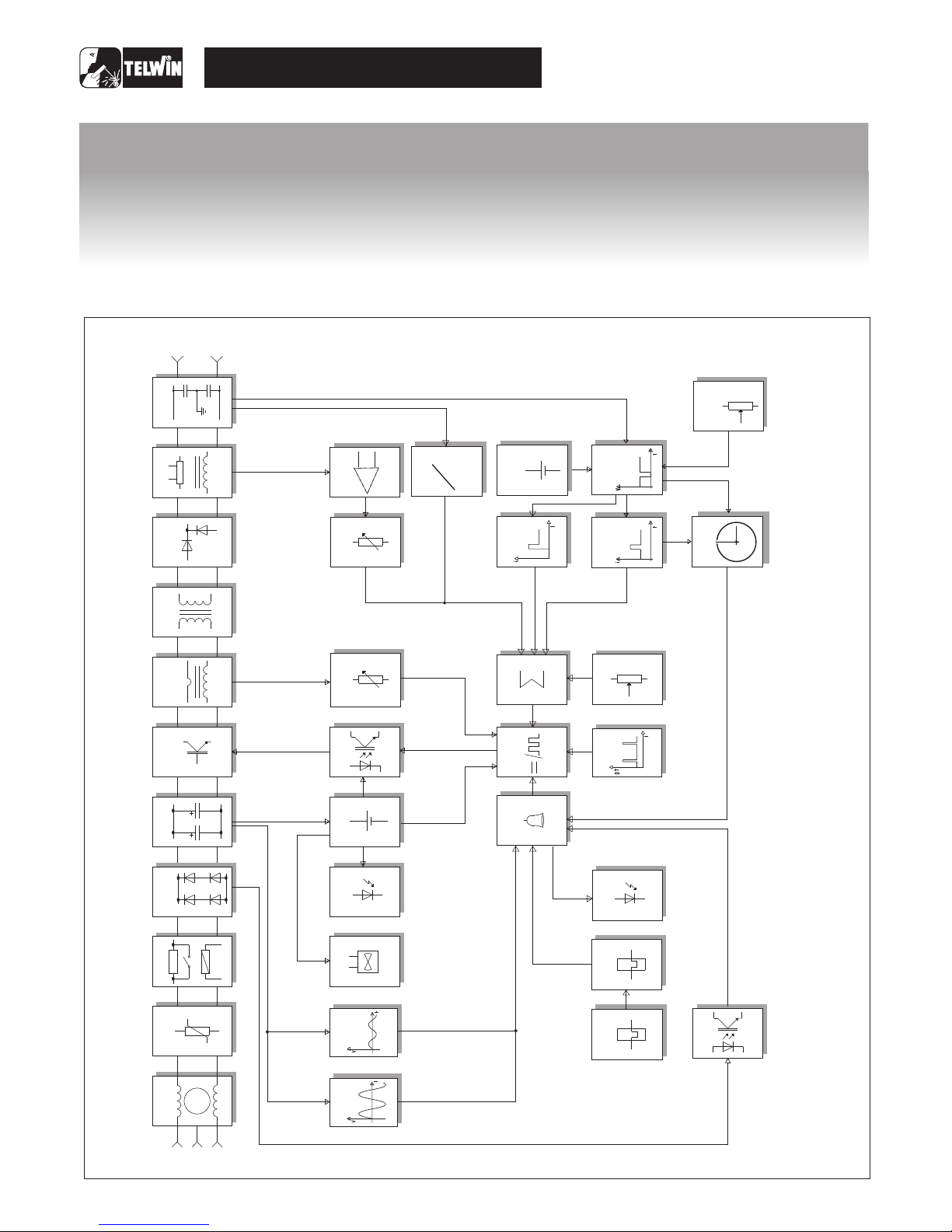
Block 9
ANALYSIS OF THE BLOCK DIAGRAM Secondary diodes
NOTE: Unless indicated otherwise, it should be assumed Consisting of: D1, D2, D3, D4, D5 (secondary board)
that the components are assembled on the primary N.B. Some versions may have 4 power diodes (D1, D2, D3,
board or machine. D4)
D1 and D2 make the current circulating in the transformer
Block 1 one-way, thus preventing saturation of the nucleus.
EMC Filter D3, D4 and D5 recirculate the inductance output current
Consisting of: C1, C2, C3, C4, C5, C6, C7, L1, L2, L3 (input when the IGBT’s are not conducting, by-passing the
filter board) transformer.
Prevents noise from the machine from being transmitted
along the main power line and vice versa. Block 10
Inductance and shunt
Block 2 Consisting of: L1, R1
Varistor The inductance levels the secondary board diodes’ output
Consisting of: RV1, RV2, RV3 (input filter board) current making it practically continuous/direct. The shunt
Prevents spike noise from the mains, with amplitude reads the current circulating in the inductance and sends it
greater than 400V, from entering the machine. to block 24/25 (amplifier shunt), which will process the
data.
Block 3
Pre-charge Block 11
Consisting of: K1, K2, R3, R9 Secondary EMC Filter
Prevents the formation of high transitory currents that could Consisting of: C1, C2
damage the main power switch, the rectifier bridge and the Prevents noise from the power source from being
electrolytic capacitors. transmitted through the welding cables and vice versa.
When the power source is switched on relays K1 and K2
are de-energised, capacitors C6, C17, C22, C38, C45, C47 Block 12
are then charged by R3 and R9. When the capacitors are Flyback power supply
charged the relays will be energised. Consisting of: U4, Q6,T3, U1, U2, U3
Uses switching methods to transform and stabilise the
Block 4 voltage obtained from block 5 (filter) and supply 2 voltage
Rectifier bridge values of 27V that enable block 13 (driver) to be powered
Consisting of: D19, D10 correctly. It also generates a further three stabilized
Converts the mains alternating voltage into continuous voltages (U1, U2, U3) of -12V, +5V and +12V which are
pulsed voltage. mainly used to power the control board.
Block 5 Block 13
Filter Driver
Consisting of: C6, C17, C22, C38, C45, C47 Consisting of: U1 (opto-insulators board), Q7, Q8 and U2
Converts the pulsed voltage from the rectifier bridge into (opto-insulators board), Q9, Q10.
continuous voltage. Takes the signal from block 12 (flyback power supply) and,
controlled by block 15 (duty cycle maker), makes the signal
Block 6 suitable for piloting block 6 (chopper).
Chopper
Consisting of: Q3, Q4, Q5, Q12, Q13, Q14 Block 14
Converts the continuous voltage from the filter into a high Primary current reader and limiter
frequency square wave (32.5 kHz approx.) capable of Consisting of: D1, R2, R55, R56, R57 R68 (control board)
piloting the power transformer. Picks up and limits the signal from block 7 (current
Regulates the power according to the required welding transformer) and using R68 limits the maximum admissible
current/voltage. primary current. This signal is also scaled down so that it
can be processed and compared in block 15.
Block 7
Current transformer Block 15
Consisting of: T1 Duty cycle maker
The C.T. is used to measure the current circulating in the Consisting of: U2=UC3845 (control board)
power transformer primary and transmit the information to Processes the information from block 16 (adder) and block
block 14 (primary current reader and limiter). 14 (primary current reader and limiter) and produces a
square wave with variable duty cycle limiting the primary
Block 8 current to a maximum pre-set value under all
Power transformer circumstances.
Consisting of:T1
Adjusts the voltage and current to values required for the Block 16
welding procedure, Adder
also forming galvanic separation of primary from Consisting of: U1A, U1B (control board)
secondary (welding circuit from the power supply line). Processes the information from blocks 18, 25, 27, 28 and
3