6
Installation and Working Environment
1. Installation location and working environment
In installation locations, sufficient work space should be planned and provided for anticipated work and mainte-
nance.
In certain installation locations or working environments there may be extra requirements, such as compliance with
laws and regulations, as well as functional conformance to specifications. If there are any questions, please
contact our sales team at the planning stage. These special installation environments may include:
(1)Special working environments which are not specified in the specifications
(2)Environments where failure of the product would be expected to cause substantial damage to human beings,
assets, surroundings etc.
e.g.: Facilities covered by the High Pressure Gas Safety Act, facilities covered by the Industrial Safety and Health
Act, Nuclear power related facilities, vehicles, medical facilities, etc.
2. Atmosphere of installation location
The following measures should be taken, depending on the atmosphere of the installation location for this product.
(1)Locations which are exposed to salt-laden atmospheres, corrosive gases, chemical solutions, organic solvents,
steam, salt water, etc. should be avoided.
(2)If there is a possibility that this product may be exposed to direct radiant heat or chemicals, the product and its
attachments should be protected with covers.
(3)Do not submerge this product. If it is installed in a place that is regularly exposed to water, such as near a
cooling tower, protect the product and its attachments with covers.
3. Temperature of installation location
Using this product out of the allowable working temperature range causes thermal degradation or hardening of
seat rings and O-rings, faulty operation due to thermal expansion of parts or differential thermal contraction, etc.
(1)The ambient temperature of the installation location should be within the ambient temperature range of 0°C to
60°C.
(2)If this product is exposed to direct sunlight, ensure that the working temperature remains below the upper limit
of the above ambient temperature range.
(3)This product should be kept away from heat sources, and should be installed in a location whose temperature
is within the specified ambient temperature range. Please note that siting the product near a motor, an engine,
an air compressor, a boiler, etc. may cause conditions to exceed the specified ambient temperature range.
4. Vibration and shock at installation location
The following measures should be taken if vibration or shock are factors at the installation location of this product.
(1)When this product is used in the following conditions, check for factors potentially causing vibration or shock,
such as acceleration values, and consult our sales team.
1) Locations where excessive vibration or shock is anticipated
2) Locations where vibration or shock is exerted regularly or continuously
(2)Mounting and connecting sections of this product should be secured to prevent loosening as a result of
vibration or shock.
(3)Anti-vibration measures should be taken to isolate or reduce vibration or shock to the machine. Piping should
be secured with firm supports, and where necessary vibration isolation materials should be used.
(4)Connections should be checked periodically for looseness or deformation. If there is any abnormality, the bolts
should be re-tightened or the parts should be replaced. A bolt working loose may cause the product to fall or
rotate suddenly in an unexpected direction.
Warning
Caution
Caution
1. Transportation and Transfer
Transportation and Storage
[Fig.-1]
5
(1)Products with large mass (150 mm or more) should be transported using suitable equipment or machinery, not by manpower alone.
See the catalog, product drawings, etc. issued by our company for details on the mass of this product. Qualified personnel should
perform work with a forklift, crane or sling in accordance with laws and regulations, and safety provisions of business establishments.
In addition, please observe the instructions in "Dropping and falling” below.
(2)While transporting this product, be careful not to damage the coated surface. If the surface is damaged, repair the coated film.
Leaving surface damage unrepaired may result in corrosion.
(3)Use shipping containers for ocean transportation. If the product is not sealed within a shipping container, it will deteriorate from
contact with salt-laden wind and spray.
(4)Use a covered vehicle for inland transportation to avoid exposure to wind and rain. If an open vehicle is used, cover the product with
a protective tarpaulin and secure against the effects of weather.
(5)Do not throw the product and do not apply a heavy load.
(1)When lifting or using a sling to hoist this product, pay thorough attention to safety. For example, check the mass well in advance, and
use lifting machinery or equipment rated to be safe for the mass. Ensure that no personnel ever stand or walk under or close to a
suspended load.
(2)Lighting during transportation must be sufficient to ensure safe operation, including lighting related to scaffolding to ensure its safe
use. The stability of piping must be ensured before any work takes place on it.
(3)During unloading or transportation between warehouses, this product should be secured properly at all times to prevent it from falling
and sustaining or causing damage.
(4)Do not use the product’s handle to suspend or hoist this product. The handle may break off or fail and the product may be damaged,
which is very dangerous.
If the nominal diameter of this product is 150 mm or more, use the hanger ring on the MKT body for hook attachment when hoisting.
(1)If the nominal diameter of this product is 50 mm to 200 mm, the product is packed in a cardboard box. For other products, protective
panels made of materials such as plywood are attached to the flange faces (pipe flange contact faces) of the body to protect the
interior.
(2)For the FCD body, rust prevention oil is applied thinly to the inner face of the body.
(3)A name plate is attached. Nominal diameter, materials, etc. can be checked on the plate.
Unpack this product only when ready to connect it to the piping. Do not leave the product unpacked for long periods of time. This will
prevent adherence of dust and harmful aerosols, and deterioration due to ozone or ultraviolet rays.
Otherwise, degradation in performance of this product, contamination, discoloration or materials deterioration may occur.
Store this product as follows to prevent its degradation in performance, contamination, discoloration, and material deterioration.
Store this product in a place with no dust or water droplets while avoiding direct sunlight, high temperatures and excessive humidity.
(1)Store this product in a cool and dark indoor area (ambient temperature:
-10°C - 40°C, humidity: 70% or less) without removing the cardboard
packaging or the protective material attached to the valve body.
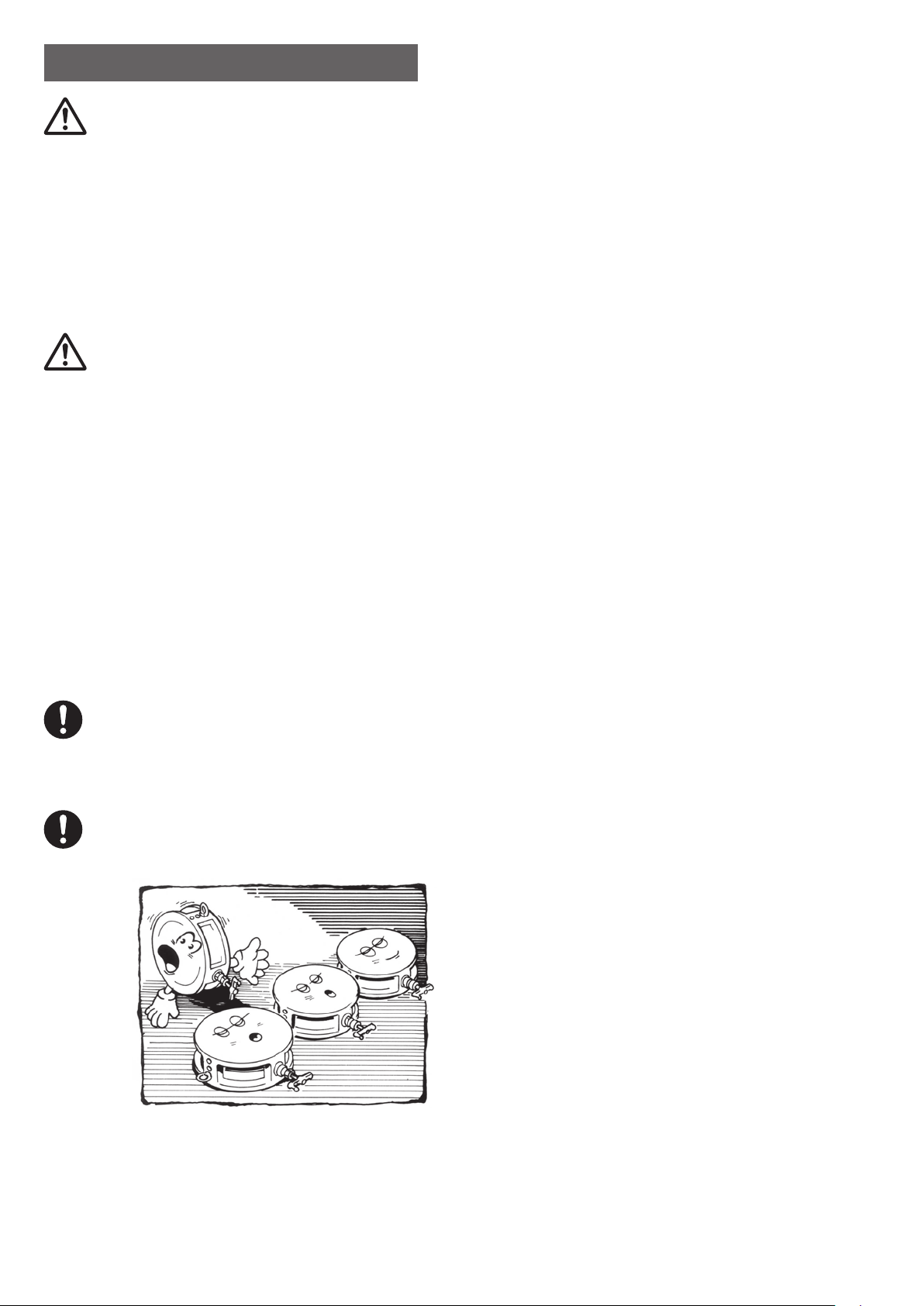
[Fig.-1]
(2)With cardboard packaging, high humidity may reduce the strength of
the box and the packaging may deteriorate or separate, which may
result in damage to the product. Be careful not to let the packaging
become damp or wet.
(3)Do not store this product in an atmosphere that contains corrosive gas.
Otherwise, the parts may be subject to corrosion, resulting in an
impairment of functions.
(4)Do not drop or overturn this product or subject it to vibration, and do
not apply a heavy load to the product during storage. Otherwise,
functions may be impaired.
(5)Do not stack more than one item when storing this product. A load
collapse may occur, which could cause damage to personnel and/or
the product. (Refer to Transportation and Storage Section 2: "Dropping
and Falling".)
(6) Individual parts of this product, such as the handle, axle shaft etc., are
not designed to carry the weight of the valve. The products must be
stored so that no load is applied to such parts. Otherwise, the handle,
axle shaft, etc. may become deformed or fail.
2. Dropping and falling
3. Packing state
4. Unpacking
5. Storage
Warning
Warning