page 8
www.sounddevices.com
T-Powering is a microphone powering scheme used
by several European condenser microphone manufac-
turers. Today, T-powered microphones are not as com-
mon as phantom microphones, but many are still in
regular use. T-power resistively applies 12 V between
the signal pins -2 and -3. The 442 provides selectable
T-power for each input. The 442 provides positive T-
power, where pin-2 on the XLR-3 connector has +12
volts relative to pin-3. When using "red dot" T-powered
microphones (reverse polarity T-power) use a polarity-
reversing adapter on the input, otherwise damage to
the microphone may occur.
NOTE: Phantom and T-powering are not interchange-
able. Use T-powering only for T-powered microphones.
High-Pass Filters
Each channel of the 442 has an adjustable high-pass
filter. High-pass (or low-cut / low roll-off) filters are
useful for removing excess low frequency energy in
audio signals. Wind noise is a common unwanted low
frequency signal and a high-pass filter is effective
for reducing wind noise. For most audio applications
engaging the high-pass filter is beneficial, since little
useable audio information exists below 100 Hz, espe-
cially for speech reproduction.
The 442's high-pass circuit features an adjustable
corner (–3 dB) frequency over a range from 80 Hz to
240 Hz. Below 80 Hz, the filter's slope is 12 dB/octave.
At higher corner frequency settings, the slope is 6 dB/
octave, and then below 80 Hz, it increases to 12 dB/
octave (see Specifications). The purpose for this com-
pound slope is to give additional roll-off at the 80 Hz
setting to reduce wind noise and rumble. The higher
settings can be used to counteract proximity effect of
directional mics where a more gentle slope is desir-
able. The 442's high-pass circuit is unique because of
its placement before any electronic amplification. Most
mixer's high-pass circuits are placed after the mic pre-
amp, where all of the high-energy low-frequency sig-
nals get amplified. By virtue of the 442's circuit cutting
the low-frequency signals before amplifying, higher
headroom is achieved in presence of signals with a lot
of low-frequency energy.
Where possible, attempt to equalize at the sound
source with microphone selection, use of windscreens,
microphone placement, and onboard microphone fil-
tering. Many microphones have on-board high pass fil-
ters, and the high-pass filters on the 442 can be used
in conjunction with the microphone's filters to increase
the filter's slope.
The filter can be removed from the circuit completely
by moving the high-pass control fully counterclockwise.
The high-pass features a pop-up knob so that it can
be adjusted easily and then hidden from the mixing
surface.
Pan Controls
The pan control routes an input channel signal any-
where between the Left and Right output. The 442
uses constant loudness pan controls, meaning that the
signal is 3 dB louder at the full-right or full-left position
relative to the center position. For most applications
the channel will be panned either full left, full right, or
to the center; the 442 features excellent "off-attenua-
tion" of the channels in the hard- left and right posi-
tions. The pan pot has a detent in the center position,
and is calibrated at Sound Devices for a maximum
difference of +/- 0.1 dB between the left and right out-
put in this position. Since pan is not often used after
channel setup, the pan pot is on a pop-up knob so it
can be hidden from the mixing surface during normal
operation.
Channel Limiters
The channel limiter acts solely as a "safety" limiter,
and is enabled when the output limiters are enabled
via the "LIM" switch on the front panel. (See Setup
Menu to defeat Channel Limiters entirely.) In nor-
mal operation, with a properly set gain structure the
threshold of the channel limiter will not be reached.
If extremely high input signal levels exist, such as in
high SPL environments or with misadjusted settings,
the channel limiter(s) will activate to prevent the input
channel from clipping. Without a channel limiter, high
signal conditions would overload the channel and
cause distortion. It is recommended that the channel
limiters be used at all times. Below the set threshold
(just below clipping), the limiter does not affect the
sound in any way.
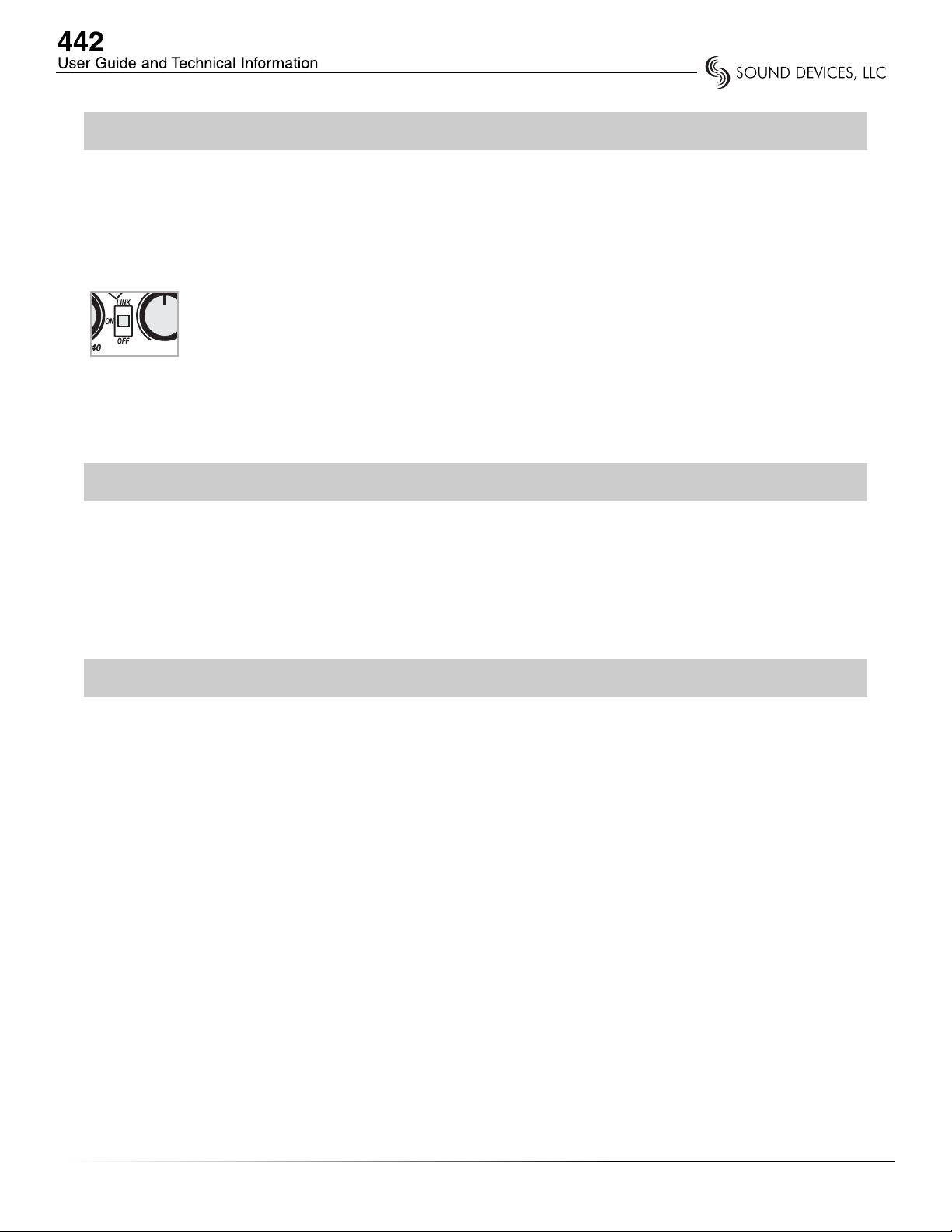
When input channels 1 & 2 are linked as a stereo pair,
their channel limiters also link to perform the same
gain reduction to both channels equally. Each channel
has an orange limiter LED which illuminates in propor-
tion to the amount of limiting. If the orange LED for a
channel comes on substantially, it is recommended to
turn down the Gain.
Peak LEDs
Each channel has an indication of peak signal activity.
When a channel approaches 3 dB below its clipping
level, the red Peak LED illuminates. If the red Peak