JR Series - Pressure Regulating Valve
Installation, Maintenance and Operation Manual
2.3 –OPERATION
Depending on the regulator type, its valve can be positioned fully open. Consequently, when a regulator is put into
operation, the shutoff valves should be opened slowly so that the regulator valve can assume its regulating position. If the
valves are quickly opened, the upstream pressure can pass downstream through the regulator and over-pressurize
downstream the main line.
All regulators, etc., should operate with the regulating spring specified by the manufacturer. This provision is particularly
important when operating relief or shutoff valves, since incorrect springs can hinder a relief valve to open and a shutoff
valve to close.
Provisions should be taken to avoid water input through breathing and ventilation openings.
2.4 –MAINTENANCE
Regulators and valves contain gases under pressure that sometimes are higher than the atmospheric pressure. Before
trying to investigate any problem or to perform service maintenance of the equipment, they should be safely de-
pressurized. Furthermore, as most gases can be flammable, poisonous, corrosive, or somehow, dangerous, it may be
necessary to purge the installation with an inert gas, as nitrogen. Special precautions are necessary for operation with
oxygen or hydrochloric gas and the user should be reassured that appropriate procedures are implemented.
Eventually, it is not enough to isolate the high-pressure device, since high pressures can be retained downstream of
isolation valves. Do not try to remove covers, plugs, etc., before these parts are properly freed-up. Even so, it is advisable
to consider if high-pressure gas can be present at the time of removal of covers and plugs.
Most regulators use spiral springs as the loading device. It is important to reduce the load of these springs relieving their
loaders as much as possible. In some cases, some residual load may last, even though the spring is relaxed to the limits of
its housing.
3 –INTRODUCTION
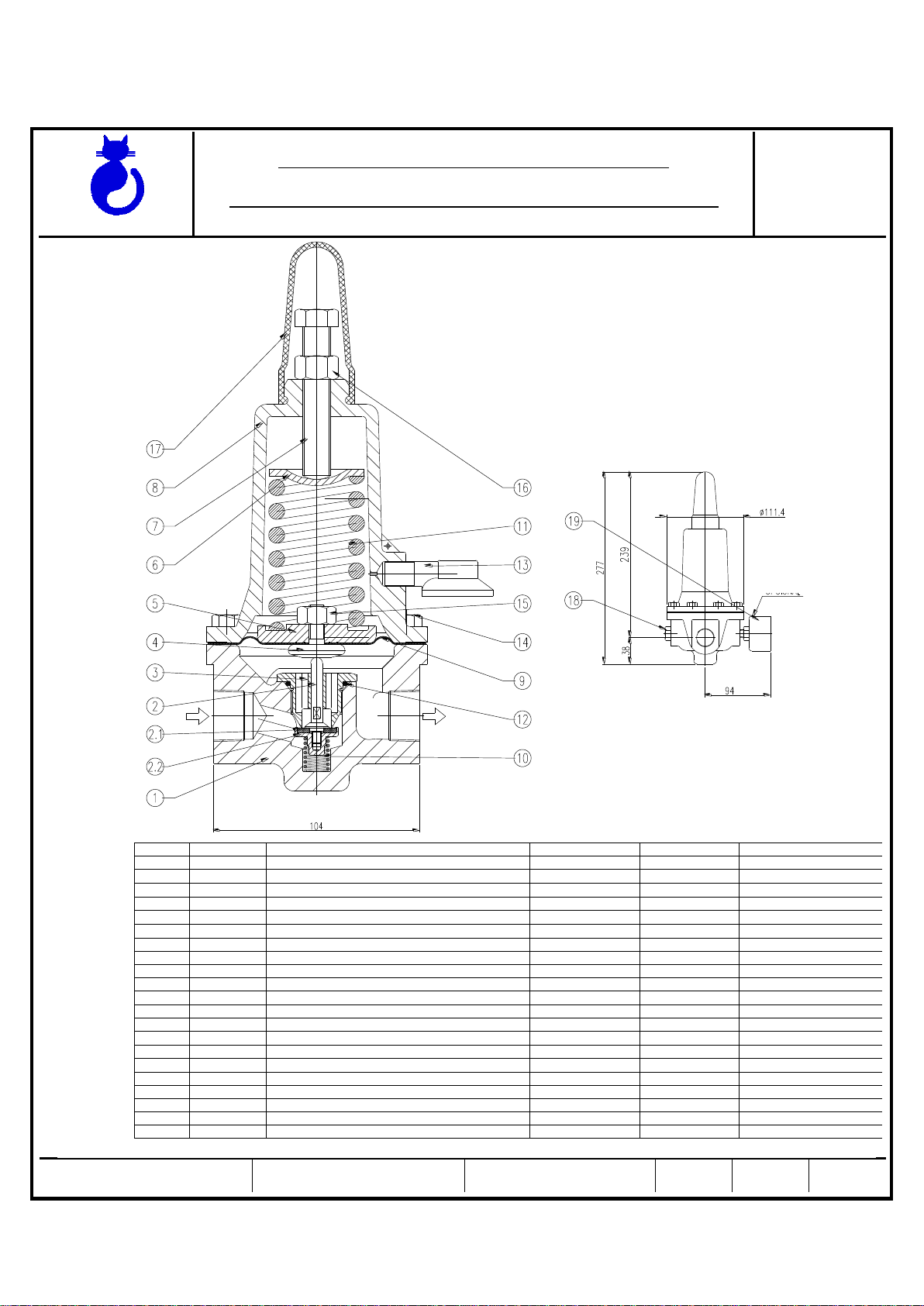
The Series JR regulators are single stage, self-operated regulators for heavy duty work under high, medium, and low
pressure applications, for all types of non-corrosive gases and for corrosive gases, when built in special versions.
These regulators were developed with the purpose of facilitating their maintenance, or parts substitution, as much as
possible. Therefore, because of their top entry characteristic, there is no need to remove them from the line for
maintenance or cleaning. The JR Series regulators are also known for their small weight, constructive simplicity and
soundness.
For valves intended for use with oxygen, all necessary precautions shall be taken for operation with this gas, avoiding
oil or grease presence in tools, and use of lubricants that are not compatible with oxygen. Always use building materials for
the valve that are compatible with the type of used gas.
4 –OPERATING PRINCIPLE
Pressure regulators of the JR Series operate by direct spring action on the output pressure sensor element (diaphragm)
that, with consumption variation and consequent pressure change on the sensor element, will re-position the shutter stem
increasing or reducing the valve aperture, in order to keep the adjusted output pressure constant.
A variation of this system uses external piloting for JR Regulators. Operation is by action of this pilot pressure directly
on the sensor element of the output pressure (diaphragm) that, with consumption variation and consequent pressure
change on the sensor element, in the same way as for regulators operated by direct spring action, will re-position the
shutter shaft increasing or reducing valve aperture, in order to keep constant the adjusted output pressure.
5 –CHARACTERISTICS
FITTINGS: ½” thread (with reduction adapter), ¾”, ¾” x 1”, 1” NPT (according to ANSI B1.20.1) or BSP (according to
BS 21 –DIN 2999); with ½”, ¾” 150# flange, and with 1” 150/300# flange (pursuant ANSI B16.5).
Self-operated regulator by direct spring action.
Open or closed fail-safe condition (the closed condition implies the regulating spring with no pressure at all).
Topy Entry