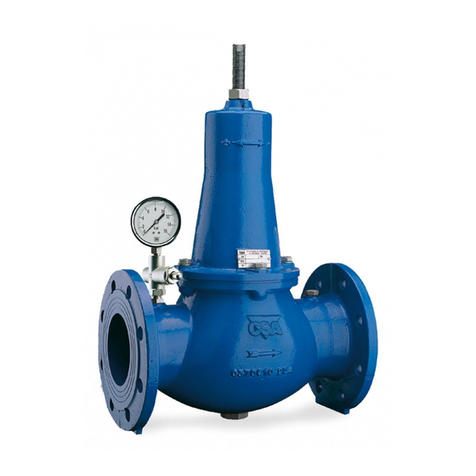
XLC 312/412
8
Regulations of pilots has to be carried out slowly to avoid unwanted pulsations and
pressure surges. Always leave enough time for the system to balance, in case of
doubts and problems allow for some flow through the by-pass to stabilize the line and
call CSA technical support.
•Slowly act on the regulation screw of the pilot (7) rotating clockwise, the variation in
pressure depends on the spring range used, and can vary from 0,47 bar to 0,95 bar per
revolution with the most common springs used. By doing so the valve will ry to maintain a
higher downstream pressure. But no flow should appear yet.
•Slowly act on the regulation screw on the pilot (6) turning it anticlockwise, the variation in
pressure depends on the spring range used, and can vary from 0,47 bar to 0,95 bar per
revolution with the most common springs used. Proceed it until water starts flowing, that
indicates that the upstream set point of the pilot has reached the incoming upstream
pressure value.
•Open the downstream gate valve completely
•Act on the pilot (7) to increase or decrease the downstream pressure by turning the screw
clockwise or anticlockwise
•Act on the pilot (6) to increase or decrease the upstream pressure, pressure by turning the
screw clockwise or anticlockwise
•Once the valve has reached the desired value set the locking nut and place the hood on top
of the pilot. Make sure to use the right pressure gauges and always have a look at the flow
meter.
•The unit flow control device GR.I.F.O. is exclusive from CSA and contains needle valves,
filter and check valves used for the proper valve’s stability and regulation. If present do
never change the settings before consulting with CSA technical support.
•Do not act or change the GR.I.F.O. set points without consulting with CSA first
•The master pilot in this case is the number (6), the valve will not operate or allow enough
pressure downstream without the proper “authorization” of the upstream pressure pilot. T
Maintenance
CSA automatic control valves XLC 400 series have been designed with a sturdy and reliable
construction to minimize servicing and possible malfunctioning. However we recommend to inspect
them at least twice per year releasing the air accumulated inside the bonnet and checking the
strainer inside the GR.I.F.O, if present, or placed as a separate entity in the circuitry. We
recommend a thorough inspection and maintenance with complete disassembly every 4 years,
according to the following instructions.