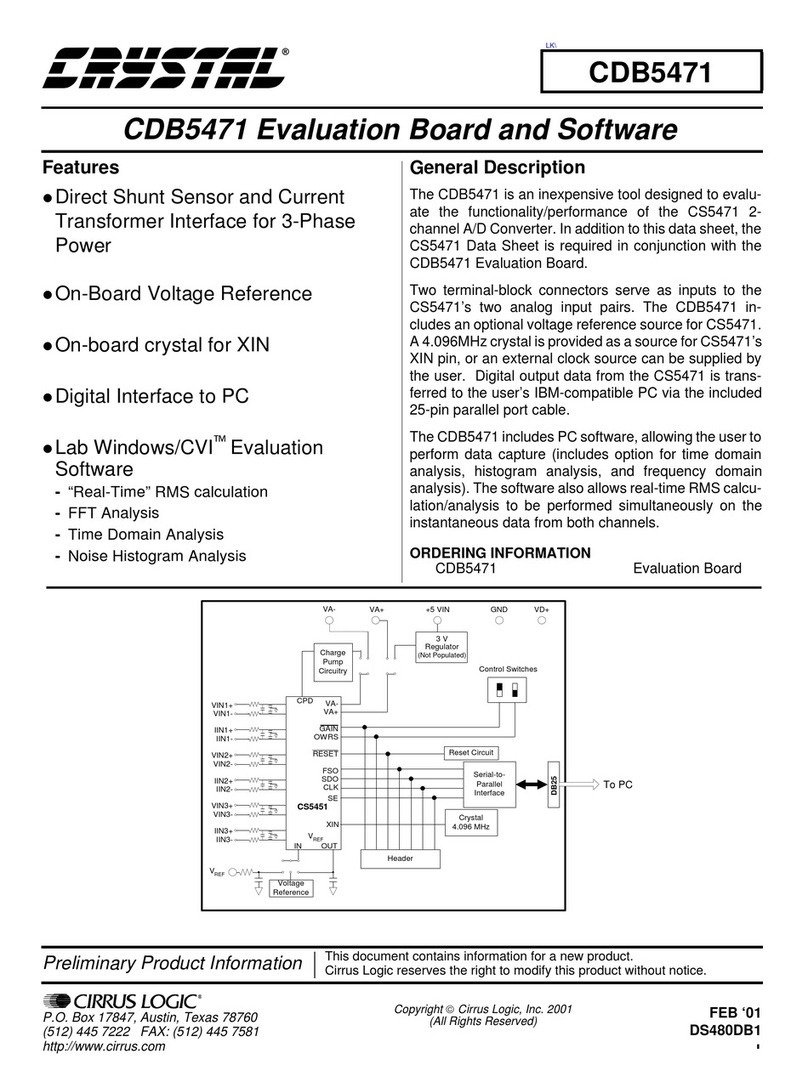
CDB5460
DS279DB1 3
PART I: HARDWARE
Introduction
The CDB5460 evaluation board provides a quick
means of evaluating the CS5460 Analog-to-Digital
Converters (ADCs) and Computational Unit. The
CDB5460 evaluation board’s analog section oper-
ates from either a single +5 V or dual ±2.5 V power
supply. The evaluation board interfaces the
CS5460 to an IBMTM compatible PC via an RS-
232 interface. To accomplish this, the board comes
equipped with an 80C51 microcontroller and a 9-
pin RS-232 cable which physically interfaces the
evaluation board to the PC. Additionally, analysis
software provides easy access to the internal regis-
ters of the CS5460, and provides a means todisplay
the performance in the time domain or frequency
domain.
Evaluation Board Overview
The board is partitioned into two main sections: an-
alog and digital. The analog section consists of the
CS5460 and a precision voltage reference. The dig-
ital section consists of the 80C51 microcontroller,
32 Kilobytes of SRAM, the hardware test switches,
the reset circuitry, and the RS-232 interface. The
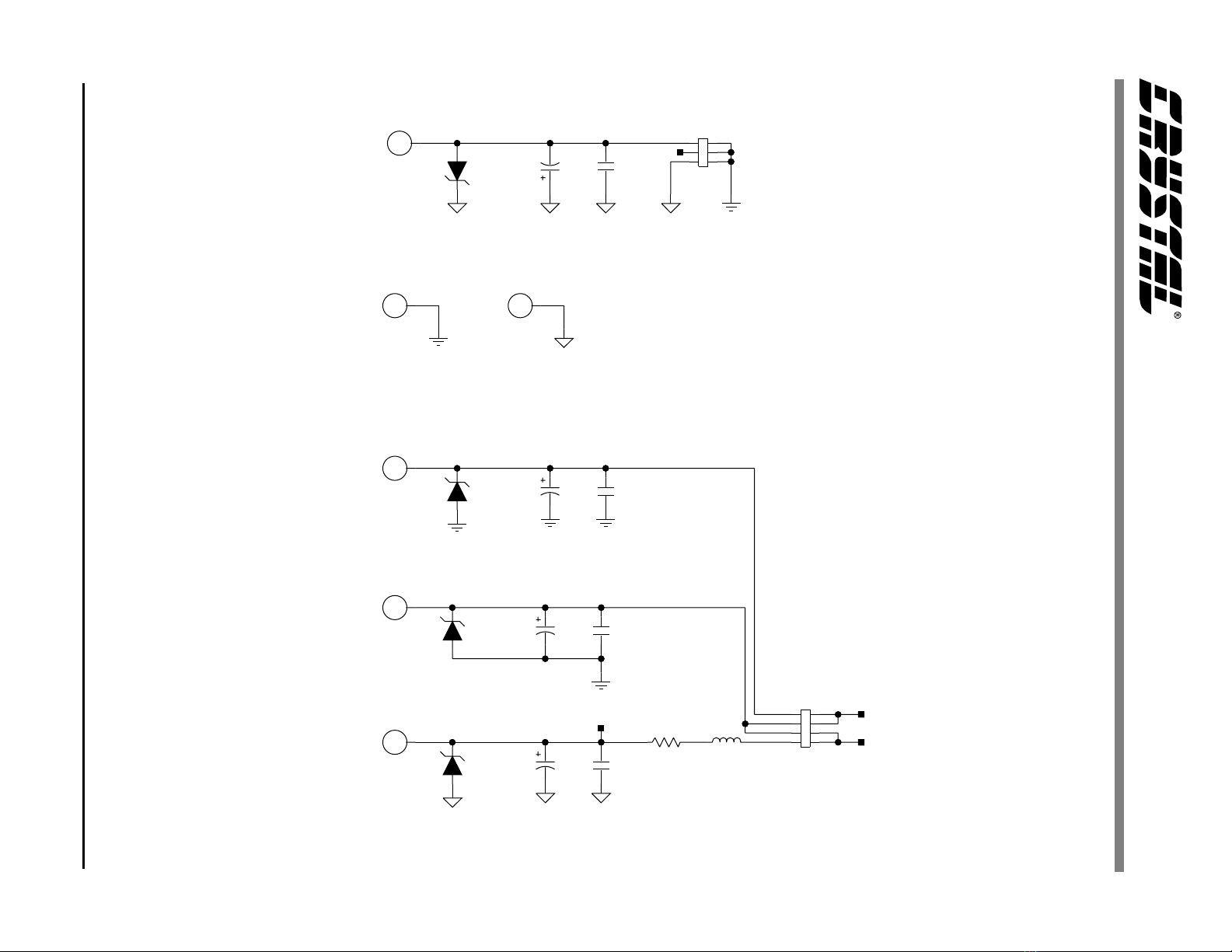
board also has a user friendly power supply con-
nection.
Analog Section
The CS5460 is designed to accurately measure and
calculate: Energy, Instantaneous Power, IRMS, and
VRMS while operating from a 4.096 MHz crystal.
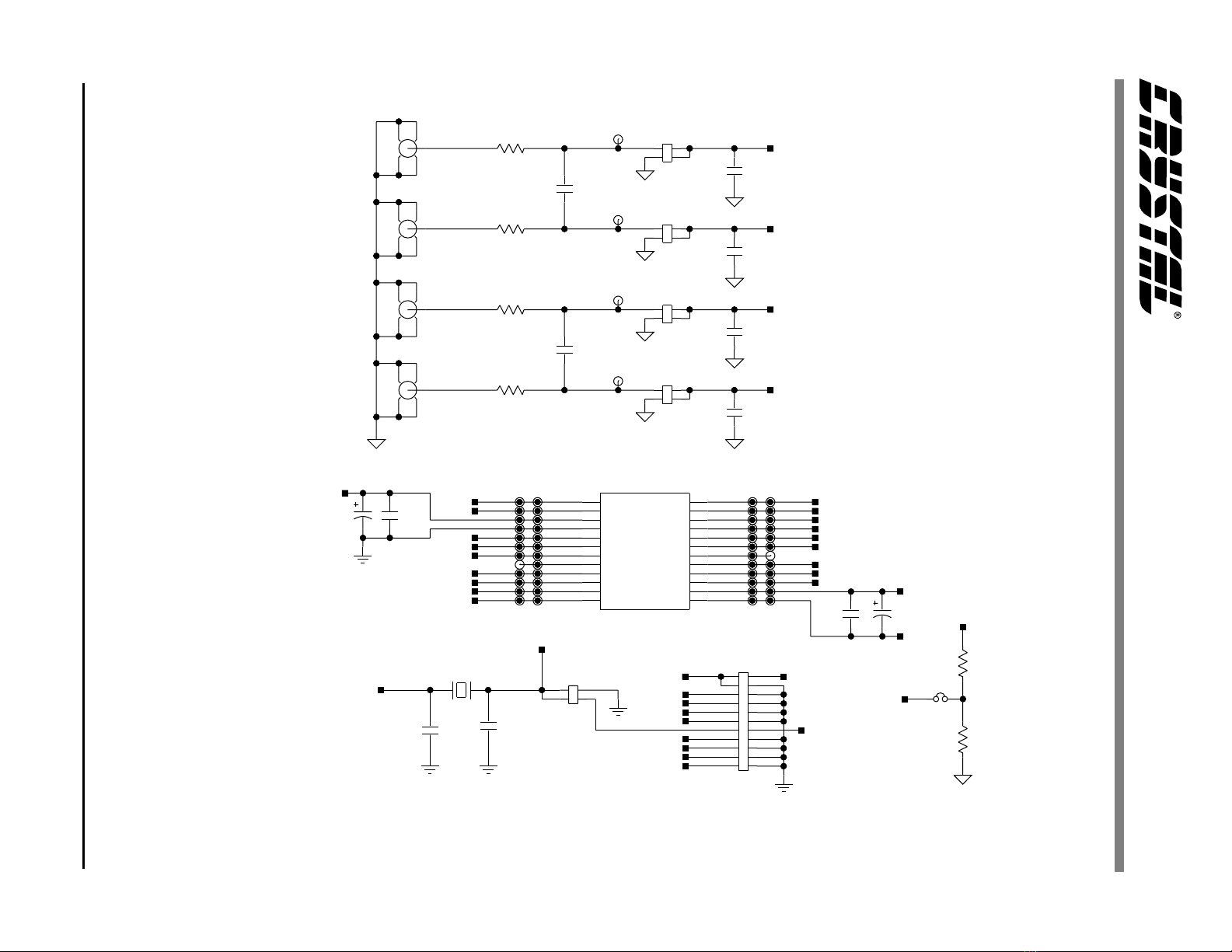
As shown in Figure 1 there are four BNC connec-
tors (J9, J10, J11, J12) provided for converter input
connections. A Shunt Sensor or Current Trans-
former can be connected to the converter’s current
inputs via J10 (IIN+) and J9 (IIN-). A voltage di-
vider can be connected to the converter’s voltage
input via J12 (VIN+) and (J11) (VIN-). Note, a
simple RC network filters the sensor’s output to re-
duce any interference picked up by the input leads.
The 3 dB corner of the filter is approximately 50K
Hz differential and common mode.
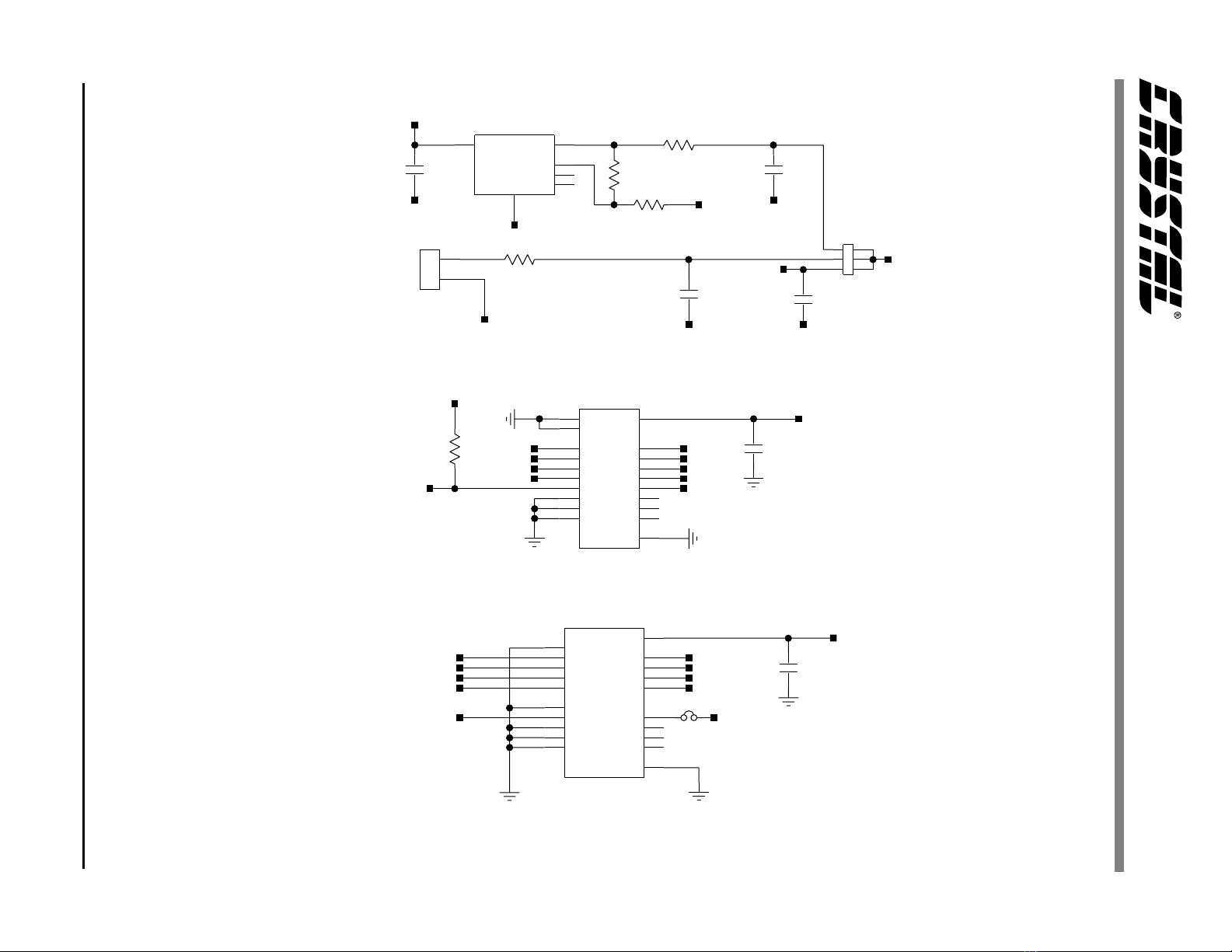
The evaluation board provides three voltage refer-
ence options, on-chip, on-board and external, as
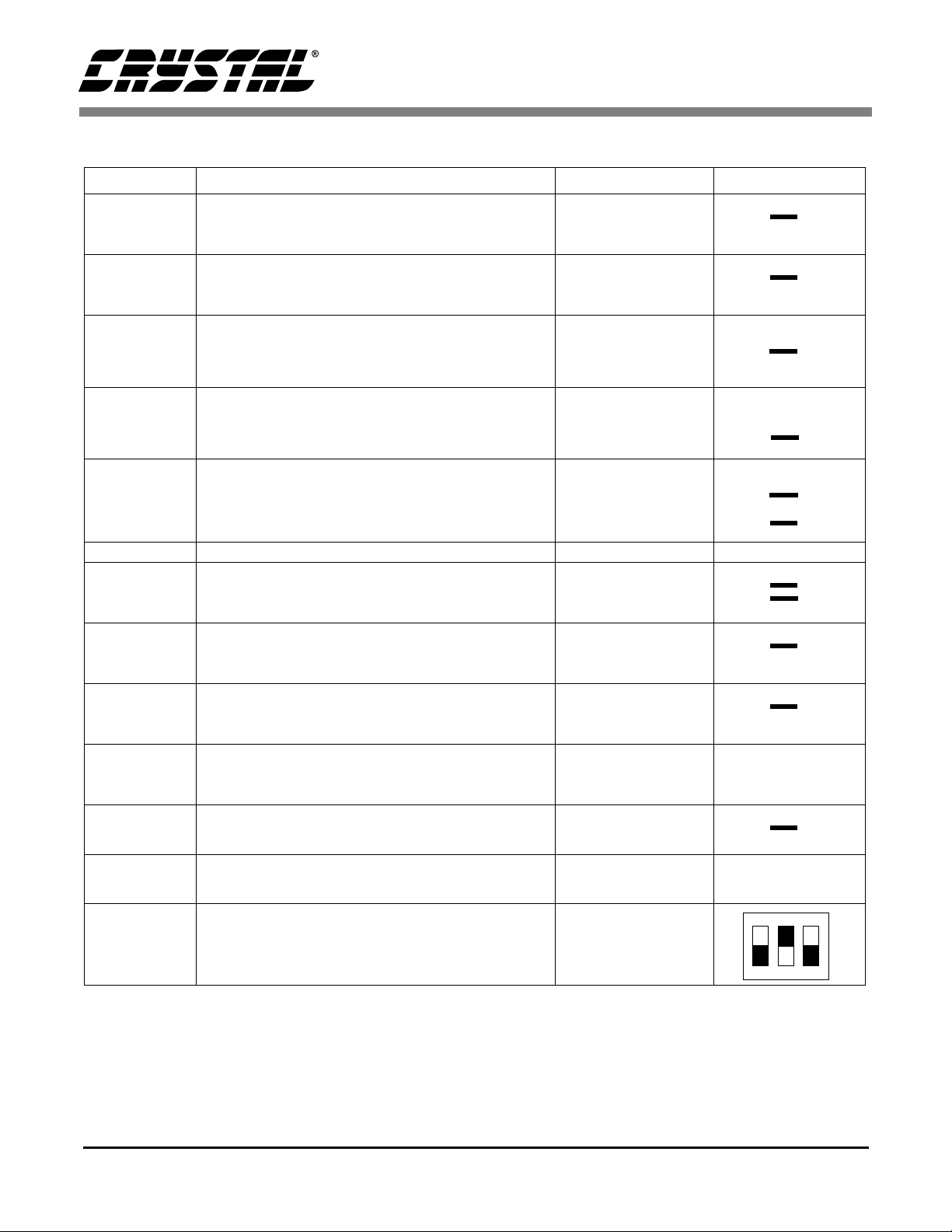
shown in Figure 2. Table 1 illustrates the options
available. With HDR4’s jumpers in position RE-
FOUT, the on-chip reference provides 2.5 volts.
With HDR4’s jumpers in position LT1019, the
LT1019 provides 2.5 volts (the LT1019 was chosen
for its low drift, typically 5ppm/°C). By setting
HDR4’s jumpers to position REF+, the user can
supply an external voltage reference to J2’s REF+
and VA- inputs. Application Note 4 on the web
(http://www.cirrus.com/products//pubs.html) de-
tails various voltage references.
The CS5460 serial interfaces are SPITM and Mi-
crowireTM compatible. The interface control lines
(CS, SDI, SDO, and SCLK) are connected to the
80C51 microcontroller via port one. To interface an
external microcontroller, these control lines are
also connected to HDR6 (Header 6). However to
accomplish this, the evaluation board must be mod-
ified in one of three ways: 1) cut the interface con-
trol traces going to the microcontroller, 2) remove
resistors R4, R7, R8, and R13, or 3) remove the mi-
crocontroller.
Digital Section
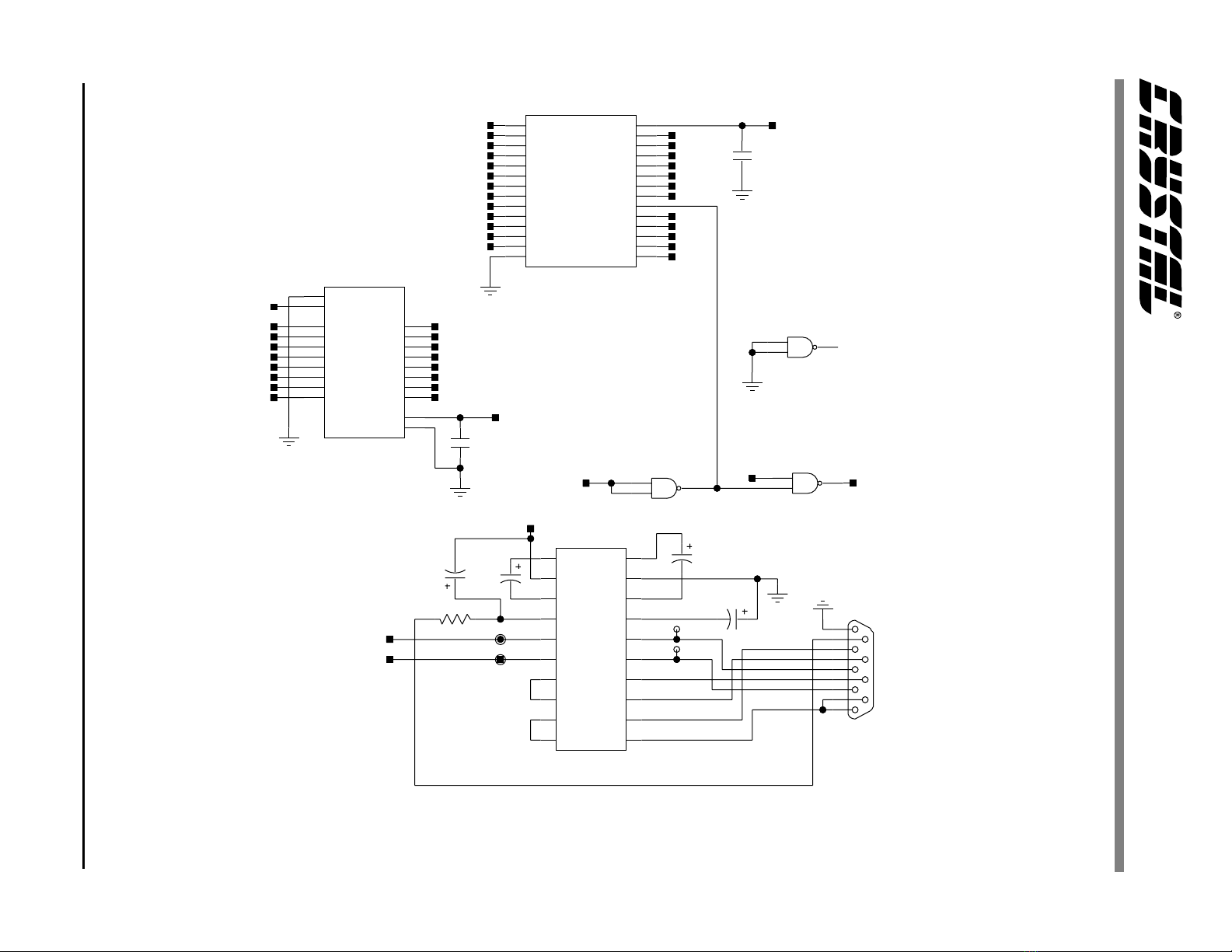
Figures 3 and 4 illustrate the schematic of the digi-
tal section. It contains the microcontroller, test
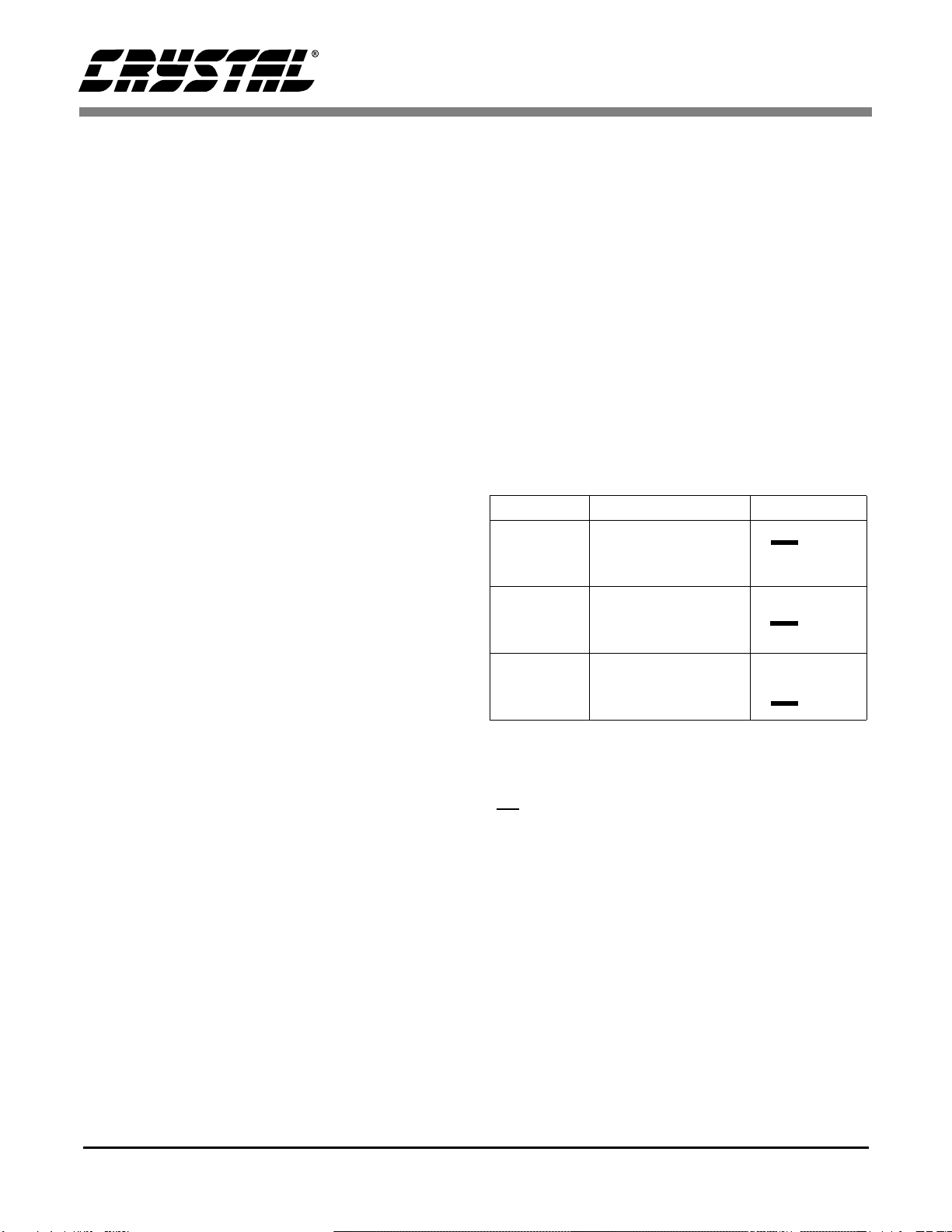
Reference Description HDR4
LT1019 Selects on board
LT1019 Reference
(5ppm/°C)
REF+ Selects external
reference
REFOUT Selects the reference
supplied by CS5460
Table 1. Reference Selection
O O LT1019
O O REF+
O O REFOUT
O O LT1019
O O REF+
O O REFOUT
O O LT1019
O O REF+
O O REFOUT