rails for reference, with some loss of stability. More on this circuit later...
At higher frequencies, the VCO will tend to run “flat” so an extra amount of current is added into Q1 via D2, R30 and
RT2.
FM (frequency modulation) can be exponential or linear. Linear FM is introduced through the second section of U3,
modulating the emitter current of Q1.
Q1 is a precision matched pair. At low voltages this transistor exhibits an exponential voltage to current conversion curve,
although the response is very temperature dependent. Using a pair reduces the first order temperature dependence. R18,
which is a temperature compensating resistor with a response of 3300 ppm/degree C eliminates the secondary temperature
effect. Any residual source of temperature instability (such as from C5) is eliminated by a thermometer circuit configured
around D3.
The current from Q1 is buffered by U4 and used to charge C5. A comparator, U6, senses when the cap is charged and
triggers Q2, which shorts out C5 and dumps the cap current. The resulting waveform is a sawtooth, which is level shifted and
buffered by U4 to +/-5V.
The pulse wave is generated by using U5 as a comparator on the sawtooth to provide an output based on the PWM CV from
R5 and J8. Various +/- CVs will trigger a comparator output at various points on the rising ramp of the sawtooth. This equals
a full spectrum of pulse waves from very narrow, through square wave to very broad.
The basic sawtooth is further processed by adding together mirrored versions of the saw to provide a triangle output. This
circuit is provided by Terry Michaels, a contributor to Electronotes and Grant Richter, of Wiard.
The triangle is processed by a classic overdriven VCA circuit to provide a sine wave. While an LM3080 is typically used
here, we need a VCA section for the VC wave, so one half of an LM13600 (U8) is used instead.
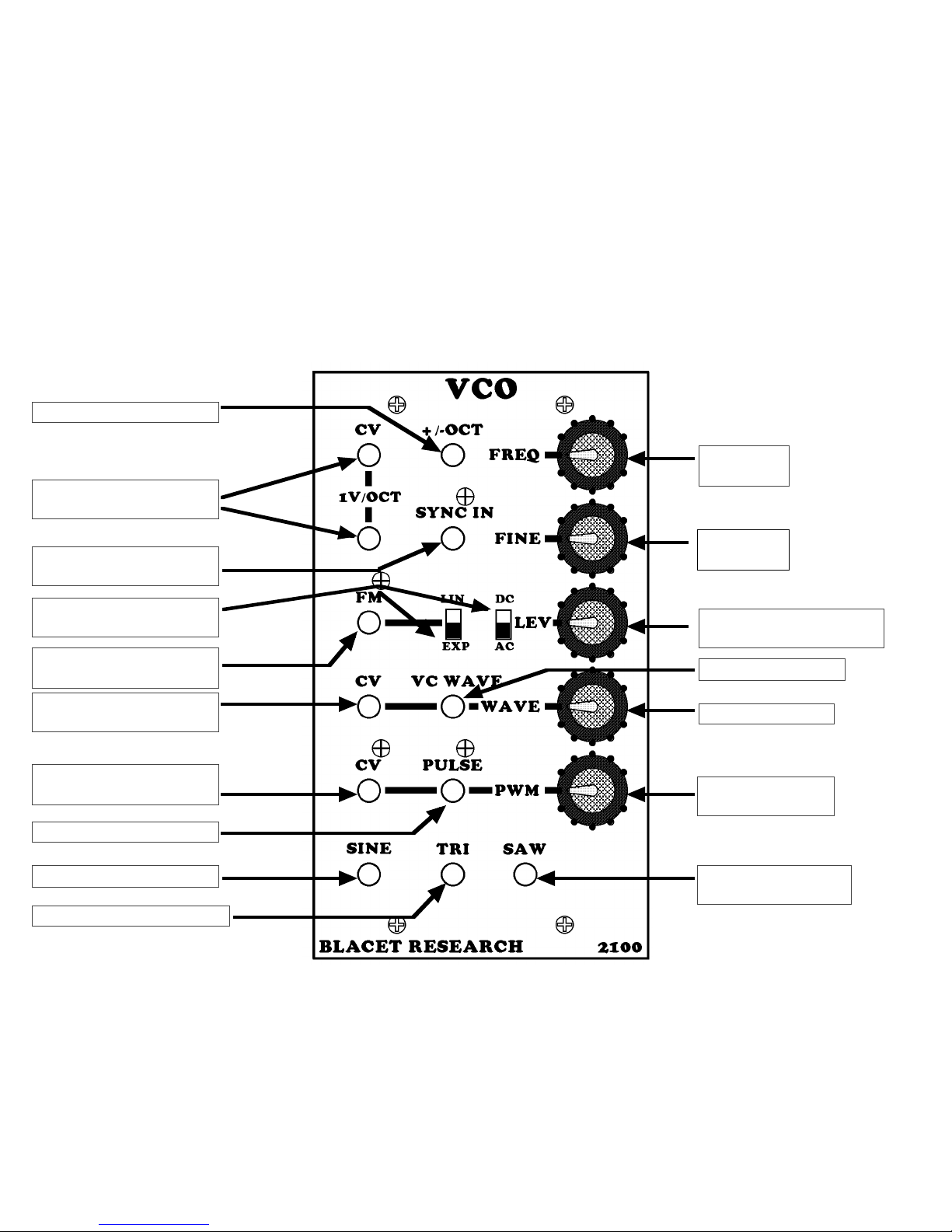
The VC wave is derived from the triangle wave by driving a diode clipping circuit through a VCA. Voltages from the Wave
CV and the Wave pot control the VCA (U8) which drives U7. Two green LEDs are used for the positive swing of the input
and a white LED is used for the negative swing. The LEDs have audibly different clipping characteristics which result in an
interesting array of triangle to distorted square waves as the CV increases. Using two green LEDs results in approximately
symmetrical clipping levels. Typical clipping for each green is 1.6V; for the white LED, it’s about 2.5V.
Reference diode D1 supplies 5.00V, which is scaled and inverted by two sections of U3 to provide stable reference voltages
of -10V and +10V. U3 is a TL054 op amp which has low offset and good temperature stability. These voltages are further
scaled and inverted to provide +1.00V and -1.00V. These voltages are used to switch octaves.
The Oct +/- input (J2) drives a dual comparator circuit based on two sections of op amp U5. This senses voltages greater
than +2.5V and less than -2.5V. The comparators drive the MAX365 quad analog switch which is used to insert +1.00V or -
1.00V into the VCO CV summer, resulting in a one octave jump up or down. Two switch sections are paralleled in each case
to lower the effects of the switch on resistance. Accuracy is further ensured by trimming the +/-1.00V voltages post analog
switch.
A bonus feature of the octave switching circuitry is that it can be a great help in scaling the VCO (trimmers RT1 and RT2).
The on board Tune pushbutton S2 provides a one octave up jump. This eliminates having to provide an external precision
voltage source for trimmer adjustment; saving time in production and for the kit builder.
PCB connector Jpwr supplies power to the circuitry. Protection against reverse supply or over current conditions are
provided by PS1, PS2, DA, and DB. The PS devices are resettable fuse-like devices that go from a very low resistance to a
very high resistance when subjected to high current flow. PS1 and PS2 are rated at 100 ma. If the supply connections are
reversed, DA and DB will essentially short circuit the supply, causing PS1 and PS2 to rise in resistance and limit the current
flow to minimal levels. A short on the board will also cause current limiting. When the fault conditions are removed, PS1
and PS2 will return to normal operation.
Kit Assembly Procedures:
• Caution! All front panel components are PCB mounted and must be aligned precisely if you ever hope to get the
front panel mounted. Be sure to follow the advice presented when mounting these components! When checking
alignment, close one eye. This will make your visual field 2D instead of 3D, which makes it easier to see alignment
problems.
• Caution! Use protective eyewear during assembly, especially during soldering and lead clipping operations.
• Caution! Solder contains lead, a toxic metal that can build up in the body if ingested. Be sure to wash your hands
after handling solder and avoid eating or touching your face while using it. (Lead traces left on your face or
hands may find their way into your mouth and this is the most common way lead enters the body.)
•The key piece of advice is to take your time, be sure you put the correct part in each location, and solder it