WP AER 43 Manuel utilisateur

OWNER‘S MANUAL
ART. NO. 53000130EN
WWW.WP-GROUP.COM
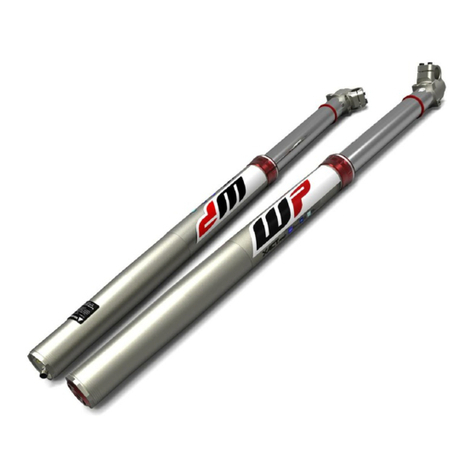
WP AER 43 CONE VALVE FORK


DEAR WP CUSTOMER
*53000130en*
53000130en
07/2017
DEAR WP CUSTOMER
Congratulations on your decision to purchase a WP chassis component. You are now the owner of a state-of-the-
art sports chassis that will give you and your child enormous pleasure if you service and maintain it accordingly.
We hope you enjoy your new ride!
The Owner's Manual contained the latest information for this model series at the time of going to print. However,
minor differences due to further developments in design cannot be ruled out completely.
All specifications are non-binding. WP Performance Sports GmbH specifically reserves the right to modify or
delete technical specifications, prices, colors, forms, materials, services, designs, equipment, etc., without
prior notice and without specifying reasons, to adapt these to local conditions, as well as to stop production of
a particular model without prior notice. WP Performance Sports GmbH accepts no liability for delivery options,
deviations from figures and descriptions, misprints, and other errors. The models portrayed partly contain special
equipment that does not belong to the regular scope of supply.
© 2017 WP Performance Sports GmbH, Mattighofen Austria
All rights reserved
Reproduction, even in part, as well as copying of all kinds, is permitted only with the express written permission
of the copyright owner.
WP Performance Sports GmbH
Stallhofnerstraße 3
5230 Mattighofen, Austria
This document is valid for the following models:
WP AER 43 Cone Valve Fork (43.18.2R.04)

TABLE OF CONTENTS
2
TABLE OF CONTENTS
1 MEANS OF REPRESENTATION ...................... 3
1.1 Symbols used .................................... 3
1.2 Formats used..................................... 3
2 SAFETY ADVICE............................................ 4
2.1 Use definition –intended use.............. 4
2.2 Misuse.............................................. 4
2.3 Safety advice..................................... 4
2.4 Degrees of risk and symbols ................ 4
2.5 Safe operation ................................... 4
2.6 Work rules......................................... 5
2.7 Environment...................................... 5
2.8 Owner's Manual ................................. 5
2.9 Correct installation............................. 5
3 IMPORTANT NOTES...................................... 6
3.1 Manufacturer and implied warranty...... 6
3.2 Operating and auxiliary substances ...... 6
3.3 Spare parts, accessories ..................... 6
3.4 Service ............................................. 6
3.5 Figures ............................................. 6
3.6 Customer service................................ 6
4 SERIAL NUMBERS ....................................... 7
4.1 Fork article number............................ 7
5 PREPARING FOR USE................................... 8
5.1 Advice on first use ............................. 8
6 RIDING INSTRUCTIONS................................ 9
6.1 Checks and maintenance measures
when preparing for use ....................... 9
7 SERVICE SCHEDULE .................................. 10
7.1 Additional information ...................... 10
7.2 Required work ................................. 10
7.3 Recommended work ......................... 10
8 SERVICE WORK ON THE CHASSIS............... 11
8.1 Raising the motorcycle with a lift
stand .............................................. 11
8.2 Removing standard fork legs .......... 11
8.3 Installing aftermarket version ......... 12
8.4 Bleeding the fork legs....................... 12
8.5 Cleaning the dust boots of the fork
legs ................................................ 13
8.6 Removing the motorcycle from the
lift stand ......................................... 14
8.7 Removing the fork protector .............. 14
8.8 Installing the fork protector............... 14
8.9 Removing the front wheel .............. 15
8.10 Installing the front wheel .............. 15
9 TUNING THE CHASSIS ............................... 17
9.1 Checking the basic chassis setting
with the rider's weight ...................... 17
9.2 Air suspension WP AER 43
Cone Valve Fork ............................... 17
9.3 Checking the basic setting of the
fork ................................................ 18
9.4 Adjusting the fork air pressure........... 18
9.5 Adjusting the compression damping
of the fork ....................................... 19
9.6 Adjusting the rebound damping of
the fork........................................... 20
10 TECHNICAL DATA....................................... 21
10.1 Fork................................................ 21
10.2 Chassis tightening torques ................ 21
11 SUBSTANCES ............................................ 22
12 AUXILIARY SUBSTANCES ........................... 23
13 STANDARDS .............................................. 24
14 LIST OF ABBREVIATIONS............................ 25
INDEX ............................................................... 26

1 MEANS OF REPRESENTATION
3
1.1 Symbols used
The meaning of specific symbols is described below.
Indicates an expected reaction (e.g. of a work step or a function).
Indicates an unexpected reaction (e.g. of a work step or a function).
All work marked with this symbol requires specialist knowledge and technical understanding. In
the interest of your own safety, have these jobs performed by a WP Authorized Center! There
your WP chassis will be treated with the optimum care and attention by specially trained
experts using the necessary special tools.
Indicates a page reference (more information is provided on the specified page).
Indicates information with more details or tips.
Indicates the result of a testing step.
Indicates the end of an activity, including potential rework.
1.2 Formats used
The typographical formats used in this document are explained below.
Proprietary name Indicates a proprietary name.
Name®Indicates a protected name.
Brand™ Indicates a brand available on the open market.
Underlined terms Refer to technical details or indicate technical terms, which are explained
in the glossary.

2 SAFETY ADVICE
4
2.1 Use definition –intended use
This chassis component is designed and built to withstand the normal stresses and strains of competitive use.
Info
Only use this chassis component in closed-off areas remote from public road traffic.
Only use this chassis component in the vehicle for which the chassis component is approved and/or rec-
ommended.
2.2 Misuse
The chassis component must only be used as intended.
Dangers can arise for people, property and the environment through use not as intended.
Any use of the chassis component beyond the intended and defined use constitutes misuse.
Misuse also includes the use of operating and auxiliary fluids which do not meet the required specification for the
respective use.
2.3 Safety advice
A number of safety instructions need to be followed to operate the model described safely. Therefore read this
instruction and all further instructions included carefully. The safety instructions are highlighted in the text and
are referred to at the relevant passages.
Info
Various information and warning labels are attached in prominent locations on the model described. Do
not remove any information or warning labels. If they are missing, you or others may not recognize dangers
and may therefore be injured.
2.4 Degrees of risk and symbols
Danger
Indicates a danger that will immediately and invariably lead to fatal or serious permanent injury if the
appropriate measures are not taken.
Warning
Indicates a danger that is likely to lead to fatal or serious injury if the appropriate measures are not taken.
Note
Indicates a danger that will lead to considerable machine and material damage if the appropriate measures are
not taken.
2.5 Safe operation
Danger
Danger of accidents A rider who is not fit to ride poses a danger to him or herself and others.
–Do not operate the vehicle and use chassis components if you are not fit to ride due to alcohol, drugs
or medication.
–Do not operate the vehicle and use chassis components if you are physically or mentally impaired.

2 SAFETY ADVICE
5
Warning
Danger of burns The damper gets very hot when the vehicle is driven.
–Do not touch the damper before it has cooled down.
–Allow the damper to cool down before performing any work.
Only use the chassis component when it is in perfect technical condition, in accordance with its intended use,
and in a safe and environmentally compatible manner.
If there are faults, which impair safety, have them immediately remedied in a WP Authorized Center.
Adhere to the information and warning labels on the chassis component.
2.6 Work rules
Special tools are necessary for certain tasks. The tools are not a component of the chassis component, but can be
ordered using the number in parentheses. Example: air pump (T1317)
During assembly, use new parts to replace parts which cannot be reused (e.g. seals, sealing rings, O-rings).
In the case of certain screws, a thread locker (e.g. Loctite®) is required. Apply according to the manufacturer's
instructions.
After disassembly, clean the parts that are to be reused and check them for damage and wear. Change damaged
or worn parts.
After completing a repair or service work, check the operating safety of the chassis component.
2.7 Environment
If you use your chassis component responsibly, you can ensure that problems and conflicts do not occur.
When disposing of used oil, other operating and auxiliary fluids, and used components, comply with the laws and
regulations of the respective country.
2.8 Owner's Manual
It is important that you read this Owner's Manual carefully and completely before your child makes his or her first
trip. The Owner's Manual contains useful information and many tips for you and your child on how to operate,
handle, and maintain your motorcycle. This is the only way for you to find out how to ideally set up the chassis
component and how to protect yourself and your child from injury.
Keep the Owner's Manual in an accessible place to enable you to refer to it as needed.
If you would like to know more about the chassis component or have questions on the material you read, please
contact a WP Authorized Center.
The Owner's Manual is an important part of the chassis component and must be handed over to the new owner if
the vehicle is sold.
2.9 Correct installation
Correct installation is essential in order to guarantee the maximum level of safety and functionality.
It is therefore strongly recommended that you have the chassis component installed at a WP Authorized Center.

3 IMPORTANT NOTES
6
3.1 Manufacturer and implied warranty
The work prescribed in the service schedule must be carried out in a WP Authorized Center only, since otherwise
no warranty claims will be recognized. Damage or secondary damage caused by tampering with and/or conversions
on the chassis component are not covered by the warranty.
3.2 Operating and auxiliary substances
Use operating and auxiliary substances (such as fuel and lubricants) as specified in the Owner's Manual.
3.3 Spare parts, accessories
For the safety of your child, only use spare parts and accessory products that are approved and/or recommended
by WP and have them installed in a WP Authorized Center. WP accepts no liability for other products and any
resulting damage or loss.
Certain spare parts and accessory products are specified in parentheses in the descriptions. Your WP Authorized
Center will be pleased to advise you.
3.4 Service
A prerequisite for perfect operation and prevention of premature wear is that the service, care, and tuning work
is properly carried out as described in the Owner's Manual. Incorrect adjustment and tuning of the chassis and
suspension can lead to damage and breakage of components.
Use of the chassis component under difficult conditions, such as on sand or on wet and muddy surfaces, can
lead to considerably more rapid wear. For this reason, it may be necessary to inspect or replace parts before the
next scheduled service.
It is imperative that you adhere to the stipulated service intervals. If you observe these exactly, you will ensure a
much longer service life for your chassis component.
3.5 Figures
The figures contained in the manual may depict special equipment.
In the interest of clarity, some components may be shown disassembled or may not be shown at all. It is not
always necessary to disassemble the component to perform the activity in question. Please follow the instructions
in the text.
3.6 Customer service
If you have any questions about your chassis component or WP, your WP Authorized Center will be pleased to
advise you.
A list of WP Authorized Centers can be found on the WP website.
WP Performance Sports international website: http://www.wp-group.com

4 SERIAL NUMBERS
7
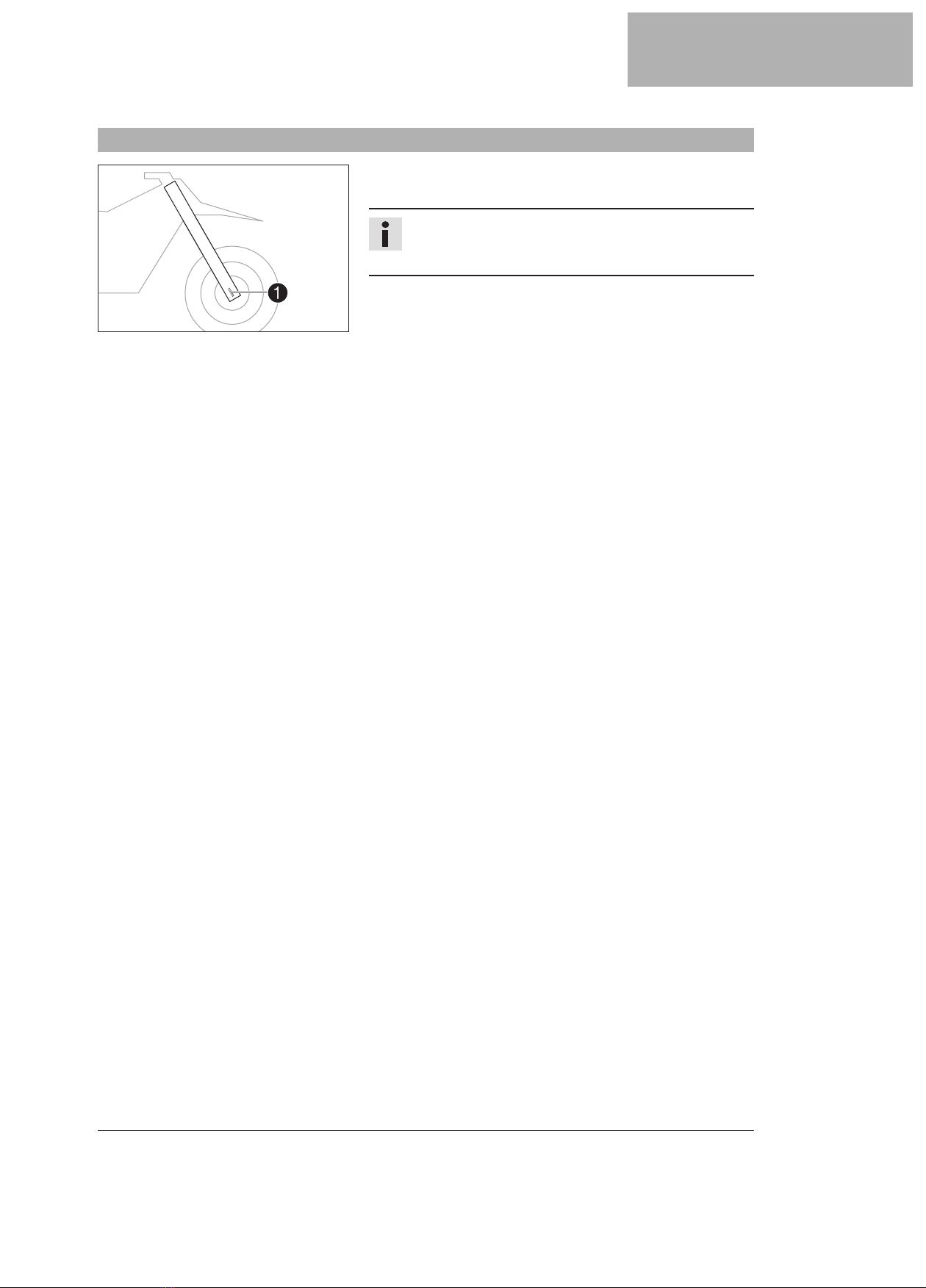
4.1 Fork article number
401947-10
The fork article number 1is stamped on the inside of the axle
clamp.
Info
The fork article number consists of an eight figure number
with a single letter in the sixth position.

5 PREPARING FOR USE
8
5.1 Advice on first use
Warning
Danger of accidents The suspension components will become damaged or destroyed if overloaded.
–Make sure the maximum permissible weight of the rider is not exceeded.
Maximum rider weight 75 kg (165 lb.)
Warning
Danger of accidents Modifications to the suspension setting may seriously alter the handling characteris-
tic.
Extreme modifications to the suspension setting may cause a serious deterioration in the handling char-
acteristic and overload components.
–Only make adjustments within the recommended range.
–Make sure your child rides slowly to start with after making adjustments in order that he or she can
assess the new handling characteristic.
–Before first use, adjust the chassis component accordingly for your child.
Ce manuel convient aux modèles suivants
1
Table des matières
Autres manuels WP Châssis