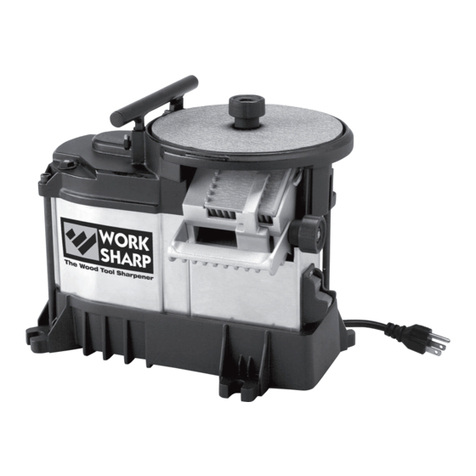
Work Sharp Ken Onion WSKTS-KO Manuel utilisateur

KNIFE & TOOL SHARPENER
WSKTS-KO USER GUIDE
WorkSharpTools.com
To reduce the risk of injury, the user must read and understand this instruction
manual before using product. Save these instructions for future reference.
•CAUTION

Not Pictured:
Bench Mount Fastener (1/4” x 20)
Getting To Know
Your Tool
1
Sharpening Guide Slots
Belt Change Lever
Angle Adjustment Knob
Belt Tracking Lever
with variable speed dial
Power Switch
Power Switch Lock Out
Belt Tensioner
Handle
Sharpening Cassette
Power Platform
Edge Guide
Cassette
Lock Lever

15° - 30° in 1° increments. The dial
indicates the angle per side. Align
desired angle with the indicator line on
top of guide.
Low speed (+/-) is 1200 SFM
Mid speed (+/-) is 2000 SFM
High speed (+/-) is 2800 SFM
SFM = Surface Feet per Minute
Belt Information
• Engineered abrasives are long lasting and will meet your sharpening needs.
• Keep clean for best performance and optimum life.
• 6000 Belt is narrow for improved gut hook sharpening.
• Belt Grits are labeled on backing (μ = micron).
• For reference, belts are equivalent to: X65 (P220) | X22 (P1000) | X4 (P3000)
Knife Sharpening Guide Adjustment
Speed Control Adjustment
Extra Coarse
P120
Norton SG
Tool Sharpening
Knife Repair
Belt Name
Grit
Size
What it Sharpens
Uses
Coarse
X65
Norax 65µ
Knife
Shape
Medium
X22
Norax 22µ
Knife
Sharpen
Fine
X4
Norax 4µ
Knife & Scissor
Hone
Extra Fine
6000
SiC 2µ
Gut Hooks
Serrations
Abrasive Belt Wear
Belt discoloration is not an indicator of wear. Engineered belts expose new
abrasive as they break down. Used belts may take extra strokes but will
continue to remove material. These belts will keep going longer than you
think. Keep using them as long as they cut.

Belt Change:
Lift & hold Belt Change Lever to remove belt. Route belt around all 3
pulleys, then release the lever. Be sure belt is within pulley flanges. Lay
tool onto its side for easier belt changes.
Belt Tracking Lever
Push lever inward, then slide up or down to track belt onto the center of
the top pulley (factory set at center).
Trigger Lock
Pull trigger & push button in to lock “on” position.
Pull trigger to release. Not intended for use when
knife sharpening, use for grinding applications only.
Sharpening Guide:
Rotate knob to select angle. Align number with
mark on top. The dial indicates the angle per side.
Removing the Sharpening Cassette:
1. Remove belt from sharpening cassette.
2. Push and hold lock lever and rotate cassette to
position shown.
3. Dismount cassette by pulling outward.
4. Locate this same position to re-install
sharpening cassette or attachments.
Sharpening
Remove
Grinding
B
B
D
E
C
AA
Side View
Setting up
Your Tool
2
On Other Side
Slide guide onto cassette (A)
Snap into place. Pull firmly to release.
Cassette Lock Lever (B)
Push & hold to rotate cassette from
sharpening to grind mode.
Edge Guide: Pull & Rotate (C)
Clockwise to use, Counter-
clockwise to parked position.
Bench Mounting (D)
Use 1/4” 20 fastener to secure
tool.
Belt Change Lever (E)
Lift to reduce belt tension during belt changes.

Outdoor Knife
Tip
Heel
Bolster
Finger Guard
HandleBlade
Edge
Spine
Point
Tip Heel
Finger Guard
Choil
Primary
Bevel
Re-Curve
Handle
Blade
Edge
Belly
Spine Ricasso
Point
Kitchen Knife
Blade Types
Re-Curve Skinner Drop
Point
Hawk BillSheepfoot ClipCombo
Tanto
Spear
Point
Know your
knife
3

Kitchen Knives
Pull rate: 1”/sec •Use Edge Guide
Western
Asian
Paring
Cleaver
Bread
Angle
20°
16°
20°
30°
X
Speed
L
L
L
H
L
X65
4-8
0
4-8
4-8
0
X22
4-8
4-8
4-8
2-8
0
X4
10
10
10
0
0
6000
0
0
0
0
2
Pocket
Hunting
Fillet
Serrated
Gut Hook
Angle
25°
25°
20°
X
X
Speed
L/M
L/M
L/M
L
M
X65
6-10
6-10
6-10
0
0
X22
6-10
6-10
6-10
0
0
X4
10
10
10
0
0
6000
0
0
0
2
2
Outdoor Knives
Pull rate: 1”/sec • No Edge Guide
Best Techniques:
Position belt at the very start of
the edge with motor off.
Place blade in guide then simultaneously
power up and pull the blade.
• Resharpen using X4 only.
• Follow the curve of the knife when sharpening for best results.
• Use the Edge Guide on long or flexible blades when possible.
• Masking tape can protect blade from scratching during sharpening.
• Use a practice knife to learn.
Number of strokes per side.
Sharpening
reference chart
4

Reference Section 4 and the Sharpening Reference Chart for recommended
angle settings, belt selection, stroke count, speed and choice of edge type.
1. Place the blade in the guide
With power off,insert blade into right side of sharpening
guide all the way to the start of the edge.
Place knife to bottom and outside edge of guide slot.
Do not put pressure onto / into the sharpening guide. It is
intended to provide a reference point for blade position.
Only use light pressure (weight of the blade) when using the
sharpening guide to yield best results.
2. Power on and Pull the knife
With power off and blade placed in the guide, simultaneously squeeze the
power switch and pull blade steadily through the guide (1” per second).
Follow the curve of the blade as
you pull through the guide. Keep
cutting edge perpendicular to the
belt for best and most consistent
results.
Use only the weight of the blade
– do not press down into / onto
guide.Hover the blade and let the
tool do the work for best results.
Guide will ‘tip over’ if too much
outer pressure is applied.
Power off as you come to the point, while the blade is still supported by the belt.
When and why to use the Edge Guide:
•Most pocket / outdoor knives are best
sharpened without using the Edge-Guide
since they often have thumb studs or belt
clips that can obstruct full blade insertion.
•It is helpful to support and guide long blades
(filet knives and machetes) through the
sharpening process. Pull and Rotate
nBest Techniques:
Sharpening outdoor knives
5

3. Repeat and feel for burr
Continue sharpening on right side of guide.
Check for a burr every 2-3 strokes (see picture).
Sharpen until a burr is created along the entire
length of the edge.
If burr is not yet raised, See
“Knife not getting
sharp”
in Troubleshooting section.
nBest Techniques: (Avoid rounding the tip)
Maintain factory blade profile / shape:
Check for a burr by
brushing fingers across/
away from the blade edge.
Repeat same number of strokes on other side of blade / sharpening guide.
Once the edge is shaped / formed, continue with finer grit belts using
alternating strokes. Alternating strokes removes the burr and refines the
edge faster.
See Sharpening Reference Chart in Section 4 for recommended belt use and
stroke count based on the edge you want (Toothy, Shaving, Shiny).
Abrasive Belt
STOP STOP
Abrasive Belt
Follow the curve of the blade so
the edge remains perpendicular
to the belt. Turn off the power as
you come to the point.
Use this technique for these
blade types:
Pull straight through the guide and
stop on the middle of the belt. Do not
lift the blade handle. Turn power off
as knife point contacts belt.
Use this technique for these blade
types:

Only use the finest grit 6000 belt (purple, narrow) for serrated sharpening.
Place flat side of blade at the bolster / handle against the fine grit abrasive
belt. Set to low speed and squeeze the power switch and pull knife steadily
across the belt from bolster to tip. An 8” blade should take 8 seconds.
Repeat until no burr remains on the flat side of the blade and serration
‘teeth’ are sharp.
nBest Techniques:
Serrated knives can be
sharpened with or without the
Knife Sharpening Guide installed
depending on height of serrated knife.
Only place serrated blades on downhill
- right side of belt. Otherwise you risk
cutting the belt.
Most serrated knives have a flat side and a bevel side
on the blade; Sharpen only the flat side.
Flat Side
Blade
Belt
Beveled Side
Sharpening
Serrated Knives
6

Reference the Sharpening Reference Chart in Section 4 for recommended
angle settings, belt selection and speed. Otherwise sharpening a filet knife
is the same as other knives.
Use the Edge Guide to help support these long, flexible blades during
sharpening to ensure a consistent sharpening along the entire edge.
Use very light pressure in the sharpening guide so the
blade does not flex.
Only use finest grit 6000 belt (purple,
narrow) for sharpening gut hooks.
Place curve of gut hook over the
belt on downhill side; allow belt to
conform to blade’s curve. Squeeze
power switch; hone 2 to 4 seconds.
Repeat on other side.
nBest Techniques:
Only place gut hook on downhill - right side of
belt. Otherwise you risk cutting the belt.
Sharpening
FiLet Knives
Sharpening
Gut Hooks
7
8
Table des matières
Autres manuels Work Sharp Outils électriques

Work Sharp
Work Sharp KNIFE & TOOL SHARPENER Manuel utilisateur

Work Sharp
Work Sharp Ken Onion Manuel utilisateur

Work Sharp
Work Sharp Ken Onion Manuel utilisateur

Work Sharp
Work Sharp WSKTS2 Manuel utilisateur

Work Sharp
Work Sharp WSKTS Manuel utilisateur

Work Sharp
Work Sharp KNIFE & TOOL SHARPENER Manuel utilisateur

Work Sharp
Work Sharp WS2000 Manuel utilisateur

Work Sharp
Work Sharp WS3000 Manuel utilisateur

Work Sharp
Work Sharp WS3000 Manuel utilisateur