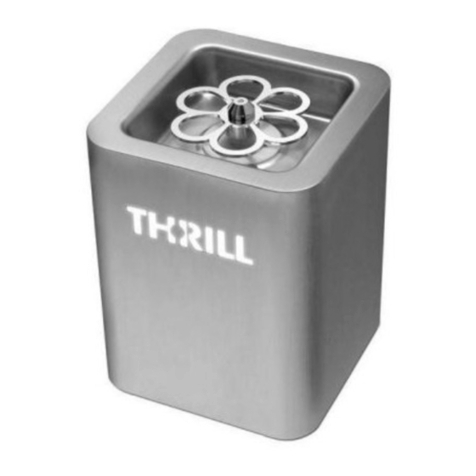
GLASSWARE SANITIZING APPLIANCE
USER AND MAINTENANCE MANUAL (REV. 7)
10
Connect the plug only to a properly installed and easily accessible socket, the
voltage of which corresponds to the indicaons on the nameplate. The socket must
be easily accessible even aer connecon.
Make sure that the power cord can not be damaged by sharp edges or hot spots.
Even aer switching o, the appliance is not completely disconnected from the
mains. To isolate it completely from the power supply, pull out the mains plug from
the socket.
When posioning the appliance, make sure that the power cord is not throled or
pinched. To remove the plug from the socket, always pull at the plug and never the
cable.
The power supply line must be protected by an RCD with IΔn = 30 mA, instantaneous
trip; if in doubt consult a qualied installer.
- HYGIENE
The appliance must be cleaned regularly in order to prevent the growth of bacteria.
Do not place dirty glasses containing liquid residues on the grille.
Avoid the build-up of liquid in the drip tray.
While the sanizing acon combats the build-up of bacteria in glassware, it is not a
substute for the cleaning and sanizaon performed by a dishwasher.
- USE
Never look directly into the jet stream or directly expose it to parts of the body
(face, hands, arms, etc.), in order to avoid the risk of frost burn.
Avoid placing your hands inside the basin during operaon or immediately aer
appliance use.
Before using the appliance, ensure it is completely dry, as the presence of water in
the tank can lead to splashing and potenal frostbite; if liquids have accumulated in
the drip tray, dry it thoroughly.
There is a risk that protecve treatments and nishes applied to work surfaces may
cause the rubber feet ed to the appliance to corrode or become stuck to the
surface; to ensure this does not occur, place a non-slip base or mat under the machine.
Do not use detergents or acids for cleaning surfaces; only use products specically
suitable for cleaning stainless steel.
Clean all exterior surfaces of the machine by hand; the nozzle, rosee and
accompanying parts can be washed in a dishwasher.
4. APPLIANCE DESCRIPTION AND
TECHNICAL SPECIFICATIONS
4.1. SANIFICATION
The sanizing appliance is designed to reduce the presence and build-up of bacteria
in ready to use glasses and plasc containers by means of a rapid chilling acon using
jets of food grade liquid carbon dioxide (E290).
This process not only eliminates most of the pathogens present on the inner surface
and on the edge of the glass or container but also has a cooling or chilling eect, thus
enhancing the taste of the contents.
The process consists of blasng the inside of the glass with a jet of carbon dioxide at
78 Celsius degrees below zero, which cools both the interior and surface of the glass.