6
Adjusting iso-elastic response:
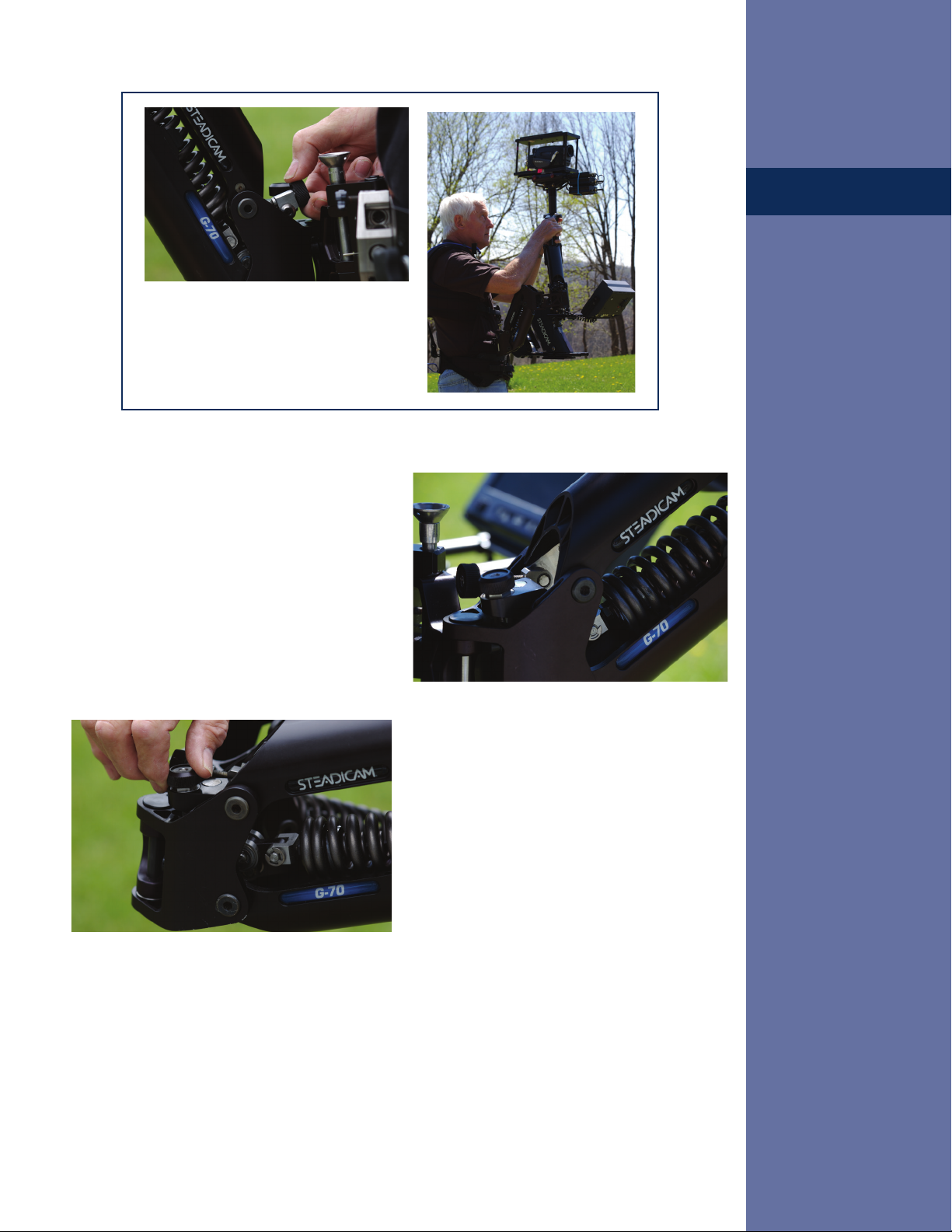
With the arm set to carry the load, we micro-adjust the Ride.
If we dialed in too much iso-elasticity, the arm segments will “hang up” at
the upper or lower extremes of boom travel. If we dialed in too little iso-
elasticity, the arm may not track well in the middle of its range. The only way
to tell if the ride is set correctly is to wear the rig, boom up and down fully,
and watch how the arm behaves.
To adjust the arm for maximum iso-elasticity at any given lift, we turn the Ride knob counterclockwise
until the arm segment begins to “lock” up or down at the extremes of travel. We then turn the ride knob
clockwise a couple of turns. This will keep the arm from locking up or down. We test and micro-adjust
the lift and ride knobs as necessary.
Next, we watch the arm segments as we boom up and down. If the upper arm segment hesitates or
dwells in the middle of its boom range, it is not iso enough to work with the forearm segment. We can
either increase the iso of the upper arm segment or decrease the iso of the forearm segment to correct the
problem.
Typically we try to increase the upper arm segment rst – to have the most iso in the whole arm. But if
we can’t increase the iso, that is, if the upper arm locks up at the extremes of travel, we must decrease
the iso in the forearm segment until the upper arm does not hesitate or dwell in the middle of its travel.
Lift and ride interact to some degree, so some tweaking of lift may be needed after setting the ride.
Typically, the G-Series arms are very forgiving of less than perfect adjustments of lift and ride.
Some tips in setting up the G-Series arms:
To minimize any lifting required with heavier cameras and/or to hold high boom heights, we often set
the arm segments to oat at a higher nominal angle (+25 degrees or more!). We nd pushing down is
easier than lifting fully with the extended boom range possible with the G-Series arms.
The arm can also be adjusted to hang lower than normal for shots with low boom heights, with very little
penalty in performance.
Ride does not have to be adjusted if you set the oat point higher or lower than “normal.” Minor
changes in sled weight (± several pounds) also do not require adjustment of the Ride knob: it’s not
something you change during the average day.
Some operaters prefer a centered ride setting for a feel similar to a IIIA arm. In addition, a centered ride
setting is preferred while using a hard mount on rough terrain. Our advice: experiment and use the arm
the way it helps you operate and get the shot. However, our preference is to have the maximum iso in all
situations.
Physical reality: With the same ride setting, all G-Series arms become progressively less iso-elastic as
the arm’s lift is increased. Heavier loads will require turning the Ride knob to increase iso-elasticity.
Lighter loads need the Ride knob turned to reduce iso-elasticity. Learn to adjust the Ride knob to obtain
— or maintain — your desired iso-elastic performance as the load changes.
Iso-elastic
Response