Mounting your scanners.
Use the diagrams on the last page to mark and drill mounting points to fix the scan block and
scanner amplifier. A common mistake is to mount the scanner block centrally in the laser
aperture window, this is not correct as the scanner output will not come from the centre of the
block but the centre of the scanner X/Y mirror combination. With a little care and planning you
will be able to get the scanner position right first time.
The scanners should be mounted so that the centre of the window corresponds to the centre of
the shaft of the X-axis scanner. This is 11mm from the right hand edge of the block as shown on
the diagram below.
counter-sunk screws (the threaded holes in the block are tapped for M4 and are approx. 13mm
deep). To determine the block size (thickness) work out where your output window will go in the
front panel of the projector. Measure the distance between the centre of the window and the top
of the base plate the scan block is mounted onto. Now subtract the Y-axis shaft height (shown
above) for your model of scanner from the measured value and that will leave you with the
height of spacer block you will need to obtain.
For example using standard mirrors and with a window centre at 40mm above the base plate
surface the block will need to be 15mm thick.
Connecting everything up
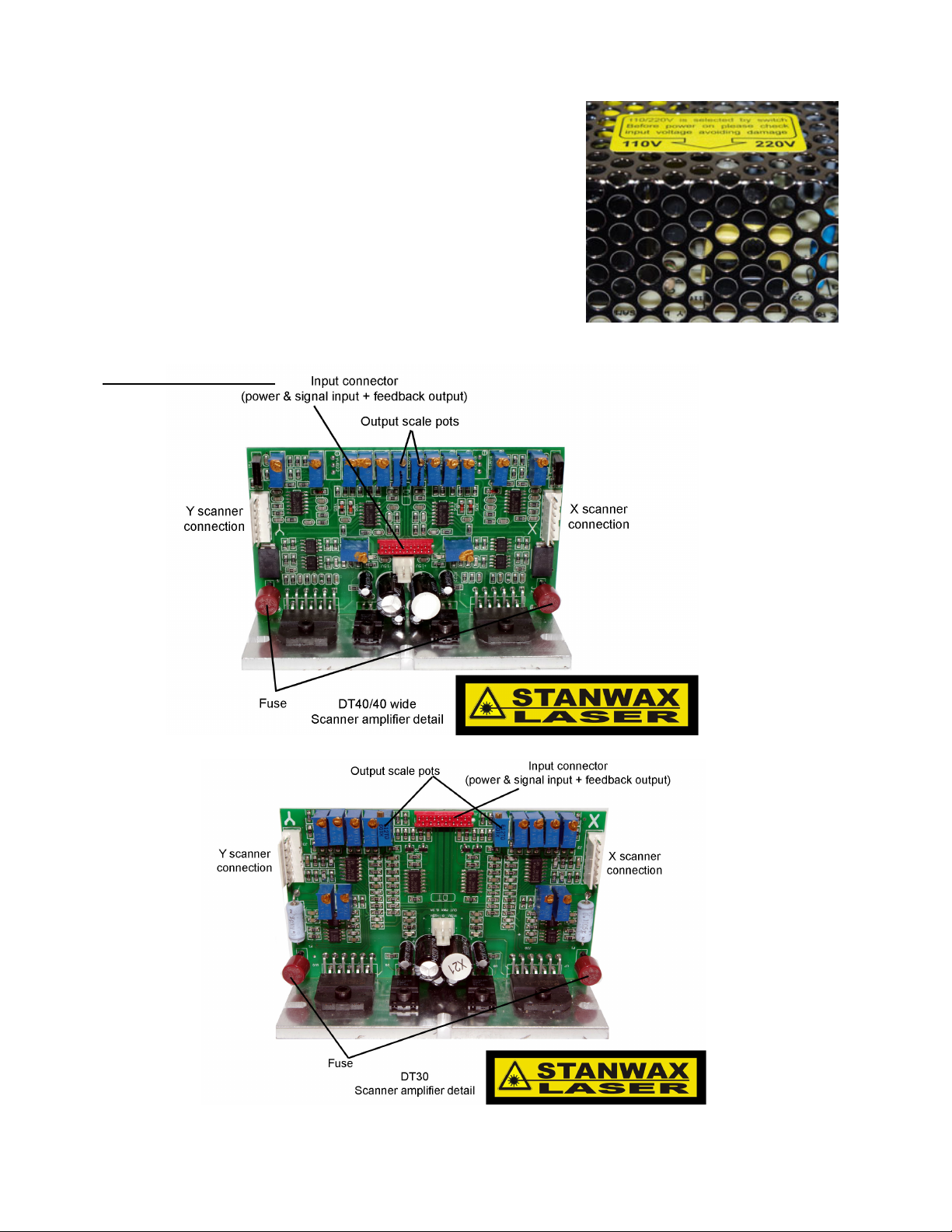
Connect your scanners up using the cables provided, the scanner motor will be clearly marked
for X and Y axis and should be linked to the appropriate connector on the driver board. The
scanners are designed to have the beam entry to the right of the scan block (as shown on the
image above). This makes the X scanner the lower one of the two. If you wish to rotate the scan
block through 90 degrees and use a beam entry from the left, that is perfectly acceptable but
the role of each scanner will become reversed i.e. Y scanner (as factory marked) will need to be
considered as the X scanner and vice versa. This does NOT mean that the scanners will
connect to a different connection on the scan amplifier, it just means you will need to swap the x
and y signals going into the scan amplifier boards. So feed the X signal into the amplifier Y
input.
To determine the scanner block height in
the window you need to know the height of
the Y-axis scanner shaft from the base of
the block. DT scanners have a low block
height in comparison to many other
scanners – the height of the Y-
25mm for the standard size mirrors
(including DT40 Wide) or 27 mm for the
larger sized mirrors. We recommend
making a block up of the correct thickness
to lift the scanners to the desired height.
This can also be useful as you and make
the block larger than the scan block and
provide holes through which you can screw
the scanners down to the laser base plate
from above (this makes life much easier if
you need to remove the scanners at any
time in the future). The scan block can be
fixed to this spacer block from below using