SWITCHES
SMX SERIES page 5
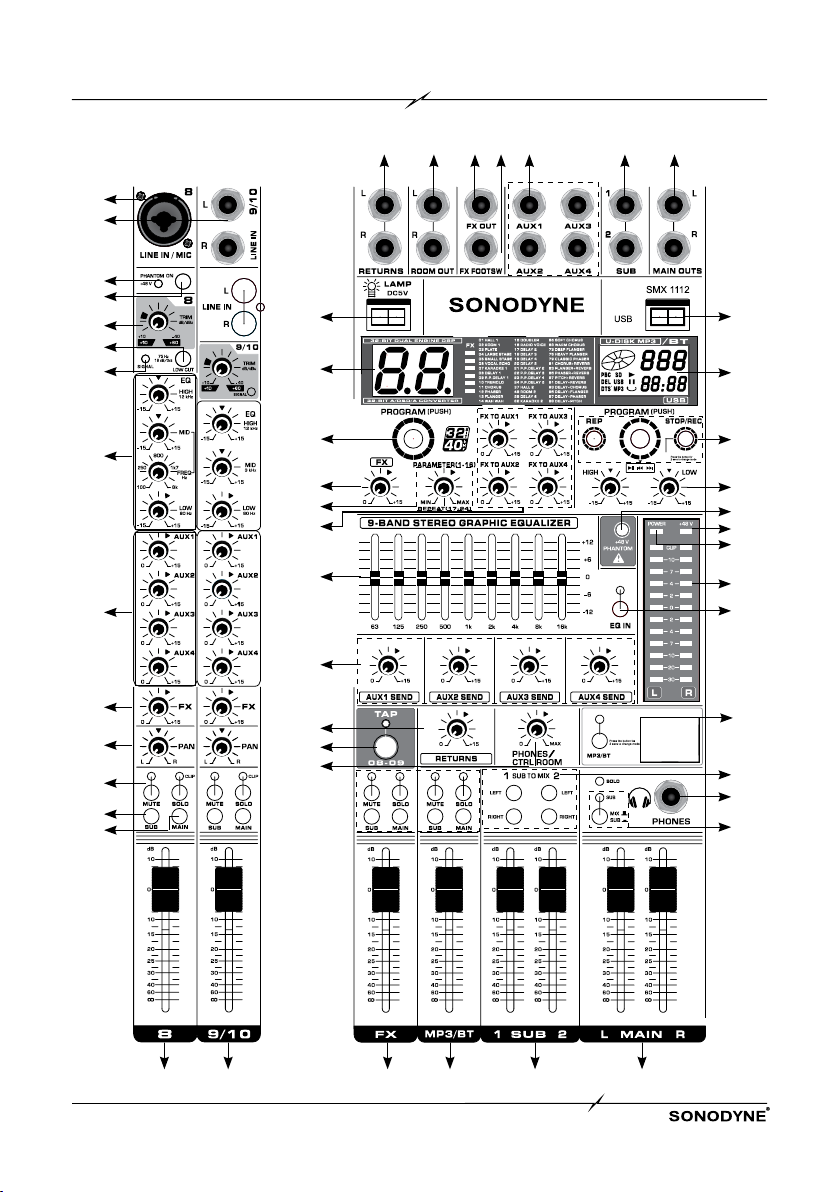
1. MIC INPUT JACKS: These are balanced XLR-type microphone input jacks.
(1: Ground; 2: Hot; 3: Cold)
2. LINE INPUT JACKS (mono channels): These are balanced TRS phone-jack line inputs. (T: Hot; R:
Cold; S: Ground). You can connect either balanced or unbalanced phone plugs to these jacks
3. 48V INDICATOR: Thered“48VLEDlightsupwhenphantompowerisswitchedon.Phantom
power is required to operate condenser microphones
4. PHANTOM +48 V SWITCH: This switch toggles phantom power on and off. When the switch
isonthemixersupplies+48VphantompowertoallchannelsthathaveXLRmicinputjacks
5. TRIM CONTROL: Adjusts the input signal level. To get the best balance between the S/N ratio
and the dynamic range adjust the gain, so that the PEAK indicator (9) lights only occasionally and
briefly on the highest input transients. The -60 to +10 scale is the MIC input adjustment range. The
-40 to +10 scale is the LINE input adjustment range
6. LOW CUT SWITCH: This switch toggles the HPF on or off. The HPF cuts frequencies below
75Hz
7. SIGNAL LED: This is a signal presence indicator which glows when signal is applied to input
8. EQUALISER (High, Mid and Low): This three-band equalizer adjusts the high, mid and low
frequency bands of the corresponding channel. Setting the knob to the "0" position produces a flat
response in the corresponding band. Turning the knob to the right boosts the corresponding frequency
band, while turning to the left attenuates the band. The center frequency of the mid equalizer can be
changed with the help of a frequency control which can be varied continuously from 100Hz to 8kHz
9. AUX CONTROL: Monitor and effects busses (AUX sends) source their signals via a control from
one or more channels and sum these signals to a so-called bus. This bus signal is sent to an aux send
connector (for monitoring applications: MON OUT) and then routed, for example, to an active monitor
speaker or external effects device. In the latter case, the effects return can then be brought back into
the console via the aux return connectors. All monitor and effects busses are mono and tapped into
postEQofferingamplicationofupto+15dB
10. FX CONTROL: The aux send marked FX offers a direct route to the built-in effects processor and
is therefore post-fader and post-mute
11. PAN CONTROL: The PAN control determines the position of the channel signal within the stereo
image. When working with subgroups, you can use the PAN control to assign the signal to just one
output, which gives you additional flexibility in recording situations. For example, when routing to
subgroups 3 and 4, panning hard left will route the signal to group output 3 only, and panning hard
right will route to group output 4 only