
Sonelastic SA-AG Manuel utilisateur

Sonelastic®Systems
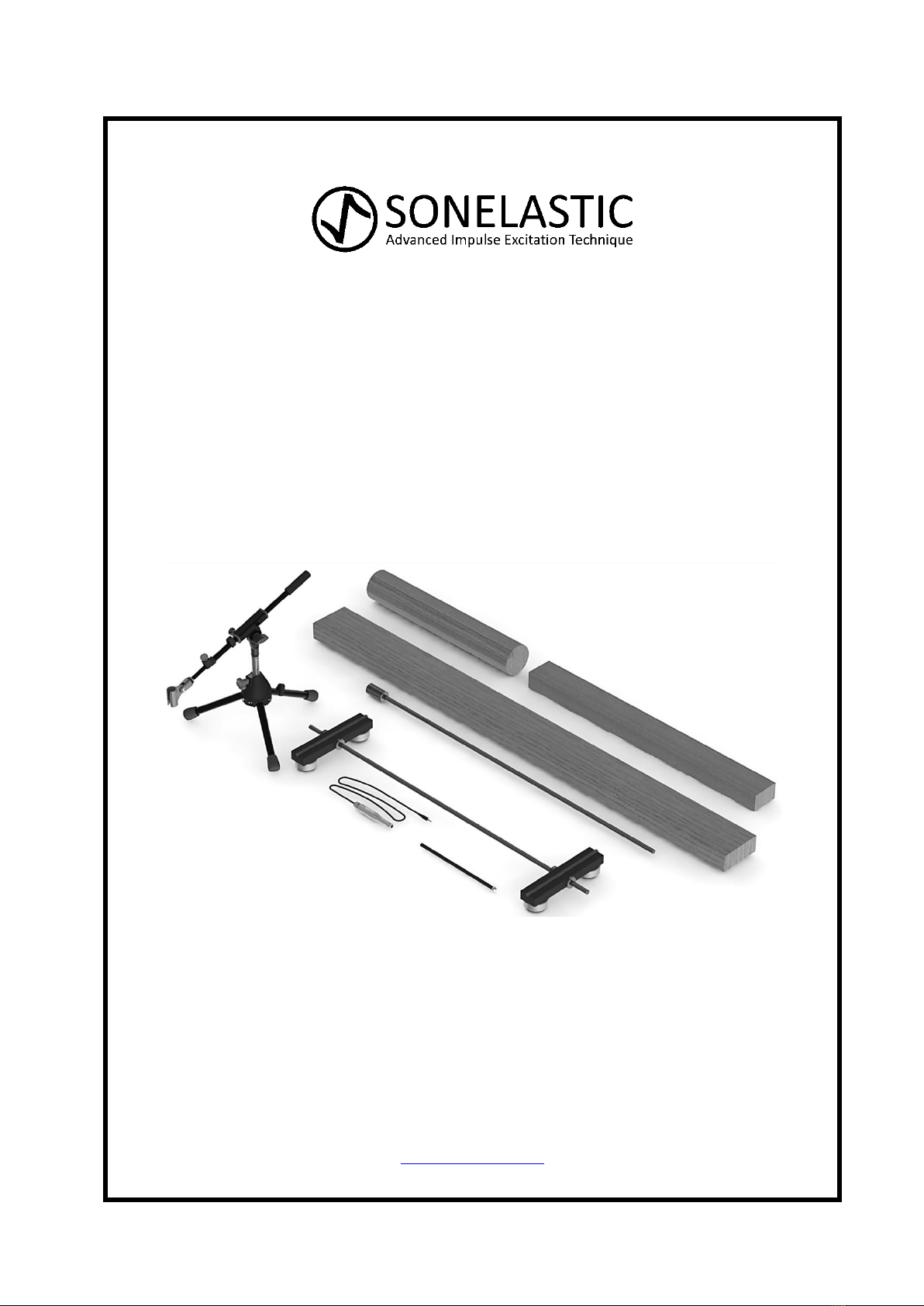
SA-AG Adjustable support for large specimens
Page 2 of 19
Installation and Operation Manual
SA-AG
Adjustable support for large specimens
Manufactured by:
ATCP do Brasil –Alves Teodoro Cerâmicas Piezoelétricas do Brasil Ltda.
ATCP Physical Engineering, SonelasticDivision
Rua Lêda Vassimon, 735-A
Ribeirão Preto –SP, Brazil
CEP 14026-567
CNPJ: 03.970.289/0001-60
Inscrição estadual: 797.013.492.110
Brazilian Industry
www.sonelastic.com

Copyright
Copyright © 2010-2022 by ATCP Physical Engineering
All rights reserved.
ATCP reserves the right to change the product or this manual without notice.
Version 3.0
January/2022

TABLE OF CONTENTS
1. Introduction ................................................................................................. 05
2. Definitions .................................................................................................... 05
3. Application and features ............................................................................... 05
4. Configuration, parts, accessories and optional items .................................... 06
5. Parts identification ....................................................................................... 07
6. Specifications ............................................................................................... 08
7. Specimen ...................................................................................................... 09
7.1 Recommended aspect ratios ..................................................................... 09
7.2 Placing the specimen ............................................................................... 10
8. Support installation ...................................................................................... 11
8.1 Requirements ......................................................................................... 11
8.2 Typical arrangements .............................................................................. 11
8.3 Mounting the support in the default configuration........................................ 13
8.4 Mounting the support with extension rod.................................................... 14
8.5 Mounting the acoustic sensor ................................................................... 14
9. Support operation ......................................................................................... 15
9.1 Positioning the specimen.......................................................................... 15
9.2 Positioning the acoustic sensor ................................................................. 15
10. Acquisition and excitation modes ................................................................ 16
11. Warnings and support transportation.......................................................... 17
12. Maintenance and troubleshooting ............................................................... 17
13. Symbology .................................................................................................. 17
14. Technical support and warranty .................................................................. 18
15. Statement of responsibility.......................................................................... 18
Notes ................................................................................................................ 19

Sonelastic®Systems
SA-AG Adjustable support for large specimens
Page 5 of 19
1. Introduction
ATCP Physical Engineering equipment and products were projected and manufactured to
provide a long-lasting and top-rated performance. This Installation and Operation Manual
contains all necessary information regarding the use and maintenance of SA-AG Support.
Carefully read this manual before using the support. Improper use may
damage the product and affect its performance.
2. Definitions
Impulse Excitation Technique: The Impulse Excitation Technique is a non-destructive
technique to determine the elastic moduli and damping of materials by the resonance
frequencies of test specimens. ASTM E1876 is the main standard related to the Impulse
Excitation Technique.
Resonance Frequencies: Specimen natural frequencies of vibration.
Elastic modulus: Elastic modulus or Young’s modulus is defined as the slope of the stress-
strain curve at the elastic region, as described by Hooke’s Law. The elastic modulus
determined by Impulse Excitation Technique is also termed as dynamic elastic modulus.
Damping: Damping is the phenomenon by which mechanical energy is dissipated in dynamic
systems. It is directly linked to the presence of defects and to the material microstructure.
3. Application and features
SA-AG Support is an apparatus to support specimens for non-destructive characterization of
Young’s modulus and damping of materials by Impulse Excitation Technique, in agreement
with ASTM E1876 and correlated standards. SA-AG Support was developed to be used
alongside Sonelastic®Systems.
SA-AG Support allows large rectangular and cylindrical specimens to rest on the nodal lines
of the fundamental flexural vibration mode (for a specimen of length L, these nodal lines are
0.224L distant from the ends). This support offers a practical system to adjust the distance
between the supporting blocks. SA-AG Support also allows tests based on torsional and
longitudinal vibration modes for bars and cylinders.

Sonelastic®Systems
SA-AG Adjustable support for large specimens
Page 6 of 19
4. Configurations, parts, accessories and optional items
SA-AG Support consist of two supporting blocks linked by a threaded rod, allowing practical
adjustment. It also has an extension rod to expand the maximum distance between the
supporting blocks.
Parts:
[01] –SA-AG Support;
[02] –Acoustic Sensor CA-DP;
[03] –Sturdy Tripod.
Accessories:
[04] –Medium Manual Impulse Device;
[05] –Extension rod (01 UNIT).
Optional items:
[05] –Extension rod.
Sonelastic®Systems
SA-AG Adjustable support for large specimens
Page 7 of 19
5. Parts identification
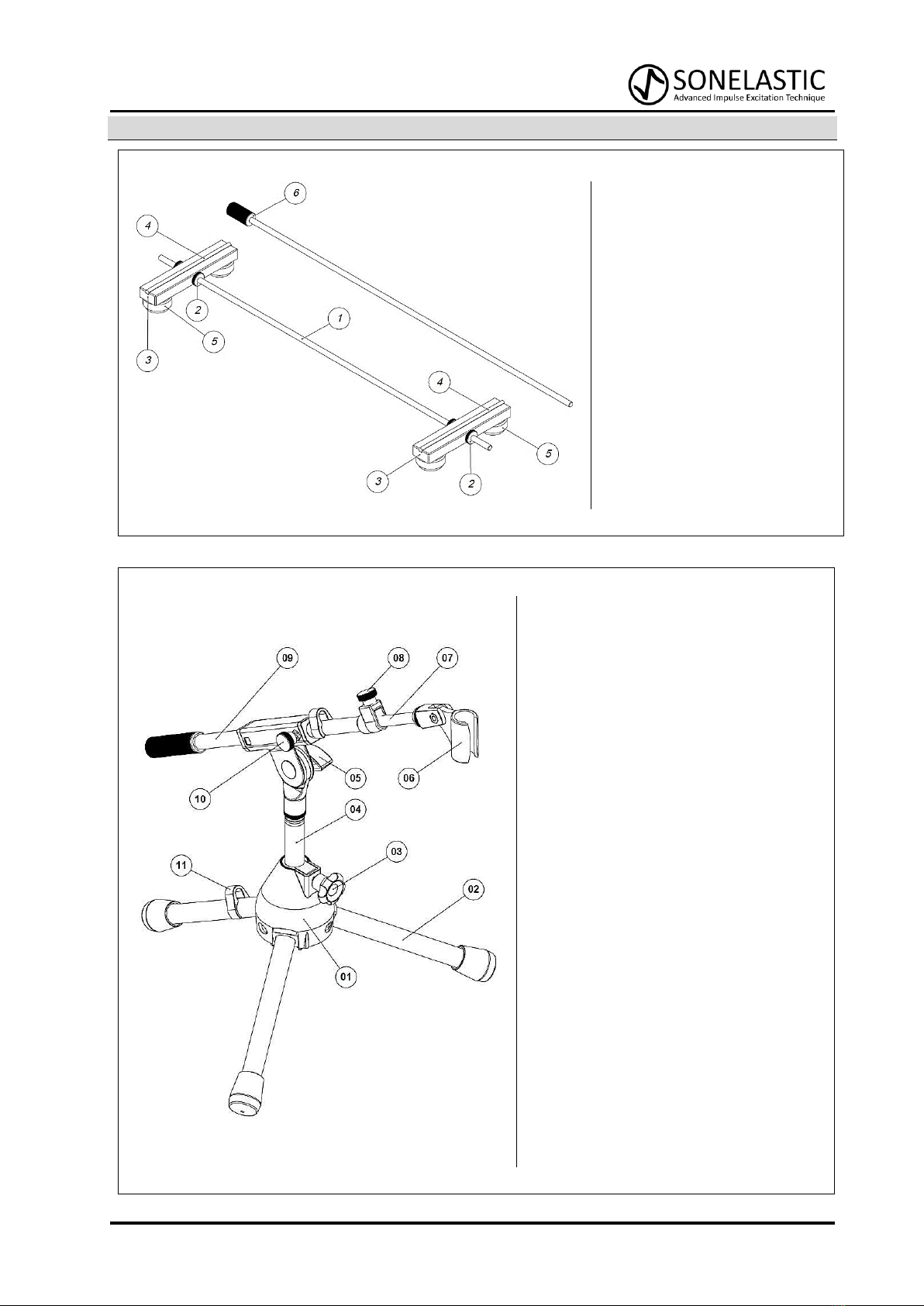
SA-AG Support
01- Threaded rod;
02- Fastening nut of the supporting
block;
03- Supporting block;
04- Supporting frieze;
05- Damper foot;
06- Extension rod.
Sturdy Tripod
01- Frame;
02- Articulated tripod;
03- Handle for securing the tube;
04- Pillar;
05- Handle for the tube articulation;
06- Acoustic sensor clip;
07- Inner tube;
08- Handle for the inner tube articulation;
09- Outer tube;
10- Handle for the outer tube articulation;
11- Cable’s organizer.

Sonelastic®Systems
SA-AG Adjustable support for large specimens
Page 8 of 19
CA-PD Acoustic Sensor
01-CA-DP Acoustic Sensor;
02- P2 plug (3.5 mm);
03- Flexible cable;
04- Cable gland;
05- Acoustic sensor frame;
06- Vertical mounting base*;
07- Height-adjusting disc**.
* The Vertical mounting base allows positioning the acoustic sensor on the vertical, directly below the specimen,
for measurements under the manual configuration.
** The height-adjusting disc should be used to balance CA-DP Acoustic Sensor and or IED Impulse device
heights, when testing lightweight specimens.
6. Specifications
Maximum dimensions for rectangular specimens (L x W x T) ....... 5,300 x 200 x 200 mm
Minimum dimensions for rectangular specimens (L x W x T) ....... 120 x 20 x 20 mm
Maximum dimensions for cylindrical specimens (L x D) ............... 5,300 x 200 mm
Minimum dimensions for cylindrical specimens (L x D) ............... 120 x 30 mm
Maximum dimensions for the Standard Support (L x W x T)......... 1,000 x 250 x 57 mm
Maximum dimensions for the extended support (L x W x T) ......... 3,000 x 250 x 57 mm
Maximum weight capacity........................................................ 200 kg
Standard Support weight, without a specimen............................ 2.8 kg
Extended support weight, without a specimen............................ 5.2 Kg
Working temperature range .................................................... 10 - 40°C (50 - 104 °F)
Sonelastic®Systems
SA-AG Adjustable support for large specimens
Page 9 of 19
7. Specimens
7.1 Recommended aspect ratios
Minimum aspect ratios must be observed to avoid coupling between specimen’s vibration
modes. In addition, aspect ratio determines the pattern of frequency spectrum of the acoustic
response. We advise users to standardize the aspect ratio in order to facilitate the frequencies
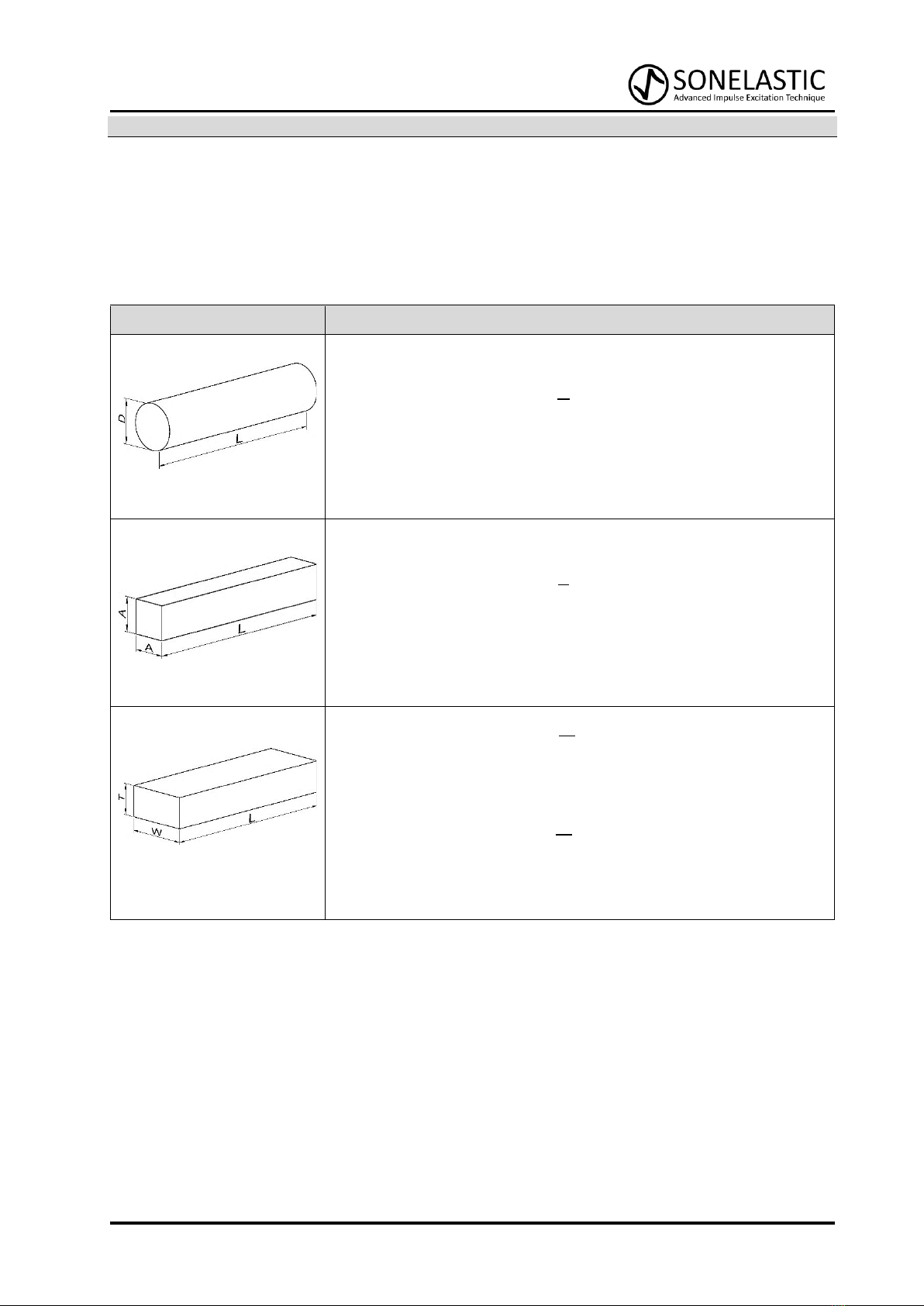
identification. The table below presents the recommended aspect ratio for bars and cylinders.
Geometry
Recommended proportions
Cylinder
𝐿
𝐷≥ 2
The ratio between length (L) and diameter (D) must be greater than
or equal to 2.
Square section bar
𝐿
𝐴≥ 3
The ratio between length (L) and edge (A) must be greater than or
equal to 3.
Rectangular section bar
𝐿
𝑊 4
The ratio between length (L) and width (W) must be greater than or
equal to 4.
𝑊
𝑇≤ 8
The ratio between width (W) and thickness (T) must be less than or
equal to 8.
Important observations for preparing and finishing the specimens:
- The recommended dimension tolerance is 2%;
- Faces should be flat and parallel;
- Corners should not be rounded.
Sonelastic®Systems
SA-AG Adjustable support for large specimens
Page 10 of 19
7.2 Placing the specimen
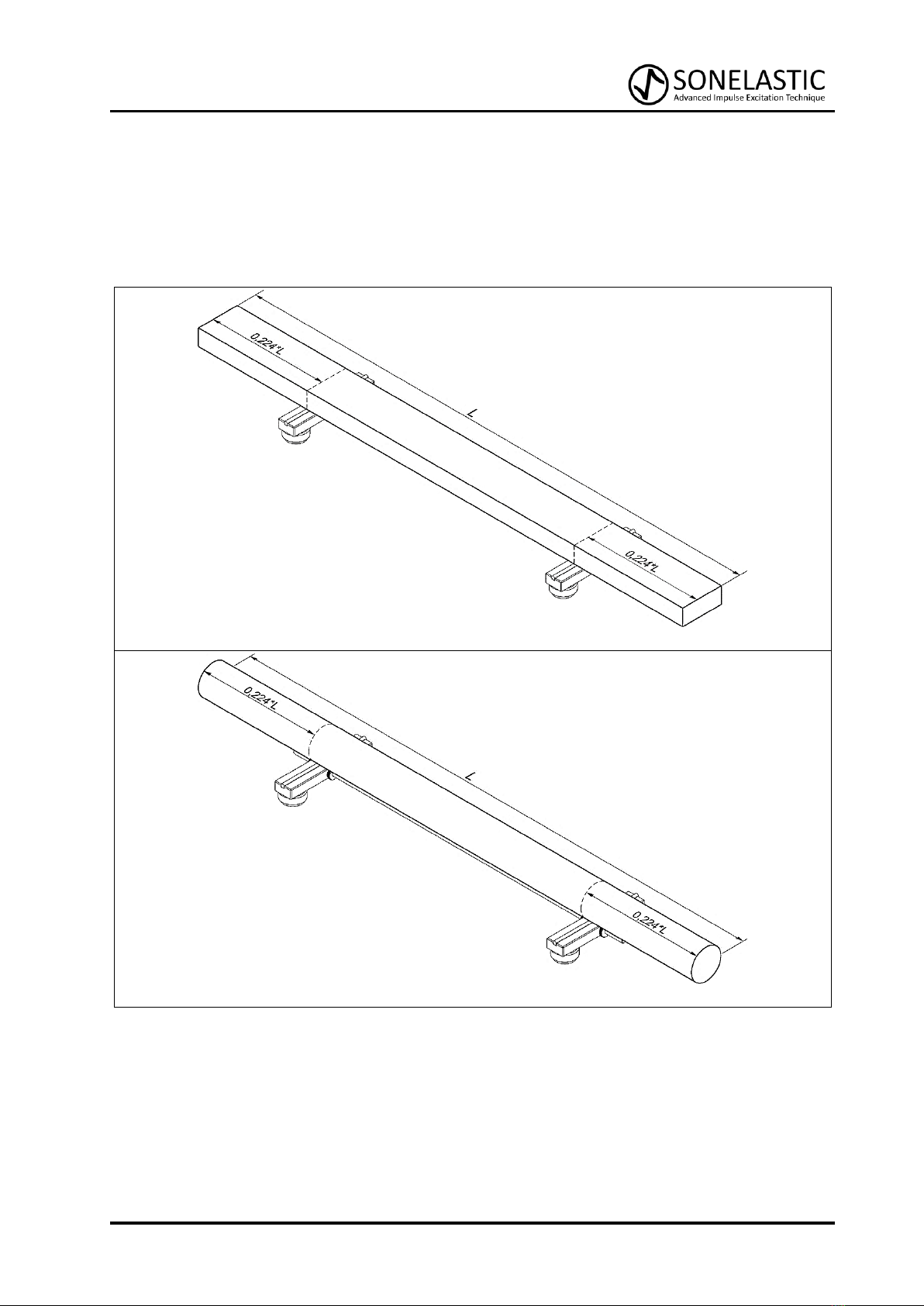
The specimen should be symmetrically supported and placed over the supporting blocks, with
these resting at a distance of 0.224 L from the specimen ends (L is the length of the
specimen). For instance, if a specimen’s length (L) is 1,000 mm, the supporting blocks should
be positioned at a distance of 224 mm from each end. The positions of 0.224 L correspond to
the nodal lines of the flexural vibration mode.
Rectangular bar
Cylinder
The corresponding distance calculation of 0.224 L is automatically generated and informed by
Sonelastic® Software. Markings on the specimen are generally done by using a pencil and a
ruler or caliper ruler.
Table des matières
Autres manuels Sonelastic Support et étagère

Manuels Support et étagère populaires d'autres marques

Salamander
Salamander Acadia AC/W/L400/WH Manuel utilisateur

Fohhn
Fohhn VAT-09 Guide de l'utilisateur

ricoo
ricoo FS0522 Manuel utilisateur

AMSOIL
AMSOIL BMK-22 Guide rapide

Kargo Master
Kargo Master 48220 Manuel utilisateur

Milestone AV Technologies
Milestone AV Technologies SIMPLICITY SLF2 Manuel utilisateur


