
Sky Country MUSCAT-3 Manuel utilisateur

19
Content
Technical data 20
Risers 21
Pre-ight check 21
Launching 22
In Flight Characteristics 22
Speed control 22
Turn control 23
Using accelerator 23
Descent Techniques 23
Big Ears 23
B-stall 24
Spiral dive 24
Flying in turbulence 24
Landing 25
Deations 25
Asymmetric collapse 25
Symmetric front collapse 25
Deep stall (parachuting) 25
Full stall 26
Asymmetrical stall 26
Self-rotation 26
Cravat 26
In ight damage 26
Packing Your glider 27
General Glider Care 27
Warrantee and Wing Repairs 28
List of materials. 29
Glider overview 30
Muscat-3 S line plan 32
Muscat-3 M line plan 34
Muscat-3 L line plan 36
20
Thank you for choosing SC Muscat-3! This manual will help you
to get maximum information about your glider. This is informa-
tion about the design of the Muscat-3, advice how to use it best
and how to care for it to ensure it has a long life. The manual also
includes technical specications and line plans. We hope that the
Muscat-3 will give you a lot of wonderful ying hours.
MUSCAT-3
Warning! Paragliding is a high risk activity. We strongly recommend to learn para-
gliding only in certied schools and to choose only the equipment which is corre-
spondent to Your ying skills.
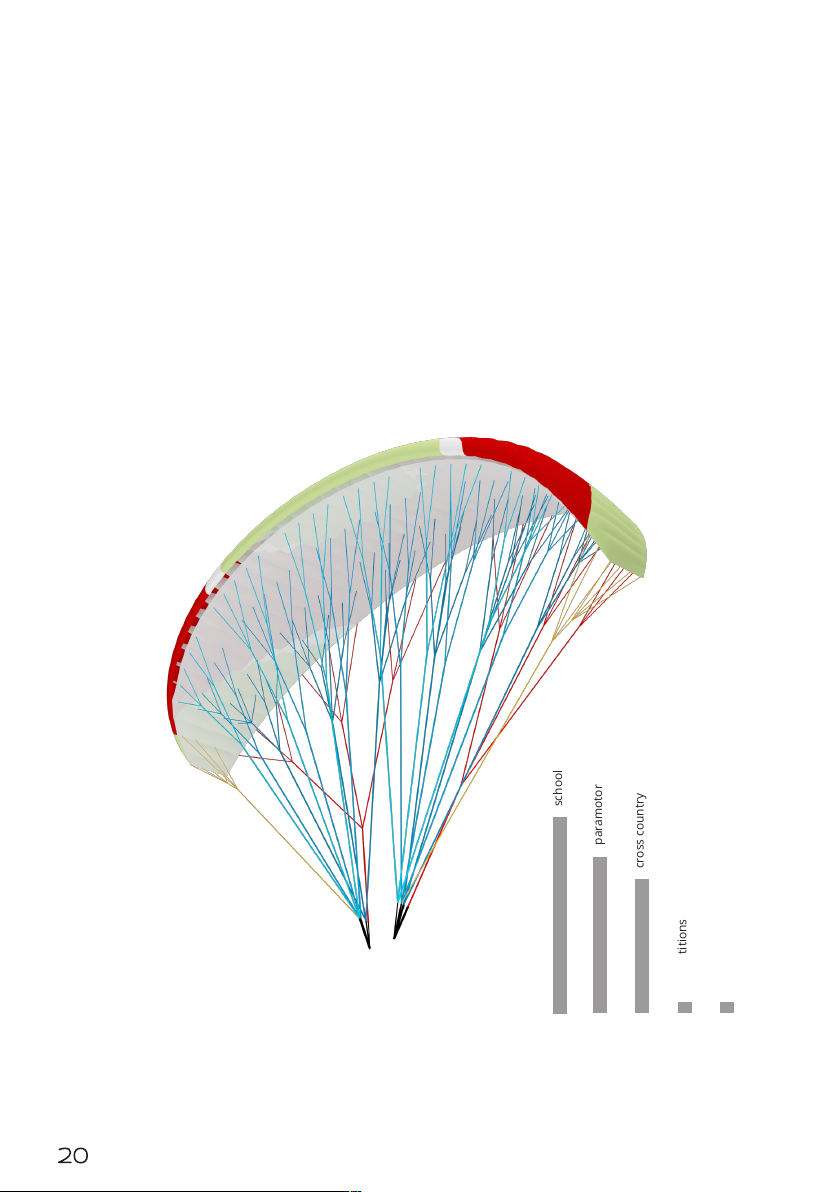
Muscat-3 is suited for all pilots, including pilots under all levels of
training. Muscat-3-S,M and L are planned to be EN “A” certied.
school
paramotor
cross country
competitions
acro

21
Technical data
The total weight in ight is equal to the weight of the pilot and all
the equipment including the wing. Usually - pilot weight + 15...17 kg.
You can nd list of materials at the end of that manual.
Materials
size XS S M L XL XXL
scale 0,923 0,962 1 1,036 1,072 1,11
wing area, sq.m 23 25 27 29 31 33
span, m 10,52 10,97 11,4 11,81 12,2 12,65
a/r 4,8
projected area,
sq.m
19,34 21,00 22,7 24,36 26,09 27,96
projected span,
m
8,12 8,46 8,8 9,12 9,43 9,77
projected a/r 3,39
root chord, m 2,68 2,79 2,9 3,0 3,11 3,22
tip chord, m 0,623 0,650 0,675 0,7 0,72 0,75
total line
length, m
285 297 309 320 331 343
weight of the
glider, kg
5,0 5,2 5,5 5,8 6,2 6,6
cells 39
Vmin, km/h 23
Vmax, km/h 50
weight in ight,
kg
60-80 70-90 80-
100
95-
120
110-
130
115-
145
EN -A* A* A* - -

22
Risers
Muscat-3 has the risers scheme A2A’1B4C3 (4 risers).
The risers are equipped with accelerator, that increases the speed
range of the glider. Accelerator travel is 12 cm for S, M and L sizes.
Muscat-3 does not have trimmers and any other adjustable or re-
movable or variable device.
You can nd risers drawings at the end of this manual.
Pre-flight check
- Lines are clear and leading edge is open
- Karabiners and maillons are tight
- All harness buckles are closed
- Helmet is on
- Check reserve parachute
- Wind direction is perpendicular to the glider
- Airspace is clear
You are not allowed to change the paraglider construction except
adjusting the brake lines, because it might lead to unpredictability
in ying and make the paraglider dangerous in certain ying situa-
tions.
Warning!

23
Launching
Your Muscat-3 can take-o with both forward and reverse tech-
niques.
Use forward technique when the wind is light, or there is no wind.
Move forward and your glider will start to inate. You must main-
tain a constant pressure on the risers until the wing is overhead.
Brake it a little and launch.
Use reverse technique in light to strong winds
Pull the glider by its A-risers. When it is overhead, pull the brakes to
stop the glider, then turn and launch.
Practise ground handling a lot! It will help you feel your glider bet-
ter.
In Flight Characteristics
You can change speed by simultaneously pulling or releasing the
brakes or using accelerator. When brakes are pulled approximately
30 cm - you get minimum sink rate.
Speed control
Muscat-3 has long brake travel, light brake pressure and turns very
well. It also has high resistance to deations in turbulence.
Maximum symmetric control travel is 60 cm for S size, 70 cm for M
and L sizes.
24
In order to make Muscat-3 turn with a minimum sink and radius
while pulling the internal brake you should pull very slightly the ex-
ternal one too. Use weightshift to decrease the spiral radius. If the
thermal ow is narrow and strong, increase the tilt and the rotation
speed by releasing the external brake.
When you need to turn fast, you should swing Muscat-3 in the op-
posite direction and then pull as hard as needed the internal brake.
Turn control
Descent Techniques
Big Ears
While holding the brakes you should symmetrically pull the А’- ris-
ers. For directional control of the glider use the weight shift. When
you do big ears, the horizontal speed increases slightly. In order to
return to normal ight, you should release the A-risers and pull the
brakes a few times, if necessary.
Spiraling is not permitted with big ears, because of the increased
load on the remaining lines so that they can be physically de-
formed.
In Flight Characteristics
Muscat-3 reaches its maximum speed when you pull the accelera-
tor to its maximum and release the brakes. Use this mode for long-
distance ying and in strong winds. When using accelerator you will
have a maximum speed of about 50 km/h.
Remember, that when you use the accelerator, your glider is more
likely to collapse. We do not recommend to use accelerator, if your
altitude is less, than 100m. If collapse occurs, release accelerator
immediately.
Using accelerator

25
Flying in turbulence
You can help your glider to avoid dierent collapses in turbulence
- you must y actively for it. When the glider pitches forward - use
the brakes to slow it, if it goes back - release brakes. These move-
ments can be symmetric or asymmetric.
Let us remind you once again that you should be very careful
choosing the weather to y.
Descent Techniques
Spiral dive
When you hold either brake down for a long time, the glider goes
into a fast sharp turn and loses a lot of height. The rotation axis can
be somewhere between the pilot and the wing. The sink rate could
be more than 15 m/sec. To get out of the spiral dive you must re-
lease the inner brake. Mind that Muscat-3 may take one more turn
after releasing the brake.
While spiral diving, the pilot experiences considerable overload up
to 3 – 4g, so you can lose orientation.
B-stall
When you need to lose height quickly because of the sudden wors-
ening of the weather, risk of entering a cloud, etc, we recommend
you B-stall.
Holding the brakes you take B-risers near the connectors. Forcefully
but not suddenly, pull down the risers 25-30 cm and hold them as
long as necessary. The wing gets a fold along the entire B-row and
sinks at a rate of 8-10 m/sec. In order to return to normal ight sim-
ply release the B-risers and your Muscat-3 will get out of the B-stall
with a small front dive. You can use the brakes once the horizontal
speed is gained. Muscat-3 does not normally tend to go into deep
stall once the B-risers are released. If this does happen (possibly for
bad adjustment or under-loading), you should either pull the B-
risers or swing the wing with the brakes.
26
Landing
In small winds, when you have 1-2 meters to the ground, you
should pull the brakes gently to your arms’ full length, so that you
put your Muscat-3 in stall at a height of about 0.2 -- 0.5 m and the
horizontal speed is zero.
In strong winds you must land facing the wind. If necessary you can
fold the ears. As you approach the ground, you must take В-risers
while holding the brakes. As soon as you hit the ground, you must
turn towards the glider and pull B-risers running towards the wing.
If the wing is opping about a meter above the ground, release the
B-risers and pull the brakes hard to your arms length. We do not
recommend you to use the brakes in the strong wind, as the wing
could catch the wind and pull the pilot.
Do not let the glider overtake you and hit the ground with its front
edge, which leads to increased pressure in the wing and may dam-
age it.
Deflations
Asymmetric collapse
Every paraglider may collapse in turbulent conditions.
Asymmetric collapses can be controlled by weight-shifting away
from the collapse and applying a small amount of brake to control
the ight direction. At the same time you should use the brake to
re-inate the canopy.
Remember that the deated glider has higher stall speed and
smaller brake travel. That is why you should be careful not to pull
the brake too hard to avoid stall.
Symmetric front collapse
Muscat-3 comes out of symmetrical front collapse by itself. You can
pull the brakes about a 20 cm to speed the re-ination.
Deep stall (parachuting)
To get out of this mode you must pull А – risers or swing the wing
by pulling and releasing the brakes (preferably the rst one).

27
Deflations
Asymmetrical stall
It can take place when you pull one of the brakes too hard, or while
spiraling at a small speed in turbulence you increase the angle of
attack. Rotation in the asymmetrical stall is called negative spiral.
This is one of the most dangerous ying situations. In order to get
out of asymmetrical stall, just release the brakes. There may follow
side thrust forward with a following wing collapse.
Cravat
If the collapsed part of the canopy is entangled in the lines, you
must try to release it by pulling the ear-line. If you cannot do it and
the rotation is increasing, you must use the parachute.
Estimate the damage. If a brake has untied - no problem as Mus-
cat-3 can be steered well by weight shift and pulling the back risers.
Even if the damage allows for a sustainable controlled ight, you
should land as soon as possible. If normal ight is impossible, you
must use the parachute.
In flight damage
Self-rotation
Increasing rotation usually takes place when the pilot has not react-
ed properly to the asymmetric collapse of the accelerated paraglid-
er. Try to slow down the rotation by counter-shifting your weight
in the harness and pulling the outer brake. If the self-rotation is
increasing, drop the rescue parachute quickly in the direction of the
rotation. This mode can also take place when you make extreme
turns of the overloaded paraglider.
Full stall
Full stall happens when you pull both brakes too hard. To return to
the normal ight you must release both brakes. After this usually
comes a front dive with a possible front deation.
Just because Muscat-3 warns the pilot about stalling by increasing
the brake load, it is highly unlikely for you to enter it unexpectedly.
Table des matières
Autres manuels Sky Country Aéronef

Sky Country
Sky Country Mystic-3 Manuel utilisateur

Sky Country
Sky Country Scout Trike Manuel utilisateur

Sky Country
Sky Country Discovery-5 Manuel utilisateur

Sky Country
Sky Country Escort-2 Manuel utilisateur

Sky Country
Sky Country DISCOVERY 3 Manuel utilisateur

Sky Country
Sky Country Alasca-2 Manuel utilisateur

Sky Country
Sky Country Scorpion-3 26 Manuel utilisateur


