Sigicom INFRA C12 Manuel utilisateur

Manual
Copyright © Sigicom AB 2019 Art.no. ML089-04212-0En
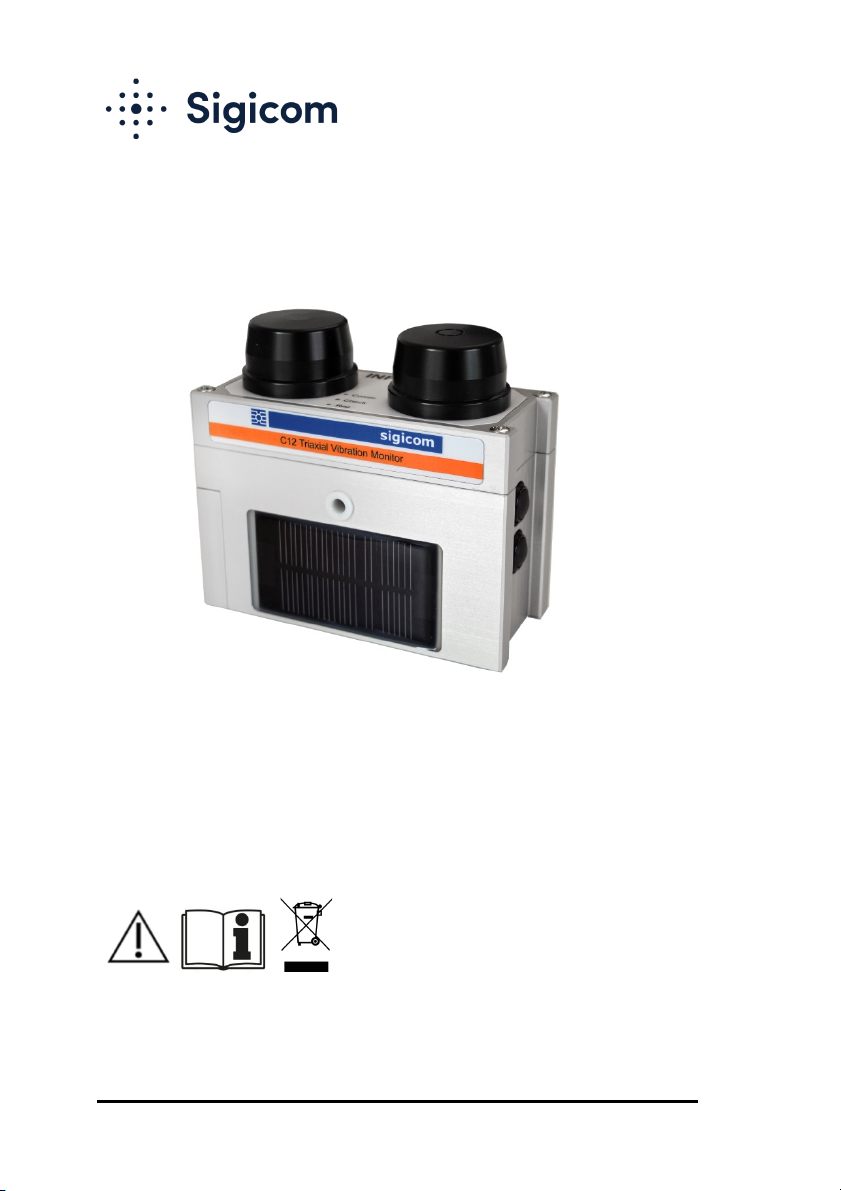
INFRA C12
Wireless Triaxial Vibration Monitor
Art no. 080-04212-0 (2G and 3G versions)
(3G version is marked on front- and right-side of unit)
Manual ver. H
Valid for firmware version 1.5.2
Read instructions on safety, electrical equipment waste and battery recycling before
operating this product.

Copyright © Sigicom AB 2019
2
Developed and manufactured by:
Sigicom AB
Glasfibergatan 8, floor 3
SE – 125 45 Älvsjö, Sweden
Support: support@sigicom.com
IMPORTANT SAFETY
INSTRUCTIONS
– read this before use.
Operating conditions and limitations:
• This equipment is designed for outdoor use and wet locations
but must not be submerged.
• Safe temperature range is -30 to +50 ºC
(-22 to +122 ºF).
• Range for full functionality is -20 to +50 ºC
(-4 to +122 ºF).
• This equipment includes radio transmitters. Its antennas should
be installed away from operator or third-party persons to be safe.
Recommended minimum distance is 1meter (3 ft.).
• Only use antennas provided or recommended by Sigicom.
• Before installing the equipment, make sure there are no
restrictions for the use of radio transmitters at the intended site.
• Do not use the equipment in presence of flammable fumes or
gases, or in explosive atmospheres.

Copyright © Sigicom AB 2019
3
IMPORTANT SAFETY
INSTRUCTIONS
– read this before use.
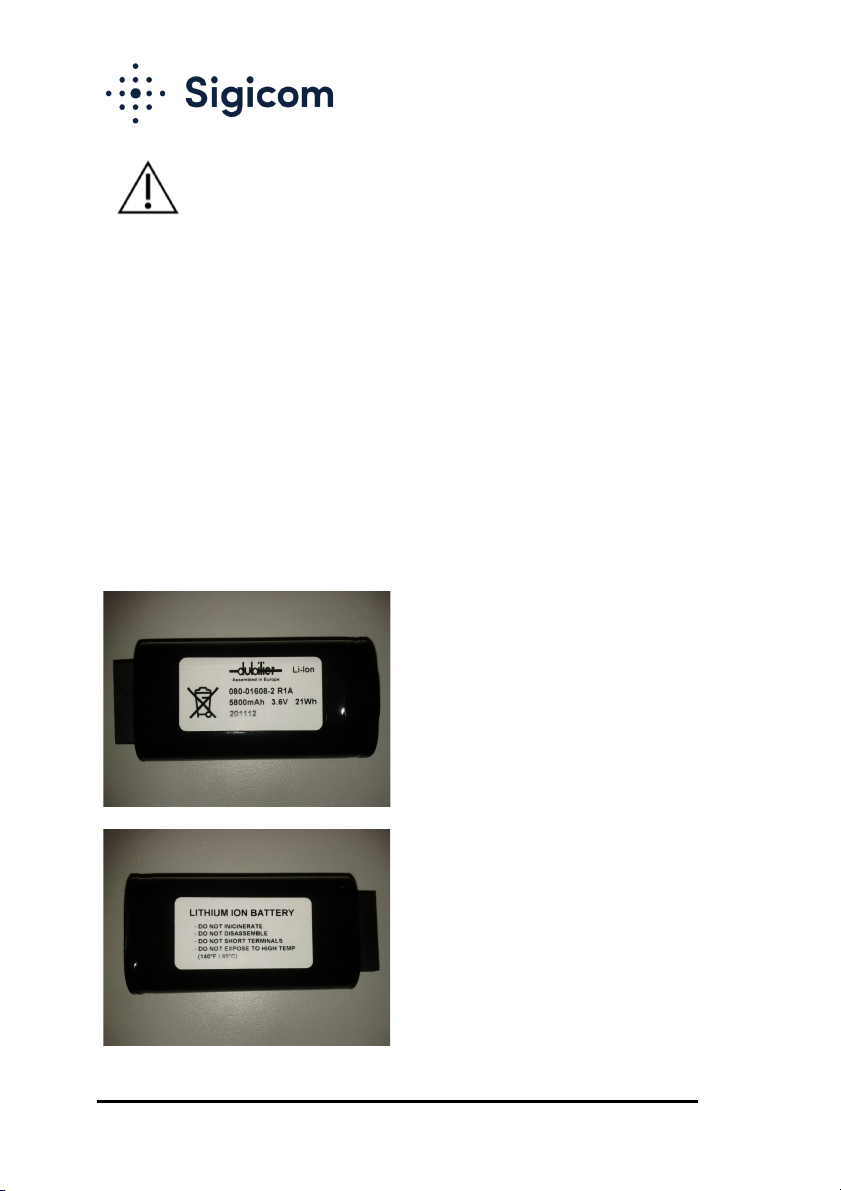
Li-Ion batteries:
• Only use batteries and chargers provided or recommended by
Sigicom, see Accessories
• Under no circumstances, a charger which can supply more than
4.2V or 1.3A may be used for loose batteries.
• A charger connected to the C12 must not be able to supply more
than 15V and 1A.
• Replacement of the batteries may only be done by persons who
have read this manual very carefully and registered this to
Sigicom AB (see the registration template in Appendix F.
Operator’s Registration Template)
• Never keep the batteries at temperatures above 50ºC (122ºF).
• Transportation of Lithium Ion batteries by aircraft is regulated by
UN and IATA, see Appendix C.
• Transportation by road or railway is exempt from dangerous
goods transportation regulations. Still, handling and packaging
needs to be handled carefully, otherwise severe injury may
happen.
• If damaged, the batteries should be individually embedded into
sand in a sturdy plastic drum container during transport. It is also
recommended to affix a “Lithium Ion” label with an additional
text: ‘Damaged batteries’ on the package.
• Never incinerate, disassemble or expose the batteries for water.
• If the terminals of the battery are shorted, the battery may
become very hot and permanently damaged.
• A worn-out battery, a battery with cracks or with signs of
swelling or leakage, should be replaced immediately.
Note! Damaged or worn out batteries are prohibited in air freight.
• Prepare your warehouse and charging sites according to
Appendix D and Appendix E.
• Charge the batteries in a well-ventilated room, away from
flammable material, open fire and electric sparks.
• If the battery case is penetrated, it may burn with open fire.

Copyright © Sigicom AB 2019
4
IMPORTANT SAFETY
INSTRUCTIONS
– read this before use.
Removal of Li-Ion batteries from the equipment:
• Remove the lid at the left side of the equipment using a Torx T20
driver.
• Turn the lock lever to one side to release the first battery and pull
out the battery.
• Turn the lock lever to the other side to release the second battery
and pull out the battery.
• The lock lever must be reset in its middle position for the lid to
fit.
For information about transportation rules for equipment and
batteries, see Appendix C.

Copyright © Sigicom AB 2019
5
IMPORTANT SAFETY
INSTRUCTIONS
– read this before use.
US customers:
• Contains FCC ID QIPMC55i (2G version)
• Contains FCC ID N7NHL8548 (3G version)
Canadian customers:
• Contains IC 267W-MC55i (2G version)
• Contains IC 2417C-HL8548 (3G version)

Copyright © Sigicom AB 2019
6
This equipment falls under the Waste Electrical and Electronic Equipment
Directive (WEEE directive) 2012/19/EU, category 9: monitoring and
control instruments:
• Scrapped equipment should be sent back to the manufacturer of
the equipment (Sigicom AB) for proper handling according to the
WEEE directive.
• Sigicom uses a certified local partner for recycling of scrapped
equipment.
The batteries used in this equipment falls under the Battery Directive
2006/66/EC:
• When the equipment is sold to customers in the European Union,
except Sweden, the customer is the importer of the battery. The
customer needs to follow the regulations in its own country or
send the battery/equipment back to the manufacturer of the
equipment (Sigicom AB) for proper disposal.
• Swedish customers are allowed to recycle the battery in the
national battery collection system.
• Users outside the EU may send the batteries back to the
manufacturer of the equipment (Sigicom AB) for proper disposal.

Copyright © Sigicom AB 2019
7
Table of Contents
1. Introduction ......................................................................................... 9
1.1. INFRA Monitoring System ....................................................... 9
1.2. INFRA C12 Triaxial Vibration Monitor ................................... 9
1.3. Automatic Data Transfer through GSM/Internet .................... 10
1.4. Unpacking and Parts Identification ......................................... 10
2. The Enclosure ................................................................................... 11
2.1. Buttons .................................................................................... 11
2.2. LEDs ....................................................................................... 12
2.2.1. Comm LED (yellow/orange) .............................................. 12
2.2.2. Check LED (white or red) .................................................. 13
2.2.3. Reg LED (green) ................................................................. 13
2.3. Antennas .................................................................................. 14
2.4. Battery Module ........................................................................ 14
2.5. Solar Panel .............................................................................. 15
2.6. External Power Port ................................................................ 15
2.7. USB Connector (Mini-B Type) ............................................... 16
2.8. CompactFlash .......................................................................... 16
2.9. SIM Card ................................................................................. 18
3. Measuring Parts of the System ......................................................... 19
3.1. Measuring Hardware ............................................................... 19
3.1.1. Vibration Sensor ................................................................. 19
3.1.2. Analog Electronics .............................................................. 19
3.1.3. Analog-Digital Conversion ................................................. 19
3.1.4. Digital Signal Processing .................................................... 19
3.2. Measuring Logic ..................................................................... 20
3.2.1. Measurement Standards ...................................................... 20
3.2.2. Interval Measurements ........................................................ 20
3.2.3. Frequency Detection, Weighting and Trigger filter ............ 21
3.2.4. Transient Recording ............................................................ 22
3.2.5. Overload Handling .............................................................. 22
3.3. File Types ................................................................................ 23
3.3.1. Event Files (.log) ................................................................. 24
3.3.2. Interval Files (.interval) ...................................................... 24
3.3.3. Transient Files (.transient) .................................................. 25
3.4. Data Storage on CompactFlash ............................................... 26
4. Configuration and Installation .......................................................... 27
4.1. Configurations and Settings .................................................... 27
4.1.1. Data Server Connection Schedule ...................................... 27

Copyright © Sigicom AB 2019
8
4.1.2. GSM Settings ...................................................................... 27
4.1.3. Running without Data Transfer .......................................... 28
4.1.4. Data Server Settings ............................................................ 28
4.1.5. Project ID Text .................................................................... 28
4.1.6. Node ID Text ...................................................................... 28
4.1.7. SMS Settings ....................................................................... 29
4.1.8. INFRA Net Messages ......................................................... 30
4.1.9. INFRA Net Live ................................................................. 30
4.1.10. Factory Default Settings ..................................................... 31
4.2. Mounting ................................................................................. 31
5. Operation .......................................................................................... 32
5.1. Startup ..................................................................................... 32
5.2. Start Monitoring ...................................................................... 32
5.2.1. Sensor Test .......................................................................... 33
5.3. Stop Monitoring ...................................................................... 34
5.4. Data Server Connection .......................................................... 34
5.4.1. Automatic Data Server Connection .................................... 34
5.4.2. Manual Data Server Connection ......................................... 35
5.5. Instrument Power Off .............................................................. 35
5.6. Power Lost .............................................................................. 36
5.7. Remote Control ....................................................................... 36
6. Other Functions ................................................................................. 38
6.1. Inhibit Sending of Transient Files ........................................... 38
6.2. Time Synchronization through Internet .................................. 38
6.3. Daylight Saving Time ............................................................. 39
6.4. Skip File Archive .................................................................... 40
7. Technical Specifications ................................................................... 41
8. Accessories ....................................................................................... 42
9. Maintenance and Calibration ............................................................ 43
10. Contact and Support .......................................................................... 44
Battery Voltage Limits ....................................................... 45
Configuration File Reference List ...................................... 46
Li-Ion battery transport. ..................................................... 47
Safe Handling of Li-Ion Batteries ...................................... 48
In Case of Li-Ion Battery Fire ............................................ 49
Operator’s Registration Template ...................................... 50
Measurement Standards ..................................................... 51
Tables of Weighted Standards ........................................... 66
The use of Weighting Standard .......................................... 71
The use of US standard ISEE Seismograph (S51 and S52)75

Copyright © Sigicom AB 2019
9
1. Introduction
1.1. INFRA Monitoring System
The traditional INFRA system is based on a model with a central data
logger unit and different types of digital sensor nodes connected to the
data logger via a digital bus cable.
The data logger collects measuring data from the nodes, stores these data
as files on a CompactFlash and also sends these files over GSM/Internet
to a data server. The data files can then be used by applications such as
INFRA Net for presentation of reports etc.
The original concept with separate data logger and sensor nodes should be
kept in mind to fully understand the various aspects of the C12 instrument
as described in this manual.
1.2. INFRA C12 Triaxial Vibration Monitor
The INFRA C12 is a complete wireless vibration monitor measuring in
three directions. It consists of a tri-axial vibration sensor, together with
measuring electronics, digital signal processing, CompactFlash, quad band
GSM/GPRS modem, antenna and batteries.
The vibration sensor is divided in three nodes named:
• C12V (vertical)
• C12L (longitudinal)
• C12T (transversal)
all with separate serial numbers.
Generated data files are sent in the same file format as used by the
traditional INFRA system, and they can be used with ordinary INFRA
applications such as INFRA Net.
The INFRA C12 concept presupposes the presence of INFRA Net to
control the instrument, because C12 has no graphical display or menu
interface.

Copyright © Sigicom AB 2019
10
1.3. Automatic Data Transfer through GSM/Internet
All files, which are stored on the CompactFlash, are normally sent to a
data server through GSM/Internet when:
• Monitoring is started or stopped.
• A trigger event has occurred.
• An error event has occurred, e.g. low battery.
• Manual connection is performed by the operator.
• Time has reached a scheduled time for data server connection.
The files are sent to a data server available through the Internet, where
INFRA Net can access them.
Note! 3G version can be identified by the product label and is 2G
compatible. It does not communicate faster than the 2G version.
1.4. Unpacking and Parts Identification
Your INFRA C12 Triaxial Vibration Monitor has been shipped in
protective packaging. Please keep this and use it when transporting your
equipment.
Verify the package content with the following list:
• C12 Triaxial Vibration Monitor instrument.
• Foam (which protects your C12 from shock during
transportation).
• CompactFlash inserted in the C12.
• Two (2) batteries, either inserted in C12 or separate.
Note! Because of shipping regulations, batteries may be
charged below 30% state of charge at delivery.
• Calibration document.
Any damage or shortage should be reported immediately to Sigicom.
Keep record of the instrument’s serial number. You will be asked to give
this number in any C12 related communication you may have with
Sigicom.
Ce manuel convient aux modèles suivants
2
Table des matières
Autres manuels Sigicom Moniteur