5
Changes to UL 325 ED. 6th for Gate Operators
Starting on Jan. 12, 2016, new UL 325 changes take effect, bringing a series of new mandates for the gate operator
industry. Here’s a quick guide to the key modifications.
Entrapment-Protection Devices. Gate operators are required to have a minimum of two independent means of
entrapment protection where the risk of entrapment or obstruction exists. A manufacturer can use two inherent-type
systems, two external-type systems, or an inherent and an external system to meet the requirement. However, the
same type of device cannot be used for both means of protection.
Monitoring Required. An external non-contact sensor or contact sensor may be used as a means of entrapment
protection. However, the sensor must be monitored once every cycle for (1) the correct connection to the operator and
(2) the correct operation of the sensor.
If the device is not present, not functioning, or is shorted, then the gate operator can only be operated by constant
pressure on the control device. Portable wireless controls will not function in this case.
Entrapment Risk Identification. As in the past, it’s up to the installer to examine the installation and determine where
a risk of entrapment or obstruction exists. Manufacturers are required to provide instructions for the placement of
external devices, but they give only examples of suggested entrapment protection in their installation manuals. If the
installer identifies a risk of entrapment or obstruction, at least two independent means of entrapment protection are
required.
Terminology Change. The terms “primary” and “secondary” have been removed in the description of entrapment
protection devices. This was done to emphasize that all entrapment protection devices are equally important.
The End of Type E. Type E (audible alarm) devices can no longer be used for entrapment protection. This change
was made because the Type E device is really a warning device, not an entrapment-protection device. Also, all gate
operator classes are now required to have an audio alarm that sounds when two successive obstructions are
encountered via a contact-type system.
Access Control Location for Emergency Use. An exception has been added in the manufacturer’s instructional
requirements for the location of controls that operate the gate.
The instructional requirements state that these controls must be at least 6' away from any moving part of the gate. In
the new exception, “Emergency access controls only accessible by authorized personnel (e.g., fire, police, EMS) may
be placed at any location in the line-of-sight of the gate.”
Barrier-Arm Operator Exception. An exception has changed for barrier-arm gate operators requiring entrapment
protection. The previous exception stated that a barrier-arm operator did not require entrapment protection if the arm
did not move toward a rigid object closer than 2'. The distance has been reduced to 16" so it more closely aligns with
the industry-defined entrapment protection provisions in ASTM F2200.
Gate Operator Class II and Class III Definitions. The definitions for installation classes for gate operators were
modified. Class II now includes commercial locations accessible to the general public. Class III was refined to specify
industrial locations not accessible to the general public. These changes, while seemingly minor, may affect which gate
operator is suitable for a particular installation location.
1.
2.
3.
4.
5.
6.
7.
8.
International registered trademark n. 2.777.971
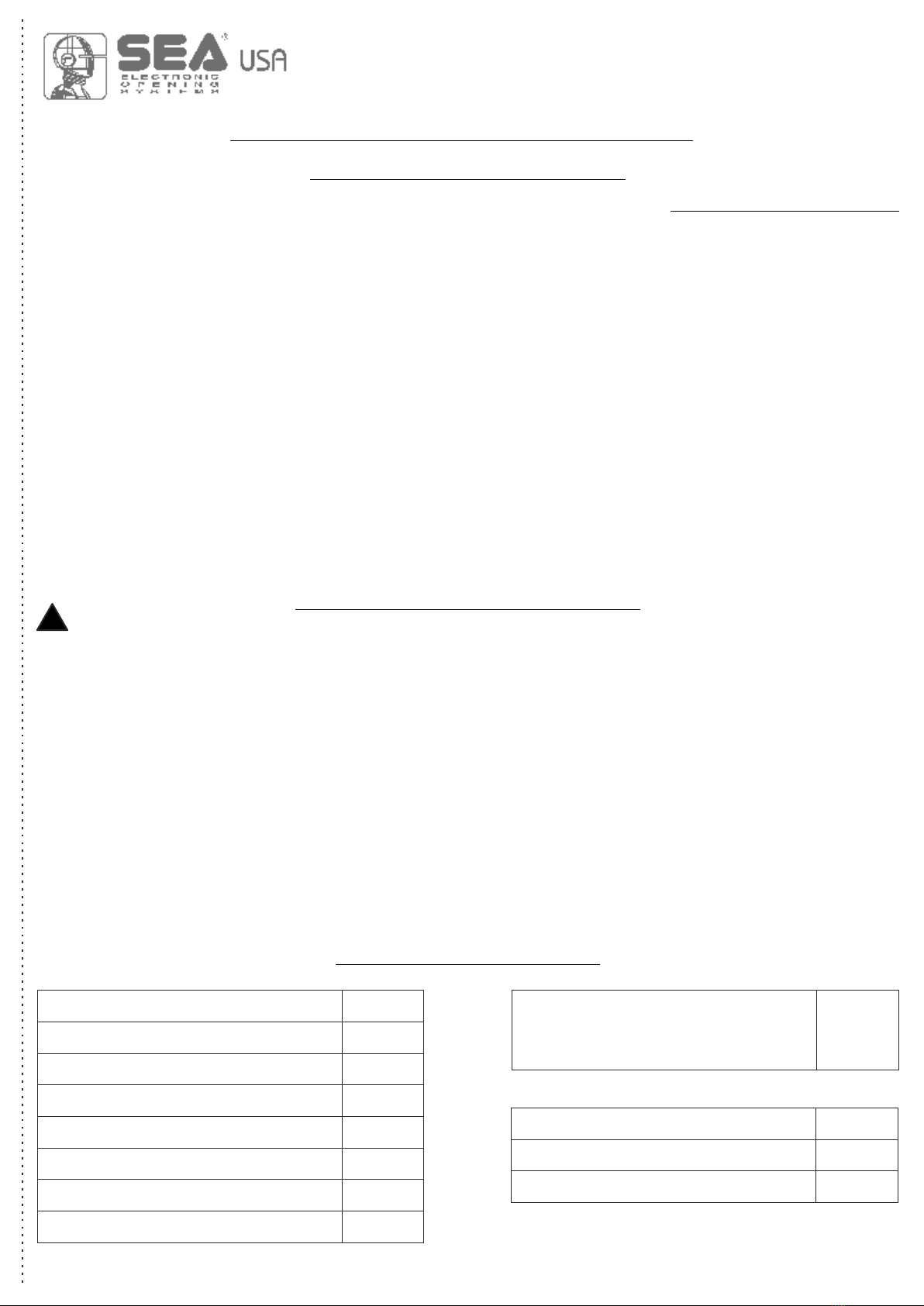
UL 325 ED. 6th ENTRAPMENT PROTECTION REQUIREMENTS
This vehicular gate operator must be installed with at least two independent entrapment protection means
as specified in the table below.
HORIZONTAL SLIDE AND SWING GATE OPERATOR
GATE OPERATOR ENTRAPMENT PROTECTION TYPES
TYPE A
TYPE B1
TYPE B2
TYPE C
Inherent (built into the operator) entrapment
protection system
Non-contact sensors such as photoelectric sensors
Contact sensors such as edge sensors
Inherent force limiting, inherent adjustable clutch or
inherent pressure relief device
The same type of device shall
not be used for both entrapment
protection means. Use of a
single device to cover both the
opening and closing directions
is in accordance with the
requirement; however, a single
device is not required to cover
both directions. Tice installer is
required to install entrapment
protection devices in each
entrapment zone.