Supplied By www.heating spares.co Tel. 0161 620 6677
Remeha P 500
6
5.1.4 Water treatment
The system should be fi lled with mains cold water (for
the UK this will usually have a pH of between 7 and 8).
Pressurised installations with a boiler/system content
ratio of 1:10 or less should not require water treatment,
provided that the following conditions apply:
1. The system is fl ushed thoroughly to remove all fl uxes
and debris and then fi lled completely once.
2. Make up water is limited to 5 per annum.
3. The hardness of the water does not exceed 360 ppm
(20°D).
All scale deposits will reduce the effi ciency of the boiler
and should be prevented. However provided the above
is complied with any scale produced will not be too
detrimental to the boiler effi ciency and will not reduce
the anticipated life expectancy of the boiler.
NOTE: Scale deposits in excess of 3 to 5 mm will
reduce boiler effi ciency and greatly increase the risk of
premature casting failure.
As most systems contain a variety of metals which can
react with each other to cause corrosion. It is consid-
ered good practice to provide some form of water treat-
ment (especially in open vented systems) in order to
prevent or reduce the following:
- Metallic corrosion;
- Formation of scale and sludge;
- Microbiological contamination;
- Chemical changes in the untreated system water.
Suitable chemicals and their use should be discussed
with a specialist water treatment company prior to car-
rying out any work. The specifi cation of the system
and manufacturers recommendations must be taken into
account, along with the age and condition of the system.
New systems should be fl ushed thoroughly to remove all
traces of fl ux, debris, grease and metal swarf generated
during installation. Care to be taken with old systems
to ensure any black metallic iron oxide sludge and other
corrosive residues are removed, again by thoroughly
fl ushing, ensuring that the system is drained completely
from all low points.
NOTE: Please ensure that the new boiler plant is not
in circuit when the fl ushing takes place, especially if
cleansing chemicals are used to assist the process.
Under no circumstances is the boiler to be operated
with cleaning chemicals in the system.
To summarise:
- Minimise water loss;
- Prevent pumping over in open vented systems;
- Provide adequate air venting at all high points;
- Keep pH level between 7 - 9 when using additives;
- Maximum chlorine content of 200 mg/l;
- Take advice on the suitability of inhibitors.
5.2 Economisers
ECO’s can be delivered upon request (for natural gas
only). For specifi cations please refer to Technical infor-
mation ECO 13/14/15.
5.3 Flue gas discharge
For the discharge of the fl ue gases, chimney draught is
not required.
Tests have shown that very good combustion results are
obtained with zero draught at the boiler outlet.
5.4 Noise production
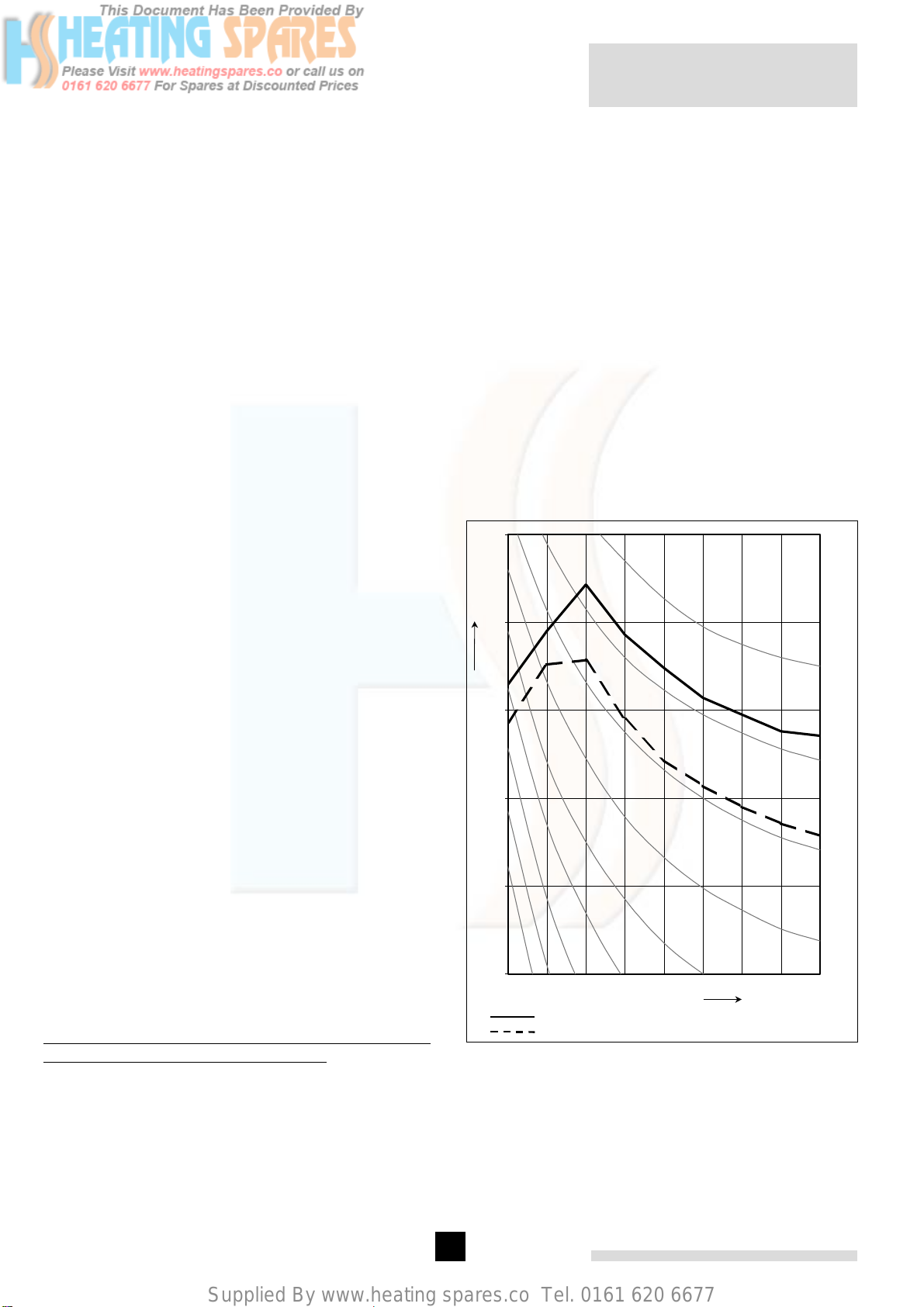
The noise level taken at a distance of 1 m around the
boiler is approximately 75 to 90 dBA. The noise level
at the chimney outlet will, depending on load, type of
burner and chimney situation, vary from 75 to 90 dBA,
measured at a distance of 1 m from the outlet. If
this noise production gives rise to problems in the imme-
diate vicinity, then noise reducing or absorbing measu-
res should be taken.
50
60
70
80
90
100
31,5 63 125 250 500 1000 2000 4000 8000
NR 60
NR 70
NR 80
NR 90
frequency (Hz)
dB re 2x10⁻⁵ N/m2
full load
part load
9
Fig. 03 Noise level readings without burner silencer
The values that have been taken are averages obtained
from various measurements carried out at a distance of
approximately 1 m around the boiler and at a height of
approximately 1 m.