
Optica B-20 Manuel utilisateur

B-20 & B-20Solar
OPERATION MANUAL
GUIDA UTENTE
MANUAL DE INSTRUCCIONES
MANUEL D’INSTRUCTIONS
BEDIENUNGSANLEITUNG

Page 2
INDEX
1.0 DESCRIPTION page 4
2.0 INTRODUCTION page 6
3.0 UNPACKING AND ASSEMBLY page 6
4.0 USING THE MICROSCOPE page 6
5.0 MAINTENANCE page 7
6.0 TECHNICAL SPECIFICATIONS page 8
7.0 RECYCLING AND RECOVERY page 8

Page 3
This microscope is a scientic precision instrument designed to last for many years with a minimum of main-
tenance. It is built to high optical and mechanical standards and to withstand daily use.
Optika reminds you that this manual contains important information on safety and maintenance, and that it
must therefore be made accessible to the instrument users.
Optika declines any responsibility deriving from instrument uses that do not comply with this ma-nual.
Safety guidelines
This manual contains important information and warnings regarding safety about installation, use and
maintenance of the microscope. Please read this manual carefully before using the equipment. To
ensure safe use, the user must read and follow all instructions in this manual. OPTIKA products are
designed for safe use in normal operating conditions. The equipment and accessories described in
the manual are manufactured and tested according to industry standards for safety instrumentation
laboratory. Misuse can cause personal injury or damage to the instrument. Keep this manual at hand
close to the instrument, for an easy consultation.
Electrical safety
Before connecting the power cord to wall outlet, ensure that your mains voltage for your region corre-
sponds to the voltage supply of the instrument, and that the illuminator’s switch is in position OFF. The
user must observe the safety regulations in force in his region. The instrument is equipped with CE sa-
fety marking, in any case the user has full responsibility concerning the safe use of that instrument.
Warning/Caution symbols used in this manual
The user should be aware of safety aspects when using the instrument. Warning or hazard symbols
are shown below. These symbols are used in this manual.
The instructions on this symbol to avoid possible severe personal injuries.
Warning of use; the incorrect operation on the instrument can cause damages
to the person or instrument.
Possibility of electric shock.
Attention: high temperature surfaces. Avoid direct contact.
Technical notes or usage tips.
SAFETY GUIDELINES
Page 4
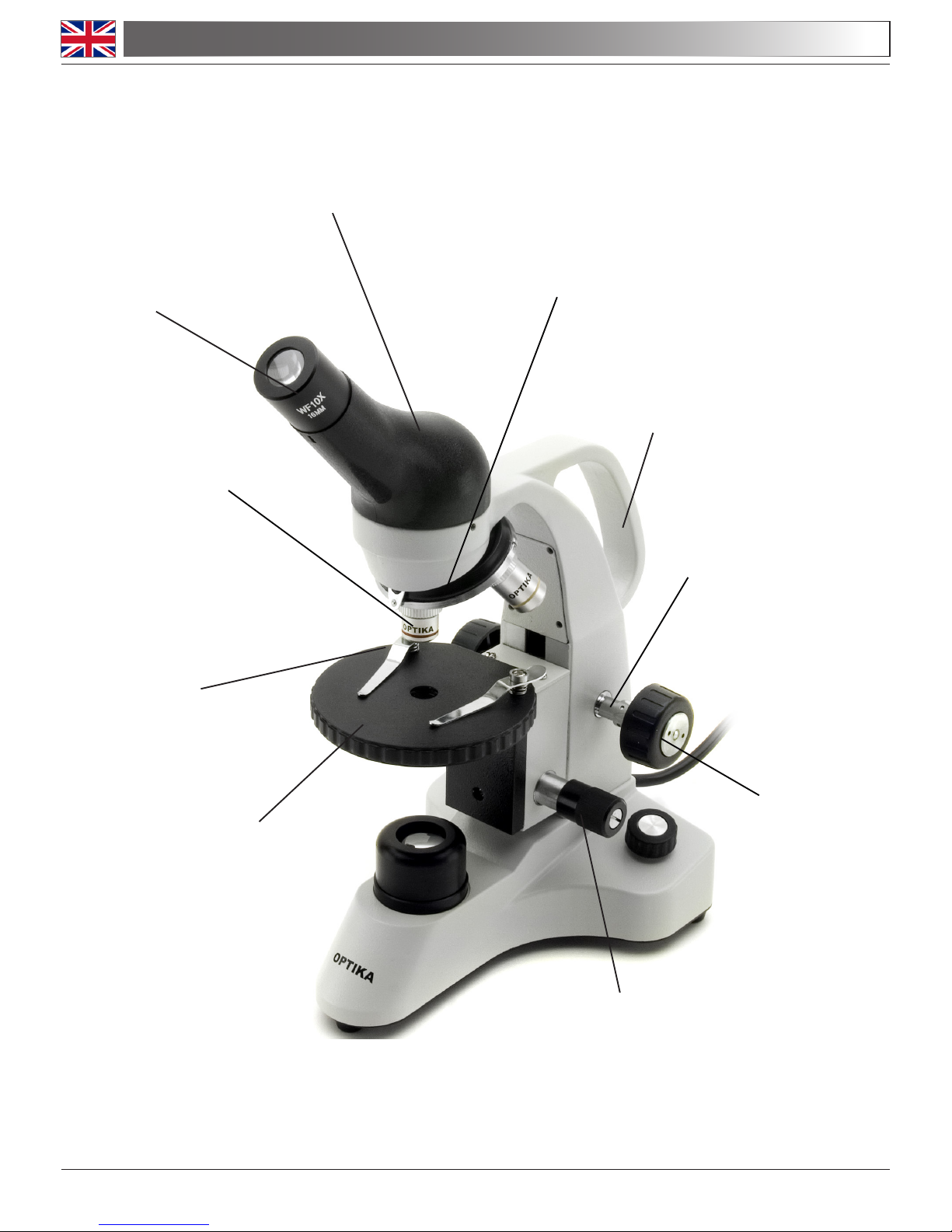
1.0 DESCRIPTION
TENSION
REGULATION
MAIN BODY
OBSERVATION
HEAD
EYEPIECE
SLIDE CLIP
MOVEABLE STAGE
FINE FOCUSING KNOB
NOSEPIECE
OBJECTIVE
B-20: FRONT VIEW
COARSE FOCUSING
KNOB

Page 5
1.0 DESCRIPTION
LED LIGHT
ILLUMINATOR
BRIGHTNESS
ADJUSTMENT KNOB
ON-OFF SWITCH
MAIN CABLE
CARRYING HANDLE
LOCK SCREW
B-20: REAR VIEW
B-20SOLAR: REAR VIEW

Page 6
This microscope is a scientic precision instrument designed to last for many years with a minimum of main-
tenance. It is built to high optical and mechanical standards and to withstand daily use.
Optika reminds you that this manual contains important information on safety and maintenance, and that it
must therefore be made accessible to the instrument users.
Optika declines any responsibility deriving from instrument uses that do not comply with this manual.
3.0 UNPACKING AND ASSEMBLY
3.1 The microscope is housed in a moulded Styrofoam container. Remove the tape from the edge of the
container and lift the top half of the container. Take some care to avoid that the optical items (objec-
tives and eyepieces) fall out and get damaged. Lift the microscope from the container and put it on a
stable desk.
3.2 Insert the eyepiece into the eye tube.
Connect the mains plug into the socket at the base
Make sure, before you turn the illumination on, that the voltage selector is set to the mains voltage for
your region.
The power cord should be used only on network sockets equipped with adequate grounding.
Contact a technician to check the state of your electrical system. If there is no need to install additional
accessories, the instrument is now ready for use. Once positioned and installed with the necessary
components, the microscope is ready to be used. Your microscope is a laboratory instrument desi-
gned to last. Handle it always carefully and avoid abrupt vibrations or shocks. Always disconnect the
power cable from the microscope when not in use for long time, while you clean it or when you perform
any maintenance.
AVOID DISASSEMBLING THE INSTRUMENT
Do not disassemble the instrument. This entails the cancellation of the warranty and may cause
malfunction.
3.3 In order to mount the Schuko plug adapter, please refer to manual B-20 on
www.optikamicroscopes.com.
4.1 Place the specimen on the stage
Turn the observation head to a comfortable position for observation. Lock the specimen slide on the
mechanical stage using the slide clip. Ensure that the specimen is centred over the stage opening by
adjusting the coaxial knobs of the stage.
4.0 USING THE MICROSCOPE
2.0 INTRODUCION

Page 7
5.1 Microscopy environment
This microscope is recommended to be used in a clean, dry and shock free environment with a tem-
perature of 0-40°C and a maximum relative humidity of 85 % (non condensing). Use a dehumidier
if needed.
5.2 To think about when and after using the microscope
• The microscope should always be kept vertically when moving it and be careful so that no
moving parts, such as the eyepieces, fall out.
• Never mishandle or impose unnecessary force on the microscope.
• Never attempt to service the microscope yourself.
• After use, turn o the light immediately, cover the microscope with the included dust-cover,
and keep it in a dry and clean place.
5.3 Electrical safety precautions
• Before plugging in the power cord with the supply, make sure that the supplying voltage of
your region matches with the operation voltage of the equipment and that the lamp switch is
in o-position.
• Do not turn the power on and o, o and on immediately as this will shorten the life span of
the bulb and may cause damage to the electrical system.
• Users should observe all safety regulations of the region. The equipment has acquired the
CE safety label. However, users do have full responsibility to use this equipment safely.
5.4 Cleaning the optics
• If the optical parts need to be cleaned try rst to: use compressed air.
• If that is not sucient: use a soft lint-free piece of cloth with water and a mild detergent.
• And as a nal option: use the piece of cloth moistened with a 3:7 mixture of ethanol and
ether.
Note: ethanol and ether are highly ammable liquids. Do not use them near a heat source,
near sparks or near electric equipment. Use these chemicals in a well ventilated room.
• Remember to never wipe the surface of any optical items with your hands. Fingerprints can
damage the optics.
• Do not disassemble objectives or eyepieces in attempt to clean them.
5.5 If you need to send the microscope to Optika for maintenance, please use the original
packaging
5.0 MAINTENANCE
4.2 Lamp settings
The microscope is tted with white LED illuminator. Before turning on the light, read the section 5.3
about electrical safety precautions. Insert the plug of the cable into the power socket and turn on the
switch on the back of the main body. Turn the brightness adjustment knob to a brightness suitable for
observation.
4.3 Focus adjustment
Rotate the coarse focusing knob to bring the slide into focus using an objective with a low magnica-
tion. Adjust the ne focusing knob to get is in focus, turn the nosepiece to choose the objective you
need.
4.0 USING THE MICROSCOPE

Page 8
HEAD: Monocular, 360° rotating, 45° inclined
EYEPIECES: WF10X/16mm
NOSEPIECE: Triple, reversed
OBJECTIVES: Achromatic 4x, 10x, 40x
WORKING STAGE: Rotating round stage, diameter: 90 mm, moving range 5 mm, slide clips
FOCUSING SYSTEM: Coarse and ne with dierent axis, with focus tension adjustment
ILLUMINATION: White LED, non-rechargeable, with brightness control
MAINS POWER: 220V / 50Hz
B-20SOLAR: solar cell
FUSE: 2A
6.0 TECHNICAL SPECIFICATIONS
Art.13 Dlsg 25 july 2005 N°151. “According to directives 2002/95/EC, 2002/96/EC and 2003/108/EC relating
to the reduction in the use of hazardous substances in electrical and electronic equipment and waste dispo-
sal.”
The basket symbol on equipment or on its box indicates that the product at the end of its useful life should be
collected separately from other waste.
The separate collection of this equipment at the end of its lifetime is organized and managed by
the producer. The user will have to contact the manufacturer and follow the rules that he adop-
ted for end-of-life equipment collection. The collection of the equipment for recycling, treatment
and environmentally compatible disposal, helps to prevent possible adverse eects on the environ-
ment and health and promotes reuse and/or recycling of materials of the equipment. Improper dispo-
sal of the product involves the application of administrative penalties as provided by the laws in force.
7.0 RECOVERY AND RECYCLING


Pagina 10
INDICE
1.0 DESCRIZIONE pag. 12
2.0 INTRODUZIONE pag. 14
3.0 RIMOZIONE DELL’IMBALLAGGIO E MONTAGGIO pag. 14
4.0 USO DEL MICROSCOPIO pag. 15
5.0 MANUTENZIONE pag. 15
6.0 CARATTERISTICHE TECNICHE pag. 16
7.0 MISURE ECOLOGICHE pag. 17
Ce manuel convient aux modèles suivants
1
Table des matières
Langues :
Autres manuels Optica Microscope


Manuels Microscope populaires d'autres marques





VWR
VWR VisiScope 384 Series Manuel utilisateur

Nikon
Nikon ECLIPSE E200 POL Manuel utilisateur

Leica
Leica DI C800 Manuel

ThermoFisher Scientific
ThermoFisher Scientific Continuµm Manuel utilisateur

ThermoFisher Scientific
ThermoFisher Scientific Continuµm Manuel utilisateur
Olympus
Olympus SZ61 Manuel utilisateur