5
U87Ai
the 5-pin XLR output of the BS48i-2 power sup-
ply or the MTX191A matrix amplier to units with
a 3.5mm stereo input. It is designed for all mi-
crophones of the fet 80/100 series and KM100F,
excluding the KM100 and the GFM132.
AC25 (0.3 m) ......................... Cat. No. 006600
Adapter cable with XLR3M connector and unbal-
anced 6.3mm mono jack. It is used to connect
3-pin XLR outputs of power supplies to units with
a 6.3mm monojack input. Designed for all micro-
phones, excluding KM100 System and GFM132.
AC27 (0.3 m) ......................... Cat. No. 006602
Y-cable with XLR 5M connector and two unbal-
anced 6.3mm mono jacks. It is used to connect
XLR5 outputs of the BS48i-2 power supply or the
MTX191A matrix amplier to units with 6.3mm
monojack inputs. Designed for all microphones,
excluding KM100 System and GFM132.
Custom-made cables are available on request.
4. Power Supply
4.1 Phantom Powering
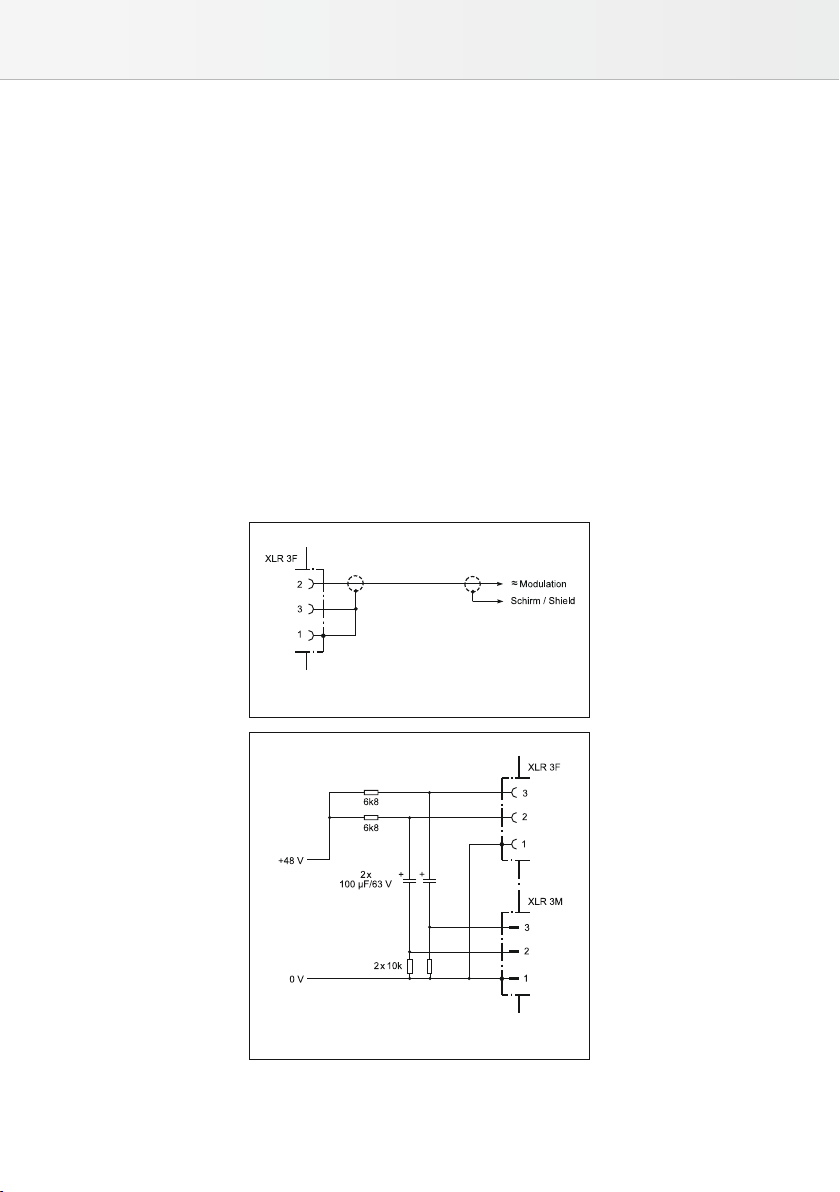
The U87Ai microphone operates on 48volt phan-
tom power (P48, IEC1938).
With phantom powering the dc from the positive
supply terminal is divided via two identical re-
sistors, one half of the dc owing through each
audio (modulation) conductor to the microphone,
and returning to the voltage source via the cable
shield. As a consequence, the eect of dc supply
voltage noise super-imposed on the microphone
output voltage is reduced by the common mode
rejection factor. Neumann microphones have a
common mode rejection factor exceeding 60dB.
Phantom powering provides a fully compatible
connecting system, since no potential dierences
exist between the two audio conductors. Studio
outlets so powered will therefore also accept
dynamic microphones and ribbon microphones as
well as the modulation conductors of tube-equipped
condenser microphones without the need to switch
o the dc supply voltage. No harm is done even if
a phantom power supply is connected to an outlet
which is centrally phantom powered.
Anschluss des XLR 5-Ausganges des Speisege-
rätes BS 48i-2 oder der Matrixbox MTX 191 A an
Geräte mit 3,5mm Stereoklinkenbuchse. Für alle
Mikrofone außer der Ausgangsstufe KM 100 und
des GFM132.
AC25 (0,3m)......................... Best.-Nr. 006600
Adapterkabel mit XLR 3 F-Buchse und 6,3 mm
Monoklinkenstecker, unsymmetrisch, für den
Anschluss des 3-poligen XLR-Ausganges eines
Speisegerätes an Geräte mit 6,3 mm Monoklin-
kenbuchse. Für alle Mikrofone mit Ausnahme der
Ausgangsstufe KM100 und des GFM132.
AC27 (0,3m)......................... Best.-Nr. 006602
Y-Kabel mit einer XLR 5 F-Buchse und zwei 6,3mm
Monoklinkensteckern, unsymmetrisch, für den
Anschluss des XLR 5-Ausganges des Speisegerätes
BS48i-2 oder der Matrixbox MTX191A an Geräte
mit 6,3mm Monoklinkenbuchsen. Für alle Mikrofo-
ne mit Ausnahme von KM 100 und GFM132.
Andere Kabellängen sind auf Wunsch lieferbar.
4. Stromversorgung
4.1 Die Phantomspeisung
Das Mikrofon U87Ai wird mit 48V phantomge-
speist (P48, IEC1938).
Bei der Phantomspeisung ießt der Speisestrom
vom positiven Pol der Spannungsquelle über die
elektrische Mitte der beiden Modulationsadern
zum Mikrofon. Er wird hierzu über zwei gleich große
Widerstände beiden Tonadern gleichsinnig zuge-
führt. Die Rückleitung des Gleichstroms erfolgt über
den Kabelschirm. Der Einuss von Störspannungen,
die der Speisegleichspannung überlagert sind, auf
die Ausgangsspannung des Mikrofons wird dadurch
um das Maß der Unsymmetriedämpfung herabge-
setzt, bei Neumann-Mikrofonen um mehr als 60dB.
Mit der Phantomspeisung ist eine kompatible An-
schlusstechnik möglich, weil zwischen beiden Mo-
dulationsadern keine Potentialdierenz besteht:
Auf die Anschlussdosen können wahlweise auch
dynamische Mikrofone oder Bändchenmikrofone
sowie die Modulationskabel röhrenbestückter
Kondensator-Mikrofone geschaltet werden, ohne
dass die Speisegleichspannung abgeschaltet wer-
den muss.