
MSF 16th Edition Manuel utilisateur

MOTORCYCLE
OPERATOR
MANUAL
MSF LICENSING PROGRAMS
an msf
manual
With Supplementary Information
for Three-Wheel Motorcycles
16th Edition

2 Preface
Welcome to the Sixteenth Edition of
the MSF Motorcycle Operator Manual
(MOM). Operating a motorcycle safely
in traffic requires special skills and
knowledge. The Motorcycle Safety
Foundation (MSF) has made this manual
available to help novice motorcyclists
reduce their risk of having a crash. The
manual conveys essential safe riding
information and has been designed
for use in licensing programs. While
designed for the novice, all motorcyclists
can benefit from the information this
manual contains.
The original Motorcycle Operator
Manual was developed by the National
Public Services Research Institute (NPSRI)
under contract to the National Highway
Traffic Safety Administration (NHTSA)
and within the terms of a cooperative
agreement between NHTSA and the
MSF. The manual and related tests
were used in a multi-year study of
improved motorcycle operator licensing
procedures, conducted by the California
Department of Motor Vehicles under
contract to NHTSA.
The purpose of this manual is to
educate riders and to help them avoid
crashes while safely operating either
a standard two-wheel motorcycle or a
three-wheel motorcycle.
This latest edition has undergone
significant improvements, and contains
new, more in-depth information,
designed to:
• Guide riders in preparing to ride
safely
• Develop effective street strategies
• Give riders more comprehensive
understanding of safe group riding
practices
• Describe in detail best practices for
carrying passengers and cargo
In promoting improved licensing
programs, the MSF works closely with
state licensing agencies. The Foundation
has helped more than half the states
in the nation adopt the Motorcycle
Operator Manual for use in their
licensing systems.
Improved licensing, along with high
quality motorcycle rider education and
increased public awareness, has the
potential to reduce crashes. Staff at the
Foundation are available to assist state,
private and governmental agencies in
efforts to improve motorcycle safety.
Tim Buche
President,
Motorcycle Safety Foundation
2 Jenner, Suite 150
Irvine, CA 92618-3806
www.msf-usa.org

contents 3contents
THE RIDER AND
THE MOTORCYCLE ���������������������������4
PREPARING TO RIDE
Wear the Right Gear ����������������������������5
Know Your Motorcycle ������������������������7
Know Your Responsibilities ���������������10
RIDE WITHIN YOUR ABILITIES
Basic Vehicle Control ��������������������������11
Keeping Your Distance �����������������������15
SEE �������������������������������������������������������20
Intersections ���������������������������������������21
Increasing Conspicuity �����������������������24
Crash Avoidance ���������������������������������27
Handling Dangerous Surfaces �����������30
Mechanical Problems �������������������������33
Animals �����������������������������������������������34
Flying Objects �������������������������������������35
Getting Off the Road �������������������������35
Carrying Passengers
and Cargo ���������������������������������������35
Group Riding ���������������������������������������38
BEING IN SHAPE TO RIDE
Why This Information Is
Important ���������������������������������������42
Alcohol and Other Drugs in
Motorcycle Operation ��������������������42
Alcohol in the Body ����������������������������42
Alcohol and the Law ��������������������������44
Minimize the Risks �����������������������������44
Step in to Protect Friends ������������������45
Fatigue ������������������������������������������������45
EARNING YOUR LICENSE ��������������46
THREE-WHEEL SUPPLEMENT
Supplementary Information
for Three-Wheel Motorcycles ���������48
Know Your Vehicle ������������������������������48
Basic Vehicle Control ���������������������������50
Carrying Passengers and Cargo ����������53
HAND SIGNALS �������������������������� 55
T-CLOCS PRE-RIDE CHECKLIST ����57
4 the rider and the Motorcycle
Motorcycling is a
unique experience.
Compared to a car,
you don’t sit in a
motorcycle, you
become part of it.
Not as a passive
driver, but as an
active rider arcing
into a string of
smooth corners,
playing along with
the rhythm of the
road; shifting,
accelerating,
and braking
with precision.
Whether you
ride to and from
work or prefer
the camaraderie of a group ride on the
weekend, motorcycling engages all your
senses and creates an invigorating sense
of freedom.
Along with that freedom comes
responsibility. All states require
some form of license endorsement
demonstrating you possess a minimum
level of skill and knowledge. This
booklet and other motorcycle
publications can help prepare you to
be successful. You might also consider
taking a formal hands-on training
course, even if your state doesn’t require
that you complete one. You’ll learn how
to improve your riding skills and mental
strategies, so you can be a safer, more
alert rider.
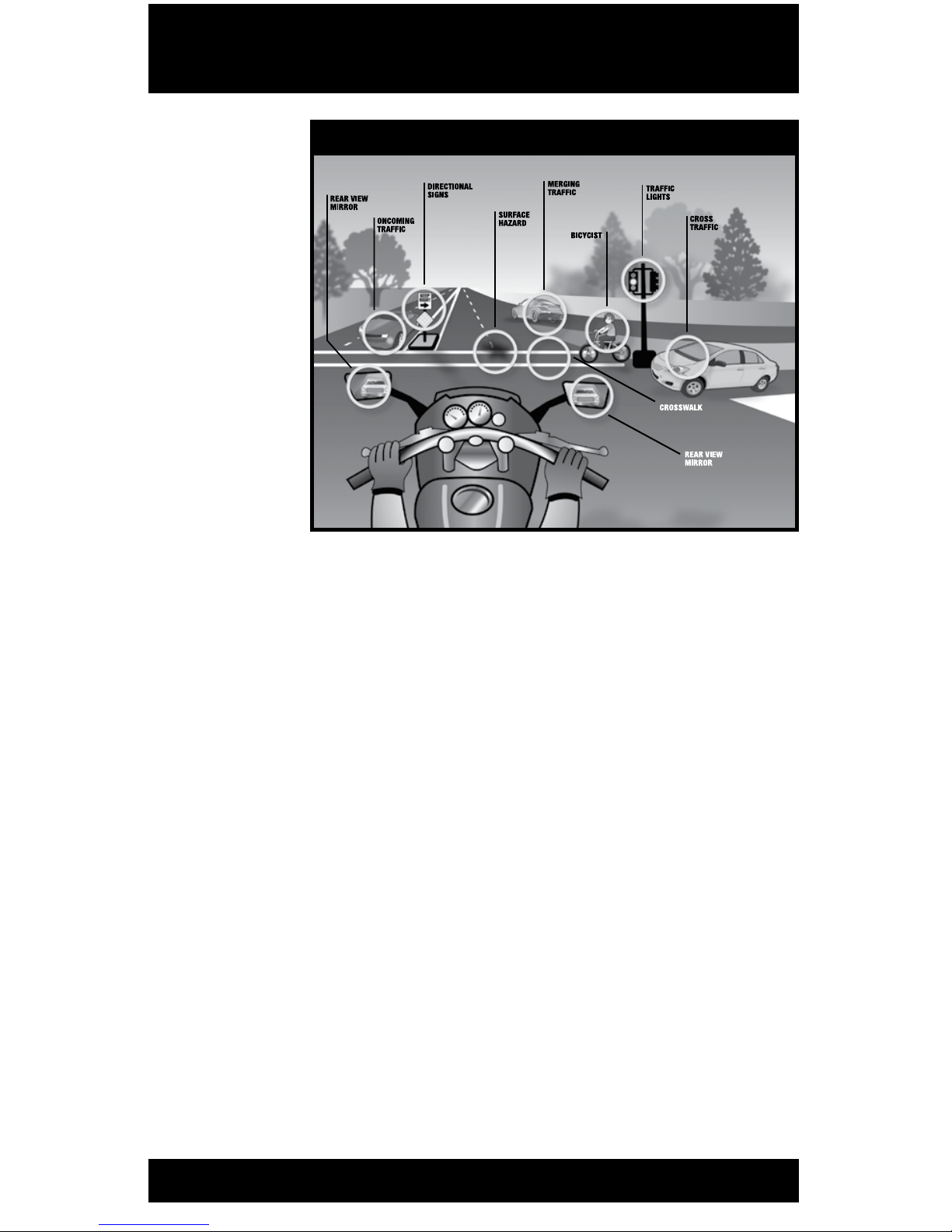
The diagram above illustrates the
complex environment that awaits you,
and supports the concept that, as the
Motorcycle Safety Foundation says,
“Safe riding is as much a skill of the
eyes and mind as it is of the hands and
feet.”
Successfully piloting a motorcycle is a
much more involved task than driving a
car. Motorcycling requires a fine sense
of balance and a heightened sense of
awareness and position amidst other
roadway users. A motorcycle responds
more quickly to rider inputs than a car,
but is also more sensitive to outside
forces, like irregular road surfaces or
crosswinds. A motorcycle is also less
visible than a car due to its narrower
profile, and offers far less protection by
exposing its rider to other traffic and
the elements. All these risks can be
managed through study, training, and
practice.
riding environMent

PreParing to ride 5
What you do before you start a trip goes a long way toward determining
whether or not you’ll get where you want to go safely. Before taking off on any
trip, a safe rider makes a point to:
1� Wear the right gear�
2� Become familiar with the motorcycle�
3� Check the motorcycle equipment�
4� Be a responsible rider�
Wear the right gear
When you ride, your gear is “right”
if it protects you. In any crash, you have
a far better chance of avoiding serious
injury if you wear:
• A DOT compliant helmet�
• Face or eye protection�
• Protective clothing�
Helmet Use
Crashes can occur — particularly
among untrained, beginning riders.
And one out of every five motorcycle
crashes results in head or neck injuries.
Head injuries are just as severe as neck
injuries — and far more common. Crash
analyses show that head and neck
injuries account for a majority of serious
and fatal injuries to motorcyclists.
Research also shows that, with few
exceptions, head and neck injuries are
reduced by properly wearing a quality
helmet.
Some riders don’t wear helmets
because they think helmets will limit
their view to the sides. Others wear
helmets only on long trips or when
riding at high speeds. But, here are
some facts to consider:
• A DOT-compliant helmet lets
you see as far to the sides as
necessary. A study of more than
900 motorcycle crashes, where
40% of the riders wore helmets,
did not find even one case in which
a helmet kept a rider from spotting
danger.
• Most crashes happen on short
trips (less than five miles long), just
a few minutes after starting out.
• Most riders are riding slower than
30 mph when a crash occurs. At
these speeds, helmets can cut both
the number and the severity of head
injuries by half.
No matter what the speed, helmeted
riders are three times more likely to
survive head injuries than those not
wearing helmets at the time of the
crash. The single most important thing
you can do to improve your chances of
surviving a crash is to wear a securely-
fastened, quality helmet.
Helmet Selection
There are two primary types of
helmets, providing two different levels
of coverage: three-quarter and full face.
Whichever style you choose, you can
get the most protection by making sure
that the helmet:
• Is designed to meet U�S�
Department of Transportation
(DOT) and state standards. Helmets
with a label from the Snell Memorial
Foundation also give you an
assurance of quality.
• Fits snugly, all the way around.
• Has no obvious defects such as
cracks, loose padding or frayed
straps.

6 PreParing to ride
Whatever helmet you
decide on, keep it securely
fastened on your head
when you ride. Otherwise,
if you are involved in a
crash, it’s likely to fly off
your head before it gets a
chance to protect you.
Eye and Face
Protection
A plastic shatter-resistant
faceshield can help protect
your whole face in a
crash. It also protects you
from wind, dust, dirt, rain, insects and
pebbles thrown up from cars ahead.
These problems are distracting and
can be painful. If you have to deal
with them, you can’t devote your full
attention to the road.
Goggles protect your eyes, though
they won’t protect the rest of your face
like a faceshield does. A windshield
is not a substitute for a faceshield or
goggles. Most windshields will not
protect your eyes from the wind. Neither
will eyeglasses or sunglasses. Glasses
won’t keep your eyes from watering,
and they might blow off when you turn
your head while riding.
To be effective, eye or faceshield
protection must:
• Be free of scratches.
• Be resistant to penetration.
• Give a clear view to either side.
• Fasten securely, so it does not
blow off.
• Permit air to pass through, to
reduce fogging.
• Permit enough room for
eyeglasses or sunglasses, if needed.
Tinted eye protection should not be
worn when little light is available.
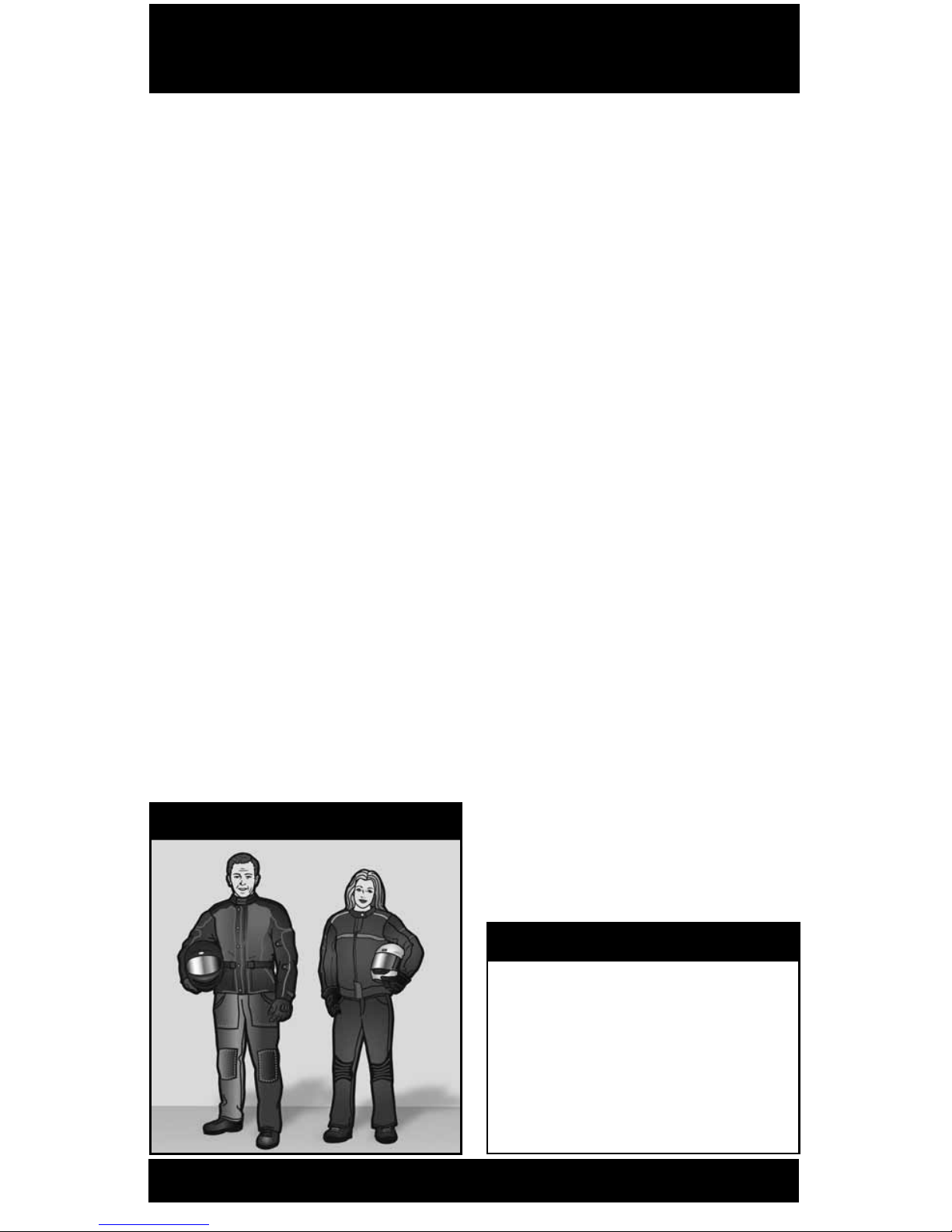
Clothing
The right clothing protects you in
a collision. It also provides comfort,
as well as protection from heat, cold,
debris and hot and moving parts of the
motorcycle. It can also make you more
visible to others.
• Jacket and pants should cover
arms and legs completely. They
should fit snugly enough to keep
from flapping in the wind, yet
loosely enough to move freely.
Leather offers the most protection.
Sturdy synthetic material provides
a lot of protection as well. Wear
a jacket even in warm weather to
prevent dehydration. Many are
designed to protect without getting
you overheated, even on summer
days. Some riders choose jackets
and pants with rigid “body armor”
inserts in critical areas for additional
protection.
• Boots or shoes should be high
and sturdy enough to cover your
ankles and give them support. Soles
should be made of hard, durable,
slip-resistant material. Keep heels
short so they do not catch on rough
surfaces. Tuck in laces so they won’t
catch on your motorcycle.
helMets
7
• Gloves allow a better grip and help
protect your hands in a crash. Your
gloves should be made of leather or
similar durable material.
• Hearing protection reduces
noise while allowing you to hear
important sounds such as car horns
or sirens. Long term exposure to
engine and wind noise can cause
permanent hearing damage even
if you wear a full face helmet.
Whether you choose disposable
foam plugs or reusable custom
molded devices, be sure you adhere
to state laws regarding hearing
protection.
In cold or wet weather, your clothes
should keep you warm and dry, as
well as protect you from injury. You
cannot control a motorcycle well if
you are numb. Riding for long periods
in cold weather can cause severe chill
and fatigue. A winter jacket should
resist wind and fit snugly at the neck,
wrists and waist. Good-quality rainsuits
designed for motorcycle riding resist
tearing apart or ballooning up at high
speeds.
KNOW YOUr
MOtOrCYCLe
There are plenty of things on the
highway that can cause you trouble.
Your motorcycle should not be one
of them. To make sure that your
motorcycle won’t let you down:
• Start with the right motorcycle
for you.
• Read the owner’s manual.
• Be familiar with the motorcycle
controls.
• Check the motorcycle before
every ride.
• Keep it in safe riding condition
between rides.
• Avoid add-ons and modifications
that make your motorcycle harder
to handle.
The Right Motorcycle For You
First, make sure your motorcycle is
right for you. It should “fit” you. Your
feet should reach the ground while
you are seated on the motorcycle, and
the controls should be easy to operate.
Smaller motorcycles are usually easier
for beginners to operate.
At a minimum, your street-legal
motorcycle should have:
• Headlight, taillight and
brakelight�
clothing
A plastic shatter-resistant face
shield:
A. Is not necessary if you have a
windshield.
B. Only protects your eyes.
C. Helps protect your whole face.
D. Does not protect your face as well
as goggles.
test yourself 1
Answer - page 47

8 PreParing to ride
• Front and rear brakes�
• Turn signals�
• Horn�
• Two mirrors�
Borrowing and Lending
Borrowers and lenders of motorcycles,
beware. Crashes are fairly common
among beginning riders — especially
in the first months of riding. Riding
an unfamiliar motorcycle adds to the
problem. If you borrow a motorcycle,
get familiar with it in a controlled area.
And if you lend your motorcycle to
friends, make sure they are licensed and
know how to ride before allowing them
out into traffic.
No matter how experienced you
may be, ride extra carefully on any
motorcycle that’s new or unfamiliar
to you. More than half of all crashes
involve riders with less than five months
of experience on their motorcycle.
Get Familiar with the
Motorcycle Controls
Make sure you are completely familiar
with the motorcycle before you take
it out on the street. Be sure to review
the owner’s manual. This is particularly
important if you are riding a borrowed
motorcycle.
If you are going to use an unfamiliar
motorcycle:
• Make all the checks you would on
your own motorcycle.
• Find out where everything is,
particularly the turn signals, horn,
headlight switch, fuel-supply valve
and engine cut-off switch. Find and
operate these items without having
to look for them.
Motorcycle controls

9
• Know the controls� Work the
throttle, clutch, brakes, and shifter a
few times before you start riding.
• Ride very cautiously and be aware
of surroundings. Accelerate gently,
take turns more slowly and leave
extra room for stopping.
Check Your Motorcycle
A motorcycle needs more frequent
attention than a car. A minor technical
failure on a car is seldom more than an
inconvenience for the driver. The same
failure on a motorcycle may result in a
crash or having to leave your motorcycle
parked on the side of the road. If
anything’s wrong with your motorcycle,
you’ll want to find out about it before
you get in traffic.
The primary source of information
about how a motorcycle should be
inspected and maintained is its owner’s
manual. Be sure to absorb all of its
important information. A motorcycle will
continue to ride like new if it is properly
maintained and routine inspections
become part of its maintenance cycle.
A pre-ride inspection only takes
a few minutes and should be done
before every ride to prevent problems.
It’s quick and easy to check the critical
components and should be as routine
and automatic as checking the weather
forecast before heading out for the day.
A convenient reminder developed by
MSF is T-CLOCSSM. There is a T-CLOCS
“tear-out” sheet at the back of this
manual for you to keep with you when
you ride. A T-CLOCS inspection should
be conducted before every ride, and
includes checks of:
T — Tires and Wheels
• Check tire inflation pressure,
treadwear and general condition of
sidewalls and tread surface.
• Try the front and rear brake levers
one at a time. Make sure each feels
firm and holds the motorcycle when
fully applied.
C — Controls
• Make sure the clutch and throttle
operate smoothly. The throttle
should snap back to fully closed
when released. The clutch should
feel tight and should operate
smoothly.
• Try the horn. Make sure it works.
• Clean and adjust your mirrors
before starting. It’s difficult to ride
with one hand while you try to
adjust a mirror. Adjust each mirror
so you can see the lane behind and
as much as possible of the lane next
to you. When properly adjusted, a
mirror may show the edge of your
arm or shoulder – but it’s the road
behind you and to the side that are
most important.
L — Lights and Electrics
• Check both headlight and taillight.
Test your switch to make sure both
high and low beams work.
• Turn on both right and left hand
turn signals. Make sure all lights are
working properly.
• Try both brakes and make sure each
one turns on the brake light.
O — Oil and Other Fluids
• Check engine oil and transmission
fluid levels.
• Check the brake hydraulic fluid and
coolant level weekly.
• Be sure your fuel valve is open
before starting out. With the fuel
valve closed, your motorcycle may
start with only the fuel that is still in
the lines, but will stall once the lines
are empty.

10 PreParing to ride
• Look underneath the motorcycle for
signs of an oil or fuel leak.
C — Chassis
• Check the front suspension. Ensure
there is no binding. The rear shocks
and springs should move smoothly.
• Be sure the chain is adjusted
according to the manufacturer’s
specifications and that the sprockets
are not worn or damaged.
S — Stands
• Ensure the side stand operates
smoothly and that the spring holds
it tightly in the up position. If
equipped, the center stand should
also be held firmly against the frame
whenever the motorcycle is moving.
Additionally, regular maintenance
such as tune-ups and oil changes are as
important for a motorcycle as routine
checkups by your doctor are for you.
Wear and tear is normal with use;
routine maintenance will help prevent
costly breakdowns. The schedule for
regular upkeep for motorcycle parts
and controls is contained in your
motorcycle’s owner’s manual.
KNOW YOUr
reSPONSiBiLitieS
“Accident” implies an unforeseen
event that occurs without fault or
negligence. In traffic, that is not the
case. In fact, most people involved in a
crash can claim some responsibility for
what takes place.
Consider a situation where someone
decides to drive through an intersection
on a yellow light turning red. Your
light turns green. You pull into the
intersection without checking for
possible traffic. That is all it takes for the
two of you to crash. It was the driver’s
responsibility to stop, and it was your
responsibility to look before pulling out.
Both of you are at fault. Someone else
might be the first to start the chain of
events leading to a crash, but it doesn’t
leave any of us free of responsibility.
As a rider you can’t be sure that other
operators will see you or yield the right
of way. To lessen your chances of a
crash occurring:
• Be visible — wear proper clothing,
use your headlight, ride in the best
lane position to see and be seen.
• Communicate your intentions —
use the proper signals, brake light
and lane position.
• Maintain an adequate space
cushion — when following, being
followed, lane sharing, passing and
being passed.
• Search your path of travel 12
seconds ahead.
• Identify and separate hazards.
• Be prepared to act — remain alert
and know how to carry out proper
crash-avoidance skills.
Blame doesn’t matter when someone
is injured in a crash. The ability to ride
aware, make critical decisions and carry
them out separates responsible riders
from the rest. Remember, it is up to you
to keep from being the cause of, or an
unprepared participant in, any crash.
More than half of all crashes:
A. Occur at speeds greater than
35mph.
B. Happen at night.
C. Are caused by worn tires.
D. Involve riders who have less than
five months of experience on their
motorcycles.
test yourself 2
Answer - page 47
Ce manuel convient aux modèles suivants
2
Table des matières
Autres manuels MSF Moto

Manuels Moto populaires d'autres marques


MOTO GUZZI
MOTO GUZZI QUOTA 1100 ES Manuel utilisateur

APRILIA
APRILIA ETV MILLE CAPONORD - PART1 02-2001 Manuel utilisateur

Yamaha
Yamaha 2006 YZF-R1V Manuel utilisateur

KTM
KTM Freeride E-XC 2021 Manuel utilisateur

Fantic
Fantic Enduro 125 Manuel utilisateur

Ducati
Ducati Supersport 750 desmodue Manuel utilisateur


