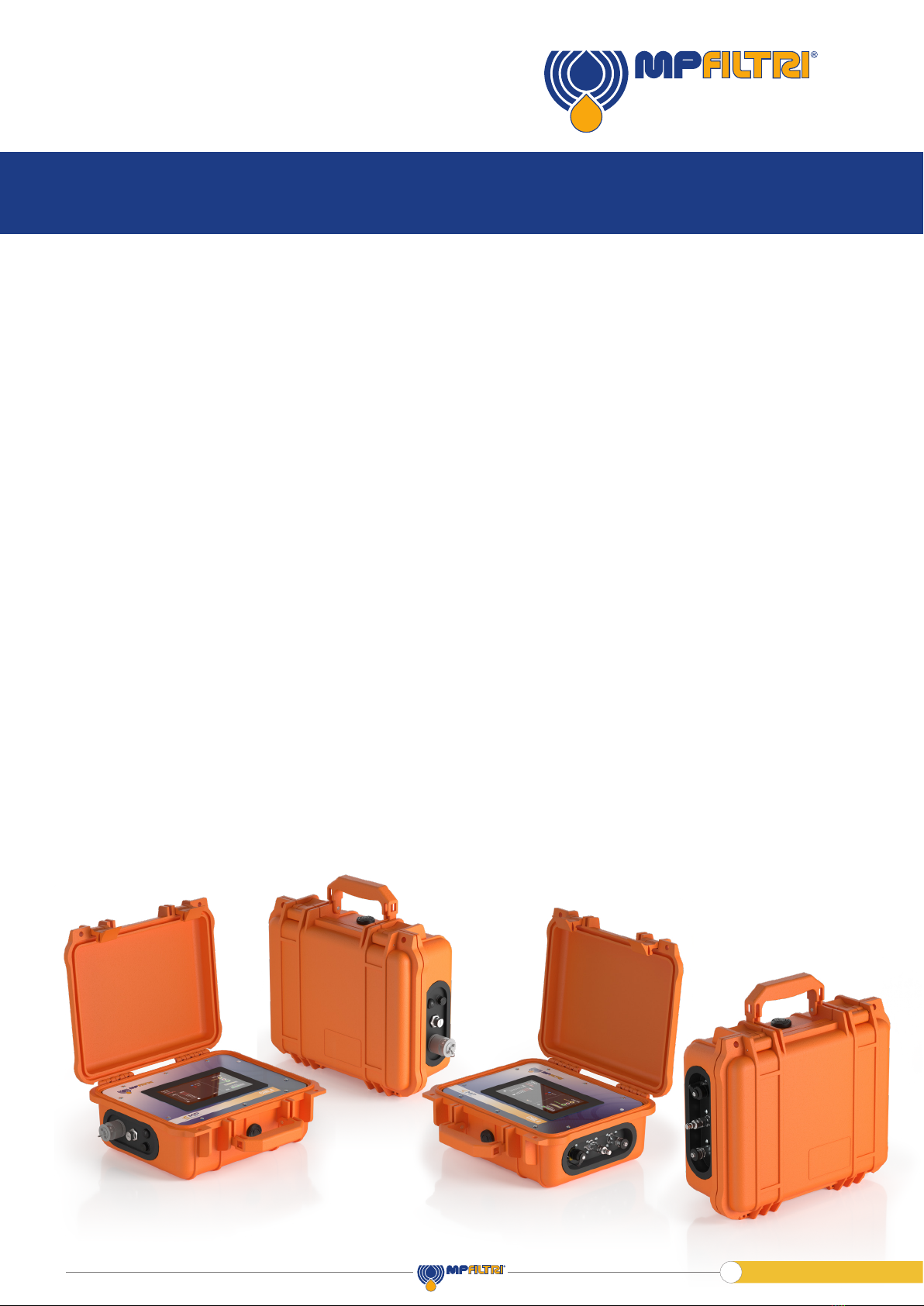
Product Presentation
The CML4 measures and quanties the solid contaminants in hydraulic applications. The unit is designed to be an accurate
instrument for applications using mineral oil as the operating uid.
The unit can operate using any of the international standard formats ISO 4406, NAS 1638, AS 4059E&F Tables 1 and 2, ISO 11218, GBT
14039, GJB 420B, GOST 17216
The CML4 incorporates a connector for power as well as separate USB connections for connection to a personal computer for
remote monitoring; settings access; and direct download to a USB memory stick.
The integrated data logger records up to 4000 test results internally, for use where a computer cannot be permanently connected.
The instrument utilises the light extinction principle whereby a specially collimated precision LED light source is used to illuminate
the test media. This light is then captured via a photodiode module. When a particle passes through the beam it reduces the amount
of light received by the diode, and from this change in condition, the size of the particle can be deduced and subsequently counted.
Product features
Metering pump
The CML4 is equipped with a high-performance metering pump, which delivers an accurate and consistent ow. It is suitable for
both low and high viscosity liquids (≤ 400 cSt).
Moisture sensor
The CML4 measures water content using a capacitive RH (relative humidity) sensor. The result is expressed as percentage of
saturation. 100% RH corresponds to the point at which free water exists in the uid, i.e. the uid is no longer able to hold the water
in a dissolved solution. This is also normally the point at which signicant damage occurs in a hydraulic system, making RH% an
ideal measurement scale that is independent of the uid characteristics.
The water saturation point (100% RH) is temperature dependent, so the temperature is measured at the same time. This enables
results to be compared meaningfully.
The temperature measured is that of the uid passing through the unit.
Note: This may differ from that of the hydraulic system, depending on ow rate, pipe length and ambient temperature.
It is not intended to be an accurate indication of system temperature, but to provide a reference for the RH measurement at the
point of sample. Nevertheless, experience has shown the temperature measured is within a few degrees of that of the hydraulic
system, in most applications.
Contamination Monitors
2