Other Precautions
1. Do not modify the product.
−Do not modify spray gun.
−If you modify spray gun, it cannot provide sufficient performance. Also, a failure of the machine may result.
2. Stop other equipment.
−To conduct spray work in an operating area of other equipment (robot, reciprocating equipment, etc.), confirm that the equipment has stopped first.
−If you touch a robot or reciprocating equipment, you may get injury.
3. Do not use spray gun for food and chemicals.
−Do not apply spray gun to food or chemicals.
−Corrosion of paint circuit may result in an accident. Also, mixture of foreign substances may result in health disorder.
4. If an abnormal condition occurs, immediately stop spray gun.
−If you find a problem, immediately stop spray gun, and examine the cause of the problem. Do not use gun until the problem can be solved.
Installation
1. Use clean compressed air.
−Use clean compressed air that has passed through an air dryer or air filter. If contaminated air is used, it results in a failure in spray work.
2. Ensure tight connections.
−When connecting paint cup and air hose to spray gun, tighten them securely by using spanner. If the connection is loose, compressed air, paint and other liquids
may spatter over human body, painted work pieces and peripheral equipment, resulting in damage.
3. Conform to the rated withstand pressure of hose.
−Make sure that the air pressure supplied to air hose does not exceed the rated withstand pressure of hose. Do not use an old or damaged hose.
1. Operating Procedure
2. Mount paint cup and air hose securely to spray gun by using spanner.
3. Paint viscosity and property vary depending on operating conditions. Recommended spraying pressure is 0.2 to
0.34 MPa. Never use spray gun at a pressure higher than the maximum operating pressure (0.69 MPa).
4. Recommended spraying distance is 150 to 250 mm. If spray gun is too close to a target
work piece or it swings like an arc, good finished conditions cannot be obtained. (See
Fig. 1)
5. To obtain a uniformly finished condition, always hold spray gun at a right angle to the
spraying surface.
6. During air volume adjustment, if you tighten air volume adjusting screw by turning it
clockwise, air volume decreases. If you loosen air volume adjusting screw by turning it
counterclockwise, air volume increases.
7. If you tighten pattern adjusting screw by turning it clockwise completely, paint is
sprayed in a spot pattern. Then, as pattern adjusting screw is loosened by turning it
counterclockwise, spray pattern area gradually increases. When screw is turned about three turns, pattern area becomes the maximum. Adjust spray pattern
depending on the spray work step and the type of paint being used.
8. If you tighten paint volume adjusting screw by turning it clockwise, spay volume decreases. Then, as screw is loosened by turning it counterclockwise, spray volume
gradually increases. When screw is turned by three or four turns, spray volume becomes the maximum. Set paint volume depending on spray work conditions.
2. Maintenance and Inspection
1. Clean and lubricate spray gun everyday to maintain it in the best operating condition.
2. To clean spray gun body, wipe dust off body with a cloth damped with a solvent. If spray gun is soaked in a solvent, lubricant is removed, and an adhering substance
enters air circuit, causing a trouble in spay work.
We shall not be liable for any trouble resulting from use of gun cleaner that causes dust or paint waste to enter paint nozzle air circuit.
3. After using spray gun, be sure to clean spray gun with a clean solvent, and leave cup empty.
4. To clean cup, remove surplus paint from cup first, and then pour an appropriate solvent into cup, to wash off residual paint completely.
5. If spray gun is used with a cleaning solvent remaining in gun and cup, and with paint waste or dust adhering to paint circuit, it causes a failure in spray work.
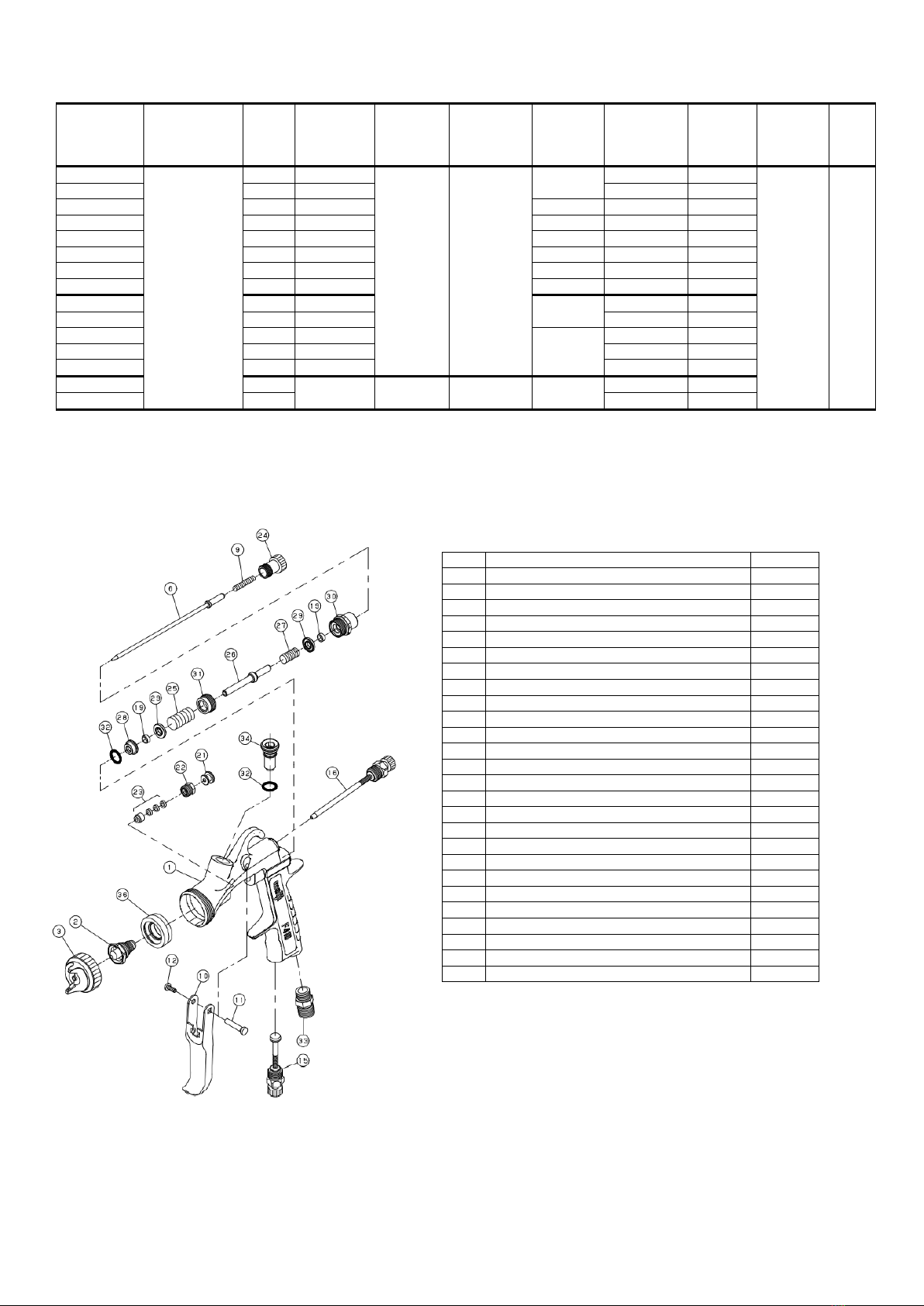
6. After disassembling air cap (3) and fluid nozzle (2), clean them with a brush. When disassembling fluid nozzle (2), be careful not to damage it.
7. To clean paint circuit, spray a small quantity of solvent as in the same manner as spray work.
8. Be sure not to damage each hole of air cap (3), and center hole and tip periphery of fluid nozzle (2).
9. If needle valve set (6) or air valve (26) malfunctions, apply a small quantity of oil (non-silicone oil) to sliding part from the outside.
10. After cleaning the equipment with water, be sure to eliminate water. Residual water causes the equipment to rust away.
11. Soaking whole spray gun in solvent may cause spray gun malfunction. Also soaking air cap assy. itself for extended period may cause a defective spray pattern.