
Gin Boomerang12 Manuel utilisateur

v1.0 March 2022
Boomerang 12 user manual
_____________________________________________________________________________________________________________________________________
!"
#$$$%#&
Gin Gliders reserves the right to alter or add to the contents of this manual at any time. You
should therefore regularly visit our website:
where you will find additional information relating to your paraglider and any changes to the
manual. The date and version number of this manual are given on the front page.
© Gin Gliders Inc
The reproduction of this manual, including the partial reprint (with the exception of short quotations in technical articles), regardless of how or by
what means, electronic or mechanical, this is done, is only permitted with the express written permission of Gin Gliders Inc.
The data and information contained in these documents are subject to non-binding changes and may be changed without prior notice. The
provision of this manual does not claim to be the descriptions of the goods, names of use and trade, and other intellectual property.
Page 2

Boomerang 12 user manual
_____________________________________________________________________________________________________________________________________
Thank you ...
… for choosing Gin Gliders. This user manual contains important information for the use and
maintenance of your paraglider. Detailed knowledge of your glider and equipment will help you to fly
safely and make the most of your flights.
The manual complies with the EN airworthiness and forms part of the certification. There are no
special flying procedures and / or configurations apart from those detailed in this manual.
Your GIN paraglider has been designed to meet all safety and regulatory requirements. These
requirements also include the need to familiarise yourself with this user manual and the information
and instructions regarding safety, equipment and service prior to the initial commissioning. These
operating instructions must be fully read and understood before the first flight.
If you have any further questions about these operating instructions, please contact your GIN dealer
in the first instance, or Gin Gliders directly.
We wish you exciting flights and always a safe landing.
Your GIN team
Page 3
Boomerang 12 user manual
_____________________________________________________________________________________________________________________________________
Contents
Gin Gliders website 7
Gin Gliders and the environment 7
Respect for nature and the environment 7
Environmentally-friendly recycling 8
Safety advice 9
Safety notices 9
Liability, warranty exclusion and operating limitations 9
Liability and warranty exclusion 9
Operating limitations 10
Before the first flight 10
Harnesses 10
Reclined harnesses 11
Reserve 11
Weight range 11
Overload 11
First flight 12
Preparation for launch 13
General warnings and advice 13
Material check 13
Pre-flight check 13
5-point check 14
Launching 14
Forward inflation 14
Reverse inflation 14
Tips for paragliding take-off 15
Towing 15
Attaching the towline release system 16
Knots or loops in the lines 16
In-flight characteristics 16
Normal flight 16
Accelerated flight 17
Turning 17
Active flying 17
B-riser control 18
Page 4
Boomerang 12 user manual
_____________________________________________________________________________________________________________________________________
Rapid descent techniques 19
Spiral dives 19
G-chute 20
B3-Descent 20
Big ears 20
B-Stall 20
Landing 20
Dangerous situations 22
SIV / Safety training 22
Material stress 22
Canopy Collapses 23
Asymmetric collapses 23
Cravat / glider wrapped around lines 23
Symmetric collapses (Front stall) 24
Types of stall 24
Deep stall (parachuting, stable stall) 24
Full stall (dynamic stall) 25
Spin 25
Other tips for dangerous situations 26
Cascade 26
Emergency steering (rear riser steering) 26
Flying in the rain 26
Advertising and adhesives 26
Overloading 26
Sand and salt air 26
Storing the paraglider 27
Packing the paraglider 27
Rucksack 28
Storing and transporting the glider 28
Care 29
Ground handling 29
Fabric
29
Lines 30
Rigid construction 30
Cleaning 30
Maintenance 31
Type designation 31
Regular inspections 31
Lines 31
Inspection periods 31
Validity of inspection 32
Line trimming 32
Page 5

Boomerang 12 user manual
_____________________________________________________________________________________________________________________________________
Repairs 33
Gin Gliders workshops 33
Small repairs to the glider 33
GIN quality and service 33
Glider categories and guidelines 34
Glider category 34
EN/LTF certification 34
Description of flight characteristics 34
Suitability for training 34
Paramotoring 34
Tandem paragliding 34
Aerobatics 34
Description of pilot skills required 35
Target group and recommended flying experience 35
Normal flight requirements 35
Requirements for incidents and quick descents 35
Manufacturing and delivery 35
CCC Test-Lab-Template 35
Overall illustration 36
Technical data 36
Riser and speed system 37
Riser 37
Riser diagram 37
Riser lengths 38
Speed System 38
Line system and brakes 38
Line system 38
Folding lines 39
Brake line adjustment 39
Factory setting 39
Incorrect adjustment 40
Line layout 41
Materials 42
Glider details 43
Pilot details / Proof of ownership 43
Inspections and repairs overview 44
Notes 44
Addresses 45
Page 6

Boomerang 12 user manual
_____________________________________________________________________________________________________________________________________
Gin Gliders
In forming Gin Gliders, designer and competition pilot Gin Seok Song had one simple dream: to make
the best possible paragliding equipment that pilots all over the world would love to fly - whatever their
ambitions.
At Gin Gliders, we bring together consultant aerodynamicists, world cup pilots, engineers and
paragliding school instructors, all with one goal: creating better paragliders.
We’re a “hands-on” company that puts continuous innovation and development at the centre of
everything we do.
At our purpose-built R&D workshop at the head office in Korea, we are able to design, manufacture,
test-fly and modify prototypes all in a matter of hours. Our international R&D team is on hand both in
Korea and at locations worldwide. This guarantees that your equipment has been thoroughly tested to
cope with the toughest flying conditions.
Our own production facilities in East Asia ensure the quality of the finished product and also the
well-being of our production staff. Our facilities are independently certified to AS9100C (Aerospace
standard) and also to ISO 9001:2008.
We believe that the product should speak for itself. Only by flying can the pilot understand the wing
and develop trust and confidence in it. From this feeling comes safety, comfort, performance and fun.
The grin when you land should say it all!
Gin Gliders website
Gin Gliders has a comprehensive website, which provides additional information about the
Boomerang 12, any updates to the manual and many other issues related to paragliding.
On the Gin Gliders website, you will find an extensive range of accessories for your paraglider and
other useful products.
You will also find links there to other services and websites:
●Gin Gliders Shops
●Facebook, Instagram, Twitter and YouTube
These websites and their content are provided for your use. The content of Gin Gliders websites has
been made available for your use on an “as is” and “as available” basis. Gin Gliders reserves the right
to alter the websites at any time or to block access to them.
Gin Gliders and the environment
Protection of the environment, safety and quality are the three basic values of Gin Gliders and these
have implications on everything we do. We also believe that our customers share our environmental
awareness.
You can easily play a part in protection of the environment by practising our sport in such a way that
there is no damage to nature and the areas in which we fly. Keep to marked trails, take your rubbish
Page 7

Boomerang 12 user manual
_____________________________________________________________________________________________________________________________________
away with you, refrain from making unnecessary noise and respect the sensitive biological equilibrium
of nature. Consideration for nature is required even at the launch site!
Paragliding is, of course, an outdoor sport – protect and preserve our planet’s resources.
Gin Gliders gives consideration to the entire lifecycle of its paragliders, the last stage of which is
recycling in an environmentally-friendly manner. The synthetic materials used in a paraglider must be
disposed of properly. If you are not able to arrange appropriate disposal, Gin Gliders will be happy to
recycle the paraglider for you. Send the glider with a short note to this effect to the address given in
the appendix.
Page 8

Boomerang 12 user manual
_____________________________________________________________________________________________________________________________________
Safety
Safety advice
Paragliding demands a high level of individual responsibility. Prudence and risk-awareness are basic
requirements for the safe practice of the sport, for the very reason that it is so easy to learn and
practically anyone can do so. Carelessness and overestimating one’s own abilities can quickly lead to
critical situations. A reliable assessment of conditions for flying is particularly important. Paragliders
are not designed to be flown in turbulent weather. Most serious accidents with paragliders are caused
by pilots misjudging the weather for flying.
Paragliders are subject to specific guidelines for air sports equipment in each country. They must
not under any circumstances be flown without a valid certification. It’s your responsibility to know and
observe the regulations of the region where you fly. Independent experimentation is strictly
prohibited. This manual does not replace the need to attend training at a paragliding school.
The manual must be passed on to any new owner if the paraglider is sold. It is part of the
certification and belongs with the paraglider.
Observe the other specific safety advice in the various sections of this manual.
Safety notices
Safety notices are issued when defects arise during use of a paraglider which could possibly also
affect other gliders of the same model. The notices contain instructions on how the affected gliders
can be inspected for possible faults and the steps required to rectify them.
Gin Gliders publishes on its website any technical safety notices which are issued in respect of GIN
products. The paraglider owner is responsible for carrying out the action required by the safety notice.
Liability, warranty exclusion and operating limitations
Use of the paraglider is at the pilot’s own risk!
The manufacturer cannot be held liable for any personal injury or material damage which arises in
connection with Gin Gliders paragliders.
Pilots are responsible for their own safety and must ensure that the airworthiness of the glider is
checked prior to every flight. The pilot should launch only if the paraglider is airworthy and must
observe the relevant regulations in each country.
In terms of the warranty and guarantee conditions, the paraglider may not be flown if any of the
following situations exists:
●changes of any kind (incl. paraglider design or changes to the brake lines beyond the
permissible tolerance levels)
●incorrect repairs to the glider
●the inspection period has expired, or the inspection has been carried out by the pilot
him/herself or by an unauthorised inspector
●the pilot has incorrect or inadequate equipment (reserve, protection, helmet etc)
Page 9
Boomerang 12 user manual
_____________________________________________________________________________________________________________________________________
●the glider is used for winch-launching with a winch which has not been inspected or by
non-licensed pilots and/or winch operators
●the pilot has insufficient experience or training
The paraglider must be operated only within the operating limits. These are exceeded, if one or more
of the following points are complied:
●the take-off weight is not within the permissible weight range
●the glider is flown in rain or drizzle, cloud, fog and / or snow
●the canopy is wet
●there are turbulent weather conditions or wind speeds on launch higher than 2/3 ot the
maximum flyable airspeed of the glider (varies according to the total take-off weight)
●air temperature above 50°C and extremely low temperatures, which can lead, in combination
with moisture, to icing
●aerobatics
●modifications to the canopy, lines or risers which have not been approved
Before the first flight
The Boomerang 12 is certified for use with all harnesses with variable cross-bracing (GH type).
Practically all modern harnesses are GH type harnesses. Older harnesses with fixed cross-bracing (GX
type) are not certified and should not be used. Check with the manufacturer of the harness or your
paragliding instructor if in doubt whether your harness is a GH or GX type harness.
It’s important for your comfort and safety to fly with a suitable harness that is properly adjusted.
When choosing a harness, remember that the height of the attachment points (i.e. distance from the
carabiners to the seat plate) affects the sensitivity of the glider and the relative brake travel. The lower
(shorter) the attachment points, the more sensitive the glider is to weight-shift.
The adjustment of the harness chest strap controls the distance between carabiners and affects the
handling and stability of the glider. Excessive tightening of the chest strap increases stability but also
the risk of riser twists following glider collapses. It also increases the likelihood of getting collapses
due to poor feedback from the glider. The risk of twisting is also strongly influenced by the seating
position of the pilot. Flying in a laid back (reclined) position makes it much more difficult to react in
time to prevent riser twisting. With the chest strap in a more closed position the glider also has more
tendency to maintain a stable spiral. With the chest strap in a more open position, feedback from the
glider is increased but stability is decreased.
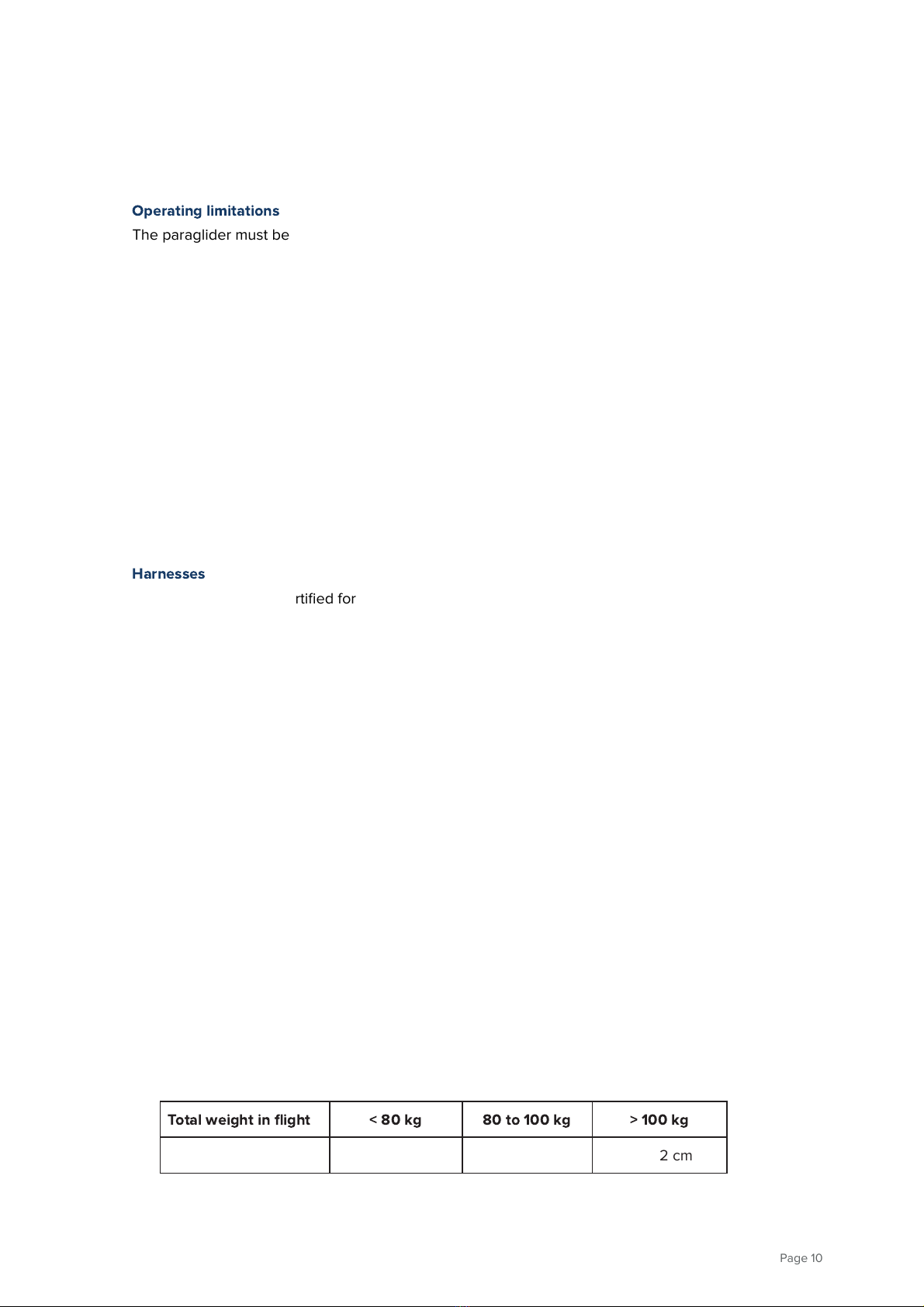
GIN gliders are developed with GIN harnesses, which have an attachment point of approximately
40-48 cm (depending on size and model). EN/LTF as well as CCC certification test flights are carried
out with the horizontal distance between the harness attachment points (measured between
connector centrelines) set depending on the total weight in flight as follows:
Width 40 ± 2 cm 44 ± 2 cm 48 ± 2 cm
Page 10
Table des matières
Autres manuels Gin Aéronef


Gin
Gin Sprint 3 Manuel

Gin
Gin Bolero 4 Manuel utilisateur

Gin
Gin ESKIMO 07 Manuel utilisateur

Gin
Gin Boomerang RF M Manuel utilisateur

Gin
Gin beetle Manuel utilisateur

Gin
Gin Bolero 6 Instructions d'installation

Gin
Gin Carrera + Manuel

Gin
Gin Safari Passenger Manuel utilisateur

Gin
Gin Bolero 7 Manuel utilisateur

Gin
Gin BOBCAT Manuel utilisateur


