
Firestone 2239 Manuel utilisateur

Air
Pressure
0
2
4
68
10
12
14
15
0
20
40
60
psi
lb/in3220
80
100 120
140
160
180
200
kg/cm2
Bar
0
200
400
600 800
1000
1200
1400
1500
kpa
AIR COMPRESSOR
ACCESSORY KIT
COMPRESSOR 9335 1
AIR TANK 9127 1
PRESSURE SWITCH 9016 1
COMPRESSOR T-FITTING 3066 1
1/4" NPT PTC MALE FITTING 3
BULK HEAD FITTING 1
DRY COUPLER FITTING 1
INFLATION GAUGE UNIT 1
25 FT. EXTENSION HOSE 1
3/8" -16 x 1" HEX BOLT 4
3/8" -16 FLANGED HEX NUT 4
3/8"FLATWASHER 4
10 -32 x 1" MACHINE SCREW 3
10 -32 NYLON-INSERT HEX NUT 3
3/16"FLATWASHER 4
18 FT. AIR LINE TUBING 1
NYLON TIE 6
15 FT. 14 GAGE WIRE 1
WIRE CONNECTOR 1
FEMALESPADETERMINAL 1
25AMPBLADEFUSE 1
FUSE HOLDER 1
AIR COMMAND
24-8216 08-06 NAD-30734-3
PARTS LIST
INSTALLATION INSTRUCTIONS
Congratulations on your purchase of a new Air
CompressorAccessoryKit. Thiskitwillbeanassettoyour
vehicle, meeting nearly any of your air supply needs.
Please take a few minutes to read through the
instructions, identify the components, and learn how to
properlyinstallyourAirCompressorAccessoryKit.
NOTE ON CONNECTING AIR LINE TUBING:
Cuttheairlinetubingassquareaspossible. Toconnect
theairlinetubingtothefitting,pushthetubingintothefitting
asfaraspossible. Ifthetubingmustberemovedfromthe
fitting,firstreleasetheairpressurefromthesystem. Push
thecollar onthe fittingtoward thebody ofthe fittingand
pulloutthetubing.
TOOLS REQUIRED:
• UTILITY KNIFE • 3/8" DRILL BIT
• PHILLIPS SCREW DRIVER • 11/16" DRILL BIT
• WIRE CRIMPER/STRIPPER • ELECTRIC DRILL
• (2) 9/16"OPEN-END WRENCH • 1/2"WRENCH
• CENTERPUNCH • 3/8"WRENCH
2239
NOTE:
THISKITIS NOTDESIGNED TORUN AIRPOWEREDTOOLS.
THE COMPRESSOR IS DESIGNED TO RUN AT A20%DUTY
CYCLEWITH AMAXIMUM RUN TIME OF 6MINUTES.PLEASE
ALLOW ADEQUATE TIME FOR THE COMPRESSOR TO COOL
BETWEENRUNNINGS.
25 AMP FUSE
5

STEP 1 - PREPARE THE VEHICLE
Remove the negative terminal on the battery.
STEP 2 - PREPARE THE COMPRESSOR
Install the rubber isolator feet onto the compressor mounting
brackets. Insert the brass sleeves into the top of the isolator feet, see
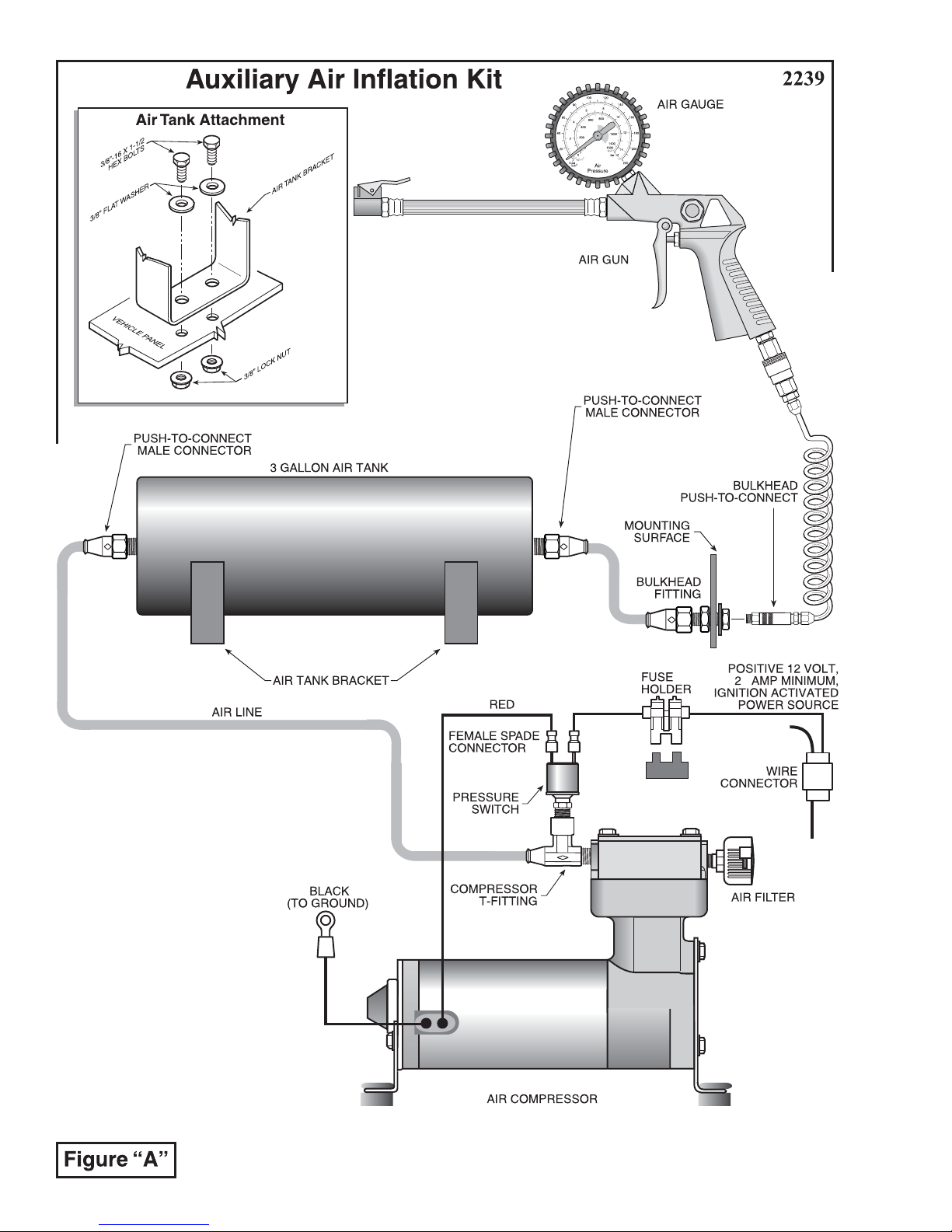
Figure "B". Install the compressor T-fitting into the threaded
exhaust port on the compressor head, see Figure "A". Tighten the
fitting sufficiently to engage the pre-applied orange thread sealant.
(Torque to 40 in. lbs.) DO NOT OVERTIGHTEN THE FITTING.
InstallthepressureswitchintothecompressorT-fitting. Installtheair
filter into the threaded inlet port on the compressor head (finger
tight). Installthe positive(red) wirefrom thecompressor ontoeither
spade on the pressure switch, see Figure "A".
STEP 3 - MOUNT THE COMPRESSOR
Selectaconvenientlocationtomountthecompressor. Thislocation
shouldprovideampleairflowandbeprotectedfromairbornedebrisand
moisture. The mounting surface should be rigid to support the compressor, such as under the hood on a fender well
or in a vented storage compartment. The compressor is oil-less and can be mounted in any orientation necessary for
installation.
Usingthe compressor as a template, center punch, and drill three 3/16" holes. Before drilling, ensure that thereare
no electrical , fuel, or brake lines on the opposite side of the mounting surface that can be damaged by the drill. Any
burrsintheholesshouldberemovedtopreventdamagetotherubberisolators. Mountthecompressorusingthesupplied
10 -32 x 1" machine screws, 10 -32 lock nuts, and 3/16" washers. SeeFigure "B". Maximum vibration isolation can
be achieved by properly mounting the compressor. The machine screw and nut should be tightened only enough to
bottom-out the brass insert, see Figure "B". DO NOT OVERTIGHTEN. Overtightening will crush the brass insert
andtherubberisolator,thereby reducing vibrationisolation.
Attach the black wire from the compressor to a grounded component of the vehicle's chassis.
STEP 4 - MOUNT THE AIR TANK
Installthemalepush-to-connectfittingsintobothportsontheairtank. Tightenthefittingsufficientlytoengagethe
pre-appliedorangethreadsealant.Selectalocationtomounttheairtank. Thisshouldbeaprotectedlocationtoprevent
damagefromflyingrocksordebris. Usingtheholesinthetankbracketsasatemplate,markthelocationsofthemounting
holesonthemountingsurface.Useacenterpunchtomarkthecenteroftheholesonthemountingsurface.Beforedrilling,
ensurethattherearenoelectrical,fuel,orbrakelinesontheoppositesideofthemountingsurfacethatcanbedamaged
by the drill. Drill four 7/16" holes on the center marks. Using the supplied 3/8" hex bolts and flanged hex nuts, attach
theairtankintothemountingsurface.SeeFigure"A". Ensureclearaccesstothefittingsontheairtankismaintained.
Do not exceed 120 psi in the tank.
STEP 5 - MOUNT BULK HEAD FITTING
Installthebulkheadfittinginaconvienentprotectedlocation.Thelocationcouldbeanyrigidflatsurfacethatwould
beaccessibleforeasydischargeofairfortheenduser.Beforedrilling,ensurethattherearenoelectrical,fuel,orbrake
lines on the opposite side of the mounting surface that can be damaged by the drill. Mark and drill a 11/16" hole in the
desiredlocation.Installthebulkheadfittingandtighten,seeFigure"E". Installthe1/4NPTfittingonthecompressor
side of the bulk head fitting and tighten the fitting sufficiently to engage the pre-applied thread sealant. Install the dry
couplerfittingontheothersideofthebulkheadfittingandtightenthefittingsufficientlytoengagethepre-appliedsealant.
Figure "B"
BRASS SLEEVE
COMPRESSOR
FOOT
RUBBER
ISOLATOR
BRASS SLEEVE
COMPRESSOR
FOOT
RUBBER
ISOLATOR
#10 FLAT WASHER
#10 FLAT WASHER
VEHICLE
MOUNTING
SURFACE
#10 -32 LOCK
NUT
#10-32 x 1 PAN HEAD
SCREW

STEP 6 - ROUTE THE AIR LINE TUBING
Routealengthofairlinetubingfromthepush-to-connectfittingon
the air tank to the T-fitting on the compressor. See Figure "A".
Route a length of the airline tubing from the tank to the bulk head
fitting,seeFigure"A".Routetheairlinetoavoidsharpedgesorheat
fromtheengineor exhaust system. Using arazorknife,makethe cut
as square as possible and push the air line into the fittings as far as
possible. Do not fold or kink the air line tubing.
STEP 7 - WIRE THE SYSTEM
Strip1/4"offtheendof the red 14 gage wire supplied withthekit.
Crimp a female spade connector onto the end of the red wire. Install
thefemalespadeconnector onto theremainingspadeonthe pressure
switch. Usingawireconnector,attachtheoppositeendofthewireto
an ignition activated, positive 12 Volt, 25 Amp minimum power
source. Consult the manufacturer's wiring diagram for your
vehicle. Slip the wire connector over the existing ignition activated
wireandinserttheun-stripped14gagewireintotheconnector. Close
the wire connector over the wires with pliers, see Figure "C".
Install an in-line fuse in the 14 gage power wire, as close to the
power source as conveniently possible. Cut the 14 gage wire and
inserttheun-stripped ends intothefuseholder. Closethefuseholder
with pliers and insert a 25 Amp blade fuse. See Figure "D".
NOTE: Shouldadditionalwirebenecessary,14gagemultistrand
wire may be used.
STEP 8 - TEST THE SYSTEM
Re-attachthenegativeterminalonthebattery.Turnonthevehicle'signition. Theaircompressorwillrunforashort
time to build pressure in the tank. Once the pressure reaches 120 psi in the air tank, the pressure switch will turn the
compressor off. It will not restart until the pressure in the tank drops below 90 psi.
USING THE AIR COMPRESSOR ACCESSORY KIT
Yoursystemisnowreadytouse. Withthecoiledtubingprovided,attachtheendwiththecoupler fittingtothebulk-
headfitting.Installthecouplerfittingonthegaugeunitthenattachthegaugeunittothecoiledtubing Youcannowuse
theairchuck gauge unitforinflation.
FILTER MAINTENANCE
It is recommended that the air compressor filter be inspected periodically. If the filter is sufficiently clogged with
road debris or moisture, it will require replacement.
EXISTING
POWER
WIRE
CONNECTINGWIRE
PLASTIC
CONNECTOR
Figure "C"
Figure "D"
FUSE HOLDER
Figure "E"
Autres manuels Firestone Compresseur d'air


Manuels Compresseur d'air populaires d'autres marques


Campbell Hausfeld
Campbell Hausfeld RP3300 Guide de démarrage rapide

Ingersoll-Rand
Ingersoll-Rand UP6 20 HP Manuel utilisateur

Hitachi
Hitachi EC99S Manuel de l'opérateur

Parkside
Parkside PKO 270 A1 Manuel utilisateur

Sullair
Sullair 185 Manuel utilisateur

Clas Ohlson
Clas Ohlson QIE-ZTH-15 Manuel utilisateur


