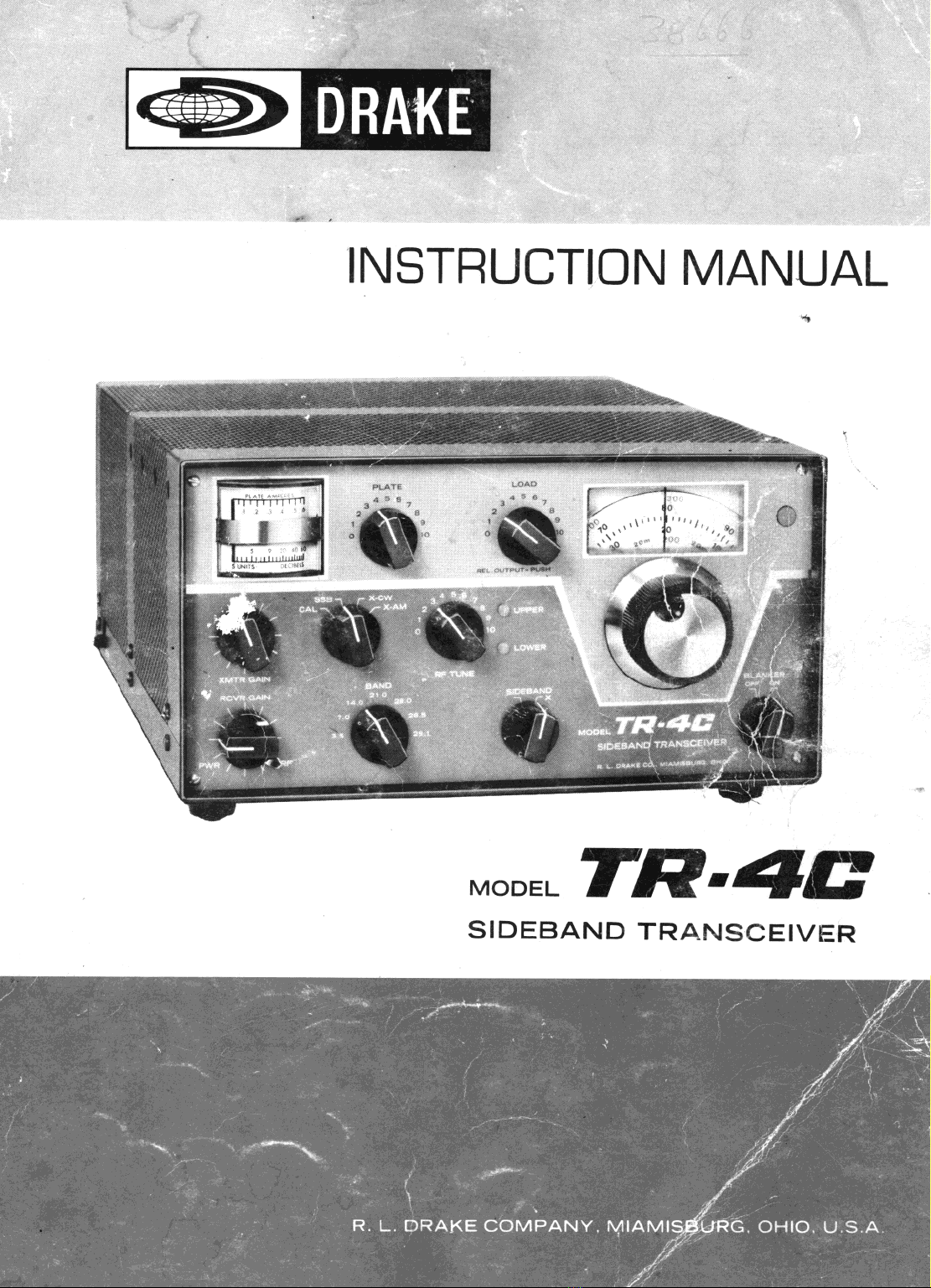
DRAKE TR-4C Manuel utilisateur


TABLE OF CONTENTS
CHAPTER I INTRODUCTION .......................
l-l.
GENERAL DESCRIPTION
.....................
l-2.
MANUAL COVERAGE
......................
CHAPTER II
2-1.
2-2.
2-3.
2-4.
2-5.
2-6.
2-7.
2-8.
2-9.
2-10.
2-11.
2-12.
CHAPTER III
OPERATION .........................
3-l. GENERAL. ..........................
3-2.
MODE SWITCH
.........................
3-3.
BLANKER SWITCH
.......................
3-4. VFODIAL. ...........................
3-5.
TUNING PROCEDURE
......................
3-6.
BIAS ADJUSTMENT
.......................
3-7.
3-8.
SPECIFICATIONS . . . . . . . . . . . . . . . . . . . . . . . . l-3
INSTALLATION. .......................
UNPACKING
..........................
LOCATION
..........................
MOBILE INSTALLATION
.....................
POWER REQUIREMENTS
.....................
MOUNTING
..........................
ANTENNA.
..........................
SPEAKER
...........................
MICROPHONE
.........................
STATIONARY INSTALLATION
...................
POWER REQUIREMENTS
.....................
VIEWING ANGLE
........................
ACCESSORIES
.........................
FRONT PANEL CONTROLS
.....................
OTHER CONTROLS
.......................
TUNE UP
...........................
SSB OPERATION
........................
Page
l-l
l-l
l-l
2-l
2-l
2-l
2-l
2-l
2-l
2-l
2-l
2-l
2-2
2-2
2-2
2-2
3-l
3-l
3-l
3-l
3-l
3-l
3-l
3-3
3-4
3-5
3-5
i

TABLE OF CONTENTS (continued)
3-9.
3-10.
3-11.
3-12.
3-13.
CHAPTER IV
4-l.
4-2.
4-3.
CHAPTER V
5-l.
5-2.
5-3.
5-4.
5-5.
5-6.
5-7.
5-8.
5-9.
5-10.
5-11.
5-12.
5-13.
5-14.
5-15.
5-16.
5-17.
5-18.
5-19.
CW OPERATION.
........................
AM OPERATION .........................
OPERATION NEAR BAND EDGES
-
..................
OPERATION WITH A LINEAR AMPLIFIER ...............
NOVICE OPERATION. ......................
THEORY OF OPERATION. ...................
GENERAL. ..........................
RECEIVER CIRCUITRY......................
TRANSMITTER CIRCUITRY ....................
MAINTENANCE. . . .
SERVICE DATA. . . . .
TOP COVER REMOVAL . .
BOTTOM COVER REMOVAL
TUBE REPLACEMENT . .
TROUBLE SHOOTING . .
TEST EQUIPMENT. . . .
ALIGNMENT PROCEDURES
CRYSTAL CALIBRATOR .
9.0 MHz OSCILLATOR . .
INJECTION CRYSTAL OSCILLATOR .................
VFO ADJUSTMENT
.......................
INJECTION COUPLER
......................
RECEIVER IF
.........................
BALANCED MODULATOR AND CARRIER BALANCE ...........
FILTER MATCHING TRANSFORMER.................
MIXER AND IF ALIGNMENT....................
PA NEUTRALIZATION ......................
TRANSMITTER NEUTRALIZATION. .................
S METER ADJUSTMENT.
.....................
Page
3-6
3-6
3-6
3-6
3-7
4-l
4-l
4-l
4-2
5-1
5-l
5-l
5-l
5-l
5-l
5-2
5-2
5-2
5-2
5-2
5-2
5-2
5-5
5-5
5-6
5-6
5-6
5-6
5-6
ii

LIST OF ILLUSTRATlONS
Figure
l-l.
2-l.
2-2.
2-3.
2-4.
2-5.
2-6.
2-7.
2-8.
2-9.
3-l.
4-l.
5-1.
5-2.
5-3.
5-4.
5-5.
TR-4C SIDEBAND TRANSCEIVER
.....................
MICROPHONE CONNECTIONS
......................
REAR CHASSIS CONNECTORS
....................
.-
.
ELECTRICAL CONNECTIONS REQUIRED FOR MOBILE INSTALLATION
.......
MOBILE INSTALLATION MOUNTING OPTIONS
................
VIEWING ANGLE OPTIONS IN A STATIONARY INSTALLATION
..........
CONNECTING THE AC-4 POWER SUPPLY AND MS-4 SPEAKER
..........
CONNECTING THE AC-4 POWER SUPPLY, RV-4C REMOTE VFO AND
A LINEAR AMPLIFIER
.........................
CONNECTING THE AC-4 POWER SUPPLY AND THE L-4B LINEAR AMPLIFIER
....
CONNECTING AN EXTERNAL RECEIVER
..................
FRONT PANEL CONTROLS
.......................
BLOCK DIAGRAM
...........................
ALIGNMENT LOCATIONS, TOP VIEW
....................
ALIGNMENT LOCATIONS, BOTTOM VIEW
..................
AC-4 POWER SUPPLY SCHEMATIC.
....................
DC-4 POWER SUPPLY SCHEMATIC.
....................
TR-4C SCHEMATIC
..........................
Page
l-2
2-l
2-2
2-3
2-4
2-5
2-5
2-6
2-6
2-7
3-2
4-4
5-8
5-9
5-11
5-11
5-l 1
.
.
.
III

CHAPTER I
INTRODUCTION
l-l. GENERAL DESCRIPTION. an MC-4 Mobile Console, and a TR-4C VHF
Modification Kit.
The TR-4C is a 300 Watt HF single sideband trans-
ceiver which covers the 80 through 10 meter
amateur bands. AM and CW modes are also included.
The TR--4C requires either an R. L. Drake AC-4,
120 V AC power supply, or an R. L. Drake DC-4,
12 V DC power supply. The TR-4C features a
high-stability linear permeability tuned VFO and
two 8 pole crystal lattice filters for sideband selec-
tion. Available accessories include an RV-4C
Remote VFO, a matching MS-4 Speaker, an FF-1
Fixed Frequency Adapter, a 34-PNB Noise Blanker,
1-2. MANUAL COVERAGE.
This manual provides sufficient information for
operation of the TR-4C Transceiver by a licensed
operator and for repair and maintenance by an ex-
perienced electronics technician. Chapter II provides
installation instructions and illustrates interconnec-
tion with accessories. Chapter III describes operation
procedures. Chapter IV presents theory of operation
supported by a block diagram. Chapter V provides
maintenance instructions and parts ordering infor-
mation.
l-l


SPECIFICATIONS
GENERAL:
FrequencyCoverage
:
3.5 to 4.1 MHz, 7.0 to7.6MHz, 13.9to 14.5 MHz, 21.O to 21.6 MHz
and 28.5 to 29.1 MHz; accessory crystals are available for the 28.0
to 28.6 MHz and 29.1to29.7 MHzsegments of the10 meter band.
Mode of Operation: Lower Sideband, Upper Sideband, AM and CW.
Frequency Stability: Total drift is less than 100 Hz after warm up. Total frequency change
is less than 100 Hz for a
+-
10% line voltage change.
Power Supply
Requirements: + 650 Volts DC at 300 mA average and 500 mA maximum with 10%
regulation from 100 to 500 mA and a maximum ripple 1%.
+ 250 Volts DC at 200 mA with 10% regulation from 170 mA to
200 mA. This includes the effect of the 650 Volt supply change if
both voltages are obtained from the same transformer. Maximum
ripple must be less than
l/4%.
-45 to -65 Volts DC adjustable filtered bias into 33 K Ohm load.
12.6 Volts AC or DC at 5.5 Amperes.
Antenna Impedance: Nominal 52 Ohms (VSWR less than 2: 1).
Better than +- 1 kHz when calibrated at the nearest 100 kHz calibra-
tion point.
Dial Calibration:
Dimensions:
Weight:
RECEIVER:
Sensitivity:
AGC:
Selectivity:
IF Frequency:
Audio Output:
Output Impedance:
TRANSMITTER:
Power Input:
Output Impedance:
Average Distortion
Products:
Microphone Input:
5.5 in. High x10.75 in.Wide x 14.375in.Deep.
13.97
cm.
High
x
27.31 cm. Widex 36.51cm. Deep.
16 lbs. (7.26 kg.)
S+N
Less than 0.5
micro
Vfor 10
dB
N
Less than 3
dB
variation for 60
dB
change in input signal.
2.1
kHzzat-6
dBB
and3.4kHzzat-60
dB.
9 MHz.
3 Watts with less than 10% distortion.
4 Ohms.
300 Watts PEP SSB, 260 Watts CW and 260 Watts PEP AM.
Nominal 52 Ohms.
The odd order products are down 30
dB
below PEP.
High Impedance.
l-3

CHAPTER II
INSTALLATION
2-1. UNPACKING.
Carefully remove the unit from the shipping carton
and examine it for evidence of damage. If any
damage is discovered, immediately notify the trans-
portation company that delivered the unit. Be sure
to keep the shipping carton and packing material as
the transportation company will want to examine
them if there is a damage claim. Keep the carton
and packing material even if no shipping damage
occurs. Having the original carton available makes
packing the unit much easier if it should ever be
necessary to store it or return it to the factory for
service.
NOTE
Fill out the enclosed registration card
and return it to the factory immediately
to insure registration and validation of
the warranty.
2-2. LOCATION.
The location of the TR-4C is not critical. However,
care should be taken to insure that adequate clear-
ance is provided to insure free circulation of air
around the unit and to allow access to the side
controls and connectors. Do not cover the top of
the cabinet with books, papers or other equipment
as overheating may result.
2-3. MOBILE INSTALLATION.
2-4. POWER REQUIREMENTS. Refer to figure
2-2 for rear chassis connector identification. The
TR-4C
may be installed in any vehicle with a 12
volt dc negative ground system. An R. L. Drake
Model DC-4 Power Supply is required for a mobile
installation. The recommended location for the
DC-4 is on the passenger side of the firewall. Refer
to figure 2-3 for the electrical connections required.
2-5. MOUNTING. Mount the TR-4C in a con-
venient location below the dash with an R. L. Drake
Model MMK-3 Mobile Mounting Kit. Refer to
figure 2-4 for various mounting options. Be sure
to allow adequate clearance for air circulation and
cable connections. Turn the TR-4C off. Connect
the power cable between the TR-4C and the DC-4.
Coil up any excess cable and tape it in place out of
sight. Connect the black wire from the power supply
to a convenient ground. Route the red wire from the
power supply through the firewall and connect it to
the positive battery terminal or the starter solenoid.
The fuse holder should be installed as close to the
solenoid as possible. Shorten both of these wires as
much as possible.
2-6. ANTENNA. Install a mobile antenna as rec-
ommended by the antenna manufacturer. Connect
a coaxial cable from the antenna to the SO-239
connector at the rear of the TR-4C.
2-7. SPEAKER. DO NOT connect the TR-4C to
the speaker of the car radio. Install a separate
speaker for use with the TR-4C. The R. L. Drake
Model MC-4 Mobile Console is recommended for
this type of installation. It includes a speaker and a
wattmeter and is designed to mount over or under
the TR-4C.
2-8. MICROPHONE. Use a microphone with a flat
frequency response. The microphone should have a
cardioid pattern to reduce pickup from the back
and sides. Connect the microphone as illustrated in
figure 2-l to insure proper performance.
L-_________~
S-230 CONNECTOR
MICROPHONE
Figure
2-
1.
Microphone Connections
2-l

2-9. STATIONARY INSTALLATION. 2-l 1. VIEWING ANGLE. Refer to figure 2-5 for
illustrations of viewing angle options. See Chapter V
for bottom cover removal.
2-10. POWER REQUIREMENTS. An R. L. Drake
Model AC-4 Power Supply rated at 120 volts ac,
50/60 Hz, is required for stationary installations.
The AC-4 is designed to fit inside the MS-4
speaker cabinet.
2-l 2. ACCESSORIES. Refer to figures 2-6 through
2-9 for the electrical connections required to
operate the TR-4C with the various recommended
accessories.
NOTE
If the old RV-3 is to be used it must
be modified as follows: Install a 22 K,
2 Watt resistor from pin 1 of the tube
(OA2) to the terminal of the FUNCTION
switch to which the orange wire is
attached.
GROUND ANTENNA POWER EXTERNAL EXTERNAL
RECEIVER RECEIVER
ANTENNA MUTE
Figure 2-2.
Rear Chassis Connectors
2-2

Autres manuels pour TR-4C
1
Table des matières
Autres manuels DRAKE Émetteur-récepteur

DRAKE
DRAKE TR-33C Manuel utilisateur

DRAKE
DRAKE UV-3 Manuel utilisateur

DRAKE
DRAKE TR7 Manuel utilisateur

DRAKE
DRAKE TR5 Manuel utilisateur

DRAKE
DRAKE Tr-6 Manuel utilisateur

DRAKE
DRAKE ML-2 Manuel utilisateur

DRAKE
DRAKE TR7 Manuel utilisateur

DRAKE
DRAKE TR-4CW Manuel utilisateur

DRAKE
DRAKE TR-4C Manuel utilisateur

DRAKE
DRAKE TR7 Manuel utilisateur