
DAVINCI GLIDERS DUET Manuel utilisateur

DAVINCI GLIDERS / DUET
1
for TANDEM
REV. 4
5 August 2017
Davinci Products Inc.
53 Sinchon-gil, Okcheon-myeon, Yangpyeong-gun, Gyeonggi-do, South Korea. (12505)
Tel. +82(0)10-9799-3472 Fax. +82(0)10-9799-3472

DAVINCI GLIDERS / DUET
1
Thank you for choosing the DUET.
he DUET has been designed for professional tandem pilots
who want to share their most fantastic moments.
This manual will help you to get all information about your
glider. We strongly recommend that you read this manual
carefully in order to be aware of any general limitations,
performance characteristics, take off and ight character-
istics, landing procedures, dealing with emergency situa-
tions and general maintenance.
This is information about the design of the DUET, advice
how to use it best and how to care for it to ensure it has a
long life, We hope that the DUET will give you a lot of satis-
factory ying times.
WARNING!
THIS IS NOT TRAINING MANUAL. ATTEMPTING TO FLY THIS
OR ANY OTHER PARAGLIDER WITHOUT PROPER INSTRUC-
TION FROM A CERTIFIED PROFESSIONAL INSTRUCTOR IS
EXTREMELY DANGEROUS TO YOURSELF AND BYSTANDERS.
DAVINCI GLIDERS are carefully manufactured and inspect-
ed at the factory. Please use the glider only as described in
this manual.
Do not make any modications to the glider.
As with any sport – without taking the
necessary safety precautions, paragliding can be danger-
ous.
Congratulations!
15pt
-DAVINCI GLIDERS TEAM-

DAVINCI GLIDERS / DUET
2
INDEX
1. Technical DATA
2. Materials DATA
3. Introduction and
Pilot Target
4. Risers
5. Lines
6. Trimmers
7. Pre-ight check
8. Take-0ff
9. In ight characteristics
10. Deations
10.2 Frontal collapse
10.3 Full stall
10.1 Asymmetric collapse
10.5 Asymmetrical stall
10.6 B stall
10.7 Cravat
12
11
10
9
7
6
5
4
3
10.4 Deep stall
14. Packing your DUET
15. Maintenance and
cleaning
16. Caring tips
13. Landing
17. Warrantee
18. Respecting nature
and environment
11.2 Spiral dive
11. Descent Techniques
12. Special Flying
11.1 Big ears
11.1 Big ears
12.1 Towing
12.2 Acrobatic ight
8

DAVINCI GLIDERS / DUET
3
1. Technical DATA
15pt
DUET 41
CELLS
NUMBER 54
CLOSED 10
FLAT
AREA m² 41.1
SPAN m 14.8
ASPECT RATIO 5.4
PROJECTED
AREA m² 35.2
SPAN m 11.8
ASPECT RATIO 3.94
FLATTENING % 14
CORD
MAX m 3.49
MIN m 0.13
AVER m 2.78
LINES
HEIGHT m 8.99
MAIN 2+1/4/3/2
RISERS
NUMBER 4 A+A’/B/C/D
TRIMS mm 110
ACCELERATOR No
WEIGHT RANGE MIN-MAX KG 120-212
CERTIFICATION EN-926-1/2
LTF KG EN-B
GLIDER WEIGHT KG 6.7

DAVINCI GLIDERS / DUET
4
2. Materials DATA
15pt
CANOPY FABRIC CODE SUPPLIER
UPPER SURFACE Skytex 38/32 PORCHER IND
BOTTOM SURFACE Skytex 32 PORCHER IND
PROFILES 32 Hard MYUNGJIN TEX
DIAGONALS 32 Hard MYUNGJIN TEX
RISERS FABRIC CODE SUPPLIER
MATERIAL WEBBING 20MM GUTH&WOLF GMBH
PULLEYS RIELY LW RILEY PTY LTD
SUSPENSION LINES FABRIC CODE SUPPLIER
UPPER CASCADES PPSL 160/120 LIROS
UPPER MIDDLE CASCADES PPSL-200/160 LIROS
LOWER MIDDLE CASCADES PPSL-160 LIROS
MAIN 7343-420/280 EDELRID
UPPER/MIDDLE STABLE PPSL 120 LIROS
MAIN STABLE 6843-160 EDELRID
UPPER BRAKE DSL 70 LIROS
UPPER MIDDLE BRAKE PPSL-120 LIROS
LOWER MIDDLE BRAKE PPSL-200 LIROS
MAIN BREAK 7850X-240 EDELRID
DAVINCI GLIDERS / DUET
5
3. Introduction and Pilot Target
4. Risers
15pt
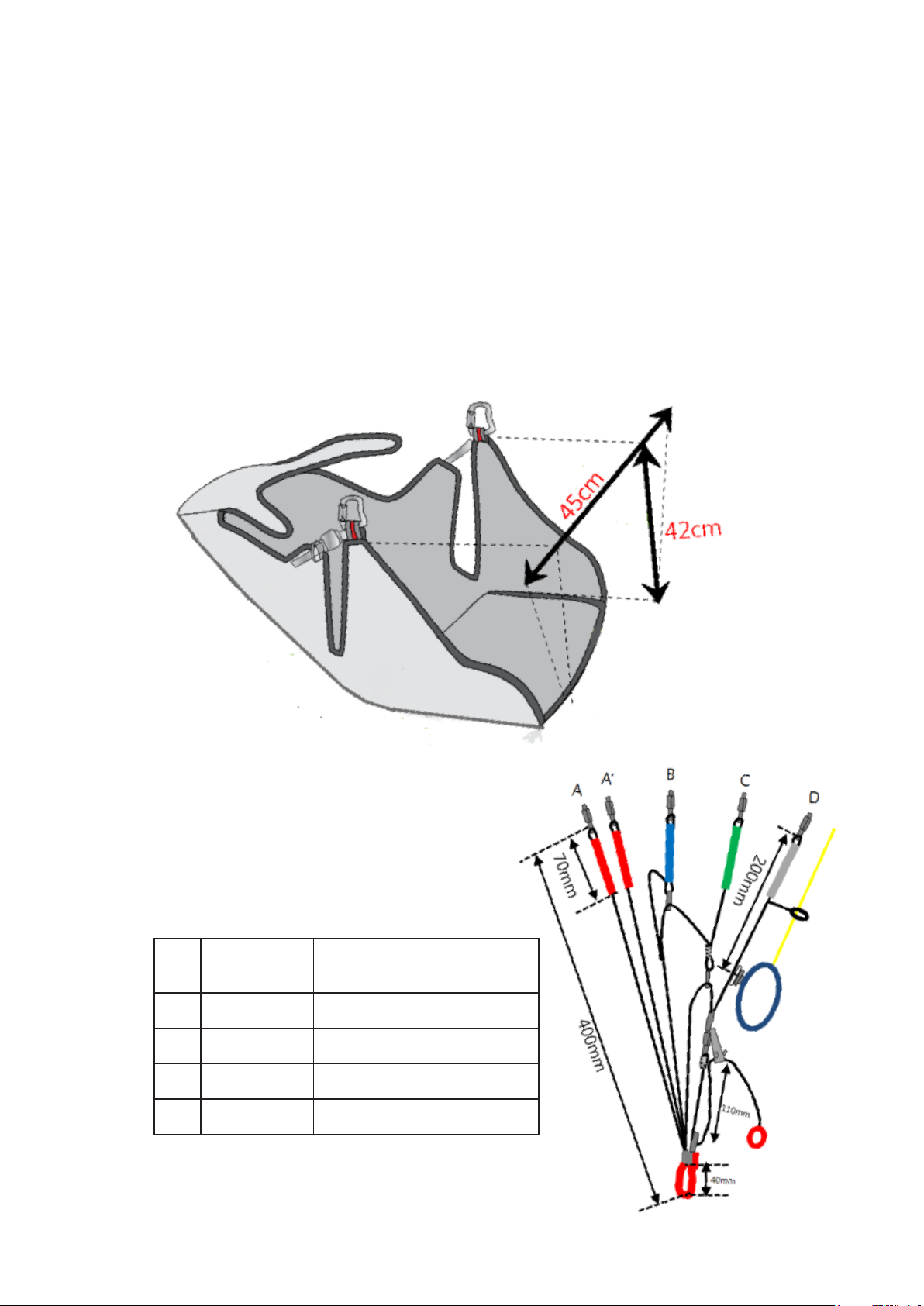
DUET has 4 risers. The A riser has a red cover to easy
identication. There is another line with red mailon.
There is A’ and is for the big ears.
The DUET is a tandem paraglider
suitable for both commercial and
entering of tandem ying. You must be in possession of the appropriate licence and
insurances to y with passengers.
Standard
[mm]
Trim opened
[mm]
Travel length
[mm]
A400 400 0
B400 427 27
C400 482 82
D400 510 110
The DUET has been classied as EN-B and LTF-B.
The glider has been type-tested for
“one-and two-seated” use.
During type-testing the DUET was tested with a
‘GH’ type harness.
The setup shown on the below picture.
You must do not
- Be own with more than the
maximum certied total weight
- Be towed with a tow line tension in
excess of 200kg

DAVINCI GLIDERS / DUET
6
15pt 5. Lines
6. Trimmers
7. Pre-ight check
They come in different diameters of Kevlar and Dyneema with sheathed cover. They must to be
inspected every 100 hours maximum.
In case of Brake lines, it was cut a little longer, so every pilot can adjust it according to his
personal taste.
But you must always leave 10cm before the brakes line starts acting in order to avoid trailing
edge deformation when the wing is fully trim opened. In case the brake handle comes loose
during ight or any brake lines is cut you can use the D riser softly for directional control instead
of brake line.
The DUET is supplied with a trim riser set. The ‘neutral’ or standard position is when the
trimmers are pulled all the way down and A/B/C/D riser lengths are equal. We recommend
performing landing and take-off with the trimmers closed. With the trimmers closed, the DUET
will reliably inate without any overshooting.
As a result, the take off characteristics are very smooth, straightforward, easy, forgiving and
require no special skills.
You can be accelerated in ight using the trimmers which make low angle of attack and increase
the ying speed. DUET trimmers provide you with more satisfying ight on windy days.
We advise you to use this trimmers carefully and do not use in turbulent and strong thermal
conditions. During full trim condition should be meet the dynamic reaction ight of the wing
in case of collapse.
To know yourself with the glider it is a good idea to perform practice inations and ground
handling in advance.
You should have no diculties ying the DUET for the rst time in suitable conditions, but as
with all new equipment.
When you have the new glider, the below points should be inspected.
- Check the lines are clear and not twisted.
- Connection points between the glider and harness.
- All harness buckles are closed.
- The Karabiners are fully closed and not damaged.
- The sewing, condition of the lines and connection of the lines are right
- Internal demage to ribs and diagonal ribs.
- Demage to the top and bottom panels and seams between panels.

DAVINCI GLIDERS / DUET
7
15pt 8. Take-0ff
9. In ight characteristics
DUET has easy ination behaviour at the forward/reverse launch because of its super light
glider weight. To get the right wing shape for the take-off, pull the brake until the canopy
shows at the perfect banana shape on the at ground. While inating the DUET, you should
hold both of th A risers on your hands. Smoothly and gradually inate the wing. It does not
need excessive energy and you feel the lift force very fast. It does not tend to over-shooting
characteristics and provides a leisurely launch time with your passenger.
We recommend to take off with closed trimmers.
DUET has the best glide performance in a normal trim position with no any brakes.
In strong thermals and turbulence, we recommend to gently pull both brakes to increase
stability without trim released.
To familiarize yourself with the DUET your rst turns should be gradual and progressive.
To make efcient and coordinated turns with the DUET rst look in the direction you want to
go and check that the airspace is clear. Your rst input for directional change should be weight-
shift, followed by the smooth application of the brake until the desired
bank angle is achieved. To regulate the speed and radius of the turn, coordinate your weight
shift and use the outer brake.
In the unlikely event that a brake line releases from the brake handle or breaks, the glider is
manoeuvrable using the D-risers. By pulling gently on the D-risers it is possible to steer the
glider and land safely.
Alternative Steering:
In the unlikely event, that a brake line releases from the brake handle, or breaks, or the brake-
lines are tangled up, the glider is manoeuvrable using the rear-risers. By pulling gently on the
rear-risers, it is possible to steer the glider and land safely. Don’t pull the rear-risers too much,
to avoid a deep stall!

DAVINCI GLIDERS / DUET
8
15pt
10.2 Frontal collapse
10.3 Full stall
DUET does not come out the symmetrical front collapse by itself. It has high
internal pressure with its well designed prole. However a symmetric collapse
my occur in strong turbulent condition, but It could be fast recovered, if you
apply the brake down to 15 to 20cm. Release the brake lines, you may recover
to the normal ight.
Full stall can occur when you fully pull the both brakes enough long time.
To recover to the normal ight you must release both brakes. After this
usually comes a front dive with a possible front deation. An asymmetric
recovery (one control released faster than the other) from a full-stall can
cause a big dynamic collapse. The full-stall is a hazardous manoeuvre and not
recommended as it requires very high forces.
The available brake travel before stalling the wing depends on the size and the
ight weight. For the DUET it has minimum of 65cm travel length at maximum
total-load. Those numbers are just a rough indication. (The publication of the
brake travel is claimed by the EN 926-2.)
It would be dangerous to use the brake travel according to those numbers,
because it is not practicable to measure the brake travel during ight, and in
turbulences the stall might occur with less brake travel. If you want to use the
whole brake travel of your glider safely, it is necessary to do many intended
spins and full stalls to get a feeling for the stall behaviour.
10. Deations
10.1 Asymmetric collapse
Asymmetric collapse usually happens when the pilot has not foreseen this
possible reaction of the wing.
Asymmetric collapses should be controlled by weight shifting away from
the collapse and applying enough brake to control your direction. And you
should use the brake to re-inate the glider.
In spite of the DUET has great stability of the ight, strong turbulence or piloting error may
cause a portion of the wing suddenly to be a deation.

DAVINCI GLIDERS / DUET
9
15pt
10.5 Asymmetrical stall
10.6 B stall
10.7 Cravat
It can take place when you pull one of the brakes too hard, or while spiraling
at a small speed in turbulence you increase the angle of attack. Rotation in the
asymmetrical stall is called negative spiral. This is one of the most dangerous
ying situations. In order to get out of asymmetrical stall, just release the
brakes. There may follow side thrust forward with a following wing collapse.
We do not recommend a B stall with the DUET. This techniques is generally
very hard to use with DUET by the high force needed to pull down the B lines.
In case a cravat should occur from an asymmetric collapse or other
manoeuvres, it is important to keep your ying direction by applying some
brake on the opposite side and weight shift.
You can also use strong deep pumps on the brake to the cravated side. If
a pull of the break line is unsuccessful, pulling the stable line which is the
outermost line on the B-riser may work.
If you can not do it and the rotation is increasing, you must use the parachute.
10.4 Deep stall
It is possible for gliders to enter a state of deep stall. This can be caused by
several situations including; a very slow release from a B-line stall; ying the
glider when wet; or after a front/symmetric deation.
When you meet this situation you should fully raise up the both brakes and
push the A-risers forwards or release the trims symmetrically to regain
normal ight.
Autres manuels pour DUET
1
Table des matières
Autres manuels DAVINCI GLIDERS Aéronef

DAVINCI GLIDERS
DAVINCI GLIDERS DUET Manuel utilisateur

DAVINCI GLIDERS
DAVINCI GLIDERS BALLAD 19 Manuel utilisateur

DAVINCI GLIDERS
DAVINCI GLIDERS SOUL Manuel utilisateur

DAVINCI GLIDERS
DAVINCI GLIDERS JAZZ 21 Manuel utilisateur

DAVINCI GLIDERS
DAVINCI GLIDERS TANGO XS Manuel utilisateur

DAVINCI GLIDERS
DAVINCI GLIDERS Funky2 Manuel utilisateur

DAVINCI GLIDERS
DAVINCI GLIDERS Point Manuel utilisateur

DAVINCI GLIDERS
DAVINCI GLIDERS OPERA Manuel utilisateur


