
Coopers 9082 Manuel utilisateur

Petrol Chainsaw 9082 Instru tions
WARNING Before using our product please
read carefully to understand the proper use of your unit.

2
C ntents
Parts location 3
Specifications 3
Symbols on the machine 4
Warning 5 - 7
For safe operation 8 - 9
Installing guide bar and saw chain 10 - 11
Fuel and chain oil 12
Operation 13 - 17
Sawing 18 - 21
Maintenance 22 - 24
Maintenance of saw chain and guide bar 25 - 26
Troubleshooting guide 27
Storage 28
Packaging Disposal 28
EC Declaration of Conformity 28
Warning
This mark indicates instructions which must be
followed in order to prevent accidents which could lead
to serious bodily injury or death.
Imp rtant
This mark indicates instructions which must be
followed, or it leads to mechanical failure, breakdown,
or damage.
N te
This mark indicates hints or directions useful in
the use of the product.
!
!
SAFETY
FIRST
Instru tions ontained in
warnings within these
instru tions marked with a
symbol on ern riti al
points whi h must be
taken into onsideration to
prevent possible serious
bodily injury, and for this
reason you are requested
to read all su h
instru tions arefully and
follow them without fail.
!
!
WARNING SYMBOLS

3
Specifications are subject to change without notice.
Parts l cati n
Front guard
Guide bar
Saw chain
Air cleaner cover
Starter rope
Oil tank
Choke knob
Left handle
Engine switch
Throttle lever
Fuel tank
Throttle trigger
Throttle interlock
Right handle
Specificati ns
Power unit
Displacement: 45cm3Usable cutting length: 440mm (18in)
Fuel: Mixture Petrol 25 : 2-cycle oil 1 Max. chain speed (at 1.33 x max. engine power) 21.2m/s
Fuel tank capacity: 550ml
Chain oil: Motor oil SAE 10W-30
Oil tank capacity: 260ml
Carburetor: Diaphragm type Engine idling speed 3000 +200 min-1
Ignition system: Pointless CDI
Power: 1.7/7,500 kw/min-1 Sound pressure level ISO 22868 LPA: 108dB(A)
Max speed: 2,800min-1 Sound pressure level ISO 22868 LWA< 116dB(A)
Dimensions: L400 xW250 x 270mm Vibration tool value ISO 22867: <15m/s2
Dry Weight: Power unit only 6.4kg
Cutting attachment
Guide bar: Type: Sprocket nose 16(40) Size: 18in (45cm) Gauge: 0.050in (1.27mm)
Saw Chain: Type: Oregon Pitch: .325in (8.26mm) Sprocket teeth: 7
Tensioner
nut

4
Symb ls n the machine
For safe operation and maintenan e, symbols are arved in relief on the ma hine.
A ording to these indi ations, please be areful not to make any mistake.
!
(a) The port to refuel Petrol/2-Stroke Oil mix using
mixing container.
Position: Fuel cap, bottom of the power unit.
(b) The port to top up chain oil.
Position: Oil cap.
(c) Setting the switch to the “O” position, the engine
stops immediately.
Position: Rear-left of the unit.
(d) Starting the engine. If you pull out the choke knob
(at the back-right of the rear handle) to the point of the
arrow, you can set the starting mode as follows: First-
stage position – starting mode when the engine is
warm. Second-stage position – starting mode when the
engine is cold.
Position: Upper-right of the air cleaner cover.
(e) The screw under the Hstamp is the high-speed
adjustment screw.
The screw under the Lstamp is the slow-speed
adjustment screw.
The screw at the left of the Tstamp is the Idle
adjustment screw.
Position: to the right of the starter rope.
(f) Shows the directions that the chain brake is released
(white arrow) and activated (black arrow).
Position: Front of the chain cover.
g) Use a screwdriver to turn the screw to increase or
decrease the flow of oil to the chain.
Position: Bottom of the power unit.
C OKE
START
RUN
(a)
(b)
( )
(d)
(e)
(f)
(g)

5
• Chainsaws are potentially dangerous tools.
Professional training is recommended before first
use.
• If you are not familiar with chainsaws and the
felling of trees, it is recommended that you
obtain further more detailed instructions and
information regarding chain-sawing in addition
to reading this manual fully. We also recommend
that inexperienced chainsaw users practice
cutting logs on a saw-horse or log cradle before
attempting to fell a tree.
• Keep work area clean.
• Do OT start cutting until you have a clear work
area, secure footing and a planned, clear escape
path from the falling tree or limb.
• Use extreme caution when cutting small size
brush and saplings because the slender material
may catch the saw chain and be whipped toward
you or pull you off balance.
• Do OT operate a chainsaw at height in a tree
or on a ladder unless specifically trained to do so.
• When cutting a limb that is under tension, be
alert for spring back so that you will not be
struck when the tension in the wood fibres is
released.
• Do OT expose the chainsaw to rain.
• Do OT use the chainsaw in damp or wet
conditions.
• Do OT use the chainsaw in presence of
flammable liquids or gases.
• Keep children, bystanders and pets away from
the work area.
• When not in use, chainsaws should be stored in a
dry, secure location – well out of the reach of
children.
• Always fit the chain guard when not in use.
• Never force the chainsaw - it will do the job better and
safer when used correctly.
• Only suitable for use to cut wood with a diameter
smaller than the length of the guide bar.
• Do OT use chainsaw for cutting plastic, masonry,
non-wood building materials.
• Do OT use the chainsaw for any use other than the
intended use described in these instructions.
• Make sure you are suitably dressed when using the
chainsaw with correct standard Personal Protective
Equipment.
• Do OT wear loose clothing or jewellery that can get
caught in moving parts. eavy duty gloves and sturdy
non-slip work boots are recommended when working
outdoors.
• Wear a hairnet to contain long hair which can get
caught in moving parts.
• Always wear suitable head, ear and eye protection.
• Carry the chainsaw by the front handle with the saw
stopped, your finger off the trigger and the guide bar
and saw chain to your rear.
• Periodically inspect chainsaw for damage. Do OT use
if damaged in any way.
• Always clean after use and replace worn parts when
performance becomes reduced.
• Do not smoke while handling fuel or while operating
the chainsaw.
• Follow instructions for lubricating and changing
accessories.
• Keep handles dry, clean and free from oil and grease.
• Turn off the chainsaw when not in use, before servicing
or cleaning, and when changing accessories and
attachments, such as saw chain and guard.
• Stay alert, watch what you are doing. Always use
common sense.
Warning
!!

6
• Do OT operate chainsaw when you are tired, ill
or under the influence of alchol or drugs.
• Using a chainsaw can be strenuous. Remember to
take regular breaks. Tiredness may result in loss of
control.
• Keep all parts of the body away from the chain
when the chainsaw is switched on.
• Before you start the saw, make sure the saw chain
is not in contact with anything.
• Always check for damaged parts before first and
every use or if the chainsaw is dropped. Do OT
use if any part is damaged in any way. Check for
alignment of moving parts, binding of moving
parts, breakage of parts, mounting and any other
conditions that may affect operation. Any part that
is damaged should be properly repaired or replaced
by an authorised service centre unless otherwise
indicated elsewhere in this instruction manual.
• Regularly check that all the fixings are secure as
vibrations in use may cause them to loosen over
time.
• When servicing, use only identical replacement
parts.
• Do OT use the chainsaw if the switch does not
turn it on and off.
• Do OT operate a chainsaw that is damaged,
improperly adjusted, or is not completely and
securely assembled. Be sure that the saw chain
stops moving when the trigger is released before
using to cut wood.
• Guard against kickback.
• Only use replacement bars and chains specified by
the manufacturer or the equivalent.
• For outdoor domestic use only.
Warning
!
RESIDUAL RISKS
Despite the above warnings and due to the nature of
the product, there remains a residual risk, which
cannot be prevented when using a chainsaw. The
following potential hazards might apply:
• Contact with exposed saw teeth of the saw chain
(cutting hazards).
• Access to the rotating saw chain (cutting hazards).
• Unforeseen, abrupt movement of the guide bar
(cutting hazards.)
• Parts flung out from the saw chain (cutting/injection
hazards).
• Wood splinter ejection.
• Inhalation of wood particles and dust - there may
be health risks caused by breathing in dust,
especially dust generated from sawing oak, beech
and MDF.
• Skin contact with the lubricating oil.
• Loss of hearing, if ear protection is not worn.
I TE DED/U I TE DED USE
When using the chainsaw, the user must arrange to
use personal protective equipment according to the
manual. Parts of the intended use are detailed in the
manual’s safety warnings and references for use by
those who work with the chain saw or maintain it,
therefore the user must be familiar with the manual.
Only use original or approved spare parts (e.g. guide
bar; saw chain).

7
Warning
!
Vibration Warning!
Prolonged use of chainsaws or any other machine
that vibrates in use, may produce a medical condition
called “white finger disease”, “Raynaud’s
phenomenon”, or “carpal tunnel syndrome”.
These conditions can cause numbness, burning
sensations and circulation damage, and may reduce
the hand’s ability to feel and regulate temperature.
The factors that contribute to these conditions are
not fully known, but high vibrations may be a cause.
Users should take precautions to minimise the risks
which include:
• Wear gloves
• Keep hands warm
• Take breaks from prolonged use
• Keep the chain saw sharp so that it operates as
smoothly as possible
• Maintain a firm grip but do not squeeze too tight
and for too long at any one time.
Continual and regular users should monitor their
hands and fingers and if any symptoms occur, or if
you are worried at any time, cease use and consult
your medical practitioner for further advice.
Warning! Restriction of use.
Please check with your local authority before using a
chainsaw as there may be regulations in force that
restrict their use e.g. in times of drought.
Warning! Hearing protection.
It is recommended that safety ear/hearing protection
is worn at all times when operating this chain saw.
Chain saw noise may damage your hearing. Regular
users should have frequent hearing tests with their
medical practitioner.
The hearing protection should be suitable for
defending hearing for the following levels:
Sound pressure level according to ISO22868
LPA:108dB(A).
Sound pressure level according to ISO22868 LWA:
<116dB(A)
Inhalation Warning!
Using the chainsaw may generate dust, mist and
fumes containing chemicals that could be harmful to
the user. Dust alone may also be harmful and should
not be inhaled. Never use the chain saw to cut
anything that is known to contain a harmful
substance such as asbestos. Always operate the
chainsaw in a well-ventilated location, preferably
outdoors. Remember that the fuel and oil used to
power and lubricate this machine will give off
harmful fumes in use, and when filling – always
ensure there is sufficient ventilation as soon as you
start the engine. A dust mask or breathing apparatus
is recommended safety equipment, and anyone with
a respiratory or other breathing medical condition is
advised to consult their medical practitioner before
using the chainsaw.

8
KICKBACK SAFETY PRECAUTIO S FOR CHAI SAW USERS
WAR I G
Ki kba k may o ur when the nose or tip of the guide bar tou hes an
obje t, or when the wood loses in and pin hes the saw hain in the ut.
Tip onta t in some ases may ause a lightning fast reverse rea tion,
ki king the guide bar up and ba k towards the operator. Pin hing the saw
hain along the top of the guide bar may push the guide bar rapidly ba k
towards the operator. Either of these rea tions may ause you to Iose
ontrol of the hainsaw, whi h ould result in serious personal injury.
Do not rely exclusively on the safety devices built into your chainsaw. As a
chainsaw user you should take several steps to keep cutting jobs free from
accident or injury.
(1) With a basic understanding of kickback you can reduce or eliminate the
element of surprise. Sudden surprise contributes to accidents.
(2) Keep a good grip on the saw with both hands, the right hand on the rear
handle, and the left hand on the front handle, when the engine is running.
Use a firm grip with thumbs and fingers encircling the chain saw handles.
A firm grip will help you reduce kickback and maintain control of the saw.
(3) Make certain that the area in which you are cutting is free from
obstructions. Do not let the nose of the guide bar make contact with a
log, branch, or any other obstruction which could be hit while you are
operating the saw.
(4) Cut at high engine speeds.
(5) Do not overreach or cut above shoulder height.
(6) Follow the manufacturer’s sharpening and maintenance instructions for
the saw chain.
(7) Only use replacement bars and chains specified by the manufacturer
or the equivalent.
!
!
F r safe perati n
Ki kba k
situations
Good grip
positions
Corre t
handle grip
In orre t
handle grip
Do not
overrea h

9
AVOIDI G PULL-I
Pull-in can occur when the bottom of the chain is used for
cutting and is stopped suddenly by hitting a foreign object
or getting pinched. This pulls the chainsaw forwards and
may cause the user to lose control. Pull-in can also occur
when the chain is not running at full speed when contact is
made with the wood and if the bumper spike is not held
securely against the wood being cut.
• Ensure the chain is rotating at full speed and the bumper
spike is correctly positioned when making a cut.
AVOIDI G PUSHBACK
Pushback can occur when the top of the chain is used for
cutting and is stopped suddenly by hitting a foreign object
or getting pinched. This pulls the chainsaw towards the
user and may cause the user to lose control.
• Take care not to twist the chainsaw as it is removed
when bucking from underneath the log.
• Do OT cut more than one log at any one time.
• Be aware of situations that may cause the chain to pinch
or pull.
BUMPER SPIKE
This is used to help secure the tree or limb when cutting
and should be used at all times when positioning the
chainsaw. It will help prevent pull-in, pushback, kickback
and loss of control.
!F r safe perati n
Bumper
Spike
10
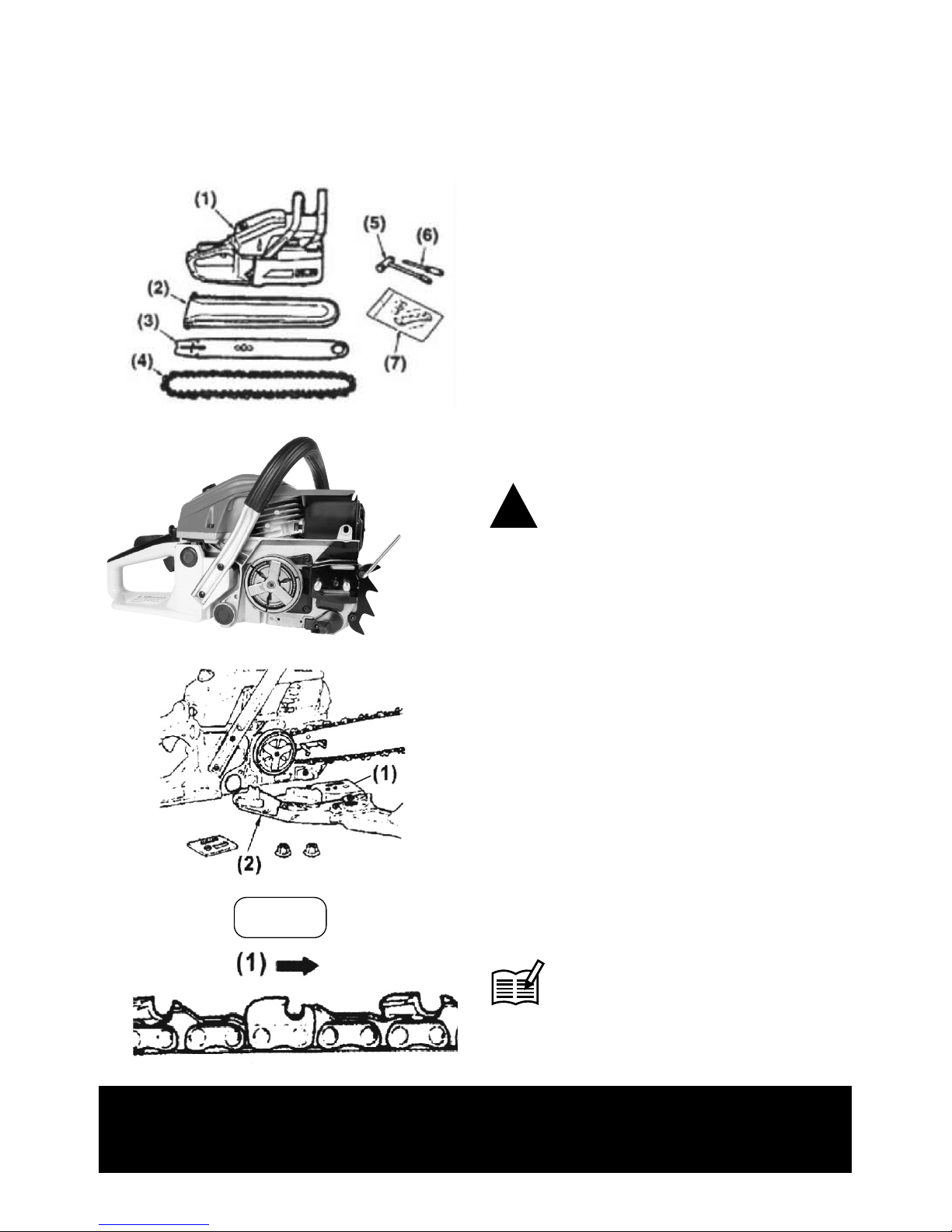
A standard saw unit package contains the items (F0).
(1) Power unit
(2) Saw guard
(3) Guide bar
(4) Saw chain
(5) Plug wrench
(6) Screwdriver for carburetor adjustment
(7) Spike, 2 screws and Allen key
Open the box and install the guide bar and the saw
chain on the power unit as follows:
Warning
The saw hain has very sharp edges.
Use thi k prote tive gloves for safety.
1. Pull the front guard towards the front handle to
check that the chain brake is not engaged.
2. Loosen the nuts using the wrench and remove the
chain cover.
3. Install the spike to the power unit. Secure using
2x screws and Allen key (F1).
4. Gear the chain to the sprocket and, while fitting
the saw chain around the guide bar, mount the
guide bar to the power unit. Adjust the position of
the chain tensioner (F2).
(1) Tensioner nut
(2) Chain cover
ote
Pay attention to the correct direction of the saw
chain (F3)
Installing guide bar and saw chain
!
(F0)
(F2)
(F3)
(1) Moving
dire tion
(F1)
Table des matières
Autres manuels Coopers Tronçonneuse


