
CaptiveAire TANK Manuel utilisateur

Model TANK Fire Suppression Extinguishing System
Installation, Operation, and Maintenance Manual
TANK Fire Suppression Extinguishing System Typical Hood End Cabinet Installation
RECEIVING AND INSPECTION
Check for any signs of damage upon receipt, and if found, report it immediately to the carrier.
Check that all items are accounted for and free of damage.
WARNING!!
The TANK Fire Suppression extinguishing system unit is to be installed, inspected, recharged
and maintained in accordance with NFPA 17A, NFPA 96, and the National Fire Code of Canada
as applicable.
Installation and maintenance of the TANK Fire Suppression extinguishing system must be
performed in accordance with this manual by a factory trained and authorized distributor.
Improper installation poses serious risk of injury due to electric shock and other potential
hazards. Read this manual thoroughly before installing or servicing this equipment. ALWAYS
disconnect power prior to working on equipment.
Save these instructions. This document is the property of the owner of this equipment and is required
for future maintenance. Leave this document with the owner when installation or service is complete.
Part No. A0029342
August 2021 Rev 13

2

3
WARRANTY ............................................................................. 4
Certifications and Approvals ................................................. 4
System Overview .................................................................. 4
COMPONENTS ....................................................................... 5
Cylinder Assembly ................................................................ 6
Cylinder and Actuator Bracket .............................................. 7
Discharge Adapter ................................................................ 7
Nozzles ................................................................................. 8
Primary Actuator Kit (PAK) ................................................... 8
Secondary Valve Actuator (SVA) and Hose ......................... 9
Supervisory Pressure Switch ................................................ 9
Gas Shut-Off Valves ........................................................... 10
Electric Remote Manual Release ....................................... 10
Firestat (Heat) Detector ...................................................... 10
INSTALLATION ...................................................................... 11
Cylinders ............................................................................. 11
Primary and Secondary Actuator Installation ...................... 12
Primary Actuator Kit (PAK) ................................................. 12
Secondary Valve Actuator .................................................. 13
Supervisory Pressure Switch .............................................. 14
Duct and Plenum Protection ............................................... 15
Plenum Protection ........................................................... 15
Duct Protection ................................................................ 16
Ventilation Exhaust and Dampers ...................................... 18
Electrostatic Precipitators (ESP) ......................................... 18
Appliance Protection ........................................................... 19
Overlapping Appliance Protection ................................... 19
Appliance Coverage ........................................................... 20
Coverage Exceptions ...................................................... 21
Overlapping Protection .................................................... 23
Overlapping Coverage - Group Protection ...................... 23
Upright Broiler/Salamander Protection ............................ 26
Appliance with Shelf ........................................................ 27
Wok Protection ................................................................ 28
Large Wok Protection ...................................................... 29
Appliance with Upright Obstruction ................................. 30
Appliance with Overhead Salamander ............................ 31
Pizza Ovens .................................................................... 32
Agent Distribution Piping .................................................... 34
Single Cylinder Nozzle and Piping Parameters ............... 35
Dual Cylinder Nozzle and Piping Parameters ................. 35
Nozzle Installation ........................................................... 36
Gas Shut-Off Valves ........................................................ 37
Fire Protection System Firestat .......................................... 38
Non-Solid Fuel Appliances (Rated 450°F) ....................... 38
Non-Solid Fuel Appliances (Rated 600°F) ....................... 38
Solid Fuel Appliances (Rated 700°F) .............................. 38
Hood Riser Sensor Replacement ....................................... 40
Fire Protection Manual Actuation Device ............................ 41
Trouble Input Wiring ........................................................... 41
Battery Backup ................................................................... 42
Power Supply Adjustment ................................................... 42
Fire Protection System Printed Circuit Board .................. 43
ELECTRICAL ......................................................................... 46
Wire Ampacity Rating ......................................................... 47
Distance Limitations ............................................................ 47
Fire Alarm Contacts ............................................................ 47
Fire Group ........................................................................... 48
Fire Protection System Supervised Loops .......................... 49
OPERATION .......................................................................... 50
Test Mode Overview ........................................................... 50
Reset Overview .................................................................. 51
TROUBLESHOOTING ........................................................... 53
Appliance Shutdown in Fault Conditions ............................ 54
Local Alarm Muting .......................................................... 54
Test Mode ....................................................................... 54
Supervised Loop Wiring Troubleshooting ........................... 55
DIP Switch Settings ......................................................... 56
Typical DIP Switch Arrangement ..................................... 57
INSPECTION AND TEST ...................................................... 58
Start-up/Test Procedure ..................................................... 58
Preparing System for Test ............................................... 58
Connecting Service Test Tank to the System ................. 58
Test Procedure ................................................................ 59
Disconnecting Service Tank/Re-arming System ............. 60
MAINTENANCE ..................................................................... 61
Every Month (System Owner) ............................................ 61
Every Six Months (Authorized Distributor) .......................... 62
Every Twelve-Years ........................................................... 62
Agent Cylinders ............................................................... 62
Actuation Hoses .............................................................. 62
Conditional Maintenance .................................................... 63
Replacing A Primary Actuation Kit .................................. 63
Replacing A Secondary Valve Actuator .......................... 63
Mobile Kitchen Decommissioning/Commissioning .......... 64
POST-DISCHARGE MAINTENANCE ................................... 65
General Information ............................................................ 65
Appliance Cleanup ............................................................. 65
Cleaning Distribution System ............................................. 65
Cleaning Nozzles ................................................................ 65
Flushing the Distribution Pipe Network ............................... 66
Flushing Procedure with Spare/Test Cylinder .................... 66
Flushing Procedure with an External Water Supply ........... 67
Cylinder Maintenance ......................................................... 67
Removing a Cylinder .......................................................... 68
Depressurizing a Cylinder ............................................... 69
Installing a Cylinder ......................................................... 70
Rechecking the System ................................................... 70
TANK FIRE SUPPRESSION SYSTEM PARTS .................... 71
Start-Up and Maintenance Documentation ........................ 72
Job Information ................................................................... 72
Table of Contents

4
WARRANTY
Model TANK Fire Suppression extinguishing system is warranted to be free from defects in materials and
workmanship, under normal use and service, for a period of 60-months from date of shipment. Warranty
does not cover consumable products such as batteries and nitrogen. This warranty is null and void if:
1. The system is not installed by a factory trained installer per the MANUFACTURER’S installation
instructions shipped with the product.
2. The equipment is not installed in accordance with Federal, State, Local codes, and regulations.
3. The system is misused or neglected, or not maintained per the MANUFACTURER’S maintenance
instructions.
4. The system is not installed and operated within the limitations set forth in this manual.
5. The invoice is not paid within the terms of the sales agreement.
The MANUFACTURER shall not be liable for incidental and consequential losses and damages potentially
attributable to malfunctioning equipment. Should any part of the equipment prove to be defective in
material or workmanship within the 60-month warranty period, upon examination by the
MANUFACTURER, such part will be repaired or replaced by MANUFACTURER at no charge. The BUYER
shall pay all labor costs incurred in connection with such repair or replacement. Equipment shall not be
returned without MANUFACTURER’S prior authorization, and all returned equipment shall be shipped by
the BUYER, freight prepaid to a destination determined by the MANUFACTURER.
NOTE: To receive warranty coverage for this product, copy and print out the “Start-Up and
Maintenance Documentation” on page 72. Fill in all required information. Fax the page to
1-919-516-8710 or call 1-866-784-6900 for emailing information.
Certifications and Approvals
The Tank Fire Suppression system is ETL Listed in accordance with ANSI/CAN/UL/ULC 300, ULCORD-
C1254.6.
The microprocessor-based control board is ETL Listed to UL Standard 864 and CAN/ULC-S527-11.
The Tank Fire Suppression system is acceptable for use in New York City, and is approved per FDNY
COA #5870.
System Overview
The Tank Fire Suppression extinguishing system provides fire protection for commercial cooking
appliances and ventilation. The Tank Fire Suppression extinguishing system is electrically released via a
24V DC solenoid valve. Extinguishing system units with electrical detection, activation, and control require
the use of a Listed Control Panel, which has been found acceptable for releasing device service and which
is compatible with the electrical actuators used on the extinguishing system. In addition, all electrical
detectors, notification devices, and pull stations are required to be Listed and compatible with the Control
Panel.

5
COMPONENTS
The following section lists the major components used in the TANK Fire Suppression extinguishing
system.
Figure 1 - Shipping/Test View
Figure 2 - Exploded View
NOTE: Tanks should never be filled in the field.
1. Unit is shown in Shipping/Test
Position
2. Tank Straps
3. Tank Mounting Bracket
(Secured to cabinet with rivets)
4. Cylinder Tanks (Up to four
tanks may be installed
depending on cabinet size.)
1
2
3
4
2
1. Tank Mounting Brackets
2. Secondary Supervisory Pressure
Switch (Optional)
3. Secondary Cylinder (Optional)
4. Primary Cylinder
5. Supervisory Pressure Switch
6. Primary Actuator Kit
7. Secondary Actuator Hose (Optional)
8. Secondary Valve Actuator (Optional)
9. Primary Valve with Siphon Tube
10. Secondary Valve with Siphon Tube
(Optional)
Tank straps not shown.
1
3
7
2
8
4
5
10
6
9

6
Cylinder Assembly
The TANK Fire Suppression cylinder assembly (p/n 87-300001-001) uses a mild steel cylinder, conforming
to 4BW250 DOT & 4BWM-17 TC specifications, and a nickel-plated brass valve with pressure indicator
gauge. Each valve includes a Schrader port for connection to the primary actuator hose (for primary
cylinders) or the supervisory pressure switch (optional for secondary cylinders).
Each cylinder assembly is factory-filled with TANK liquid fire suppressant and pressurized to 200 PSIG
(1379 kPA) at 70°F (21°C). Each cylinder supports up to 5 nozzles for a total of 20 flow points.
Figure 3 - Cylinder Tank Details
The pressure of a cylinder will vary with the ambient temperature, as detailed in Table 1. The gauge
indicator (shown in Figure 3) should be in the acceptable ‘green’ range for a cylinder that is properly
pressurized and within the listed operating temperature range. For a cylinder at the lowest listed operating
temperature of 32°F (0°C), the pressure gauge should read approximately 175 psig (the lower end of the
green range). For a cylinder at the highest listed operating temperature of 130°F (54.4°C), the pressure
gauge should read approximately 225 psig (the upper end of the green range).
Table 1 - Cylinder Temperature Vs Pressure
1. Valve Actuation Interface
2. Schrader Valve
3. Pressure Gauge
4. Discharge Outlet
A. Tank to Actuator Distance =
23-1/4”
B. Tank Diameter = 10”
A
B
1
2
3
4
2
225
(1551 kPA)
215
(1482 kPA)
205
(1413 kPA)
195
(1344 kPA)
185
(1275 kPA)
175
(1206 kPA)
30
(-1)
40
(4)
50
(10)
60
(15.6)
70
(21)
80
(27)
90
(32)
100
(38)
110
(43.3)
120
(49)
130
(54.4)
Temperature °F (°C)
Pressure PSIG (kPa)

7
Cylinder and Actuator Bracket
Each cylinder assembly is secured to a factory-installed cylinder bracket in the cabinet (p/n TFS-
UCTANKBRACKET). The cylinder is secured to the cylinder bracket via three (3) stainless steel straps.
The cylinder bracket also includes a platform for securing a primary actuator kit or secondary valve
actuator during shipping and maintenance procedures.
Figure 4 - Cylinder and Actuator Bracket
Discharge Adapter
The discharge adapter (p/n WK-283952-000) is used to connect the TANK Fire Suppression cylinder valve
outlet to the agent distribution pipe network. The 1/2-inch NPT internal thread of the discharge adapter
outlet is connected to the supply line via an elbow and adapter.
The discharge adapter uses an O-ring (p/n WK-108019-000) at the valve port to eliminate leaks during
discharge.
Figure 5 - Discharge Adapter

8
Nozzles
The nozzle (p/n 3070-3/8H-SS10) is a 4 flow nozzle and is used for plenum, duct, and dedicated appliance
coverage (e.g., salamanders, upright broilers, chain broilers, and appliance with upright obstructions). The
nozzles include a cap (p/n 3074-1-1). The cap prevents contamination from entering the pipe network and
is designed to pop-off upon system discharge, allowing the agent to flow to the protected hazard area.
Refer to “Duct and Plenum Protection” on page 15.
Figure 6 - Fire System Nozzle
Primary Actuator Kit (PAK)
The Primary Actuator Kit (PAK) (p/n 87-300030-001) is installed on each primary cylinder assembly to
pneumatically open the cylinder valve and provide actuation pressure for up to three secondary valve
actuators.
The PAK consists of a pneumatic actuator, 24V DC solenoid valve, check valve, primary actuator hose,
and associated fittings.
Upon automatic or manual system actuation, the control panel sends a momentary 24V DC release signal,
opening the PAK solenoid. Pressure from the primary cylinder is passed through the solenoid and check
valve, into the primary actuator (actuating the primary cylinder), and into the interconnected secondary
valve actuators (actuating the secondary cylinders).
The primary actuator has a 1/8” NPT inlet port for connection to the primary system cylinder, and a 1/8”
NPT outlet port for connection to the secondary cylinder actuation line or actuation plug for single cylinder
system. The primary actuator includes a piston with a spring-loaded locking pin which locks the piston in
the discharge position, ensuring complete discharge of the cylinder contents.
Figure 7 - Primary Actuator Kit
NOTE: The primary supervisory pressure switch is standard on primary tanks. Secondary
supervisory pressure switches are optional on secondary tanks.
1. Schrader Service Port
2. Primary Actuator Hose
(Stainless Steel)
3. Solenoid Valve
4. Supervisory Pressure
Switch Connection
5. Primary Actuator
6. Locking Pin
7. Piston
5
1
2
1
3
4
6
7

9
Secondary Valve Actuator (SVA) and Hose
A Secondary Valve Actuator (SVA) (p/n 87-120042-001) is installed on each secondary cylinder assembly
to pneumatically open the cylinder valve(s). The SVA has 1/8” NPT inlet and outlet ports for connection to
the system actuation line via the SVA hose. All secondary hoses require a 1” minimum bend radius. The
SVA includes a spring-loaded locking pin that locks the actuator piston in the discharge position, ensuring
complete discharge of the cylinder contents.
Figure 8 - Secondary Valve Actuator
Supervisory Pressure Switch
The primary and (optional) secondary supervisory pressure switch (p/n 87-300040-001) are preset to
alarm at a cylinder pressure of ~10% below the lowest operating system pressure of 175 psig (pressure at
the lowest listed operation temperature of 32°F). The supervisory pressure switch uses a diaphragm
sensor to detect pressure changes. At the predetermined set point, the unit actuates a SPDT snap-acting
switch, converting a pressure signal into an electrical signal. The supervisory pressure switch can be used
on primary and/or secondary cylinders. For primary cylinders, the pressure switch is mounted on the
primary actuator kit. For secondary cylinders, the pressure switch is mounted on the Schrader fitting
installed on the cylinder valve.
Figure 9 - Supervisory Pressure Switch
1. Actuation Line Plug
2. Locking Pin
3. Piston
4. Secondary Valve Actuator Hose
• 7.5” hose option (p/n 87-120045-001)
• 24” hose option (p/n 87-120045-002)
• 60” hose option (p/n 87-120045-003)
32
1
4
1. Supervisory Pressure Switch
(Primary)
2. Wrench Flats
3. Secondary Supervisory
Pressure Switch (Optional)
4. Schrader Valve Port
4
1
2
2
3

10
Gas Shut-Off Valves
Electric gas shut-off valves are used to shut down the flow of fuel gas to the kitchen appliances upon
actuation of the TANK Fire Suppression system. An energized solenoid is used to hold the gas valve in the
open position. The solenoid closes the valve when de-energized via the output relay of the control panel.
The gas valves are available in 120V AC and 24V DC, ranging from 3/4” to 3” pipe sizes (Table 2).
Electric Remote Manual Release
An electrically operated manual release that is listed must be used with the TANK Fire Suppression
extinguishing system. The electric remote manual release is used to actuate the TANK Fire Suppression
extinguishing system manually and must be properly located and supervised in accordance with NFPA
17A and NFPA 96.
Firestat (Heat) Detector
The Firestat (Fenwal Detect-a-Fire) is a listed electric thermal detector available in a variety of temperature
settings and used to actuate the TANK Fire Suppression extinguishing system automatically. When a
Firestat senses a temperature higher than its setpoint, the Firestat contacts will close and energize the
TANK Fire Suppression system via the control panel.
Figure 10 - Firestat
Table 2 - Electric Gas Valves
Size P/N (ASCO) 120V AC P/N (ASCO) 24V AC
3/4” 8214235 8214G236-24VDC
1” 8214250 8214G251-24VDC
1-1/4” 8214265 8214G266-24VDC
1-1/2” 8214275 8214G276-24VDC
2” 8214280 8214G281-24VDC
2-1/2” 8214290 -
3” 8214240 -
Table des matières
Autres manuels CaptiveAire Extincteur


Manuels Extincteur populaires d'autres marques


First Alert
First Alert FE10G Manuel utilisateur

Housegard
Housegard PE2TGH Manuel utilisateur

Amerex
Amerex 322 Manuel utilisateur

IFEX Technologies
IFEX Technologies IFEX 3000 Manuel utilisateur

First Alert
First Alert FEBRA5-6 Instructions d'installation
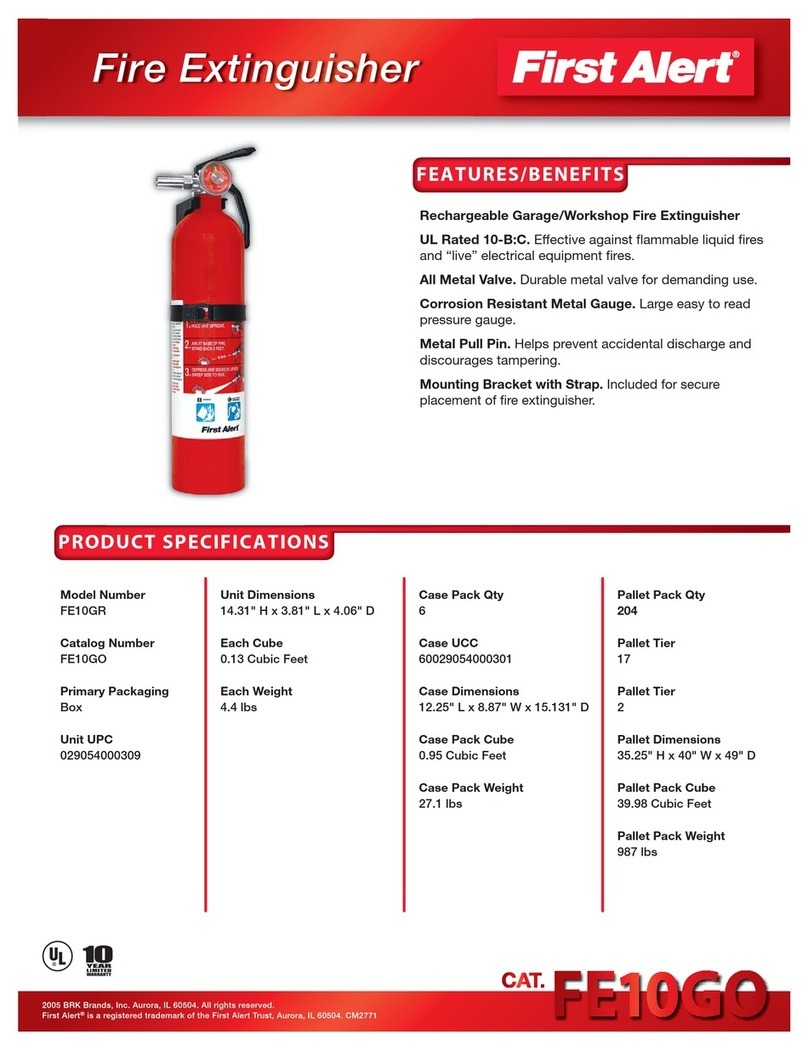
First Alert
First Alert FE10GO Instructions d'installation

First Alert
First Alert FESA5 Manuel utilisateur

Task Force Tips
Task Force Tips Extend-A-Gun XG12 Manuel de programmation

Sea-Fire
Sea-Fire FM200 Manuel de service

HNE
HNE VARIO 9 Carbon Manuel utilisateur

SenseTek
SenseTek CEA10 Manuel utilisateur

Tyco Fire Protection Products
Tyco Fire Protection Products FAST2000/2 Manuel utilisateur