BTC 9013RF Manuel utilisateur

9013RF
Wireless Keyboard & Mouse Kit
User’s Guide
Version 1.1
封面

The information in this document is subject to change without notice and does not represent a
commitment on the part of the vendor.
No warranty of representation, either expressed or implied, is made with respect to the quality,
accuracy or fitness for any particular purpose of this document. The manufacturer reserves the
right to make changes to the content of this document and/or the products associated with it at any
time without obligation to notify any person or organisation of such changes.
In no event will the manufacturer be liable for direct, indirect, special, incidental or consequential
damages arising out of the use or inability to use this product or documentation, even if advised of
the possibility of such damages.
Copyright ©2003. All rights reserved
IBM, PC/AT and PS/2 are registered trademarks of International Business Machines Corporation.
Microsoft, Windows, and Windows NT are registered trademarks of Microsoft Corporation in the
United States of America and/or other countries.
All other trademarks are trademarks of their respective holders.
封面內頁

Table of Contents
1Introduction...................................................................................................1
What's in this package ................................................................................1
2System Requirements .................................................................................2
3Hardware Installation...................................................................................3
4Software Installation....................................................................................7
4.1 Keyboard Driver Installation...............................................................7
4.2 Mouse Driver Installation....................................................................7
5Using the Keyboard and Mouse ................................................................8
5.1 Using the Keyboard.............................................................................8
5.2 Using the Mouse Driver.....................................................................11
6Troubleshooting .........................................................................................14


1
1 Introduction
Congratulations on your purchase of this wireless RF keyboard and mouse!
This keyboard and mouse will finally free you of the constraints of your desktop
by providing a wireless connection between your keyboard/mouse and your PC.
Pass around the keyboard or mouse during meetings without having to bother
about a cable blocking your way or write e-mails and surf the Internet from the
comfort of your living room couch!
This keyboard and mouse kit consists of a keyboard, a mouse and a receiver.
The receiver is connected to your PC through a cable with both a keyboard and
mouse connector. The keyboard and mouse can operate freely within a radius
of at least 3.28 feet (1 meter) from the receiver, which itself has a maximum
range from your PC of around 3.28 feet (1 meter). Because the keyboard and
mouse use radio frequencies to transmit the wireless signal it has no
constrictions on viewing angles such as with infrared devices like your TV’s
remote control, etc.
Besides providing unprecedented freedom of movement when operating the
keyboard or mouse, the kit also offers more extra functionality by introducing
dedicated buttons for often used Internet browser functions as well as Sleep
functions. (Please note: The Internet keys work only under MicrosoftInternet
Explorer 5.0 or later version!). And last but not least, this package also provides
a special driver, which provides unique shortcut functions.
In order to enjoy your keyboard and mouse to their full potential we
recommended you read this manual carefully prior to installation.
What's in this package
! A wireless keyboard with palmrest
! A wireless mouse
! A receiver
! A driver CD
! Batteries (2 pcs of AA; 2 pcs of AAA alkaline batteries)

2
2 System Requirements
! MicrosoftWindows NT4.0, Windows95, Windows98, Windows
ME, Windows2000 or Windows XP operating system
! MicrosoftInternet Explorer 5.0 or later version (for the Internet keys)
! CD-ROM drive (for CD and Video operation)
! Standard sound card (for CD and Video operation)
! The system supporting ACPI or APM II (for power management buttons)
! ATX mother board and ATX power supply (for power management
buttons)
! Available PS/2 keyboard port and mouse port.
Please refer to table below for the other system requirements for the features.
Operating System
Function
Description Windows NT 4.0 /
Windows 95 /
Windows 98
Windows ME /
Windows 2000 /
Windows XP
Wireless
Functionality Available immediately after
hardware installation Available immediately after
hardware installation
Keyboard Extra
Multimedia
Buttons
Requires keyboard driver
installation (see driver CD
for details)
Requires keyboard driver
installation (see driver CD for
details)
Keyboard Extra
ACPI Keys
Requires enabling of
system ACPI (Power
Management) function
Available immediately after
hardware installation
Mouse Driver
Shortcut
Function
Requires installation of
mouse driver (see driver
CD for details)
Requires installation of mouse
driver (see driver CD for
details.)
Keyboard Battery
Low Function
Requires installation of
keyboard driver (see driver
CD for details)
Requires installation of
keyboard driver (see driver CD
for details)
Keyboard LED
Light Function
Requires installation of
keyboard driver (see driver
CD for details)
Requires installation of
keyboard driver (see driver CD
for details)
3
3 Hardware Installation
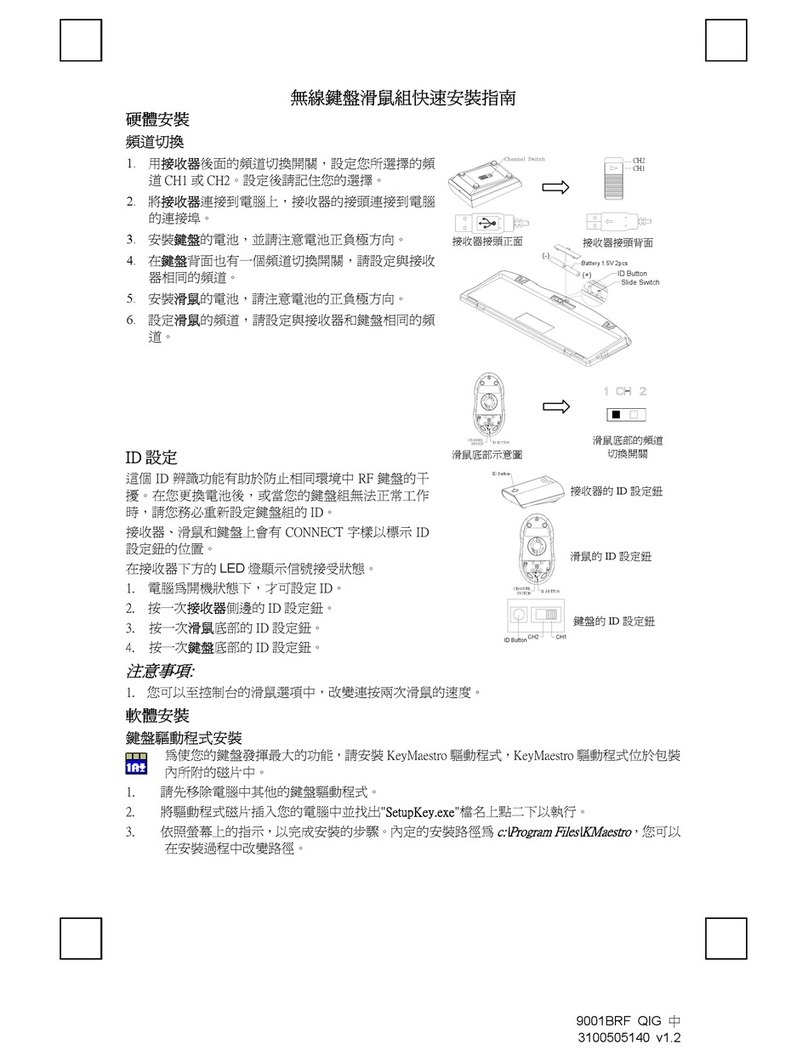
Slide Switch Setting
Step 1: Make sure your PC is switched off.
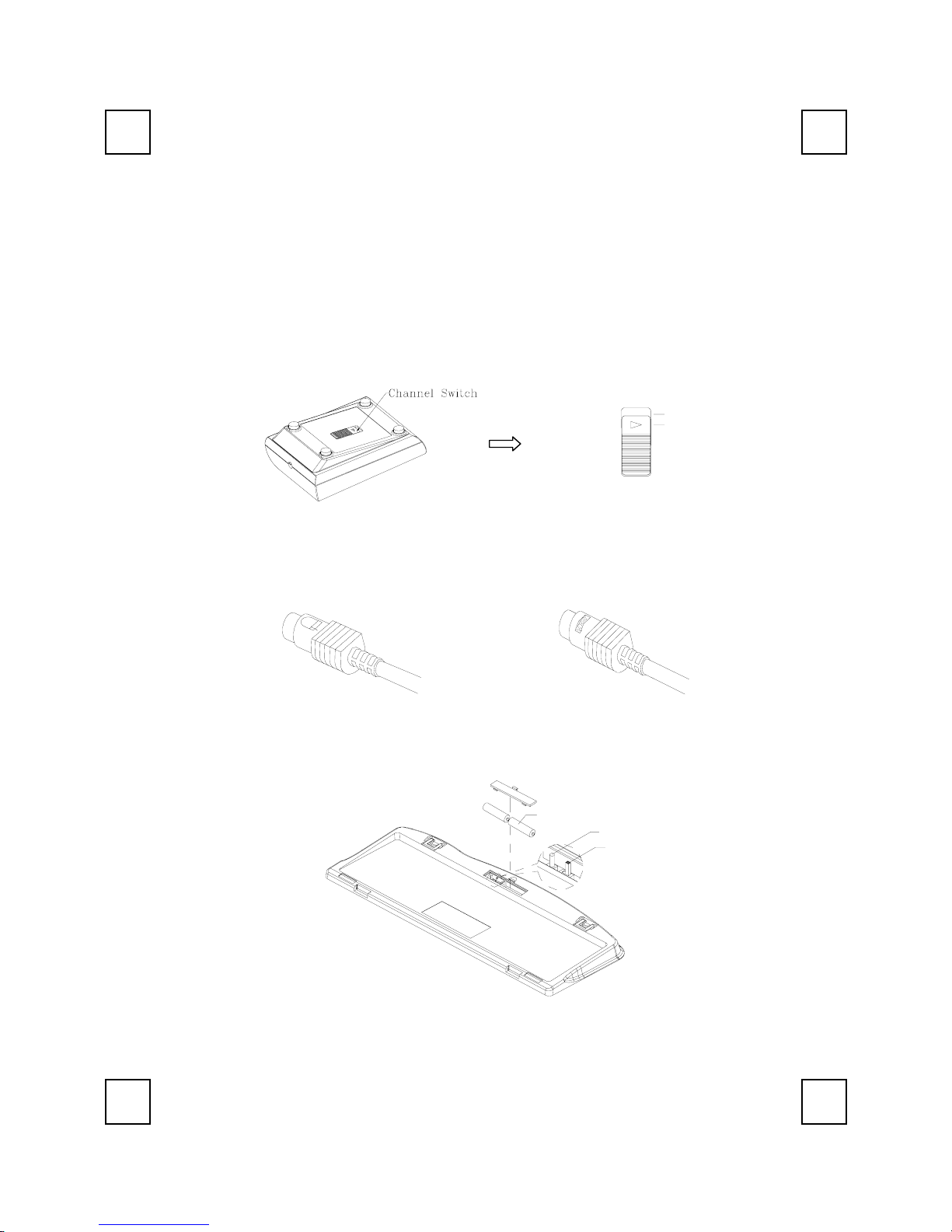
Step 2: Take the receiver and select channel CH1 or CH2 by using the slide
switch on the side of the receiver. (Remember your selection.)
CH1
CH2
Step 3: Connect the receiver to your PC by plugging in the receiver’s PS/2
mouse connector into the mouse port of your PC and the PS/2 keyboard
connector into the keyboard port.
Step 4: Take the keyboard and make sure the batteries on the back are
installed correctly. (Follow the polarity signs in the battery compartment.)
Channel Switch
(-) Battery 1.5V 2pcs
(+) ID Button
Back View of Receiver Channel Switch of Receiver
Bottom View of Keyboard
Mouse Connector Ke
y
board Connector

4
Step 5: Use the slide switch on the back of the keyboard to select the same
channel as the one selected in step 2 on the receiver.
CH2 CH1
ID Button
Step 6: Take the mouse and make sure the batteries on the back are installed
correctly. (Follow the polarity signs in the battery compartment.)
ID BUTTON
CHANNEL SWITCH
Step 7: Use the slide switch in the battery compartment of the mouse to select
the same channel as the one selected in step 2 and 5. (Open the battery
compartment cover to find the switch channel setting)
Remarks:
1. The keyboard uses 2pcs standard UM-3 (AA) 1.5V alkaline batteries, and
the mouse uses 2pcs UM-4 (AAA) 1.5V alkaline batteries.
2. Battery life is approximately 3-4 months, depending on the intensity of
usage.
3. Make sure the receiver is placed in a location relatively free of strong
electromagnetic or transmission sources in order to ensure optimal
reception of the keyboard and mouse signal.
Channel Switch & ID Setting o
f
keyboard
Bottom View of Mouse
Channel Switch of Mouse

5
ID Setting
This wireless keyboard kits contains 2 channels, and each channel contains 255
sets ID. This extra ID-recognition function helps to protect against interference
from other RF keyboards in the same environment.
# The word CONNECT labels the ID button on each unit.
# The LED under ID button of receiver shows connecting condition.
Step 1: Press the ID button on the top of the receiver once.
ID Button
Step 2: Press the ID button on the bottom of the mouse once.
ID BUTTON
CHANNEL SWITCH
Step 3: Press the ID button on the bottom of the keyboard once.
CH2 CH1
ID Button
Remarks:
1. You must follow the procedure above to set the ID of receiver, mouse and
keyboard. Once the receiver ID button is pressed you have 35 seconds to
complete the entire process, or you will need to begin again.
2. Once the keyboard and receiver are plugged in, the yellow receiver light will
flash. Once the ID is set, it will remain steadily lit.
ID Button of Receiver
ID Button of Mouse
ID Button of Keyboard

6
3. When changing the batteries of keyboard or mouse, there is no need to
reset all the ID’s. Simply reset one of them.
4. When keyboard batteries are low, a battery low icon will show on the
system tray.
5. When mouse batteries are low, a battery low icon will show on the
system tray.
6. The mouse is designed to conserve battery life and will enter a power
saving “Sleep” mode if it is inactive for 21 minutes. Click a button on the
mouse to wake it up. Move the mouse does not wake it.
Detachable Palmrest
At your discretion, you may choose to connect the palmrest with keyboard.
To connect the palmrest with the keyboard please follow figure 1 & figure 2.
Figure 1
Figure 2
Autres manuels pour 9013RF
1
Table des matières
Autres manuels BTC Accessoires informatiques

BTC
BTC 9001URF Manuel utilisateur

BTC
BTC 9013RF Manuel utilisateur

BTC
BTC 2001BRF Manuel utilisateur

BTC
BTC 2001ARF Manuel utilisateur

BTC
BTC 2003RF Manuel utilisateur

BTC
BTC 9001URF Manuel utilisateur

BTC
BTC 9001BRF Manuel utilisateur

BTC
BTC 9128URF II Manuel utilisateur

BTC
BTC 9001ARF Manuel utilisateur

BTC
BTC 2001ARF Manuel utilisateur