
Auto Anchor 730 Manuel d'instructions
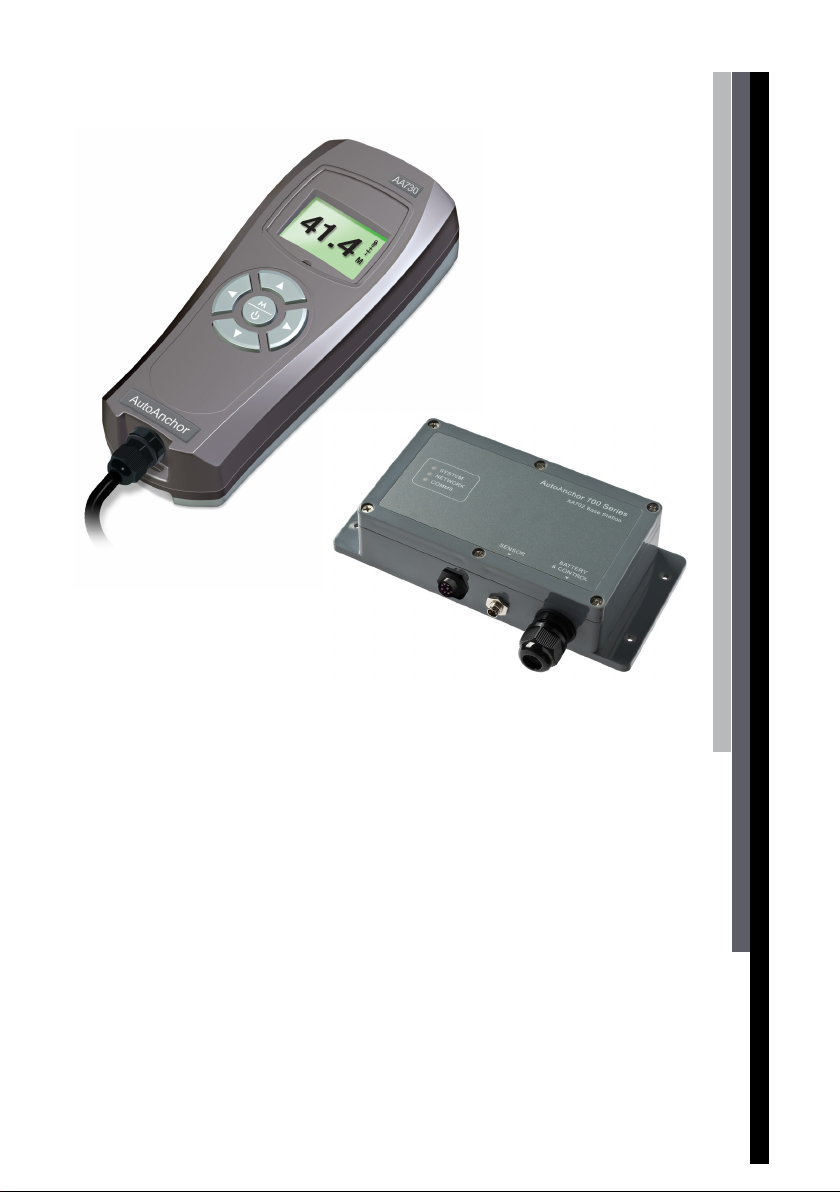
AutoAnchor 730
QUICK USER GUIDE

IMPORTANT INFORMATION
READ BEFORE USING YOUR AUTOANCHOR
This User Guide is intended as a quick reference for day to day
use of the AA730. It must be read in conjunction with the Owner’s
Manual. The Owner’s Manual has installation, set up and testing
instructions plus information relating to troubleshooting and
maintenance. If you do not have the Owner’s Manual please
contact your supplier or the manufacturer for a copy.
USER PRECAUTIONS
It is the owner’s sole responsibility to ensure the AutoAnchor is installed, used and
maintained in a manner that will not cause accidents, personal injury or property
damage. When using the AutoAnchor the operator must follow safe boating practices
for all equipment use. The AutoAnchor manufacturer and supplier accept no liability for
personal injury or property damage resulting from failure to follow the installation and
operating instructions or the use of the AutoAnchor in a way that may cause accidents
or damage or that may violate the law.
• all equipment controlled by the AutoAnchor must be installed and used strictly
according to the original equipment manufacturer’s instructions;
• only persons who are fully aware of the correct use of the thruster, windlass,
auxiliary or optional equipment should be allowed to use the AutoAnchor to
control this equipment;
• the user must personally control and supervise all anchoring, docking and
other equipment operations;
• the user must have a clear view of all equipment when operated using the
AutoAnchor;
• the user must know the location of the main breaker or battery switch to
disconnect the windlass, thruster or auxiliary equipment from all power
sources in the event of an emergency;
• the power supply to all equipment must be turned off when it is not in use;
• there must be an alternative method available to operate all equipment to be
operated by the AutoAnchor, including the windlass, thruster, auxiliary and
optional equipment.
WHEN CONTROLLING A THRUSTER
• donotoperateclosetoswimmers,thepowerfulsuctionofwatercouldcauseserious
injury;
• neverrunthethrusteroutofthewater,thiscancauseseriousdamagetothemotor;
• runningathrusterwithoutresistancefromthepropellercanalsocauseserious
damage to the motor;
• ifthethrusterstopsgivingthrustwhilethemotorisrunning,turnitoffimmediately.
WHEN CONTROLLING A WINDLASS
• maintainaclearviewofthewindlass,rodeand/oranchor,plusanyoptionalor
auxiliary anchoring equipment during windlass operation;
• alwaysensuretheanchorisfullydockedandsecuredbeforemovingtheboat.
1

USING THE AA730 SYSTEM
INFORMATION DISPLAYED DURING OPERATION
OptionAon/off
Thruster to port
Escape/Back
OptionBon/off
Thruster to
Starboard
Dualspeedon/off
Windlass down
Menu scroll
Windlass up
Menu scroll
AA730 BUTTONS
Mode & On/Off
Turn on
Holdtounlock
Tap for menu
Hold 1 second to change
application eg from windlass
to thruster
Hold 6 seconds to turn off
TO TURN THE AUTO ANCHOR ON
Power up the AA703 base station. Press the Mode button to
turntheremoteconsoleon.Thescreenwillbelocked
and will display the last mode operated.
The length of rode deployedChain or rope
OptionB
On
Option A
On
Slow
TO CONNECT THE CONSOLE FOR USE
Unscrewthesealingcaponthedecksocket.
Fittheplugintothesocketensuringthepinsarealignedcorrectly.
Turnclockwisetolock.
Switch on the power supply .
Use the system as set up.
Whennishedunscrewtheplugfromthesocket.
Replace the sealing cap and return the console to the cradle.
TO TURN THE AUTO ANCHOR OFF
In the start screen press the Mode button to
display the menu.
Scroll to Off.
Select Off.
OR
Press and hold the MODE button for 6 seconds.
Note: The AA730 remote console automatically turns off after 5 minutes without use.
Select Mode
Lock
Clear to Zero
2

CHANGING MODES
Cycle through the modes by pressing
the Mode button for 1 second at a time
Press and release the Mode button to access
the Menu.
Select the Mode.
OR
Lock
Clear to Zero
BeforeusetheAutoAnchormustbecorrectlysetupfortheequipmentitistocontrol
and then tested in a safe environment. For example, the AutoAnchor will not count
correctly if the windlass selection is wrong or the windlass is not standard (eg it is
installed with a different chainwheel or motor).
LOCK
HoldtheModebuttonfor2secondstounlock.
The AA730 automatically turns off and resets
thelockafter5minuteswithoutuse.
To reset the lock manually:
Press the Mode button to display the menu.
SelectLock.Thescreenwillreturntothecurrentmode
withthelockon.
Locked Unlocked
WINDLASS OPERATION WITH THE AA730
Installation and set up must be complete and the anchor must be
docked before starting this process.
Clear the AutoAnchor to zero if necessary. See page 6. Deploy the anchor
using the AutoAnchor. Initially the status bar will display “Sensor tuning”.
Continue deployment until this message changes to “Tuning done”. This
must be done in one continuous operation without taking your nger
off the button until the “Tuning done” message displays. This could
take up to 10 turns of the windlass. Retrievetheanchortothedocked
position and clear to zero if needed.
Note: If you do need to take your nger off the button, start the
process again.
Thisscreenautomaticallydisplaysonrstuse.IfFactoryDefaultsare loaded, the
sensor is reset or there has been a loss of sensor signal. Required for all sensors other
than a motor driven reed sensor.
PLUG & PLAY SENSOR TUNING
WHEN CONTROLLING A WINDLASS
• maintainaclearviewofthewindlass,rodeand/oranchor,plusanyoptionalor
auxiliary anchoring equipment during windlass operation;
• alwaysensuretheanchorisfullydockedandsecuredbeforemovingtheboat.
SET UP AND TESTING
3

Note: The AA730 remote console automatically turns off after
5 minutes without use.
For an accurate reading always ensure the AA730 display
reads 0.0 before deploying the anchor.
See Clear to Zero on page 6.
Counting continues if the AA730 remote console is turned off and if the windlass is
operated by another control eg foot switches.
AUTOMATIC AND MANUAL WINDLASS OPERATION
Keepyourngeronthebuttontodeploytheanchormanually or use the automatic
function for hands free anchor deployment and retrieval. See the instructions for both
options below.
Rope/Chain System: The default rode set up is chain only. If
rope and chain rode is selected without the correct sensor and
magnet set up a “Sensor installation not compatible with rope and
chainsetting”messagewilldisplay.Checktheinstallationand
rode set up and reset the sensor to restart the tuning process.
MANUAL WINDLASS OPERATION
Deploy and Retrieve the Anchor Using Manual Operation
Turn the AA730 on.
Clearthesafetylock.
Press and hold the up or down button to deploy or retrieve the anchor.
Releasing the button stops the windlass operation.
Ensure the anchor is fully docked and secured before moving the boat.
DOCKING ALARM: During retrieval the windlass will stop and the AA730 beeps to
warntheoperatortheanchorisatthepresetdockingdistance.Pressandholdthe
button to continue retrieval. If the system has been set up for dual speed. It will change
to slow at this point. Extra care must be taken at this stage of retrieval.
Use the Automatic Function to:
• Preset the length of rode for deployment;
• Have hands-free operation of the windlass;
• Retrievetheanchorautomaticallytothepresetdockingdistance.
Note:Forrope/chaincounting,ifthesensororloadsensingwiresarenotinstalled
correctly the automatic function will not operate. An Installation warning message will
display on the screen. The windlass can still be operated using manual operation but
the AutoAnchor will not count accurately.
AUTOMATIC WINDLASS OPERATION
WARNING: There is an inherent risk when using any automatic function
on a boat. If you choose to use the AA730 automatic functions, you
must still control and supervise all windlass and anchoring operation.
4

Press any button on the AA730 to stop the windlass during automatic release or
retrieval. In an emergency shut off the power to the windlass using the isolating/
breaker switch.
4.5.4.3 To Set A Rode to be Released Value
Turn the AA730 on.
Clearthesafetylock.
Press the Mode button to enter the menu.
Press the Mode button twice to enter Set auto.
Scroll up or down to the value.
Save and return to start screen.
To disable automatic operation: Set the rode to be released value to Off.
A “rode to be released” value must be entered to use automatic operation.
Select Mode
Lock
Clear to Zero
Deploy the Anchor Using Automatic Operation
Turn the AA730 on.
Clearthesafetylock.
Press the Mode button to enter the Menu.
Press the Mode button again to select Auto. The screen
displays the current length for Auto release. If this setting is
correct, press and release the down button to deploy the
anchor.
To Change the Setting:
Press the Mode button again to select Set auto.
Scroll to the value.
Save and return to Auto.
The windlass will stop and the AA730 will beep when the
preset length of rode has been released. The screen will
display “Target reached”.
Retrieve the Anchor Using Automatic Operation
Turn the AA730 on.
Clearthesafetylock.
Press the Mode button to enter the Menu.
PresstheModeButtonagaintoselectAuto.
Press and release the Up button to retrieve the anchor.
The windlass will stop and the AA730 will beep when
thedockingdistanceisreached.Thescreenwilldisplay
Dockingdistance.Ifthesystemissetupfordualspeed,
it will change to slow speed at this point.
Press and hold the Up button to complete retrieval of the
anchor. The AA730 will beep during this process.
Select Mode
Lock
Clear to Zero
Select Mode
Lock
Clear to Zero
Ensure the anchor is fully docked and secured before moving the boat.
Safety Override
Enable Automatic Operation
5

USING DUAL SPEED
You must have a windlass with a dual speed motor to use this feature. Default Speed
is slow.
Use the right arrow to toggle between fast and slow speed. The current speed is
displayed on the screen SL or FS.
If using Auto Mode select fast speed prior to selecting Auto.
The windlass automatically changes to slow speed when thedockingdistanceis
reached.
TO CHECK LOGS
The AA730 must be turned on.
Press to access the Menu.
Scroll to Logs.
Select Logs.
Return to the menu.
Exit and return to start screen.
Logs can be cleared if base station is reset.
OTHER WINDLASS OPERATION SETTINGS
TO CLEAR TO ZERO
The AA730 must be turned on.
Press to access the Menu.
Scroll to Clear to Zero.
Select Clear to zero.
SelectNo/Yes.
Yes - return to start screen.
No - return to the menu, then press again to return
to the start screen.
TO RESET SENSOR
The AA730 must be turned on.
Press to access the Menu.
Select Reset sensor.
SelectNo/Yes.
Yes - return to start screen.
No - return to the menu, then press again to return
to the start screen.
Deploy the anchor to tune the sensor. See page 3.
9
10742
112
Lock
Clear to zero
Off
Select
Mode
6

THRUSTER OPERATION WITH THE AA730
The AA730 can control a single bow thruster or a bow and stern thruster together.
USER PRECAUTIONS
Note: The AA730 remote console automatically turns off after 5 minutes without use.
There must be an alternative means of controlling the thruster installed on the boat.
Only persons who are fully aware of the requirements for safe operation of the thruster
should be allowed to use the AA730 to operate this equipment. The owner of the boat
musttakeresponsibilityforensuringthethrusterisusedaccordingtothe
manufacturer’s instructions and with the appropriate safety precautions.
The thruster must not be operated close to swimmers, the powerful suction of water
could cause serious injury. Never run the thruster out of the water as this can seriously
damage the motor. Running a thruster without resistance from the propeller can also
cause serious damage to the motor. If the thruster stops giving thrust while the motor
is running, turn it off immediately. Always turn off the power to the thruster when it is
not in use.
OR
Access the Menu.
Select “Select Mode”.
Scroll to Thruster.
Select Thruster.
TO ACCESS THE THRUSTER
Turn the AutoAnchor on.
Clearthesafetylock.
Cycle through the modes by pressing
the Mode button for 1 second at a time
THRUSTER SYSTEM LOCKS
AA730Systemlocked.
Hold Mode button to clear.
Locallockon.NoaccessfromAA730.
Thruster operated by another controller.
7

Use the left and right arrow buttons to control the thruster operation.
Left to port and and right to starboard.
SINGLE BOW THRUSTER OPERATION
Thrust to port. Thrust to starboard.Bowthrusterselected.
System powered up and idle.
Ifthereisabowandasternthrustertted,usetheupbuttontotogglebetween
the bow thruster and the combined bow and stern thruster.
Use the down button to toggle between the stern thruster and the combined bow
and stern thruster.
Use the left and right arrow buttons to control the thruster operation to port
and starboard.
COMBINED BOW AND STERN THRUSTER OPERATION
Bowandsternthrusters
selected. System powered up
and idle.
Bowandsternthrustersto
port.
Bowandsternthrustersto
starboard.
Bowthrusterselected.
System powered up and idle.
Bowthrustingtoport. Bowthrustingtostarboard.
Dual Thruster Operation
Bow Thruster Operation
8
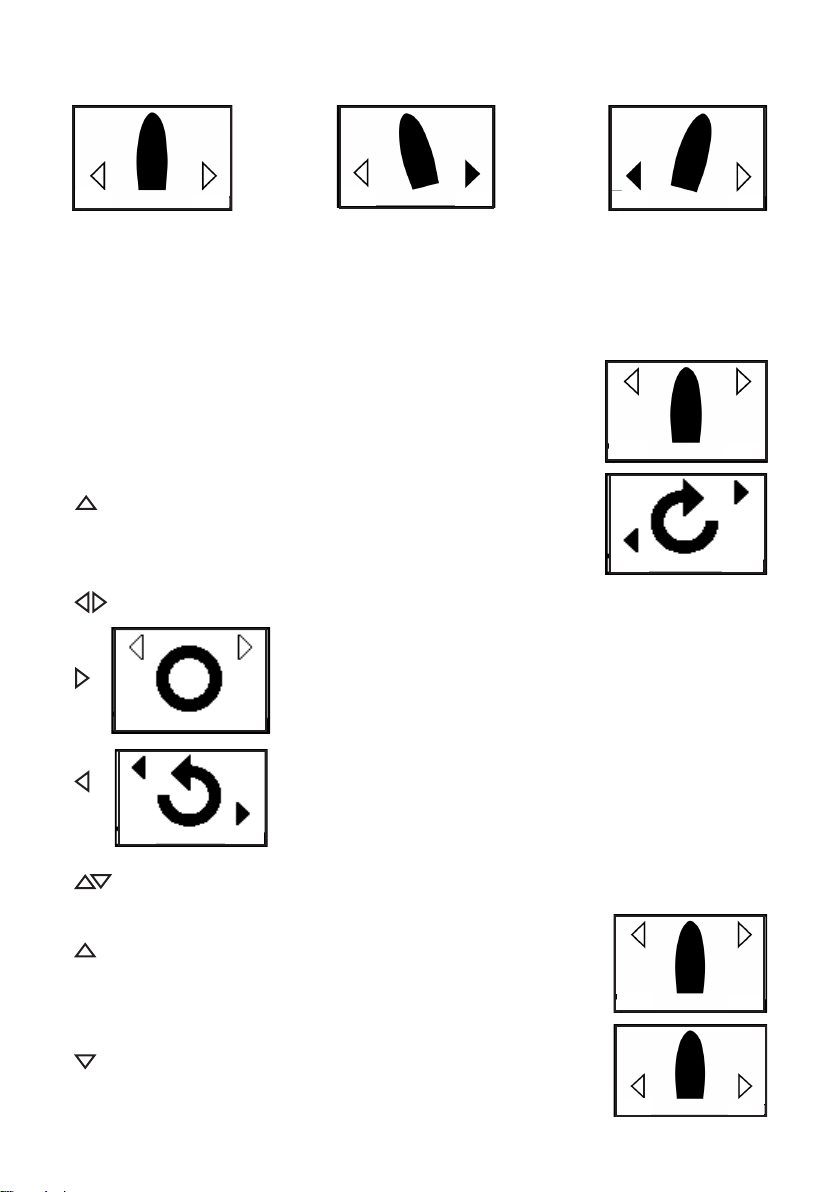
Usetheleftorrightbuttonstoturntheboatclockwiseoranticlockwise.
To exit pivot mode and return to single thruster operation press the up or down
button.
Press the up button to return to bow thruster
operation.
Press the down button to return to stern
thruster operation.
Clockwise.
Anticlockwise.
Pivot (360oTurn) Operation
Bowthrusterselected.Systempoweredupandidle.
Pivot mode can be selected from any thruster operation mode, by pressing the Up
button for more than 1 second. For example:
Hold the Up button for more than 1 second to
change to Pivot Mode.
Stern thrusting to port.
Stern thruster selected.
System powered up and idle.
Stern Thruster Operation
Stern thrusting to starboard.
9
Autres manuels pour 730
1
Table des matières
Autres manuels Auto Anchor Télécommande


Manuels Télécommande populaires d'autres marques

Panasonic
Panasonic EUR7622KB0 Manuel utilisateur

Bang & Olufsen
Bang & Olufsen Beo4 Manuel utilisateur

Sunwave Tech.
Sunwave Tech. RemoteComm SRC-7000 Manuel utilisateur

Multiplex
Multiplex PROFI TX 9 Manuel utilisateur

One Remote
One Remote RMB4 Manuel utilisateur

FUTABA
FUTABA 9ZAP - PART2 Manuel utilisateur


