
Atlas AE 45 Manuel utilisateur
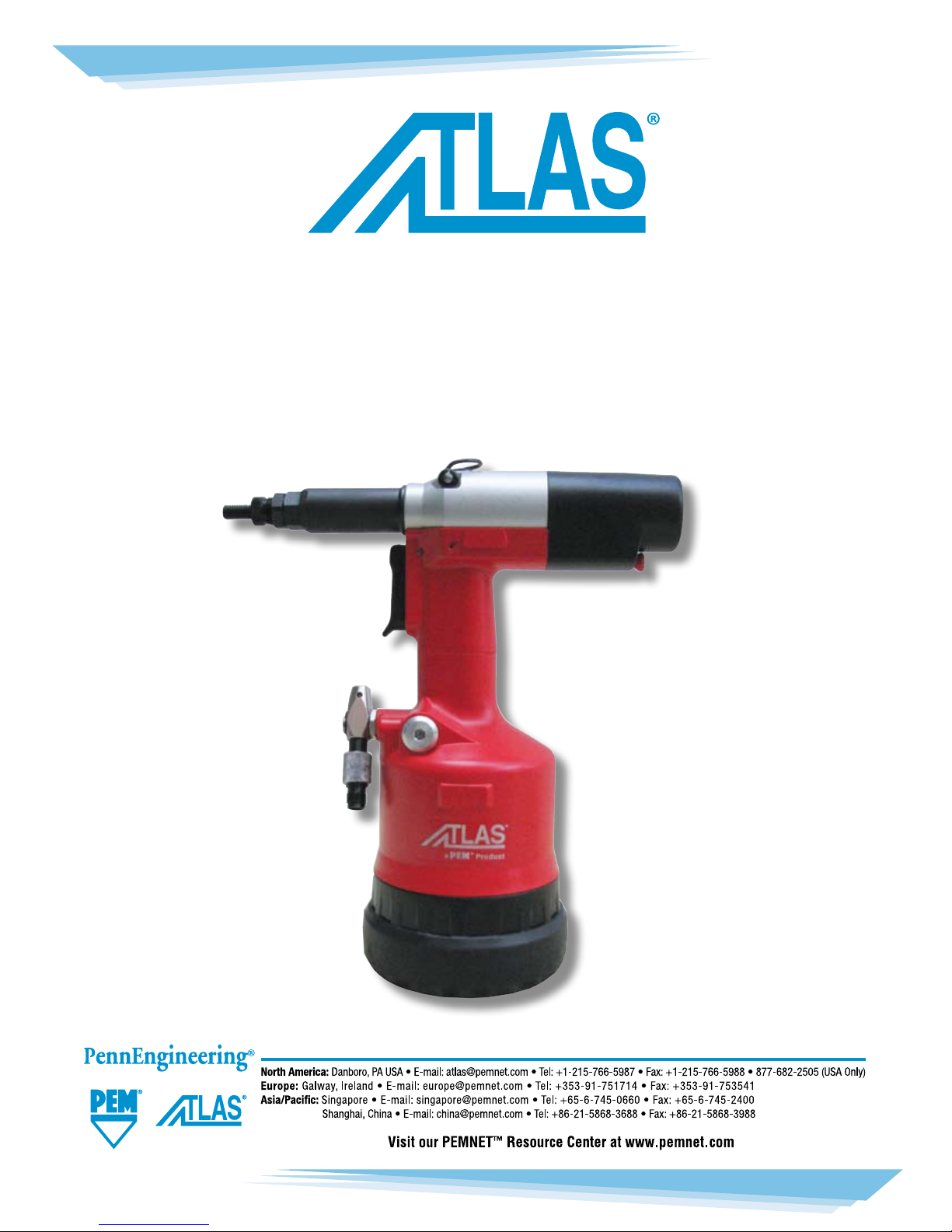
AE 45
OpErAting instructiOns
MEtric tOOl

2 PennEngineering • www.pemnet.com
• Readtheinstructionscarefullybeforeusingthetool.
• Forallmaintenanceand/orrepairspleasecontactPennEngineeringanduseonlyoriginalspareparts.
PennEngineeringmaynotbeheldliablefordamagesfromdefectivepartscausedbyfailuretouse
orginalspareparts.
• Thetoolmustbeusedonlybyexpertworkers.
• Aprotectivevisorandglovesmustbeputonwhenusingthetool.
• Useequipmentrecommendedinthemaintenancechaptertodoanymaintenanceand/orregulationof
thetool.
• Fortoppingofftheoil,wesuggestusingonlyuidsinaccordancewiththefeaturesspeciedinthis
workingbook.
• Ifanydropofoiltouchesyourskin,youmustwashwithwaterandalkalinesoap.
• Thetoolcanbecarriedandwesuggestputtingitintoitsboxafterusing.
• Thetoolneedsathoroughsix-monthlyoverhaul.
• Repairingandcleaningoperationsmustbedonewhenthetoolisnotfed.
• Ifitispossible,wesuggestasafetybalancer.
• ThetoolismadesothatacousticpressurelevelcontinuousequivalentweightedAisnotmorethan75
dB(A)wherepeopleworks.
• Ifthenoiselevelismorethan85dB(A),youmustusesomehearingprotections(anti-noiseheadset,
etc.).
• Theworkbenchandtheworksurfacemustbealwayscleanandtidy.
• Donotallowunauthorizedpersonstousetheworkingtools.
• Makeyousurethatthecompressedairfeedinghoseshavethecorrectsizetobeused.
• Donotcarrytheconnectedtoolbypullingthehose.Theholemustbefarfromanyheatingsourcesor
fromcuttingparts.
• Keepthetoolsingoodconditions;donotremoveeithersafetypartsorsilencers.
• Afterrepairingand/oradjusting,makesureyouhavealreadyremovedtheadjustingspanners.
• Beforedisconnectingthecompressedairhosefromthetoolmakesurethatthereisnopressureinthe
hose.
• Theseinstructionsmustbecarefullyfollowed.
GENERAL NOTES AND USE
ThetoolcanbeemployedonlyforthreadedinsertswiththreadofM4toM12diameter.TheAE45oil
pneumaticsystemassuresmorepowerthanthepneumaticsystemusedforothermodels.Thatmeansa
reductionintheproblemsduetothewearandtearofthecomponents,therefore,therewillbeanincrease
inreliability.Thetechnicaisolutionsadoptedreducethedimensionsandtheweightofthetoolwhich,for
thesereasons,makeitveryhandy.Thepossibilitiesofleakagefromtheoil-dynamicsystem,areeliminated
bysomesealedgaskets,whichsolvethisproblem.
SAFETY MEASURES AND REQUIREMENTS

PennEngineering • www.pemnet.com
3
A)........................................................................................................................................ Threadedtierod
B)...........................................................................................................................................................Head
C).............................................................................................................................Ring-nutclampinghead
D).................................................................................................................................. Controlpush-button
E)...................................................................................................................... Compressedairconnection
F)................................................................................................................................Pressurecontrolvalve
G)..................................................................................................................................... Protectionbottom
H)........................................................................................................................................Pneumaticmotor
I)............................................................................................................................................... Oiltankplug
L).................................................................................................................................. Balancerconnection
M).............................................................................................................................. Stroke-adjustingknob
N)........................................................................................................................................ Strokeindicator
O).....................................................................................................................................Tubecarryinghead
P)............................................................................................................................. Forcedunscrewingrod
1
MAIN COMPONENTS

4 PennEngineering • www.pemnet.com
• Workingpressure...................................................................................................................... 6-7BAR
• Min.int.diam.ofthecompressedairfeedinghose............................................................ømin.=8mm
• Maxfreeairconsumptionpercycle.................................................................................................. 11NI
• Force(6BAR)................................................................................................................................. 28KN
• Noise.........................................................................................................................................<75db(A)
• Weight(withequipmentforM10)................................................................................................... 2.9Kg
• Workingtemperature.................................................................................................................–5°/+50°C
• Rootmeansquareintotalaccelerationfrequency(Ac)
towhichthearmsaresubjected............................................................................................ <2.5m/sec2
AIR FEED
Thecompressedairsystemmustbeprovidedwithaircleanersandcondensationdrainsandmustguaran-
teethattheairsuppliedtothefeederhasaconstantpressureofmin6bars.Theregulatormustbesetata
pressureof6.5bars.
Connectthemachinetothemaincompressedairsupplyasshowninthediagram(2):
1)Stopcock(usedduringmaintenanceoftheregulatorlterorofthelubricatingunit)
2)Mainsupplyinlet
3)Mainsupplybleed
4)Pressureregulatorandlter(bleeddaily)
5)Lubricatingunit
2
TECHNICAL DATA

PennEngineering • www.pemnet.com
5
Checkthatthethreadedtierod(A)andhead(B)coupleassembledontherivetingtoolissuitabletothe
sizeoftheinserttoclamp;otherwisechangethesize.Thecoupletierod(A)+head(B)assembledonthis
rivetingtool,correspondstoaM10thread.Beforeusingtherivetingtoolandaftereachchangeofsize,the
strokeshouldbeadjustedaccordingtothedimensions,sizeoftheinsertandthicknessofthematerialto
clamp.Beforecarryingoutthisoperationrotatetheknob(M)accordingtothedirectionofthearrow,(+)for
increasingthestrokeand(-)fordecreasingit.Increasingthestroke[rotationofknob(M)]inthedirection
indicatedwiththesymbol(+),thedistance“h”decreasesincreasingtheclampingaction.Forverifyingthat
thestrokeiscorrectlyadjustedchecktheindicator(N)[comparingitwiththevaluesofthetable(g.3)].
NOTE: Before the definitive placing of the insert, its clamping on the thicknesses involved should be
checked, carrying out other adjustments, as shown at page 9 (the specified adjustments are just an indica-
tion, it is advisable to see the technical data of the inserts used).
3
PRELIMINARY OPERATIONS

6 PennEngineering • www.pemnet.com
Checkthatthethreadedtierod(A)andhead(B)coupleassembledontherivetingtoolissuitabletothe
sizeoftheinserttobeused.Adjustthestrokeasindicatedonpage5.Introducetheinsertonthetierod
(A)andpushslightlyonitasindicatedingure4,soastomakeitclampautomaticallyonthethreaded-tie
rod.Makesurethattheinsertheadtouchesthehead(B)checkingthatthetierod(A)comesoutof2mm
fromtheinsert.Incaseoffurtheradjustmentsofthetierod(A)followtheinstructionsofpage9.
Itispossibletoplacetheinsertpushingthebutton(D)andkeepingitpusheduptothecompleterelease
ofthetierod.Foracorrectplacingandrightworkingofthemachine,theinsertstobeusedshouldbe
properlycleaned.
NOTE:According to the desired clamping, carry out other adjustments of the riveting tool stroke, rotating
the knob (M) (page 5), if necessary.
Insufficient deformation =the insert could rotate inside the housing compromising its use and resistance.
Excessive deformation = possible damages of the insert and tie rod (A) with eventual breaks of both com-
ponents.
45
6
PLACING OF THE INSERT

PennEngineering • www.pemnet.com
7
Whentheconditionscauseaforcedunscrewingofthetierodfromtheinsert,actasfollows:
removethepushrod(P)fromitsseat(1)andintroduceitintotheholeinthelowerpartofthetensile-
strengthbuttonpushingitslightly(2).
WARNING! Carry out this operation keeping the riveting tool firmly in order to avoid sharp movements
which could cause injury or damage (3).
Whenthetierodisfreefromtheinsert,puttherodbackinitsseatfornotloosingit(4).
WORKING PROBLEMS

8 PennEngineering • www.pemnet.com
Therivetingtoolissuppliedwith6pairsofthreadedtierods(A)andheads(B),fortighteningarangeof
threadedinsertsfromM4toM12.Dependingonthethreadsize,itisnecessarytoreplacethethreaded
tierod(A)andhead(B)group,asfollows:loosentheringnut(C)witha22mm.standardspannerand
removetherivetingtoolhead(B)[andspacer(Q)ifitrangesfromM4toM8].Withthesamespanner,
unscrewthetubecarryinghead(O).Usetwo20mm.standardspannersfordisassemblingtheringnut
(K)andextractthethreadedtierod(A).
NOTE: Use two spanners for unblocking the ring nut (K) as indicated in figure (9); the inobservance of this
procedure can damage the riveting tool.
Afterhavingreplacedthethreadedtierod(A)withthatoneoftherightsize,assembletheringnut(K)
againandcarryouttheabove-mentionedoperationsinreverseorder,beingsurethatthecomponent(R)is
therightone.Everytimeyoucarryoutanychangeofsize,repeattheadjustmentoperationsasindicated
onpage9.
78
910
CHANGE OF SIZE

PennEngineering • www.pemnet.com
9
Changingthelengthoftheinserttoclamp,thepositionofthehead(B)comparedtothethreadedtierod
(A)shouldbeadjusted.Disconnecttherivetingtoolfromthecompressed-airsupply.
Screwaninsertofthedesiredlengthonthethreadedtierodmanuallyuntiltheinsertheadtouchestheriv-
etingtoolhead(B).Theheadisadjustedcorrectlyifthethreadedtierodcomesoutoftheinsertscrewed
onitofabout2mm.Otherwiseunblocktheringnut(C)witha22-mmstandardspannerthenscrewor
unscrewthehead(B)uptotherightposition,andblocktheringnut(C).
11
12 13
ADJUSTMENT OF THE COUPLE TIE ROD/HEAD

10 PennEngineering • www.pemnet.com
Theoil-dynamiccircuitshouldbetoppedupafteralongperiodofworkorwhenthereisapowerlossof
therivetingtool.Puttherivetingtool(notfed)inaverticalpositionrotatingtheknob(M)towardsthesign
“+”uptotheendofstroke,andremovetheplug(I)bymeansofa4mmAllenwrench(equipped).During
thisoperationchecktheoillevelinordertoavoidanyoverowing.ThenpourtheoilVISCOSITY32°into
theoilcontainer(S)(equipped)whichshallbescrewedtoitsseatontheplug(I).
Whilekeepingtherivetingtoolinverticalpositionandstartingairfeeding,pushthebutton(D)andmake
therivetingtoolcarryoutsomecyclesuntilairbubblesinsidethecontainerstopcomingout.Thiscondi-
tionindicatesthatthetoppingupoftheoilhasbeenfullyachieved.Atthispointstoptheairfeedingand
whilekeepingtherivetingtoolinaverticalposition,unscrewandclosetheoilcontainer(S)andtheplug
(I)checkingthesoundnessofthehermeticwasherandrepeatalltheadjustmentsforplacingtheinsertas
indicatedatpage5.
WARNING: It is very important to follow the above-mentioned instructions and use gloves during oil top-
ping off. If you need to empty completely the hydraulic circuit, you must put the oil in a suitable container
and contact a company authorized to dispose of wastes.
14
TOPPING UP THE OIL-DYNAMIC CIRCUIT
Table des matières
Autres manuels Atlas Outils électriques

Atlas
Atlas RIV942 Manuel utilisateur

Atlas
Atlas RIV938 Manuel utilisateur

Atlas
Atlas RIV 916 Manuel utilisateur

Atlas
Atlas PennEngineering RIV938S Manuel utilisateur

Atlas
Atlas RIV912 Manuel utilisateur

Atlas
Atlas MFC Fiche technique

Atlas
Atlas 4439600-UN Manuel utilisateur

Atlas
Atlas RIV939 Manuel utilisateur

Atlas
Atlas TTC 306 Manuel utilisateur


