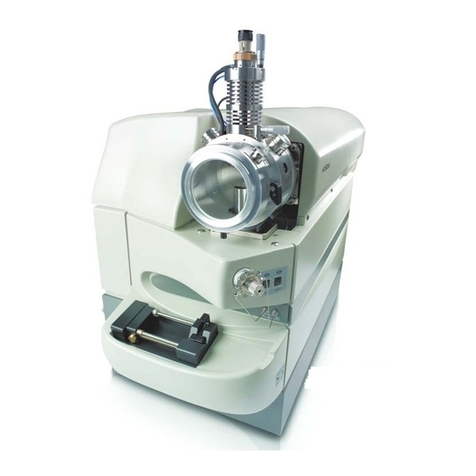
AB Sciex API 5000 LC/MS/MS Instructions d'installation

Hardware Guide
API 5000™System
D1000092206 B
May 2010

This document is provided to customers who have purchased AB SCIEX equipment to use in the
operation of such AB SCIEX equipment. This document is copyright protected and any reproduction of
this document or any part of this document is strictly prohibited, except as AB SCIEX may authorize in
writing.
Equipment that may be described in this document is protected under one or more patents filed in the
United States, Canada, and other countries. Additional patents are pending.
Software that may be described in this document is furnished under a license agreement. It is against the
law to copy, modify, or distribute the software on any medium, except as specifically allowed in the license
agreement. Furthermore, the license agreement may prohibit the software from being disassembled,
reverse engineered, or decompiled for any purpose.
Portions of this document may make reference to other manufacturers and/or their products, which may
contain parts whose names are registered as trademarks and/or function as trademarks of their respective
owners. Any such usage is intended only to designate those manufacturers' products as supplied by
AB SCIEX for incorporation into its equipment and does not imply any right and/or license to use or
permit others to use such manufacturers' and/or their product names as trademarks.
AB SCIEX makes no warranties or representations as to the fitness of this equipment for any particular
purpose and assumes no responsibility or contingent liability, including indirect or consequential
damages, for any use to which the purchaser may put the equipment described herein, or for any adverse
circumstances arising therefrom.
For research use only. Not for use in diagnostic procedures.
The trademarks mentioned herein are the property of AB Sciex Pte. Ltd. or their respective owners.
AB SCIEX™ is being used under license.
AB SCIEX
71 Four Valley Dr., Concord, Ontario, Canada. L4K 4V8.
AB SCIEX LP is ISO 9001 registered.
© 2010 AB SCIEX.
Printed in Canada.

Document Number: D1000092206 B 3
Contents
Chapter 1 System Overview . . . . . . . . . . . . . . . . . . . . . . . . . . . . . . . 5
Principles of the System . . . . . . . . . . . . . . . . . . . . . . . . . . . . . . . . . . . 5
Applications for the System . . . . . . . . . . . . . . . . . . . . . . . . . . . . . . . 5
Features of the Instrument. . . . . . . . . . . . . . . . . . . . . . . . . . . . . . . . 6
How the Instrument Works. . . . . . . . . . . . . . . . . . . . . . . . . . . . . . . . 6
Parts of the Instrument . . . . . . . . . . . . . . . . . . . . . . . . . . . . . . . . . . . . 7
I/O Panel . . . . . . . . . . . . . . . . . . . . . . . . . . . . . . . . . . . . . . . . . . . . . 8
Gas and Vacuum Panel . . . . . . . . . . . . . . . . . . . . . . . . . . . . . . . . . . 8
Control Panel . . . . . . . . . . . . . . . . . . . . . . . . . . . . . . . . . . . . . . . . . . 9
Source Exhaust System . . . . . . . . . . . . . . . . . . . . . . . . . . . . . . . . . 10
Vacuum Chamber . . . . . . . . . . . . . . . . . . . . . . . . . . . . . . . . . . . . . 11
Shutting Down and Turning on the System . . . . . . . . . . . . . . . . . . . 11
Source/Gas Parameters . . . . . . . . . . . . . . . . . . . . . . . . . . . . . . . . . . 13
Turbo V™ Ion Source Settings . . . . . . . . . . . . . . . . . . . . . . . . . . . . . 14
Compound Parameters . . . . . . . . . . . . . . . . . . . . . . . . . . . . . . . . . . 14
Related Documentation . . . . . . . . . . . . . . . . . . . . . . . . . . . . . . . . . . 14
Technical Support. . . . . . . . . . . . . . . . . . . . . . . . . . . . . . . . . . . . . . . 14
Chapter 2 API 5000™Instrument Parameters. . . . . . . . . . . . . . . . . 15

Contents
4 Document Number: D1000092206 B

Document Number: D1000092206 B 5
1
System Overview
The API 5000™ LC/MS/MS system includes a triple quadrupole mass
spectrometer, a Turbo V™ ion source, a computer, and the Analyst®software.
Figure 1-1 API 5000™ system and bench
Principles of the System
This section describes features and applications of the API 5000™ system.
Applications for the System
The API 5000 system is designed for quantitative analysis of small molecules.
This application involves measurement of specific molecular weight compounds,
usually a drug or metabolite in urine or other body fluid, and their resulting
WARNING! If you need to move the system, contact an FSE to assist you. Risk of
personal injury or instrument damage
Note: Before you operate the instrument, make sure you have read the Safety Practices
guide.
Bench
Mass Spectrometer
Line Adjustment
Transformers
Roughing Pumps

System Overview
6 Document Number: D1000092206 B
fragment ions for determining the exact quantity of the compound in the sample
of interest. Quantitation is performed using a standard curve of mass
spectrometer signal intensity for various known concentrations of the compound.
The signal in the test sample is compared to the standard curve to determine the
concentration.
The typical scan type used for this application in the API 5000 system, as well as
all triple quadrupole instruments, is MRM (Multiple Reaction Monitoring).
Features of the Instrument
The API 5000 LC/MS/MS system combines all of the features of the API 4000™
LC/MS/MS system with the additional benefits of improved sensitivity and
enhanced signal-to-noise ratio. It allows comprehensive analysis of
biopharmaceutical compounds and it has the specificity needed for new drug
development. It has the following features:
•A wide diameter intake orifice which improves sensitivity by flowing more
ions into the vacuum chamber.
•A QJet®ion guide that prefocuses the ions before they enter the vacuum
chamber for higher sensitivity and signal-to-noise ratio.
•Improved Q2 lenses reduce CAD gas leakage into the vacuum chamber
and improve sensitivity and signal-to-noise ratio.
•Higher quadrupole operating frequency, which improves ion transmission
and increases sensitivity, especially for low ion masses.
•Higher sensitivity in all RF/DC scan modes.
•Scanning in a mass range of m/z 5–1250 in quadrupole mode.
•Enhanced resolution at reduced scan speeds.
For pharmaceutical and pharmacokinetic samples, MS/MS has the sensitivity and
specificity needed to analyze hundreds of samples per day without requiring
extensive sample preparation.
How the Instrument Works
Mass spectrometry measures the mass-to-charge ratio of ions to identify
unknown compounds, to quantify known compounds, and to provide information
about the structural and chemical properties of molecules. The API 5000 system
has a series of quadrupole filters that transmit ions according to their m/z (mass-
to-charge ratios). The first quadrupole in this series is the QJet ion guide located
between the orifice plate and Q0. The QJet ion guide does not filter ions, but
focuses them before they enter Q0. By prefocusing the larger ion flux created by
the wider orifice, the QJet ion guide increases instrument sensitivity and
improves the signal-to-noise ratio. In Q0 the ions are again focused before
passing into Q1.
Q1 is a filtering quadrupole that sorts the ions before they enter Q2. Q2 is a
collision cell in which ions can be broken into fragments by collisions with gas
molecules. This technique allows users to design experiments that measure the
m/z of product ions to determine the composition of the parent ions. After
passing through Q2 the ions enter Q3 for additional filtering, and then enter the
detector. In the detector, the ions create a current that is converted into a voltage
pulse. The voltage pulses leaving the detector are directly proportional to the
quantity of ions entering the detector. The instrument monitors these voltage

Hardware Guide
Document Number: D1000092206 B 7
pulses and converts the information into a signal. The signal represents the ion
intensity for a particular m/z and the instrument displays this formation as a mass
spectrum. For more information, see Figure 1-2 Ion optics path.
Figure 1-2 Ion optics path
The API 5000 system uses the Turbo V™ ion source to produce ions from liquid
samples. The Turbo V source can use either the TIS (TurboIonSpray®) probe or the
APCI (atmospheric pressure chemical ionization) probe. The instrument is
configured to perform complex MS/MS analysis, but for less rigorous analytical
requirements it can perform single MS scans.
Parts of the Instrument
This section contains diagrams of the instrument and general descriptions of its
components.
Figure 1-3 Front view
Curtain Gas™ flow
Detector
Exit
Interface Region Analyzer Region
Curtain
Plate Orifice IQ1
ST3
Stubbies Stubbies
Deflector
Q0
ST1
Q1 Q2
ST2
IQ3IQ2 Q3
QJet®Ion Guide
Source Exhaust Vacuum Chamber Detector

System Overview
8 Document Number: D1000092206 B
Figure 1-4 Back view
I/O Panel
The input/output panel on the right-hand side of the chassis has a socket for the
external AC power supply, the IEEE-488 (GPIB) connections to the computer, the
AUX I/O to the peripherals, and a sources connector for optional sources.
Figure 1-5 I/O panel
Gas and Vacuum Panel
The vacuum line to the external roughing pumps is connected through the gas
and vacuum panel through the port labeled backing pump. The panel also
houses the gas supply connections and the external connection for the source
exhaust pump.
B BA A
RF FEEDBACK RF FEEDBACK
I/O Panel
Gas and Vacuum Panel
Control
Panel
AUX I/0
IEEE-488
207-242V
50-60 Hz 10A
Sources

Hardware Guide
Document Number: D1000092206 B 9
Figure 1-6 Gas and vacuum panel
Control Panel
The control panel is located on the right side of the instrument. It encloses the
power distribution module.
The control panel contains the main power switch, four fuses, and two
Indicator/Reset buttons. The Vacuum Status button (green) and the Fault button
(red) indicate the vacuum status on the system controller board. When triggered
together, simultaneously pushed and released, the buttons reset the two
microprocessors on the system controller. This has an effect similar to restarting
the computer.
CAUTION! Resetting the instrument using these buttons interrupts any scans and
results in the loss of any unsaved files and data.
When the operational vacuum conditions are satisfied and the instrument is in
analysis mode, the Vacuum Status button is illuminated and the Fault button is
extinguished. The Fault button flashes when a vacuum fault is detected. In Pump-
Down mode, the buttons indicate the status of the Pump-Down sequence.
BACKING PUMP
CURTAIN GAS SUPPLY
MAX 60 PSIG
GAS 1 / GAS 2
MAX 105 PSIG
EXHAUST SUPPLY
MIN 55 PSIG
MAX 60 PSIG
EXHAUST WASTE OUT

System Overview
10 Document Number: D1000092206 B
Figure 1-7 Control panel
Source Exhaust System
The source exhaust system is a safety feature that isolates the sample vapors and
exhaust products from the laboratory environment. The source requires that the
source exhaust system is properly connected and functioning. The exhaust pump
draws the solvent vapors from the enclosed source housing and delivers them to
a trap at the rear of the instrument chassis. It is recommended that these vapors
be passed through this trap and then vented to a fume hood or outside port.
F4
F3
F2
F1
POWER
ON
OFF
VACUUM
STATUS
FAULT RESET
WARNING
(see Note
below)
Spare Output B
Heated Nebulizer (APCI)
Card Cage Blower
Spare Output A
.
I
O
Table des matières
Autres manuels AB Sciex Équipement de laboratoire
Manuels Équipement de laboratoire populaires d'autres marques

Agilent Technologies
Agilent Technologies 5800 ICP-OES Manuel utilisateur

Endress+Hauser
Endress+Hauser Cleanfit CPA875 Manuel utilisateur

NI
NI PXI-5422 Manuel

Collomix
Collomix Aqix Manuel utilisateur

SPEX SamplePrep
SPEX SamplePrep 6875 Freezer/Mill Series Manuel utilisateur

Ocean Insight
Ocean Insight FLAME-NIR+ Manuel utilisateur