Yacht Devices NMEA 0183 Manuel utilisateur

User Manual
NMEA 0183 Multiplexer YDNM-02
Firmware version
1.00
2019

© 2019 Yacht Devices Ltd. Document YDNM02-001. March 13, 2019. Web: http://www.yachtd.com/
NMEA 2000® is a registered trademark of the National Marine Electronics Association. SeaTalk NG
is a registered trademark of Raymarine UK Limited. Garmin® is a registered trademark of Garmin Ltd.

Contents
Introduction 4
Warranty and Technical Support 5
I. Product Specication 6
II. NMEA 0183 Basics 8
III. Installation and Connection of Device 10
IV. LED Signals 13
V. Selecting Presets and Settings Reset 15
VI. Routing and Data Filters 16
VII. Device Conguration with NMEA 0183 Commands 19
VIII. Firmware Update 27
APPENDIX А. Troubleshooting 29
APPENDIX B. Conguration Presets 31
APPENDIX C. Conversions Between SeaTalk and NMEA 0183 37
Package Contents
Device 1 pc.
This Manual 1 pc.
Screws 2 pcs.
Paperclip for reset 1 pc.

— 4 —
Introduction
The NMEA 0183 Multiplexer (hereinafter Multiplexer or Device) is a congurable NMEA 0183 and SeaTalk
multiplexer. The Multiplexer has six conguration presets with different port speeds and routing schemes.
Presets can be selected by pressing the Device’s hidden button (a paper clip is required, supplied with
the Device). This makes installation very easy: select a suitable preset from Appendix B and set it up with
a few clicks!
The Multiplexer has ve physical NMEA 0183 ports (ve inputs and three outputs) with congurable
speed from 300 to 115200 baud. This allows organization of data exchange between multiple devices
with different speeds. Multiple physical listeners can be connected to the Multiplexer’s outputs. Port #4
is galvanically isolated and has ve terminals: four data terminals (TX+, TX-, RX+, RX-) and a dedicated
ground (also isolated from other ports and Multiplexer’s ground).
The Device is supplied with preset #1 activated (its settings are printed on the Device’s case). In this preset
three of the ve NMEA 0183 ports are congured for automatic port speed detection. This means that
in most cases you need not worry about the speed of the NMEA 0183 equipment that you connect. Port #2
is congured to lter out outgoing AIS messages, to prevent occasional ooding of this port congured for
4800 baud speed.
SeaTalk is a proprietary binary protocol of Raymarine company. It allows co-existence of multiple devices
on the bus, so the Multiplexer has only one SeaTalk port. A bi-directional converter between SeaTalk and
NMEA 0183 supports all known SeaTalk datagrams, including autopilot (see Appendix C for details). This
allows controlling SeaTalk autopilots from NMEA 0183 chart plotters and marine apps.
To change settings of conguration presets or update Multiplexer’s rmware, you need a laptop or PC
with either a serial (COM) port or USB-to-COM adaptor. You can congure physical ports speed, set up
routing between ports and dene data lters to reduce trafc on low-speed ports with special NMEA 0183
commands described at sections VI and VII.
Thank you for purchasing our product and happy voyages!

— 5 —
Warranty and Technical Support
1. The Device warranty is valid for two years from the date of purchase. If the Device was purchased
in a retail store, the sales receipt may be requested when applying for a warranty claim.
2. The Device warranty is terminated in case of violation of the instructions in this Manual, case
integrity breach, or repair or modication of the Device without the manufacturer’s written
permission.
3. If a warranty request is accepted, the defective Device must be sent to the manufacturer.
4. The warranty liabilities include repair and/or replacement of the goods and do not include the cost
of equipment installation and conguration, or shipping of the defective Device to the manufacturer.
5. Responsibility of the manufacturer in case of any damage as a consequence of the Device’s operation
or installation is limited to the Device cost.
6. The manufacturer is not responsible for any errors and inaccuracies in guides and instructions
of other companies.
7. The Device requires no maintenance. The Device’s case is non-dismountable.
8. In the event of a failure, please refer to Appendix A before contacting technical support.
9. The manufacturer accepts applications under warranty and provides technical support only
via e-mail or through authorized dealers.
10. The contact details of the manufacturer and a list of the authorized dealers are published
on the website: http://www.yachtd.com/.

— 6 —
I. Product Specification
Figure 1. Drawing of Multiplexer

— 7 —
Device parameter Value Unit
Supply voltage 7..16 V
Current consumption, maximum, all ports with 100 Ohm load 60 mA
NMEA 0183 ports (inputs / outputs) 5 / 3 —
SeaTalk 1 ports 1 —
Receiver input resistance (port #1, #2, #3, #5 / port #4) 12 / 96 kOhm
Galvanic isolation of NMEA 0183 port #4 2500 V
RMS
Device case dimensions (LxWxH) 85x45x28 mm
Weight 80 g
Operating temperature range -20..55 °С
Yacht Devices Ltd declares that this product is compliant with the essential requirements of EMC
directive 2004/108/EC.
Dispose of this product in accordance with the WEEE Directive. Do not mix electronic disposal
with domestic or industrial refuse.

— 8 —
II. NMEA 0183 Basics
The default speed of a NMEA 0183 interface is 4800 baud. High-speed interfaces are 38400 baud and were
designed especially for AIS, but usually chart plotters and instrument displays allow any data (not only AIS)
on a high-speed port. On a chart plotter, port speed can be congured in the settings. NMEA 0183 uses
different wires for talking (transmitting, TX) and listening (receiving, RX) data.
One talker can be connected to multiple listeners, but a listener can have only one talker connected.
The Device can act as a «multiplexer» and join the output of multiple physical talkers to a single data
stream.
Figure 1. (a) RS-232 and (b) RS-422
NMEA 0183, until version 2.0 (1992), used a «single ended» RS-232 interface with one TX line and one
RX signal line (grey at Figure 1.a) and ground line (dotted at Figure 1.a) used as reference for TX and RX
signals. Therefore, old devices have only three wires.
Since Version 2.0, NMEA 0183 has been based on a «differential» RS-422 interface, which has two RX lines
RX+ (can also be marked as «A») and RX- (or «B»), two TX lines TX+ (or «A», grey at Figure 1.b) and TX-
(or «B», dotted at Figure 1) and a ground (not shown at Figure 1.b). Modern devices use ve wires.

— 9 —
Devices of different versions can be connected, but with one cautionary note. TX- («B») is not equal to a
ground line. Voltage on the TX- line (dotted on Figure 1.b) changes from 0 to 5V, and connecting this line
to ground line can cause a short circuit.
The correct connection schemes are shown in Figure 2.
Figure 2. Connection of NMEA 0183 devices

— 10 —
III. Installation and Connection of Device
The Device requires no maintenance. When deciding where to install the Device, choose a dry mounting
location. Despite the fact that the Multiplexer case is waterproof, the terminals are open and seawater
can cause a short circuit. Do not place the Device where it can be ooded by water, get wet in the rain
or be sprayed with water.
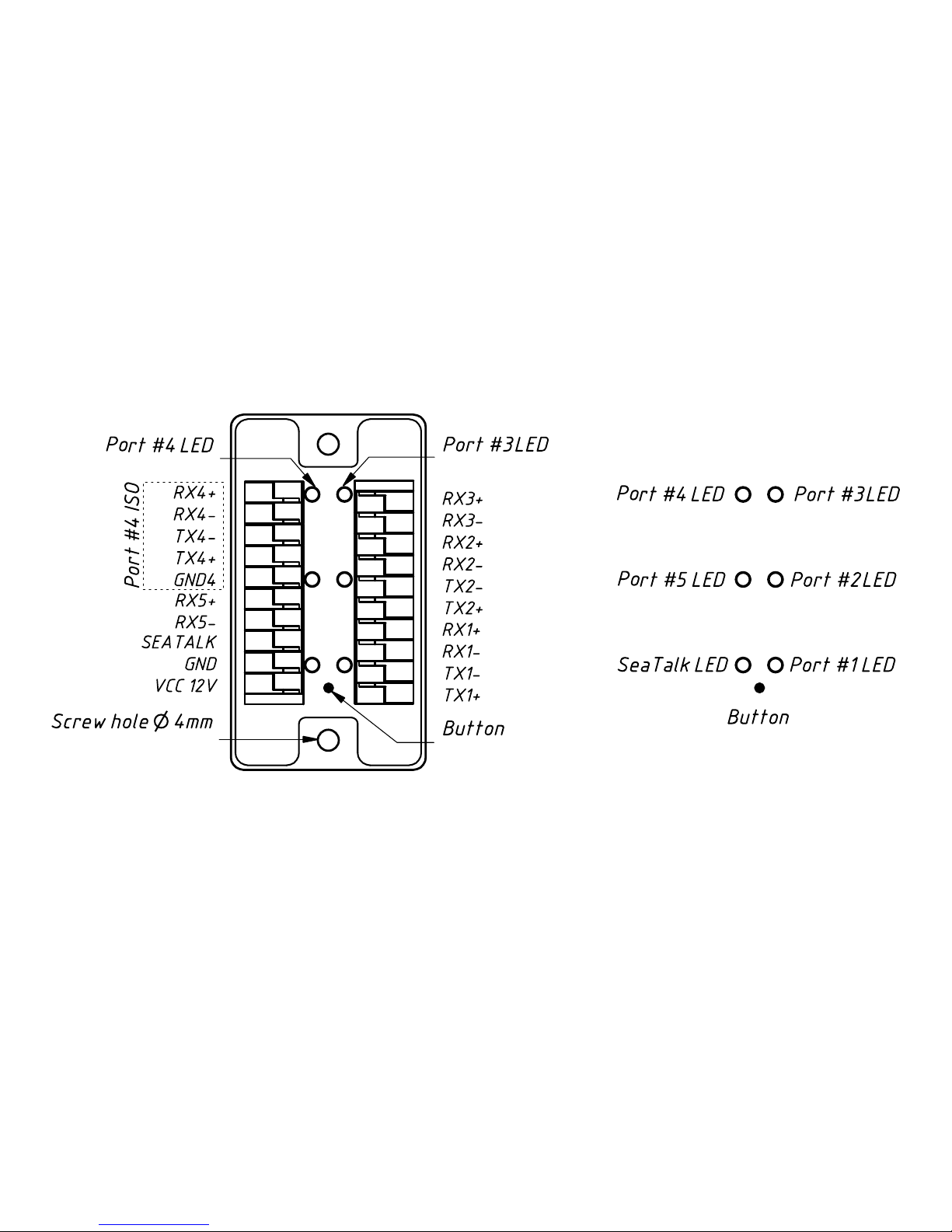
Figure 1. Multiplexer wire terminals (left) and LED’s scheme (right)
The Multiplexer can be xed horizontally or vertically using the two screw holes (4 mm diameter, 72 mm
between centers) and the screws supplied. When the holes of wire terminals are pointing to the sides, they
are better protected from occasional water spray.
Autres manuels pour NMEA 0183
1
Table des matières
Manuels Multiplexeur populaires d'autres marques

ADTRAN
ADTRAN Frameport 768 Manuel utilisateur

Elo TouchSystems
Elo TouchSystems E247 Manuel utilisateur

Paradyne
Paradyne Hotwire 8786 Manuel utilisateur

RFL Electronics
RFL Electronics 9508D UCC Manuel utilisateur

Miranda
Miranda AMX-101i Mode d’emploi

ShipModul
ShipModul MiniPlex-AIX NMEA-0183 Manuel utilisateur