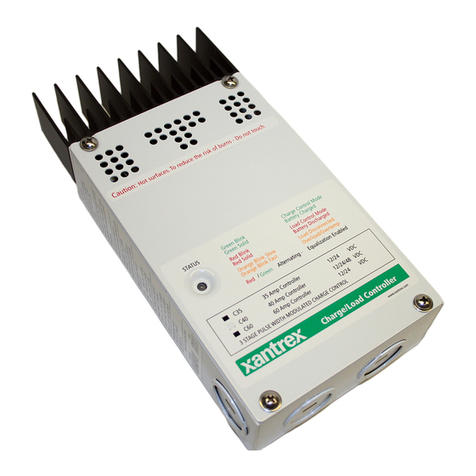
Xantrex Trace C35 Mode d'emploi

Installation and Operation Guide
C-Series
Multifunction DC Controllers
©2000 Xantrex Technology Inc. P/N 975-0004-01-01 Rev. 11/00

©2000 Xantrex Technology Inc.

©2000 Xantrex Technology Inc.
Section Description Page
1. INTRODUCTION ............................................................. 1
Operating Modes
Photovoltaic Charge Control Mode
Automatic PV Array Night Disconnect
Diversion Control Mode
DC Load Control Mode
2. FEATURES ..................................................................... 5
Over-Temperature Protection
Electronic Over-Current Protection
attery Temperature Compensation
LED Status Indicator
Charge or Diversion Control Mode Indications
Solid Green
linking Green
Load Control Indications
Solid Red
linking Red
Slowing linking Orange
Equalization Mode Indication
Alternating Red and Green
Error Mode Indication
Fast linking Orange
3. INSTALLATION ............................................................... 10
Mounting
Wiring
Minimum Recommended Wire Size
Maximum One-way Distance and Wire Size
PV Charge Control Mode Cabling
Diversion Control Mode Cabling
DC Load Control Mode Cabling
Grounding
Configuring the C-Series
Automatic/Manual attery Equalization and
Low Voltage Reconnect
Operating Mode
Reset Switch
Voltage
C-Series
Multifunction DC Controllers
Table of Contents
i

©2000 Xantrex Technology Inc.
Section Description Page
3. INSTALLATION (continued)
Adjusting the C-Series
Setting Voltage Parameters
Testpoints for Voltage Settings
Equalization
Manual Equalization
Automatic Equalization
Temperature Compensation
Setting LVR and LVD (Load Control Mode)
Setting Diversion Control Mode
4. OPTIONS ........................................................................ 35
C-Series LCD Meter Displays
Installing the DVM/C40
Mounting the CM/R
5. OPERATION ................................................................... 38
Three-Stage attery Charging
ulk
Absorption
Float
Equalization
6. BATTERIES .................................................................... 41
Automotive atteries
Maintenance-Free atteries
Deep-Cycle atteries
Sealed atteries
NiCad and NiFe atteries
attery Sizing
8. DIVERSION LOADS ....................................................... 43
Charge Controller
Load Controller
Diversion Charge Controller
Diversion Load Types
9. SPECIFICATIONS .......................................................... 46
10. SERVICE INFORMATION .............................................. 47
11. WARRANTY .................................................................... 48
ii
Table of Contents (Continued)

©2000 Xantrex Technology Inc. iii
IMPORTANT SAFETY INSTRUCTIONS
This manual contains important safety instructions that should be
followed during the installation and maintenance of this product.
To reduce the risk of electrical shock, and to ensure the safe installation
and operation of this product, the following safety symbols have been placed
throughout this manual to indicate dangerous conditions and important safety
instructions.
WARNING - A dangerous voltage or condition exists in this area.
Use extreme caution when performing these tasks.
AVERTISSEMENT - Une tension ou condition dangereuse
existe dans cette zone. Faire preuve dextrême prudence lors de la
réalisation de ces tâches.
CAUTION - This procedure is critical to the safe installation or
operation of the unit. Follow these instructions closely.
ATTENTION - Cette procédure est essentielle à linstallation ou
lutilisation de lunité en toute sécurité. Suivre ces instructions de près.
NOTE - This statement is important. Follow instructions closely.
NOTE - Cette déclaration est importante. Suivre les instructions
deprès.
·All electrical work must be done in accordance with local, national, and/or
international electrical codes.
·efore installing or using this device, read all instructions and cautionary
markings located in (or on) the manual, the inverter, the controller, the
batteries, and the PV array.
·Do not expose this unit to rain, snow or liquids of any type. This product is
designed only for indoor mounting.
·To reduce the chance of short-circuits when installing or working with the
inverter, the controller, the batteries, or the PV array, use insulated tools.
·Remove all jewelry such as rings, bracelets, necklaces, etc., while
installing this system. This will greatly reduce the chance of accidental
exposure to live circuits.
·The controller contains more than one live circuit (batteries and PV array).
Power may be present at more than one source.
·This product contains no user serviceable parts. Do not attempt to repair
this unit unless fully qualified.
SAVE THESE INSTRUCTIONS !

©2000 Xantrex Technology Inc.
iv
BATTERY SAFETY INFORMATION
·Always wear eye protection, such as safety glasses, when working with
batteries.
·Remove all loose jewelry before working with batteries.
·Never work alone. Have someone assist you with the installation or be
close enough to come to your aid when working with batteries.
·Always use proper lifting techniques when handling batteries.
·Always use identical types of batteries.
·Never install old or untested batteries. Check each batterys date code or
label to ensure age and type.
·atteries are temperature sensitive. For optimum performance, they
should be installed in a stable temperature environment.
·atteries should be installed in a well vented area to prevent the possible
buildup of explosive gasses. If the batteries are installed inside an
enclosure, vent its highest point to the outdoors.
·When installing batteries, allow at least 1 inch of air space between
batteries to promote cooling and ventilation.
·NEVER smoke in the vicinity of a battery or generator.
·Always connect the batteries first, then connect the cables to the inverter
or controller. This will greatly reduce the chance of spark in the vicinity of
the batteries.
·Use insulated tools when working with batteries.
·When connecting batteries, always verify proper voltage and polarity.
·Do not short-circuit battery cables. Fire or explosion can occur.
·In the event of exposure to battery electrolyte, wash the area with soap
and water. If acid enters the eyes, flood them with running cold water for
at least 15 minutes and get immediate medical attention.
·Always recycle old batteries. Contact your local recycling center for proper
disposal information.

©2000 Xantrex Technology Inc.
Introduction
The C35/C40/C60 (C-Series) controllers are among the finest controllers
available and can be used with 12, 24, or 48 volt DC systems (depending upon
model) as PV charge controllers, DC diversion controllers, or DC load
controllers (low voltage disconnect). These capabilities make the C-Series the
only DC controllers youll need! Numerous standard features are provided to
maximize the performance of the system:
·Solid-state Pulse Width Modulated (PWM) charging process with three-
stage control, temperature compensation, and manual or automatic
equalization to maximizes system performance and increase battery life.
·Meets National Electrical Code (NEC) and other international controller
specifications.
·UL listed for the U.S. (UL Standard 1741 (draft) 1998), and Canada
(CSA-C22.2 No. 107.1-95).
·Electronic overload and short circuit protection with automatic and manual
reset capability increases the reliability of unattended systems by eliminating
blown fuses and tripped circuit breakers.
·Field adjustment of charge setpoints is provided by rotary controls with
removable knobs, reducing the potential for setpoint tampering. Calibrated
scales and test points allow precise adjustments of settings.
·Optional external battery temperature compensation sensor ( TS) for
automatic adjustment of charge setpoints (required by UL draft standard
1741 and strongly recommended for sealed batteries).
·Over-temperature protection for the electronic circuitry when used in hot
environments (over 113 °F/45 °C).
·Indoor-type, powder-coated enclosure for wall mounting.
·Multicolor LED with easy to read mode/status label.
·Optional LCD meter for remote or direct mounting on the controller. May be
mounted up to 1000 feet away.
·2-year limited warranty.
1.0 INTRODUCTION
1

©2000 Xantrex Technology Inc.
Operating Modes
The C-Series controller can operate as either a photovoltaic charge
controller, a diversion controller, or a DC load controller. The controller cannot
operate in more than one mode at the same time. If several modes are required
in a system, a dedicated controller must be used for each mode.
Photovoltaic Charge Control
When this mode is selected, the status LED will indicate either blinking
green or solid green. It will alternate red/green when in equalization mode.
Diversion Control Mode
When this mode is selected, the status LED will indicate either blinking
green or solid green.
DC Load Control Mode
When this mode is selected, the status LED will typically indicate blinking
red or solid red as the controller turns the DC loads OFF when battery
voltage is low.
Photovoltaic Charge Co trol Mode
Depending on the model, the controller can regulate up to 60 amps of
continuous photovoltaic (PV) array current at 12 or 24 volts (C60), or 12, 24 or
48volts DC (C40) for charging batteries. This rating includes the NEC required
deratings. When used in this mode, ensure that the operating mode jumper is
on the charge control pins. To enable the Photovoltaic Charge Control Mode,
see Configuring the CSeries in the installation section of this manual.
If the PV arrays output increases above the rated amp level due to
reflection or edge of cloud effect, the controller will continue to operate until the
heatsink reaches a maximum safe operating temperature. This will take several
minutes to occur depending upon the ambient temperature involved. When the
heatsink reaches the maximum safe temperature, the controller will reduce the
current, cooling the transistors and the heatsink.
If the current from the PV array reaches 85 amps, the controller will turn off
to protect the circuitry. In the event of a shutdown, the controller automatically
resets itself after 10 minutes (if overcurrent condition is no longer present).
The C-Series charge controller rapidly cycles the current source on-and-off
to control the charging current and voltage of the battery. This occurs in both the
charge control mode and the diversion control mode. The amount of time the
current source is connected to the battery is varied to control the average current
flow. This is often referred to as pulse width modulation (PWM) and allows the
current to be tapered, rather than coarsely turning the current off and on as with
relay type PV array charge controllers.
1.0 INTRODUCTION
2

©2000 Xantrex Technology Inc.
Automatic PV Array Night Disco ect
At night, the PV array is automatically disconnected from the battery to
prevent reverse leakage of power. This eliminates the need for a blocking
diode between the battery and the PV array. If thin-film or amorphous solar
modules are being used, diodes may still be required to prevent damage from
partial shading conditions. Check the documentation provided with the PV
modules.
Diversio Co trol Mode
The C-Series can operate as a diversion control to manage battery charging
from alternative-energy sources such as wind or hydroelectric generators.
Systems utilizing solar arrays do not have a requirement for diversion loads since
a solar module can be open-circuited without damage. However, even with a
solar based system it may be desirable to use excess power to operate DC
loads. When used in this way, the C-Series controls a diversion load to redirect
the excess power generated instead of allowing it to flow into the battery. This
prevents damage to the charging source from an over-speed condition which
could occur if the charging source is suddenly disconnected from all loads as
series relay regulators do. Consult your dealer for load and regulator size
recommendations.
When the controller operates as a diversion regulator, it provides three-
stage regulation of battery voltage, with temperature compensation and auto-
matic or manual equalization. See the Three-Stage Battery Charging section
for more information on this process.
Diversion mode requires a separate dump load to regulate the battery.
This load must be able to absorb more power than the charging source is able to
produce at its peak output, or the DC voltage will become unregulated. The
dump load must be available for the diversion of power at all times. Resistive-
type heating elements are the best diversion loads. Special direct current
water heating elements are available. Light bulbs and motors are not recom-
mended as diversion loads because they are unreliable.
When used in diversion mode, ensure that the operating mode jumpers are
on the charge control pins. See Configuring the CSeries in Section 3 of this
manual.
Current draw of the diversion load is very important. Problems may arise
from operating with a load that is too small or too large. A diversion load that is
too small will not be able to absorb all the excess power from the current source
once the batteries are full.
Diversion loads in excess of 85 amps are capable of absorbing more power
than the C-Series is designed to handle, resulting in an over-current shut down.
During this time, the unit will not regulate electrical flow in the system, and battery
damage may result.
A diversion load that draws about 25% more current than the charging
sources maximum output capability is usually suitable for use with the C-Series.
1.0 INTRODUCTION
3

©2000 Xantrex Technology Inc.
DC Load Co trol Mode
The C-Series can also operate as a load control (also called a low voltage
disconnect) to manage the discharging of the battery. A load controller
prevents damage to the battery from over-discharge during periods of poor
weather or excessive loads.
When used in load control mode, ensure that the operating mode jumpers
are on the load control pins. See Configuring the C-Series section of this
booklet.
The controller delays disconnecting the DC loads for 6 minutes after the
voltage drops below the low voltage disconnect (LVD) setting. Loads are
either automatically or manually reconnected when battery voltage exceeds the
low-voltage reconnect (LVR) setting for 6 minutes. The EQUALIZE jumper
determines manual or automatic reconnect when the C-Series is used as a load
controller.
When used as a DC load controller, the settings of the LVR and LVD are
controlled by two rotary potentiometers on the circuit board. The scale on the
adjustment potentiometers differ from the scale used for other functions. A
decal with the appropriate adjustment scale is included with the C-Series and
shown below. Place this scale over the pots when using the C-Series as a
load controller. Do not temperature-compensate these settings. Do not install
the optional battery temperature compensation sensor.
DC Load
Battery C-Series
Controller
1.0 INTRODUCTION
4
Figure 1
Sticker Displaying Load Control Voltage Settings
Attach sticker over
potentiometers for
Load Control Settings
Autres manuels pour Trace C35
1
Ce manuel convient aux modèles suivants
2
Table des matières
Autres manuels Xantrex Contrôleurs

Xantrex
Xantrex Trace C Series Mode d'emploi

Xantrex
Xantrex Trace C35 Manuel utilisateur

Xantrex
Xantrex XW Manuel utilisateur

Xantrex
Xantrex LINK 2000-R Manuel utilisateur

Xantrex
Xantrex XW-MPPT60-150 Manuel utilisateur

Xantrex
Xantrex Freedom Sequence Manuel utilisateur

Xantrex
Xantrex LINK 2000-R Manuel utilisateur

Xantrex
Xantrex Link 2000 Manuel utilisateur

Xantrex
Xantrex SOLAR CHARGE CONTROLLER 30 Manuel utilisateur