
Wen 61718 Manuel utilisateur
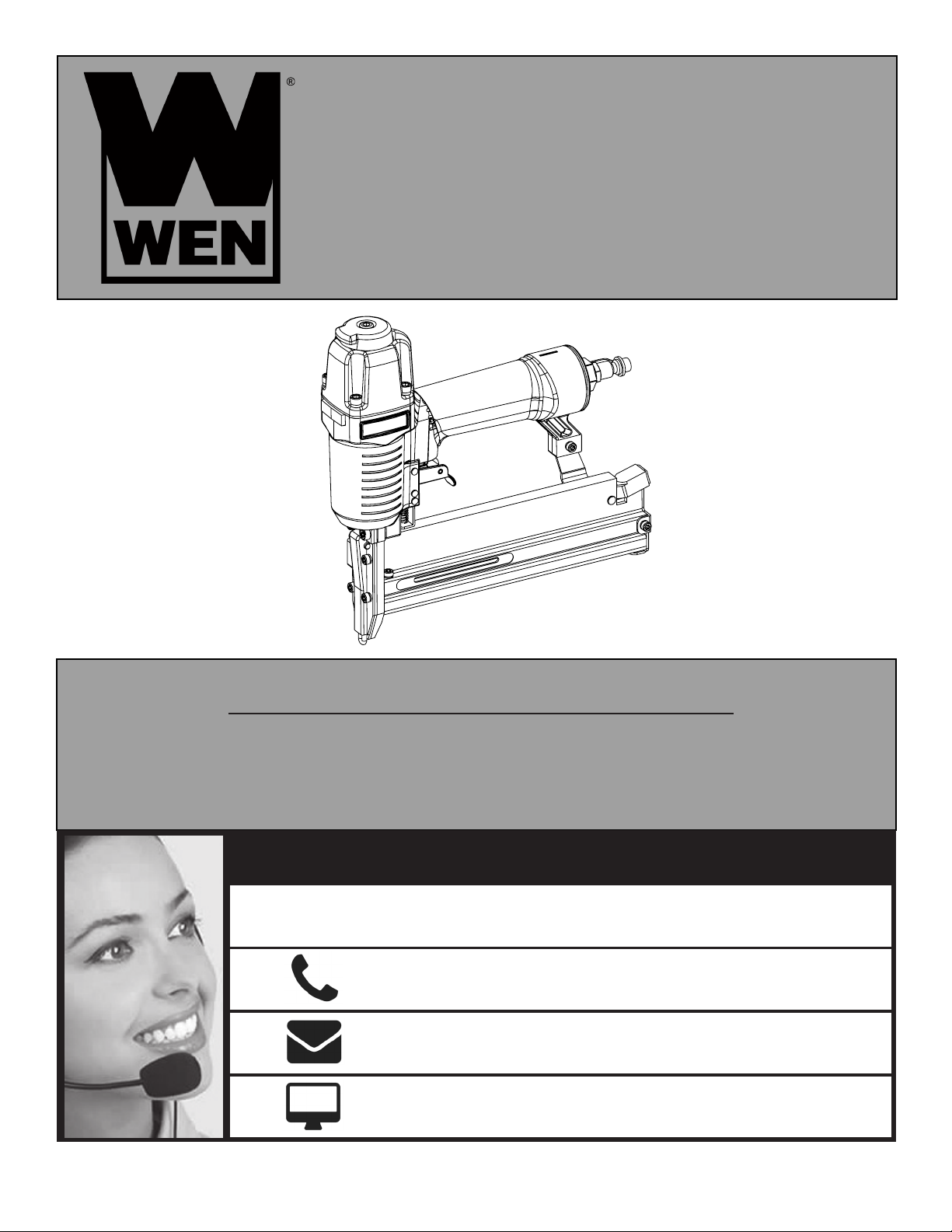
PNEUMATIC
2-IN-1 NAILER
Model # 61718
Your new tool has been engineered and manufactured to WEN’s highest standards for dependability, ease
of operation, and operator safety. When properly cared for, this product will supply you years of rugged,
trouble-free performance. Pay close attention to the rules for safe operation, warnings, and cautions. If
you use your tool properly and for its intended purpose, you will enjoy years of safe, reliable service.
IMPORTANT:
NEED HELP? CONTACT US!
Have product questions? Need technical support?
Please feel free to contact us at:
800-232-1195
WENPRODUCTS.COM
(M-F 8AM-5PM CST)
bit.ly/wenvideo
For replacement parts visit
WENPRODUCTS.COM
NOTICE: Please refer to wenproducts.com for the most up-to-date instruction manual.

TABLE OF CONTENTS
2
3
4
7
8
10
12
13
14
16
TECHNICAL DATA
Model Number:
Minimum Operating Pressure:
Maximum Operating Pressure:
Air Inlet:
Air Consumption per Fastener:
Nail Type:
Nail Length:
Staple Type:
Staple Length:
Magazine Capacity:
Weight:
61718
60 PSI
100 PSI
1/4˝- 18 NPT
0.5 CFM @ 90 PSI
18 Gauge Brad Nail
5/8˝ to 2˝ (15 mm to 50 mm)
18 Gauge 1/4˝ Narrow Crown
5/8˝to 1-5/8˝ (16 mm to 40 mm)
100 pcs
3.4 lbs
2
Technical Data
Safety Introduction
Important Safety Rules
Know Your Nailer
Preparation and Adjustments
Operation
Maintenance
Troubleshooting Guide
Exploded View and Parts List
Warranty Statement

3
SAFETY INTRODUCTION
Thanks for purchasing the WEN 2-in-1 Nailer & Stapler. This tool is designed for household use only, not for
industrial or professional purposes. Safe operation of this pneumatic tool requires that you read and understand
this instruction manual and all labels affixed to the tool. Safety is a combination of common sense, staying alert,
and knowing how your tool works.
SAFETY ALERT SYMBOL: Indicates danger, warning, or caution. The safety symbols and the
explanations with them deserve your careful attention and understanding. Always follow the safety
precautions to reduce the risk of fire, electric shock and personal injury. However, please note that
these instructions and warnings are not substitutes for proper accident prevention measures.
NOTE: The following safety information is not meant to cover all possible conditions and situations that may oc-
cur. WEN reserves the right to change this product and specifications at any time without prior notice.
Keep this manual available to all users during the entire life of the tool and review it frequently
to maximize safety for both yourself and others.

IMPORTANT SAFETY RULES
4
Safety is a combination of common sense, staying alert and knowing how your item works.
SAVE THESE SAFETY INSTRUCTIONS.
WARNING: To avoid mistakes and serious injury, do not use your tool until the following steps have
been read and understood. LEARN the tool’s applications, limitations, and possible hazards.
WORK AREA SAFETY
1. KEEP YOUR WORK AREA clean, uncluttered, and well lit. Do not work on floor surfaces that are slippery with
sawdust or wax. Keep the floor clear of oil, scrap, and other debris.
2. DO NOT USE the tool in the presence of flammable dust, gases or fumes. The tool may produce a spark that
could ignite gases and cause a fire.
5. KEEP BYSTANDERS AT A SAFE DISTANCE from the work area, especially when the tool is operating.
Never allow children or pets near the tool.
PERSONAL SAFETY
1. DRESS FOR SAFETY. Do not wear loose clothing, gloves, neckties, or jewelry (rings, watches, etc.) when
operating the tool. Always wear non-slip footwear and tie back long hair.
2. USE PERSONAL PROTECTIVE EQUIPMENT.
• Everyone in the work area MUST wear safety glasses with side shields that conform to ANSI Z87.1 requirements
(approved glasses have “Z87” printed or stamped on them). Safety glasses should be worn during operation,
assembly or maintenance of the tool.
• Wear ear protection such as plugs or muffs. Failure to use adequate ear protectors when the noise level is high
can result in lasting damage to hearing loss and other problems, such as tinnitus (ringing, whistling or buzzing in
the ear).
• Wear a face mask or dust mask to fight the debris produced by operation.
• Wear work gloves to protect your hands.
• Wear safety non-slip work boots.
• Wear safety helmet if any work is being carried out above your head.
3. STAY ALERT - watch what you’re doing and use common sense when using the tool. Do not use while you are
tired or under the influence of drugs, alcohol or medication that may affect your ability to properly use the tool.
Even a moment of inattention may result in serious personal injury.
4. DO NOT OVERREACH. Keep proper footing and balance at all times. Wear oil-resistant rubber-soled footwear.
5. KEEP ALERT. Watch what you are doing. Use common sense. Do not operate any tool when you are tired or
under the influence of drugs, alcohol or medication that may affect your ability to properly use the tool.
6. KEEP HANDS AND BODY PARTS CLEAR of immediate work area. Hold workpiece with clamps when
necessary to keep body parts out of potential harm. Be sure the workpiece is properly secured before pressing the
nailer against the material. The safety bracket may cause the work material to shift unexpectedly.

IMPORTANT SAFETY RULES
5
AIR SUPPLY SAFETY
1. USE ONLY CLEAN, DRY, AND REGULATED AIR. Condensation from an air compressor can rust and
damage the internal workings of the tool. Regularly drain water and contaminants out from the compressor. An in-
line filter is recommended to remove most of these contaminants and prolong the life of the tool the compressor.
2. DANGER OF EXPLOSION AND/OR SERIOUS PERSONAL INJURY. Do not use bottled gases to power
this tool. Bottled compressed gases, including but not limited to oxygen, carbon dioxide, nitrogen, hydrogen,
propane, acetylene or air are not for use with pneumatic tools. Never use combustible gases or any other reactive
gas as a power source for this tool.
3. REGULATE THE AIR PRESSURE. Use air pressure that is compatible with the operation pressure of the tool
(60 to 100 PSI). Do not let the air pressure exceed 100 PSI.
4. ALL AIR SUPPLY COMPONENTS (hoses, connectors, filters, regulators, etc.) must have a working pressure
rating of at least 150 PSI (150% of the maximum operating pressure).
5. USE PROPER EXTENSION CORDS. When using an air compressor outdoors, use only rounded-jacket
extensions cords. These are intended for outside use. See manufacturer’s manual for the AWG required for the
compressor’s amperage draw.
6. MAKE SURE THE AIR SUPPLY HOSE is free of obstructions or snags. Entangled or snarled hoses can cause
a loss of balance. Keep the hose in good condition.
7. MAKE SURE ALL CONNECTIONS are nice and tight. Use appropriate hose tape to prevent leaking. Pay
attention to air hoses and their connections to prevent tripping over them.
8. WHEN CONNECTING TO THE AIR SUPPLY, the tool is at risk of possibly firing fasteners. Be aware of this
and do not aim the gun at anything you do not want to shoot a nail into. It is recommended to empty the magazine
before connecting to the air supply.
9. MAKE SURE HOSE is free of obstructions or snags.
10. USE COUPLINGS that relieve all pressure from the tool when it is disconnected from the power supply. Use
hose connectors that shut off the air supply from the compressor when the tool is disconnected.
FASTENERS SAFETY
1. LOAD FASTENERS AFTER connecting the tool to the air supply. Otherwise, fasteners are at risk of being fired
during connection. The tool’s driving mechanism may cycle when it is connected to the air supply.
2. DO NOT ENGAGE the safety bracket or the trigger when loading fasteners.
3. ALWAYS ASSUME THAT THE TOOL CONTAINS FASTENERS. Do not point the tool at others or
yourself at any time, fasteners may be fired unintentionally and cause serious injury.
4. DO NOT use the body of the tool or top cap as a hammer. Discharged fasteners may follow unexpected paths
and cause serious bodily injury.

IMPORTANT SAFETY RULES
6
TOOL SAFETY
1. THIS TOOL IS DESIGNED for household use only, not for industrial or professional purposes. Do not force
the tool to do a job for which it was not designed.
2. INSPECT TOOL BEFORE USE. Do not operate if any portion of the tool, trigger, or safety bracket is damaged,
inoperable, disconnected, or altered. Leaking air, damaged parts, or missing parts should be repaired or replaced.
3. GRIP THE TOOL FIRMLY with both hands to maintain control while still allowing it to recoil away from the
work surface as the fastener is driven.
4. KEEP FACE AND BODY PARTS away from the back of the tool cap when working in restricted areas. Sudden
recoil can result in impact to the body, especially when nailing into hard or dense material.
5. DO NOT DISCHARGE FASTENERS into open air, concrete, stone, extremely hard woods, knots or any
material too hard for the fastener to penetrate.
6. DO NOT DRIVE FASTENERS near the edge of your work material. The workpiece may split, causing the
fastener to ricochet, injuring you or a bystander. Be aware that the fastener may follow the grain of the wood, causing
it to protrude unexpectedly from the side of the work material. Drive the fastener perpendicular to the grain to
reduce risk of injury.
7. DO NOT DRIVE FASTENERS onto the heads of other fasteners. Do not use the tool at too steep of an angle.
Personal injury from strong recoil, jammed fasteners, or ricochetted nails may result.
8. BE AWARE OF MATERIAL THICKNESS when using the nailer. A protruding nail may cause injury.
9. WHEN THE TOOL IS BEING UTILIZED AT PRESSURES ON THE HIGH END of its operating range,
fasteners can be driven completely through thin or very soft work material. Make sure the pressure in the compressor
is set so that fasteners are set into the material and not pushed completely through.
10. REMOVE FINGER FROM TRIGGER when not driving fasteners. Never carry the tool with your finger on
the trigger.
11. IF THE FASTENERS ARE JAMMED, disconnect the tool from the air supply first before removing the
jammed fasteners.
12. DISCONNECT tool from air supply when not in use. Remove fasteners from magazine before leaving the area
or passing the tool to another operator. Do not climb ladders, stairs, scaffoldings, etc. without disconnecting the
tool. Do not carry a connected tool to another work area. Do not make adjustments, remove magazine, perform
maintenance or clear jammed fasteners while connected to the air supply.
13. DO NOT REMOVE, tamper with, or otherwise cause the tool, trigger or safety bracket to become inoperable.
Do not tape or tie the trigger or safety bracket in the ON position. Do not remove springs from the safety bracket.
Make daily inspections for free movement of the trigger and safety bracket. Do not alter or modify the tool in any
way.
14. MAINTAIN TOOLS PROPERLY. ALWAYS keep tools clean and in good working order. Follow instructions
for lubricating, changing accessories and storage.
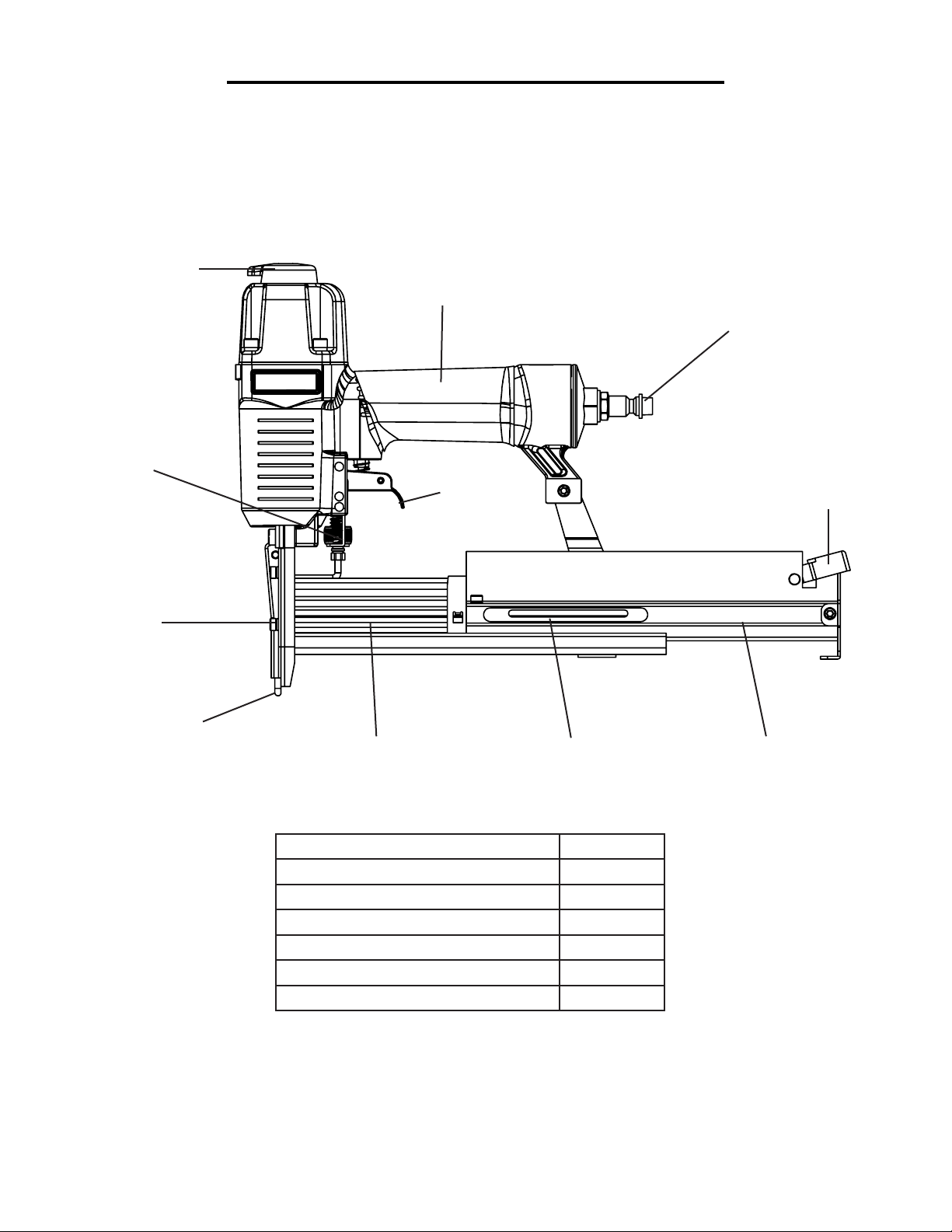
KNOW YOUR NAILER
Movable Magazine
Magazine Lock
Inlet with Protective Cap
Nail Gauge Window
Trigger
Handle
Depth Adjustment
Wheel
Air Outlet
Faceplate
Safety Bracket
Fixed Magazine
Carefully unpack the tool from the packaging. Check all components and compare against the graph below. If any
part is damaged or missing, please contact our customer service at (800) 232-1195, M-F 8-5 CST or email us at
PACKAGE CONTENT QTY
2-in-1 Nailer 1
3mm Hex Key 1
4mm Hex Key 1
Air Tool Lubricating Oil 1
Safety Glasses 1
Blow Mold Case 1
7
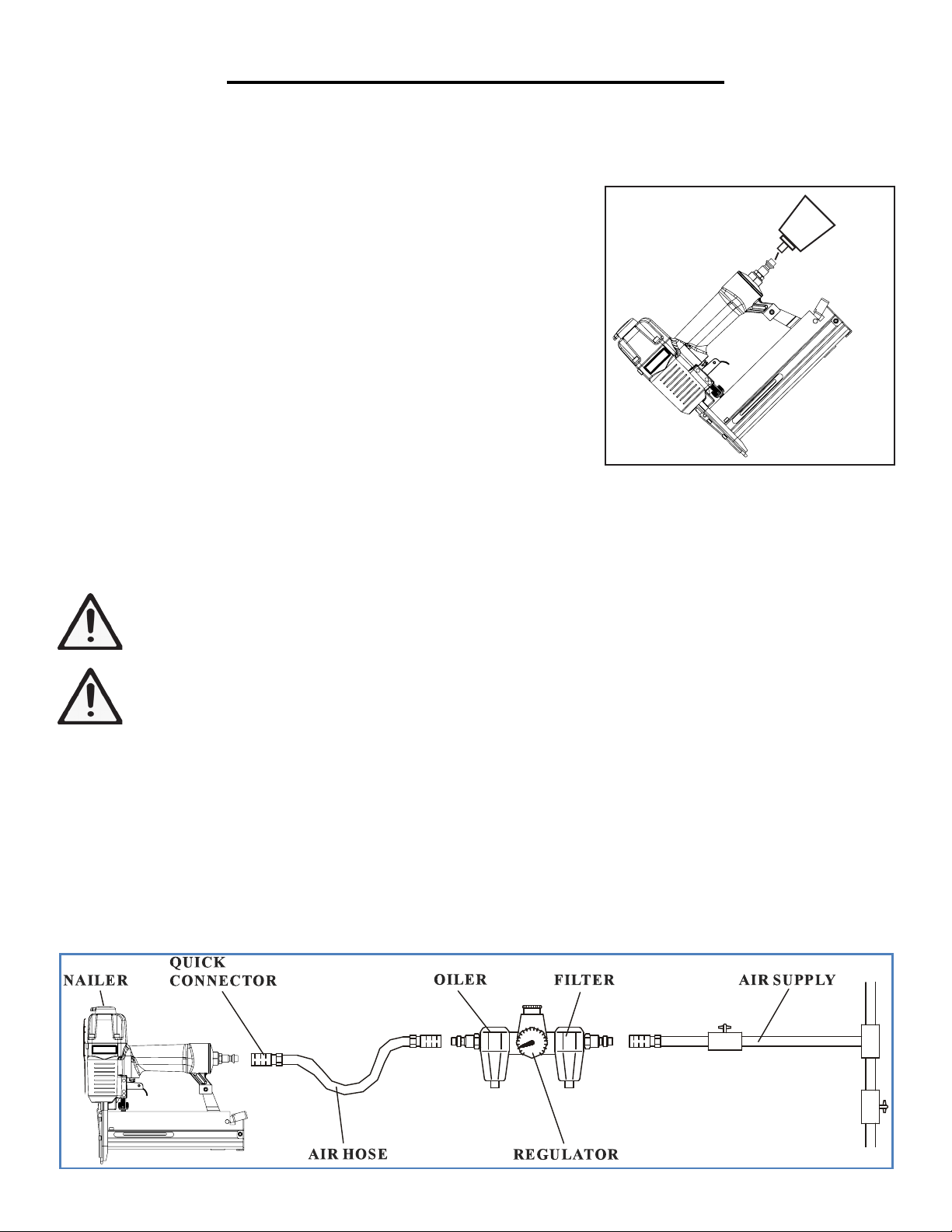
CONNECTING THE TOOL TO AN AIR SUPPLY (Fig. 2)
Your tool should be connected to a properly installed compressed air supply. The working pressure of the air
compressor must be regulated by a regulator to fit the operating pressure of your nailer (60-100 PSI). Refer to the
diagram on the bottom (Fig. 2) for the recommended accessories and connection order.
WARNING: Make sure the nailer magazine is empty and the tip of the nailer is pointed away from you
when connecting to air supply.
WARNING: Use only clean dry and regulated air. Do not use bottled gases to power this tool. Danger
of explosion and/or serious personal injury may result. Do not operate when the air pressure is outside
of the recommended range (60 to 100 PSI).
1. Turn on the compressor on and set the regulator (Fig. 2 - Regulator) to the proper pressure within 60 to 100 PSI.
The pressure can be adjusted later depending on firing depth, length of fastener and hardness of the workpiece.
2. Connect the compressed air hose to the inlet of your air compressor. Connect the other end of the air hose to the
air inlet of the nailer. The connections must click into place audibly. Use appropriate hose tape to prevent leaking.
3. To disconnect the tool from the air hose, pull back the ring on the quick connector to release the connection.
Repeat for disconnecting the air compressor from the air hose.
PREPARATION AND ADJUSTMENTS
LUBRICATING THE TOOL (Fig. 1)
This tool requires lubrication before each use (especially the first use). Proper lubrication is the owner’s responsibil-
ity. Failure to lubricate the tool properly will dramatically shorten the life of the tool and void the warranty.
Fig. 1
Oil
Fig. 2
NOTE: The in-line oiler is a convenient way to provide oil to the tool.
If an in-line oiler is installed, manual lubrication through the air inlet is
not required.
1. Always make sure the tool is disconnected from the air supply before
adding lubricant.
2. Turn the tool so the air inlet is facing up. Open the protective cap.
Place 3 to 4 drops of air tool lubrication oil into the air inlet (Fig. 1).
NOTE: Excessive lubrication may damage the work surface.
3. Close the protective cap. Wipe off any excess oil from the inlet.
8
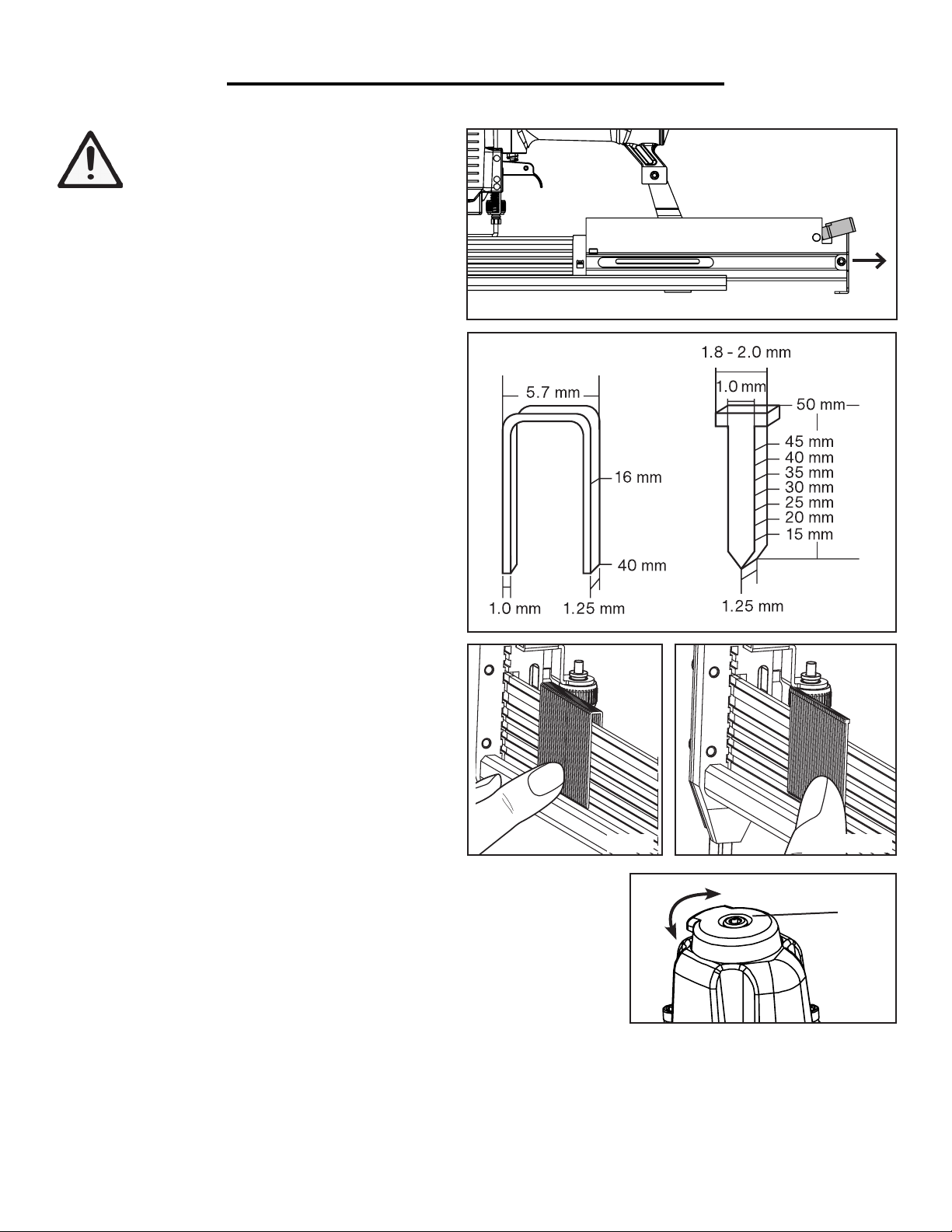
Fig. 3
Fig. 4
Fig. 5 Fig. 6
Fig. 7
1
PREPARATION AND ADJUSTMENTS
LOADING THE FASTENERS (Figs. 3 to 6)
WARNING: Always load the fasteners
after connecting the tool to its air supply.
Otherwise, unwanted misfires may occur
during connection. Never aim the tip towards your-
self or others.
1. Depress the magazine lock and pull out the mov-
able magazine fully (Fig 3).
2. Hold the nailer with the magazine to your side.
Make sure the firing tip is directed away from your-
self or others.
3. Your nailer accepts either 18 gauge brad nails 5/8˝
- 2˝ in length or 18 gauge 1/4˝ narrow crown staples
5/8˝- 1-5/8˝ in length (Fig. 4). A maximum of 100
fasteners may be loaded in the magazine.
A. Loading Staples: Place a clip of staples over the
fixed magazine track as shown (Fig. 5).
B. Loading Nails: Place a clip of nails into the
grooves of the fixed magazine with the nail tips
pointing downwards (Fig. 6). Make sure the heads
of the nails rest on the appropriate groove and that
the base of the nails are against the bottom of the
magazine.
4. Push the movable magazine forward until it is
locked. NOTE: Some force may be required to fully
close the magazine when fasteners are loaded.
NOTE: Regularly check the nail gauge window and
make sure to refill before the fasteners run out. Blank
ADJUSTING THE AIR OUTLET (Fig. 7)
Air will be released from the air outlet during operation. Rotate the adjust-
able air outlet cap (Fig. 7) on the top of the nailer to direct the released air at
your preferred direction, away from you and the workpiece.
9
NON-MARRING TIP
A rubber non-marring tip is attached to your nailer’s safety bracket to reduce marring and damage to the workpiece
during operation. Make sure to disconnect the tool from air supply before adjusting, removing or installing the
non-marring tip.
shots can damage the tool and leave unwanted marks on the workpiece.
marks on the workpiece.
WARNING: If the safety bracket is not functioning as described above, you should stop using the tool
immediately and disconnect it from the air supply.
7. After operation, turn off the air compressor and depressurize the compressor according to the instructions stated
with your compressor. Disconnect the air hose from the nailer and attach the protective cap to the nailer inlet.
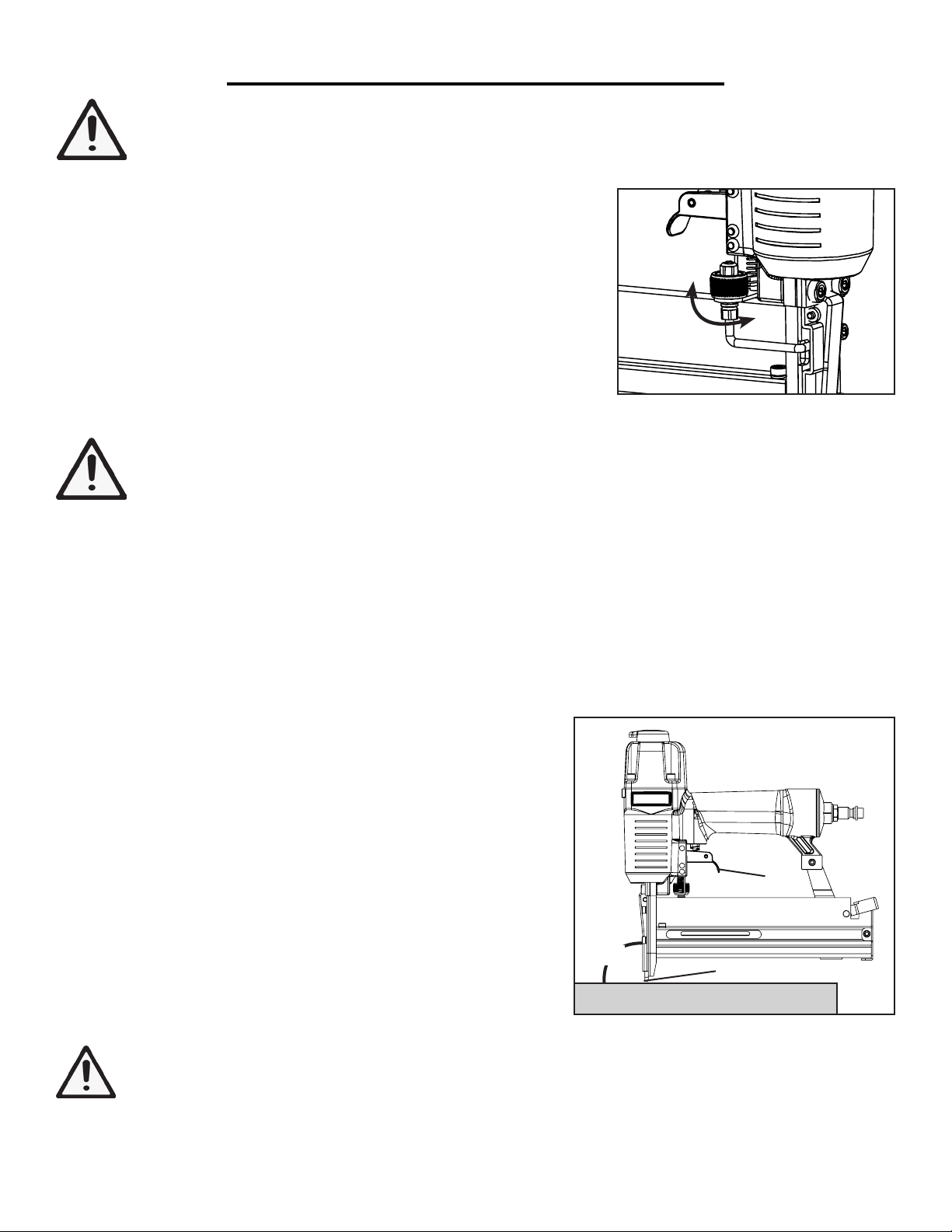
3. Hold the nailer upright on the workpiece and position the safety
bracket where the fastener will be driven (Fig. 9).
4. Carefully press down on the safety bracket (Fig. 9 - 1) and pull the
trigger (Fig. 9 - 2) to drive a fastener.
5. Release the trigger, lift the tool off the workpiece and reposition it
where the next fastener will be driven. Repeat step 4 to drive another
fastener.
6. Regularly check the nail gauge window to see the load of fasteners
in the magazine. Make sure to refill the magazine before the fasten-
ers run out. As blank shots can damage the tool and leave unwanted
OPERATION
SHOOTING FASTENERS (Fig. 9)
WARNING: Using a nail gun can be dangerous. To reduce the risk of injury, always wear proper eye
and hearing protection when operating this tool. Stay alert and keep proper balance at all times. Always
release the trigger when not operating the nail gun to reduce the risk of unintended fastener discharge.
1. Check that the air supply is correctly connected to the tool at the correct pressure and the fasteners have been
loaded into the magazine.
2. Test the driving depth on a sample piece of wood. If the fasteners penetrate too far, decrease the firing depth or
adjust the regulator to provide less air pressure. If the fasteners penetrate too shallow, increase the firing depth or
adjust the regulator to provide more air pressure. Try to adjust both the air pressure regulator and the depth wheel
so that you can achieve your desired firing depth with the lowest possible air pressure. This will save energy, reduce
noise level and reduce the wear on the tool.
ADJUSTING THE DEPTH ADJUSTMENT WHEEL (Fig. 8)
The nailer is equipped with a depth adjustment wheel (Fig. 8) for setting
the penetration depth of the fasteners.
1. Turn the wheel clockwise to increase the firing depth (wheel moves
downwards).
2. Turn the wheel counterclockwise to decrease the firing depth (wheel
moves upwards).
WARNING: Before each use, check the nailer, compressed air connections and air lines. If any parts
are missing or damaged, do not operate this tool until the parts are repaired and replaced. Failure to do
so could possibly result in a serious personal injury.
Fig. 8
Fig. 9
90°
2
1
10
Table des matières
Autres manuels Wen Cloueuse

Wen
Wen 20512BT Manuel utilisateur

Wen
Wen 61721 Manuel utilisateur

Wen
Wen 61720 Manuel utilisateur

Wen
Wen 61798 Series Manuel utilisateur

Wen
Wen 61793 Manuel utilisateur

Wen
Wen 61722 Manuel utilisateur

Wen
Wen 61731 Manuel utilisateur

Wen
Wen 61741K Manuel utilisateur

Wen
Wen 61741 Manuel utilisateur

Wen
Wen 61721 Manuel utilisateur


