VOSS OBW 501 Manuel utilisateur

Assembly instructions
VOSSOBW501
SGsensor
Strain gauge sensor for on-board weighing systems
Axle weight measuring –
at its most precise way

Assembly instructions VOSSOBW501
SG sensor
, Page 2 of 22
A. Important notices
Please observe before using the VOSSOBW501
SGsensor
VOSSOBW501
SG sensor
is suitable for axles in commercial vehicles, off-road vehicles and light
duty vehicles.
Only for assembly on axle. Any other use leads to the exclusion of warranty rights.
Before starting with the assembly process of the VOSSOBW501
SG sensor
, carefully read these
assembly instructions and make sure that you have understood these.
Before starting with the assembly process, provide the required materials and tools,
mentioned in chapter “C. Assembly instructions”.
The sensor / system must be installed and connected in accordance with the regulations valid
for the vehicle and country in question.
Make sure ignition is switched off and battery is disconnected before starting any installation.
The sensor has to be stored dry and free from humidity.
Do not remove the sensor from the ESDprotection bag before installing it in the vehicle.
Do not use the sensor data to control safety-relevant vehicle functions, e.g., ABS or ESP.
Liability:
All damages (e.g., recalls, customer services, expenses, compensation, etc.) are limited by
the respective order amount.
Damages shall be paid if VOSS is solely liable (gross negligence or intent required). Only the
actual damage will be compensated.
Under no circumstances shall VOSS be liable to the purchaser for liquidated
damages/contractual penalties and/or financial losses such as expected or lost profits, loss of
production, interest, penalties or for incidental, consequential, special, exemplary or criminal
damages in connection with the contract.
Should VOSS be held liable by third parties (e.g., due to product liability claims), the
purchaser shall indemnify VOSS against all claims.
Any processing of vehicle components must be coordinated with the component
manufacturer.

Assembly instructions VOSSOBW501
SG sensor
, Page 3 of 22
Please observe during the assembly of the VOSSOBW501
SGsensor
The assembly of the VOSSOBW501
SG sensor
must be conducted by professional mechanics
subject to these assembly instructions.
Incorrectly assembled sensors can result in failure of the system.
Before using the sensor, components must be checked. They have to be clean and must not
show any signs of damage. In case of any damage, the sensor has to be replaced.
Handle sensor with care to avoid damage due to mechanical shock and electrostatic
discharge.
VOSSOBW501
SG sensor
is measuring the strain of the material. To make sure the sensor can
measure correctly, the surface has to be clean, straight and free from grease or other release
agents (see chapter “C. Assembly instructions 1. Grinding and cleaning of surfaces”).
To protect the sensor, it hast to be covered by a protection cover and by sealing. The cable has
always to be protected by a corrugated tube. Avoid bending the cable around sharp edges
and below the specified minimum bending radius of 35 mm. The sensor will be adhesive
bonded and the cable fixed on the chassis (see chapter “C. Assembly instructions 2. Assembly
of VOSSOBW501
SG sensor
”). It is recommended to apply a first fixation of supply cable at a
distance of 150 mm behind the protection cover.
The sensor has a 3-wire harness. For connection and setup instructions see chapter
“C. Assembly instructions 3. Setup of VOSSOBW501
SG sensor
”.
Observe the manufacturer's safety instructions and handling of adhesive and sealing material.
System properties
For detailed system properties and technical data please check latest available version of
“Product information VOSSOBW501
SG sensor
”(Art. No. 7007734000) on
www.voss-automotive.net/en/downloads.
!
!
!
!
!
!
!
!

Assembly instructions VOSSOBW501
SG sensor
, Page 4 of 22
B. Components and materials
1. VOSSOBW501
SGsensor
Fig. 1: VOSSOBW501
SG sensor
with cable Fig 2: VOSSOBW501
SG sensor
with metal protection
cover and corrugated tube
2. Electrical connection possibilities
Fig 3: Connector Tyco HDSCS
Pin1: VBAT
Pin2: GND
Pin3: Signal
Fig 4: Open wire; wire configuration:
VBAT (Red)
GND (Brown)
Signal (White)

Assembly instructions VOSSOBW501
SG sensor
, Page 5 of 22
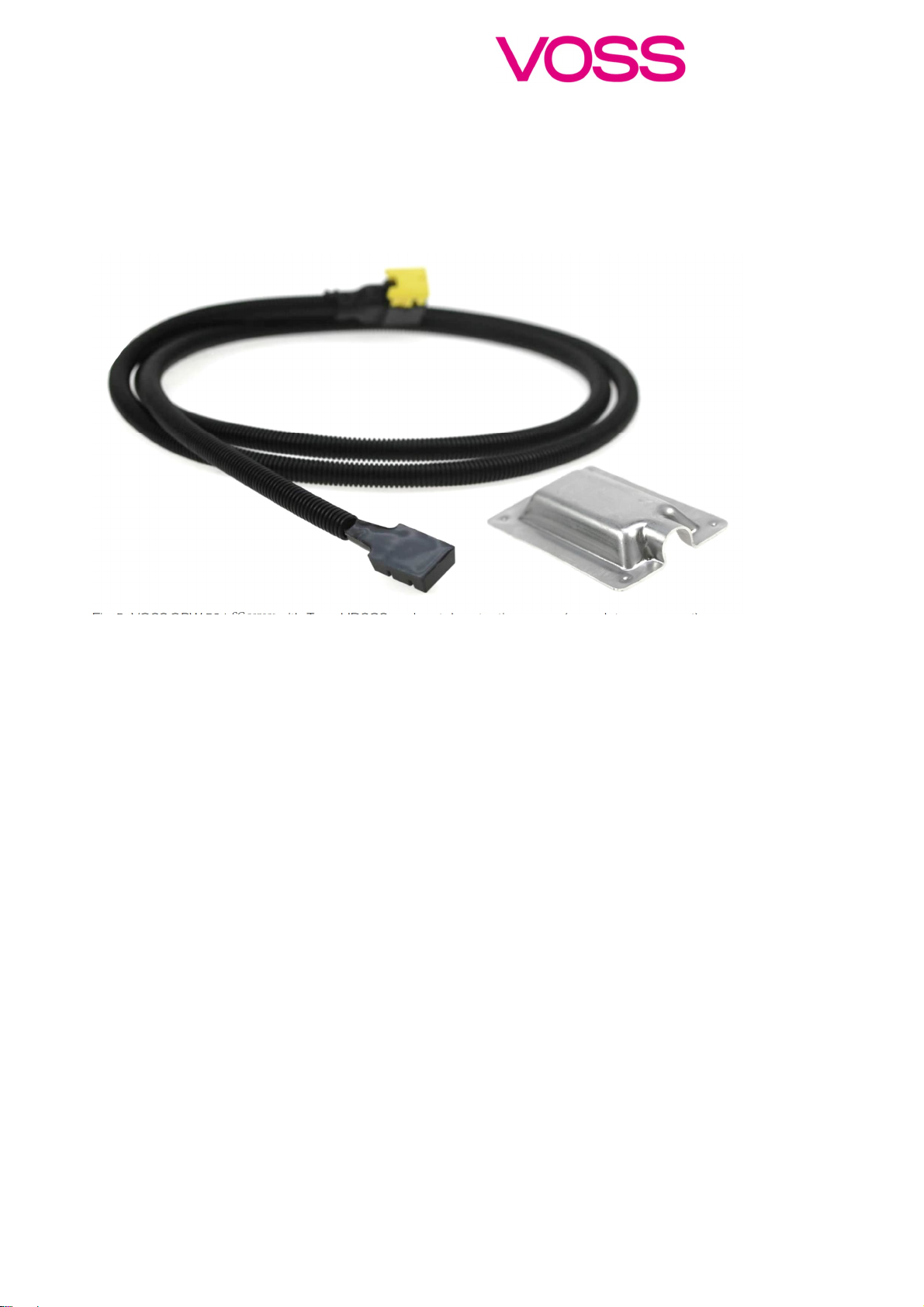
3. Complete sensor set
Fig 5: VOSSOBW501
SG sensor
with Tyco HDSCS and metal protection cover (complete sensor set)

Assembly instructions VOSSOBW501
SG sensor
, Page 6 of 22
C. Assembly instructions
Use of arrow symbols in pictures:
Indicates special points of interest described in the text.
Indicates required manual actions and their direction.
Indicates operations that should be avoided.
1. Grinding and cleaning of surfaces
Before starting cleaning, make sure that the vehicle is safely parked, the engine of vehicle is turned off (no
voltage on electrical supply lines), and the vehicle axle is ina temperature range of +10 °C to +30 °C
(+50 °F to +86 °F).
Provide the following materials/tools: angel grinder with grain 80, drilling machine with 60 and 120
grain, abrasive paper 120, abrasive paper 240, cleaning cloths, lint-free cloths and cleaning solvent:
acetone + 2-propanol (mixing ratio 1:1).
Use the middle of the axle as assembly area for the VOSSOBW501
SG sensor
. Minimum
100 mm x 60 mm needed as installation space incl. protection cover. The surface of sensor installation
(ca. 30 mm x 20 mm) has to be grinded flat.
Use gloves, while working. Prepare yourself with further personal protective equipment, if needed
according to local regulations. We recommend wearing working gloves and safety goggles.
Step 1
Before starting the grinding process, area must be free from
grease and release agents.
Polish the surface by using angle grinder with grain 80.
Do not grind an indentation.
Fig. 6: Polishing the surface with grinder
!
!
!
!
!

Assembly instructions VOSSOBW501
SG sensor
, Page 7 of 22
Step 2
Polish the surface by using drilling machine with grain 60.
Fig. 7: Polishing the surface using drilling machine with
grain 60
Step 3
Continuously polish the surface by using drilling machine
with grain 120.
Fig. 8: Polishing the surface using drilling machine with
grain 120
Step 4
Grind the surface fine by hand by using abrasive paper with
grain 120.
This step should be performed on an area at least as
large as the sensing part, ca. 30 mm x 20 mm.
Fig. 9: Fine grinding of the surface by hand by using abrasive
paper with grain 120
!

Assembly instructions VOSSOBW501
SG sensor
, Page 8 of 22
Step 5
Grind the surface fine by hand by using abrasive paper with
grain 240.
This step should be performed on an area at least as
large as the sensing part, ca. 30 mm x 20 mm.
Fig. 10: Fine grinding of the surface by hand by using
abrasive paper with grain 240
Step 6
Final result of the grinding process.
Fig. 11: Finally grinded surface
Step 7
Wipe clean the entire grinded surface with cleaning solvent
and a cleaning cloth.
Fig. 12: Cleaning of surface
!

Assembly instructions VOSSOBW501
SG sensor
, Page 9 of 22
Step 8
Use lint-free cloth and cleaning solvent for the final cleaning.
During this process, you need to change the cloth,
until the cloth remains white after wiping. This may
take several attempts. Prepared surface has to be
completely free of dirt, paint, dust, oil and grease.
Fig. 13: Cleaning of surface with lint-free cloth
Step 8.1
Use lint-free cloth and cleaning solvent for the final cleaning.
During this process, you need to change the cloth,
until the cloth remains white after wiping. This may
take several attempts. Prepared surface has to be
completely free of dirt, paint, dust, oil and grease.
Fig. 14: Still dirty lint-free cloth during cleaning process
Step 9
Use lint-free cloth and cleaning solvent for the final cleaning.
During this process, you need to change the cloth,
until the cloth remains white after wiping. This may
take several attempts. Prepared surface has to be
completely free of dirt, paint, dust, oil and grease.
Fig. 15: Final cleaning of surface
!
!
!

Assembly instructions VOSSOBW501
SG sensor
, Page 10 of 22
Step 9.1
Use lint-free cloth and cleaning solvent for the final cleaning.
During this process, you need to change the cloth,
until the cloth remains white after wiping. This may
take several attempts. Prepared surface has to be
completely free of dirt, paint, dust, oil and grease.
Fig. 16: Finally white lint-free cloth after cleaning process
Step 10
Final result of the cleaning process.
Fig. 17: Final result of the cleaning process
Step 11
Grind the protection cover by hand with abrasive paper with
grain 120 or 240.
Fig. 18: Grinding of protection cover
!
Autres manuels pour OBW 501
1
Table des matières
Autres manuels VOSS Accessoires