
Viglen Dossier L50 Manuel utilisateur
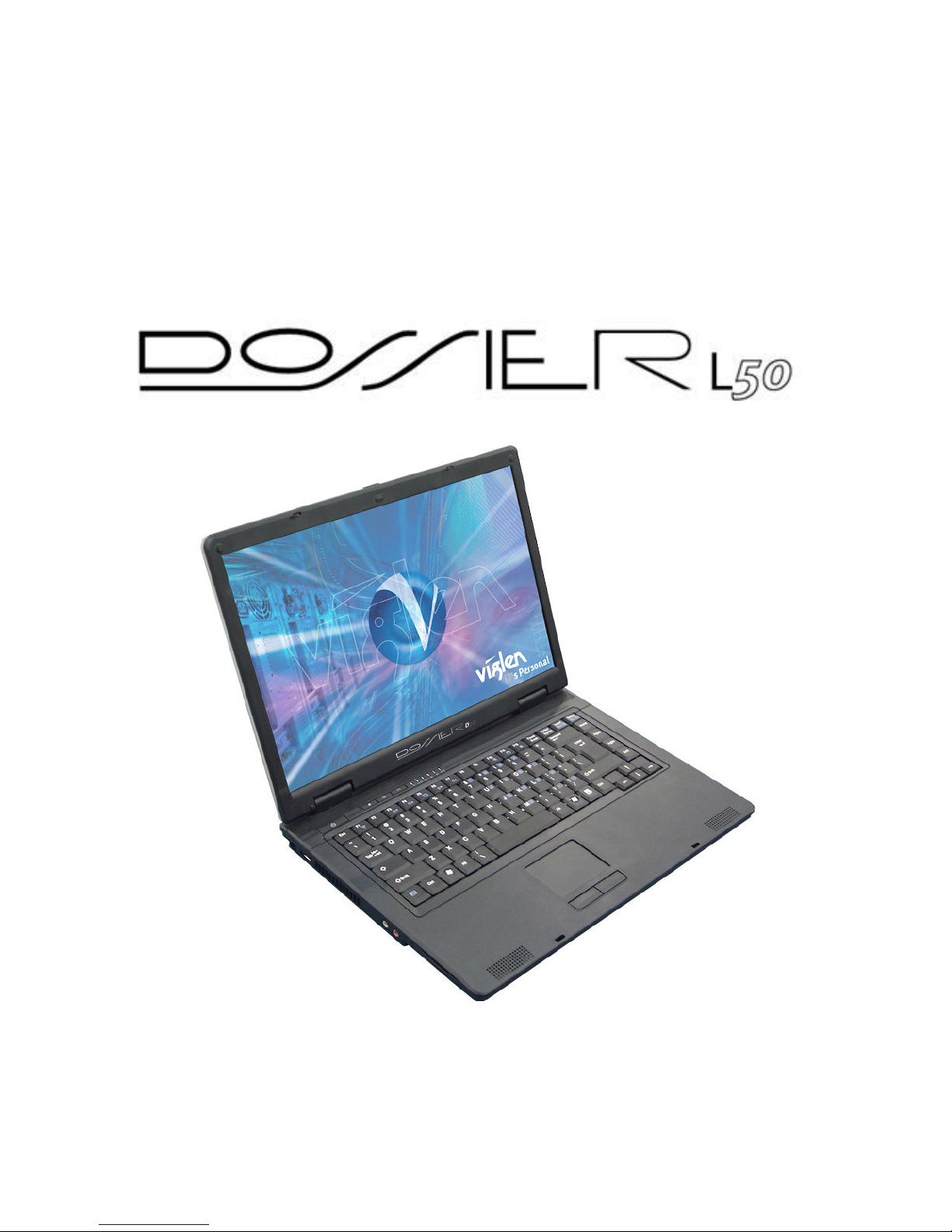
User’s Guide
for
(December 2007)

COPYRIGHTS AND TRADEMARKS
Please note
The material in this manual is subject to change without notice.
Trademarks
Microsoft, Windows, Windows NT, MS-DOS,Windows 95,Windows 98,
Windows ME, Windows 2000 Pro, Windows XP Pro and Windows Vista are
registered trademarks of Microsoft Corporation. IBM PC, XT, AT and PS/2 are
trademarks of International Business Machines Corporation. Pentium and
Pentium Pro are registered trademarks of Intel Corporation. AMI BIOS is a
registered trademark of American Megatrends. All other trademarks are
acknowledged. JAC-UP, Genie, Contender, Dossier, Vig, Viglen, and Envy are
trademarks of Viglen Limited.
Copyright and Patents
This manual and all accompanying software and documentation are copyrighted
and all rights reserved. This product, including software and documentation,
may not, in whole or in part, be copied, photocopied, translated or reduced to any
electronic or machine-readable form, without prior written consent except for
copies retained by the purchaser for backup.
© Copyright 2007 Viglen Limited
All Rights Reserved
Dossier L50 Manual Version 1.0
Printed in the United Kingdom
Liability
No warranty or representation, either expressed or implied, is made with respect
to this documentation, its quality, performance, merchantability or fitness for a
particular purpose. As a result the documentation is licensed as is, and you, the
licensee, are assuming the entire risk as to its quality and performance. The
vendor reserves the right to revise this operation manual and all accompanying
software and documentation and to make changes in the content without
obligation to notify any person or organisation of the revision or change.
In no event will the vendor be liable for direct, indirect, special, incidental or
consequential damages arising out of the use or inability to use this product or
documentation, even if advised of the possibility of such damages. In particular,
the vendor shall not have liability for any hardware, software or data stored or
used with the product, including the costs of repairing, replacing or recovering
such hardware, software or data.

i
Table of Contents
Preface ........................................................................................ v
Notational Conventions.......................................................vi
Chapter 1 Getting Started...................................................1-1
Getting the Computer Running ............................................ 1-2
Unpacking ........................................................................ 1-2
Connecting to AC Power ................................................. 1-2
Opening the Cover ........................................................... 1-4
Turning On and Off the Computer................................... 1-4
Taking a Look at the Computer............................................ 1-6
Right-Side Components ................................................... 1-6
Left-Side Components ..................................................... 1-7
Rear Components ............................................................. 1-8
Bottom Components......................................................... 1-9
Top-open Components ................................................... 1-10
Where to Go from Here...................................................... 1-12
Chapter 2 Operating Your Computer.................................2-1
Starting and Stopping the Computer .................................... 2-2
Starting the Computer ...................................................... 2-2
Stopping the Computer .................................................... 2-2
Using the Easy Start Buttons................................................ 2-4
Using the Keyboard.............................................................. 2-5
Typewriter Keys............................................................... 2-5
Cursor-Control Keys ........................................................ 2-6
Numeric Keypad .............................................................. 2-8
Euro Symbol..................................................................... 2-8
Windows Keys ................................................................. 2-9

ii
Function Keys .................................................................. 2-9
Fn Key.............................................................................. 2-9
Hot Keys ........................................................................ 2-10
Using the Touchpad ........................................................... 2-11
Configuring the Touchpad ............................................. 2-13
Using the DVD Drive......................................................... 2-14
Inserting and Removing a Disc ...................................... 2-15
Using the Video Features ................................................... 2-16
Configuring the Display Modes ..................................... 2-16
Using the Audio Features................................................... 2-17
Connecting Audio Devices ............................................ 2-18
Using the Communication Features ................................... 2-19
Using the Modem (Optional) ......................................... 2-19
Using the LAN ............................................................... 2-20
Using the Wireless LAN (Optional) .............................. 2-21
Chapter 3 Managing Power ................................................3-1
AC Adapter .......................................................................... 3-2
Battery Pack ......................................................................... 3-3
Charging the Battery Pack ............................................... 3-3
Initializing the Battery Pack............................................. 3-4
Checking the Battery Level.............................................. 3-4
Replacing the Battery Pack .............................................. 3-5
Battery Low Signals and Actions..................................... 3-7
Power Management.............................................................. 3-8
Hibernation....................................................................... 3-9
Power-Saving Tips ............................................................. 3-10
Chapter 4 Expanding Your Computer ...............................4-1
Connecting an External Monitor.......................................... 4-2
Connecting a USB Device.................................................... 4-3
Using ExpressCards ............................................................. 4-4
ExpressCard Type ............................................................ 4-4
Inserting and Removing an ExpressCard ......................... 4-5

iii
Internal Components Upgrade ............................................. 4-6
Chapter 5 Using BIOS Setup ..............................................5-1
When and How to Use BIOS Setup ..................................... 5-2
When to Use..................................................................... 5-2
Starting BIOS Setup......................................................... 5-2
Moving Around and Making Selections .......................... 5-4
Main Menu ........................................................................... 5-5
Advanced Menu ................................................................... 5-6
Boot Menu............................................................................ 5-8
Exit Menu........................................................................... 5-10
Chapter 6 Installing Software Drivers................................6-1
How to Use the Driver Disc ................................................. 6-2
Installing Drivers.................................................................. 6-2
P1 Quick Launch Key Utility........................................... 6-3
Chapter 7 Caring for the Computer ...................................7-1
Protecting the Computer ...................................................... 7-2
Using the Windows Security Center................................ 7-2
Using the Cable Lock....................................................... 7-3
Taking Care of the Computer............................................... 7-4
Location Guidelines ......................................................... 7-4
General Guidelines........................................................... 7-4
Cleaning Guidelines......................................................... 7-5
Battery Pack Guidelines................................................... 7-5
When Traveling.................................................................... 7-6
Chapter 8 Troubleshooting.................................................8-1
Preliminary Checklist........................................................... 8-2
Solving Common Problems.................................................. 8-3
Battery Problems.............................................................. 8-4
DVD Drive Problems....................................................... 8-4
Display Problems ............................................................. 8-5
ExpressCard Problems ..................................................... 8-6

iv
Hardware Device Problems.............................................. 8-7
Hard Disk Drive Problems ............................................... 8-7
Keyboard, Mouse, and Touchpad Problems .................... 8-7
LAN Problems ................................................................. 8-8
WLAN Problems.............................................................. 8-8
Modem Problems ........................................................... 8-10
Power Management Problems........................................ 8-10
Software Problems ......................................................... 8-11
Sound Problems ............................................................. 8-11
Startup Problems ............................................................ 8-12
Other Problems .............................................................. 8-13
Resetting the Computer...................................................... 8-14
Appendix A Specifications ................................................... A-1
Appendix B Regulatory Information .................................... B-1
On the Use of the System.....................................................B-2
Class B Regulations .........................................................B-2
Safety Notices ..................................................................B-3
On the Use of the RF Device ...............................................B-6
USA and Canada Safety Requirements and Notices .......B-6
European Union CE Marking and Compliance Notices ..B-9
电子信息产品有毒有害物质或元素名称及含量标示...B-13
Index .........................................................................................I-1

v
Preface
This manual contains information that will help you operate the
computer. It is divided into 8 chapters, 2 appendices, and an index.
Chapter 1, Getting Started, takes you through the process of setting
up the computer and identifying its external components.
Chapter 2, Operating Your Computer, tells you how to use the
computer’s components and features.
Chapter 3, Managing Power, provides information on power.
Chapter 4, Expanding Your Computer, provides information on
installing and using peripheral devices.
Chapter 5, Using BIOS Setup, describes the BIOS Setup program
that configures the computer’s BIOS settings.
Chapter 6, Installing Software Drivers, describes how to install the
drivers and utilities supplied with the computer.
Chapter 7, Caring for the Computer, gives you tips in care and
maintenance.
Chapter 8, Troubleshooting, gives solutions to common problems
you may encounter when using the computer.
Appendix A, Specifications, gives a brief specification of the
computer.
Appendix B, Regulatory Information, provides regulatory
statements and safety notices on your computer.

vi
Notational Conventions
Throughout this manual, the following conventions are used to
distinguish elements of text.
NOTE: identifies additional information that requires special attention.
CAUTION: identifies important information that, if not followed, may result in loss of
data or damage to the computer.
Keyboard keys are shown in a bold typeset. For example:
Press the Enter key to complete.
When keys are joined by a plus sign (+), press the first key, and, while
keeping the first key down, press the remaining keys, finally release all
the keys. When necessary, keys are also shown in graphics.
A title, command, setup item, or button that you can see on the screen is
shown in boldface. A value or an option that you can select for a setup
item is shown in italic. For example:
Select When I press the power button, set it to Shut down, and
then click the Save changes button.

Getting Started 1-1
Chapter 1
Getting Started
Congratulations on purchasing this computer.
Your computer incorporates desktop computer capabilities into a
compact notebook-sized package. It can greatly enhance your
productivity either in the office or at home. And, of course, wherever you
need it, the computer is ready and easy “to go.”
This chapter first tells you step by step how to get the computer up and
running. You will find instructions for these procedures:
Unpacking
Connecting to AC power
Opening the cover
Turning on the computer
Turning off the computer
Then, you will find a section briefly introducing the external components
of the computer. And the last section navigates you to the information
you may need after the computer is ready for use.
CHAPTER

Getting Started 1-2
Getting the Computer Running
This section guides you through the procedures for getting the computer
ready for operation.
Unpacking
After unpacking the shipping carton, you should find these standard
items:
Notebook computer
Accessories:
AC adapter
AC power cord
Driver disc (Optional)
Inspect all the items. If any item is damaged or missing, notify your
dealer immediately.
Keep the shipping carton and packing materials in case you need to ship
or store the computer in the future.
Connecting to AC Power
The computer operates either on the external AC power or internal
battery power. It is suggested that you use AC power when you start up
the computer for the very first time.
CAUTION: Use only the AC adapter included with your computer. Using other AC
adapters may damage the computer.
1. Make sure that the computer is turned off.
2. Plug the DC cord of the AC adapter to the power connector of the
computer ().
Table des matières
Autres manuels Viglen Ordinateur portable

Viglen
Viglen Futura S300 Instructions d'utilisation

Viglen
Viglen Futura M300 Manuel utilisateur

Viglen
Viglen Futura Durus Manuel utilisateur

Viglen
Viglen Dossier D100 W651UI Manuel utilisateur

Viglen
Viglen Futura S100 Instructions d'utilisation

Viglen
Viglen Dossier XR Manuel utilisateur

Viglen
Viglen Dossier LT Manuel utilisateur

Viglen
Viglen Dossier XT Manuel utilisateur


