
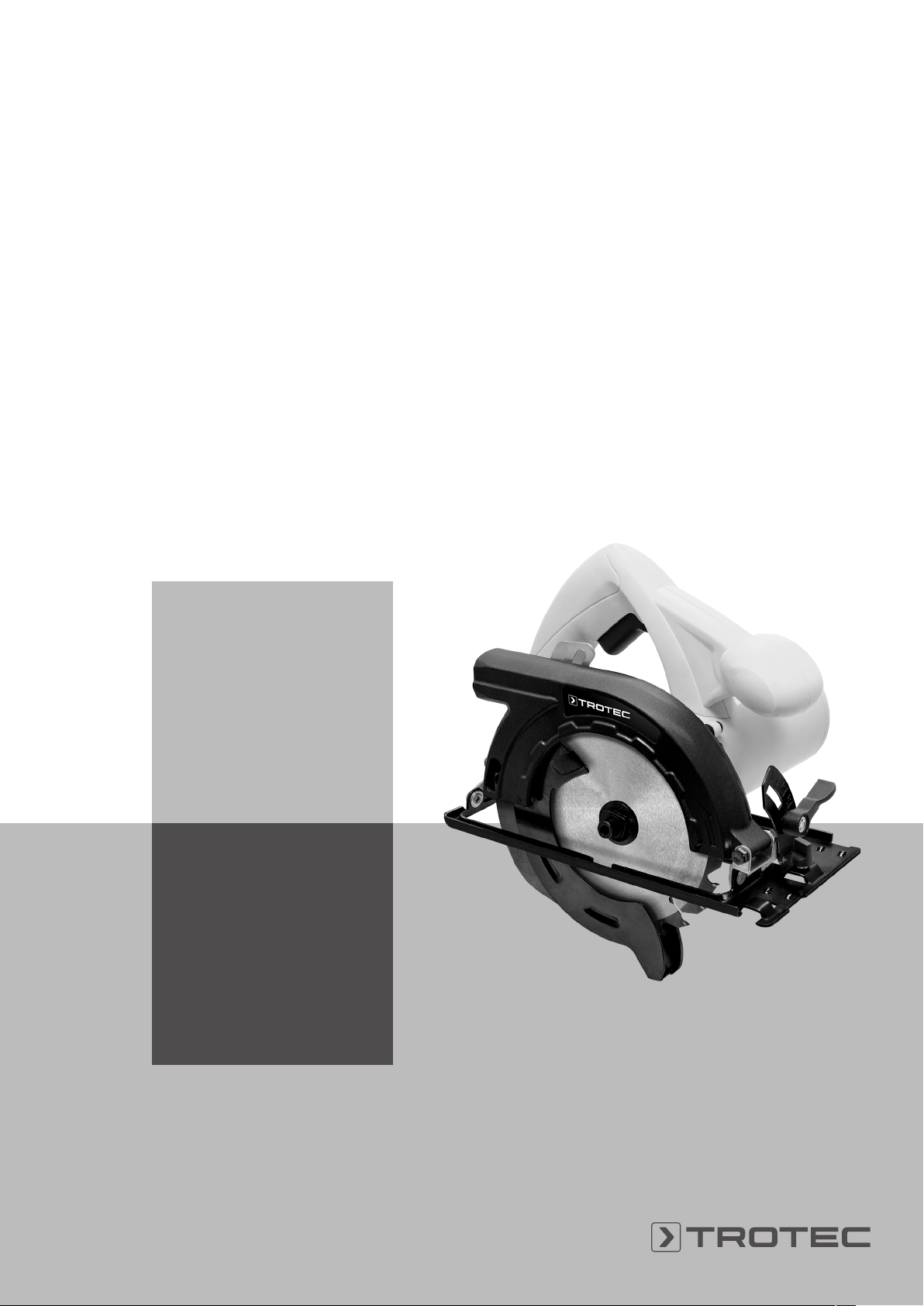
Trotec PCSS 10-1200 Manuel utilisateur
TRT-BA-PCSS10-1200-TC-002-EN
PCSS 10-1200
EN
ORIGINAL INSTRUCTIONS
PORTABLE CIRCULAR SAW
1 EN
Operating manual – portable circular saw PCSS 10-1200
Table of contents
Notes regarding the operating manual.................................1
Safety .....................................................................................2
Information about the device................................................6
Transport and storage...........................................................8
Start-up..................................................................................9
Operation .............................................................................16
Available accessories..........................................................18
Errors and faults..................................................................18
Maintenance ........................................................................19
Disposal ...............................................................................19
Declaration of conformity ...................................................20
Notes regarding the operating manual
Symbols
Warning of electrical voltage
This symbol indicates dangers to the life and health of
persons due to electrical voltage.
Warning of hot surface
This symbol indicates dangers to the life and health of
persons due to hot surface.
Warning of sharp object
This symbol indicates dangers to the life and health of
persons due to pointed objects.
Warning of hand injuries
This symbol indicates dangers to the health of persons
due to hand injuries.
Warning
This signal word indicates a hazard with an average
risk level which, if not avoided, can result in serious
injury or death.
Caution
This signal word indicates a hazard with a low risk
level which, if not avoided, can result in minor or
moderate injury.
Notice
This signal word indicates important information (e.g.
material damage), but does not indicate hazards.
Info
Information marked with this symbol helps you to carry
out your tasks quickly and safely.
Follow the manual
Information marked with this symbol indicates that the
operating manual must be observed.
Wear ear protection
Information marked with this symbol indicates that you
should wear hearing protection.
Wear safety glasses
Information marked with this symbol indicates that you
should wear eye protection.
Wear a protective mask
Information marked with this symbol indicates that you
should wear a protective mask.
Wear tight-fitting protective clothing
Information marked with this symbol indicates that you
should wear protective clothing.
Wear protective gloves
Information marked with this symbol indicates that you
should wear protective gloves.
You can download the current version of the operating manual
and the EU declaration of conformity via the following link:
PCSS 10-1200
https://hub.trotec.com/?id=41385
EN 2
Operating manual – portable circular saw PCSS 10-1200
Safety
Read this manual carefully before starting or using the
device. Always store the manual in the immediate vicinity
of the device or its site of use!
Warning
Observe all the safety warnings, instructions,
illustrations and technical data provided with this
power tool.
Failure to follow the instructions below may result in
electric shock, fire and/ or serious injury.
Save all warnings and instructions for future
reference.
The term power tool used in the safety warnings refers to both
mains-operated and battery-powered electric tools (with/
without power cable).
General Power Tool Safety Warnings – Work area
safety
•Keep work area clean and well lit. Cluttered or dark
areas invite accidents.
•Do not operate power tools in explosive atmospheres,
such as in the presence of flammable liquids, gases or
dust. Power tools create sparks which may ignite the dust
or fumes.
•Keep children and bystanders away while operating a
power tool. Distractions can cause you to lose control.
General Power Tool Safety Warnings – Electrical
safety
•Power tool plugs must match the outlet. Never modify
the plug in any way. Do not use any adapter plugs with
earthed (grounded) power tools. Unmodified plugs and
matching outlets will reduce risk of electric shock.
•Avoid body contact with earthed or grounded surfaces,
such as pipes, radiators, ranges and refrigerators.
There is an increased risk of electric shock if your body is
earthed or grounded.
•Do not expose power tools to rain or wet conditions.
Water entering a power tool will increase the risk of
electric shock.
•Do not abuse the cord. Never use the cord for carrying,
pulling or unplugging the power tool. Keep the cord
away from heat, oil, sharp edges or moving parts.
Damaged or entangled cords increase the risk of electric
shock.
•When operating a power tool outdoors, use an
extension cord suitable for outdoor use. Use of a cord
suitable for outdoor use reduces the risk of electric shock.
•If operating a power tool in a damp location is
unavoidable, use a residual current device(RCD)
protected supply. Use of an RCD reduces the risk of
electric shock.
General Power Tool Safety Warnings – Personal
safety
•Stay alert, watch what you are doing and use common
sense when operating a power tool. Do not use a
power tool while you are tired or under the influence of
drugs, alcohol or medication. A moment of inattention
while operating power tools may result in serious personal
injury.
Use personal protective equipment. Always
wear eye protection. Protective equipment such
as dust mask, non-skid safety shoes, hard hat, or
hearing protection used for appropriate conditions
will reduce personal injuries.
•Prevent unintentional starting. Ensure the switch is in
the off-position before connecting to power source
and/or battery pack, picking up or carrying the tool.
Carrying power tools with your finger on the switch or
energising power tools that have the switch on invites
accidents.
•Remove any adjusting key or wrench before turning
the power tool on. A wrench or a key left attached to a
rotating part of the power tool may result in personal
injury.
•Do not overreach. Keep proper footing and balance at
all times. This enables better control of the power tool in
unexpected situations.
•Dress properly. Do not wear loose clothing or
jewellery. Keep your hair and clothing away from
moving parts. Loose clothes, jewellery or long hair can be
caught in moving parts.
•If devices are provided for the connection of dust
extraction and collection facilities, ensure these are
connected and properly used. The use of a dust
extraction system may reduce dust-related hazards.
•Do not let familiarity gained from frequent use of tools
allow you to become complacent and ignore tool
safety principles. A careless action can cause severe
injury within a fraction of a second.
3 EN
Operating manual – portable circular saw PCSS 10-1200
General Power Tool Safety Warnings – Power tool
use and care
•Do not force the power tool. Use the correct power tool
for your application. The correct power tool will do the
job better and safer at the rate for which it was designed.
•Do not use the power tool if the switch does not turn it
on and off. Any power tool that cannot be controlled with
the switch is dangerous and must be repaired.
•Disconnect the plug from the power source and / or
the battery pack, if detachable, from the power tool
before making any adjustments, changing
accessories, or storing power tools. Such preventive
safety measures reduce the risk of starting the power tool
accidentally.
•Store idle power tools out of the reach of children and
do not allow persons unfamiliar with the power tool or
these instructions to operate the power tool. Power
tools are dangerous in the hands of untrained users.
•Maintain power tools and accessories carefully. Check
for misalignment or binding of moving parts, breakage
of parts and any other condition that may affect the
power tool’s operation. If damaged, have the power
tool repaired before use. Many accidents are caused by
poorly maintained power tools.
• Keep cutting tools sharp and clean. Properly maintained
cutting tools with sharp cutting edges are less likely to
bind and are easier to control.
•Use the power tool, accessories and tool bits etc. in
accordance with these instructions, taking into
account the working conditions and the work to be
performed. Use of the power tool for operations different
from those intended could result in a hazardous situation.
•Keep handles and gripping surfaces dry, clean and
free from oil and grease. Slippery handles and gripping
surfaces do not allow for safe handling and control of the
tool in unexpected situations.
General Power Tool Safety Warnings – Service
•Have your power tool serviced by a qualified repair
person using only identical replacement parts. This will
ensure that the safety of the power tool is maintained.
Device-specific safety warnings for portable
circular saws
Safety warnings for all saws
Sawing methods
•DANGER: Keep hands away from cutting area and the
blade. Keep your second hand on auxiliary handle, or
motor housing. If both hands are holding the saw, they
cannot be cut by the blade.
•Do not reach underneath the workpiece. The guard
cannot protect you from the blade below the workpiece.
•Adjust the cutting depth to the thickness of the
workpiece. Less than a full tooth of the blade teeth should
be visible below the workpiece.
•Never hold piece being cut in your hands or across
your leg. Secure the workpiece to a stable platform. It
is important to support the work properly to minimise body
exposure, blade binding, or loss of control.
•Hold the power tool by its insulated gripping surfaces
when performing an operation where the cutting
accessory may contact hidden wiring or its own cord.
Contact with a "live" wire will also make exposed metal
parts of the power tool "live" and could give the operator
an electric shock.
•When ripping, always use a rip fence or straight edge
guide. This improves the accuracy of cut and reduces the
chance of blade binding.
•Always use saw blades with correct size and shape
(diamond versus round) of arbour holes. Blades that do
not match the mounting hardware of the saw will run
eccentrically, causing loss of control.
•Never use damaged or incorrect blade washers or
bolts. The blade washers and bolt were specially designed
for your saw, for optimum performance and safety of
operation.

EN 4
Operating manual – portable circular saw PCSS 10-1200
Further safety warnings for all saws
Kickback causes and related warnings
A kickback is a sudden reaction to a pinched, bound or
misaligned saw blade, causing an uncontrolled saw to lift up
and out of the workpiece toward the operator.
When the blade is pinched or bound tightly by the kerf closing
down, the blade stalls and the motor reaction drives the unit
rapidly back toward the operator.
If the blade becomes twisted or misaligned in the cut, the teeth
at the back edge of the blade can dig into the top surface of the
workpiece causing the blade to climb out of the kerf and jump
back toward the operator.
Kickback is the result of saw misuse and/or incorrect
operating procedures or conditions and can be avoided by
taking proper precautions as given below.
•Maintain a firm grip with both hands on the saw and
position your arms to resist kickback forces. Position
your body to either side of the blade, but not in line
with the blade. Kickback could cause the saw to jump
backwards, but kickback forces can be controlled by the
operator, if proper precautions are taken.
•When blade is binding, or when interrupting a cut for
any reason, release the trigger and hold the saw
motionless in the material until the blade comes to a
complete stop. Never attempt to remove the saw from
the work or pull the saw backwards while the blade is
in motion or kickback may occur. Investigate and take
corrective actions to eliminate the cause of blade binding.
•When restarting a saw in the workpiece, centre the
saw blade in the kerf and check that saw teeth are not
engaged into the material. If saw blade is binding, it may
walk up or kickback from the workpiece as the saw is
restarted.
•Support large panels to minimise the risk of blade
pinching and kickback. Large panels tend to sag under
their own weight. Supports must be placed under the
panel on both sides, near the line of cut and near the edge
of the panel.
•Do not use dull or damaged blades. Unsharpened or
improperly set blades produce narrow kerf causing
excessive friction, blade binding and kickback.
•Blade depth and bevel adjusting locking levers must
be tight and secure before making cut. If blade
adjustment shifts while cutting, it may cause binding and
kickback.
•Use extra caution when sawing into existing walls or
other blind areas. The protruding blade may cut objects
that can cause kickback.
Safety warnings for circular saws with pendulum guard
and circular saws with tow guard – Lower guard function
•Check the lower guard for proper closure before each
use. Do not operate the saw if the lower guard does
not move freely and close immediately. Never clamp or
tie the lower guard in the open position. The lower
guard may be bent if the saw accidentally falls to the floor.
Use the retracting lever to raise the guard and make sure
that it moves freely and does not touch the blade or any
other part of the saw at all cutting angles and depths of
cut.
•Check that the lower guard spring operates correctly.
If the guard and spring do not operate correctly, have
the saw serviced before use. Lower guard may operate
sluggishly due to damaged parts, gummy deposits, or a
build-up of debris.
•Lower guard may be retracted manually only for
special cuts such as "plunge cuts" and "compound
cuts". Raise lower guard by retracting lever and as
soon as blade enters the material, the lower guard
must be released. For all other sawing, the lower guard
should operate automatically.
•Always observe that the lower guard is covering the
blade before placing saw down on bench or floor. An
unprotected, coasting blade will cause the saw to walk
backwards, cutting whatever is in its path. Be aware of the
time it takes for the blade to stop after switch is released.
Additional safety warnings for all saws with riving knife –
Riving knife function
•Use the saw blade appropriate for the riving knife. For
the riving knife to function, the body of the blade must be
thinner than the riving knife and the cutting width of the
teeth must be wider than the thickness of the riving knife.
•Adjust the riving knife as described in these
instructions. Incorrect spacing, positioning and alignment
can make the riving knife ineffective in preventing
kickback.
•Always use the riving knife except during plunge
cutting. The riving knife must be reinstalled after plunge
cutting. The riving knife is more of a hindrance during
plunge cutting and can cause a kickback.
•For the riving knife to work, it must be positioned in
the kerf. The riving knife is ineffective in preventing
kickback during short cuts.
•Do not operate the saw with a bent riving knife. Even a
minor hold-up can slow down the closing rate of the guard.
Additional safety warnings for portable circular saws
•Do not reach into the chip ejector with your hands.
They could be injured by rotating parts.
5 EN
Operating manual – portable circular saw PCSS 10-1200
•Do not work overhead with the saw. In this manner you
do not have sufficient control over the power tool.
•Do not use abrasive wheels.
•Only use saw blades of a diameter specified in the
technical data Using a blade of the wrong size may leave
the blade without proper protection or affect the
functioning of the guard.
•Use suitable detectors to determine if utility lines are
hidden in the work area or call the local utility
company for assistance. Contact with electrical lines
may result in fire and electric shock. Damaging a gas line
may lead to an explosion. Penetrating a water line causes
property damage and may cause an electric shock.
•Do not operate the power tool stationary. It is not
designed for operation with a saw table.
•Do not use high speed steel (HSS) saw blades. Such
saw blades can easily break.
•Do not saw ferrous metals. Red hot chips can ignite the
dust extraction.
•If the supply cord is damaged, it must be replaced with
a special connection line that can be obtained from the
manufacturer or his customer service.
•Ensure a steady forward motion of the tool. An
insufficient forward motion may result in the overheating of
the saw teeth or the melting of the workpiece to be
processed.
Intended use
Only use the device PCSS 10-1200 for producing longitudinal,
cross and mitre cuts in wood, chipboards, plastic, lightweight
construction materials and non-ferrous metals while using a
suitable saw blade, keeping base plate contact and adhering to
the technical data.
We recommend using the power tool with original Trotec
accessories.
Improper use
• The device is not intended for processing damp wood.
• The device is not intended for processing glass or stone.
• The device is not intended for processing ferrous metals.
• The device is not intended for plunge-cutting.
Personnel qualifications
People who use this device must:
• have read and understood the operating manual, especially
the Safety chapter.
Personal protective equipment
Wear hearing protection.
Excessive noise can lead to hearing loss.
Wear eye protection.
With it you protect your eyes from splintering, falling
and flying pieces which could cause injuries.
Wear a protective mask.
It saves you from inhaling harmful dusts generated
when processing workpieces.
Wear protective gloves.
They protect your hands from burns, crushing injuries
and skin abrasions.
Wear tight-fitting protective clothing.
This protects you from the draw-in and entanglement
hazard posed by rotating parts.
Residual risks
Warning of electrical voltage
Electric shock from insufficient insulation.
Check the device for damages and proper functioning
before each use.
If you notice damages, no longer use the device.
Do not use the device when the device or your hands
are damp or wet!
EN 6
Operating manual – portable circular saw PCSS 10-1200
Warning of electrical voltage
Work on the electrical components must only be
carried out by an authorised specialist company!
Warning of electrical voltage
Before any work on the device, remove the mains plug
from the mains socket!
Hold onto the mains plug while pulling the power cable
out of the mains socket.
Warning of electrical voltage
There is a risk of a short-circuit due to liquids
penetrating the housing!
Do not immerse the device and the accessories in
water. Make sure that no water or other liquids can
enter the housing.
Warning of explosive substances
Fine dust and chips produced during sawing are highly
flammable. Risk of fire and explosion!
Use a dust or chip bag or a dust extraction system for
collecting the dust and chips produced.
Warning of hot surface
The insertion tool might still be hot after the
application. Burn hazard when touching the insertion
tool.
Do not touch the insertion tool bare-handed!
Wear protective gloves!
Warning of hand injuries
Crushing hazard near saw blade and base plate if
handled without due care.
Wear protective gloves!
Warning of sharp object
Parts of the saw blade are sharp. Risk of injuries if
handled without due care.
Wear protective gloves!
Warning
Toxic dusts!
The harmful / toxic dusts produced during operation
pose of risk to the health of the operator and persons
in the vicinity.
Wear eye protection and a dust mask!
Warning
Do not process materials containing asbestos.
Asbestos is considered carcinogenic.
Warning
Make sure not to hit power, gas or water lines when
working with a power tool.
If necessary, use a pipe detector to check the wall you
want to drill in or slit open.
Warning
Risk of injuries caused by flying parts or bursting tool
heads.
Warning
Dangers can occur at the device when it is used by
untrained people in an unprofessional or improper way!
Observe the personnel qualifications!
Warning
The device is not a toy and does not belong in the
hands of children.
Warning
Risk of suffocation!
Do not leave the packaging lying around. Children may
use it as a dangerous toy.
Caution
Vibration emissions can cause a health hazard if the
device is used for an extended period of time or if it is
not properly handled and maintained.
Caution
Keep a sufficient distance from heat sources.
Notice
If you store or transport the device improperly, the
device may be damaged.
Note the information regarding transport and storage of
the device.
Behaviour in the event of an emergency
1. Switch the device off.
2. In an emergency, disconnect the device from the mains
feed-in: Hold onto the mains plug while pulling the power
cable out of the mains socket.
3. Do not reconnect a defective device to the mains.
Information about the device
Device description
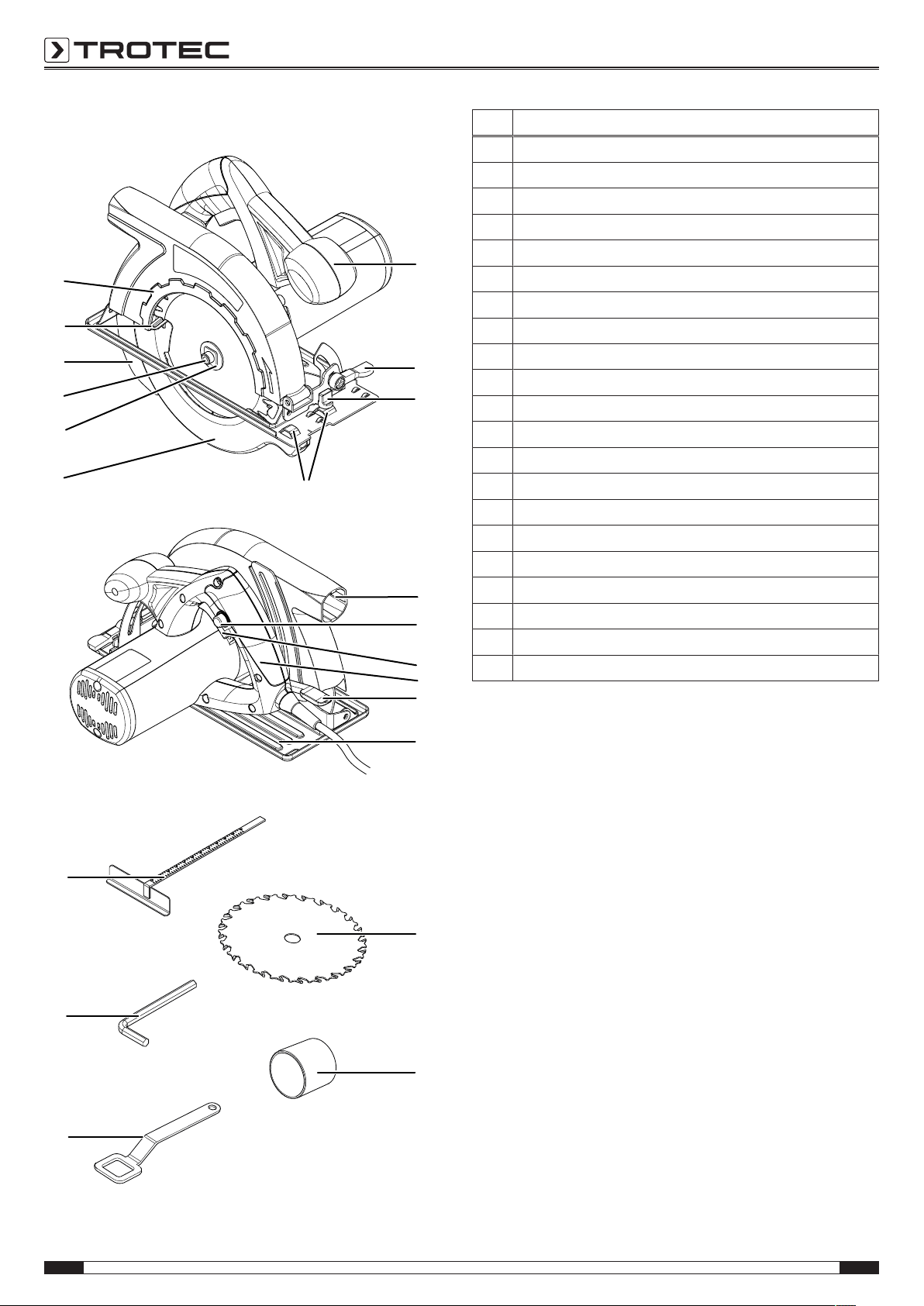
The device PCSS 10-1200 is suited for producing longitudinal,
cross and mitre cuts in wood, chipboards, plastic, lightweight
construction materials and non-ferrous metals while using a
suitable saw blade and keeping base plate contact.
The cutting depth can be steplessly adjusted from 0mm
to 55mm.
The cutting angle can be steplessly adjusted from 0°to 45°.
The device is fitted with a 1,200W motor that has an idle speed
of 5,000rpm.
The device is equipped with a start lock preventing unintentional
switch-on of the device.
7 EN
Operating manual – portable circular saw PCSS 10-1200
Device depiction
3
1
4
17
21
2
16
20
19
18
9
5
7
10
8
6
15
13
12
14
11
No. Designation
1 Additional handle
2 Locking lever for the cutting angle
3 Wing screw for rip fence
4 Rip fence holder
5 Chip ejector
6 Start lock
7 On/off switch
8 Handle
9 Locking lever for the cutting depth
10 Base plate
11 Saw blade
12 Adapter for dust extraction
13 Replacement blade wrench
14 Allen wrench
15 Rip fence
16 Lower guard
17 Clamping flange
18 Clamping screw with washer
19 Riving knife
20 Retracting lever for guard
21 Upper guard
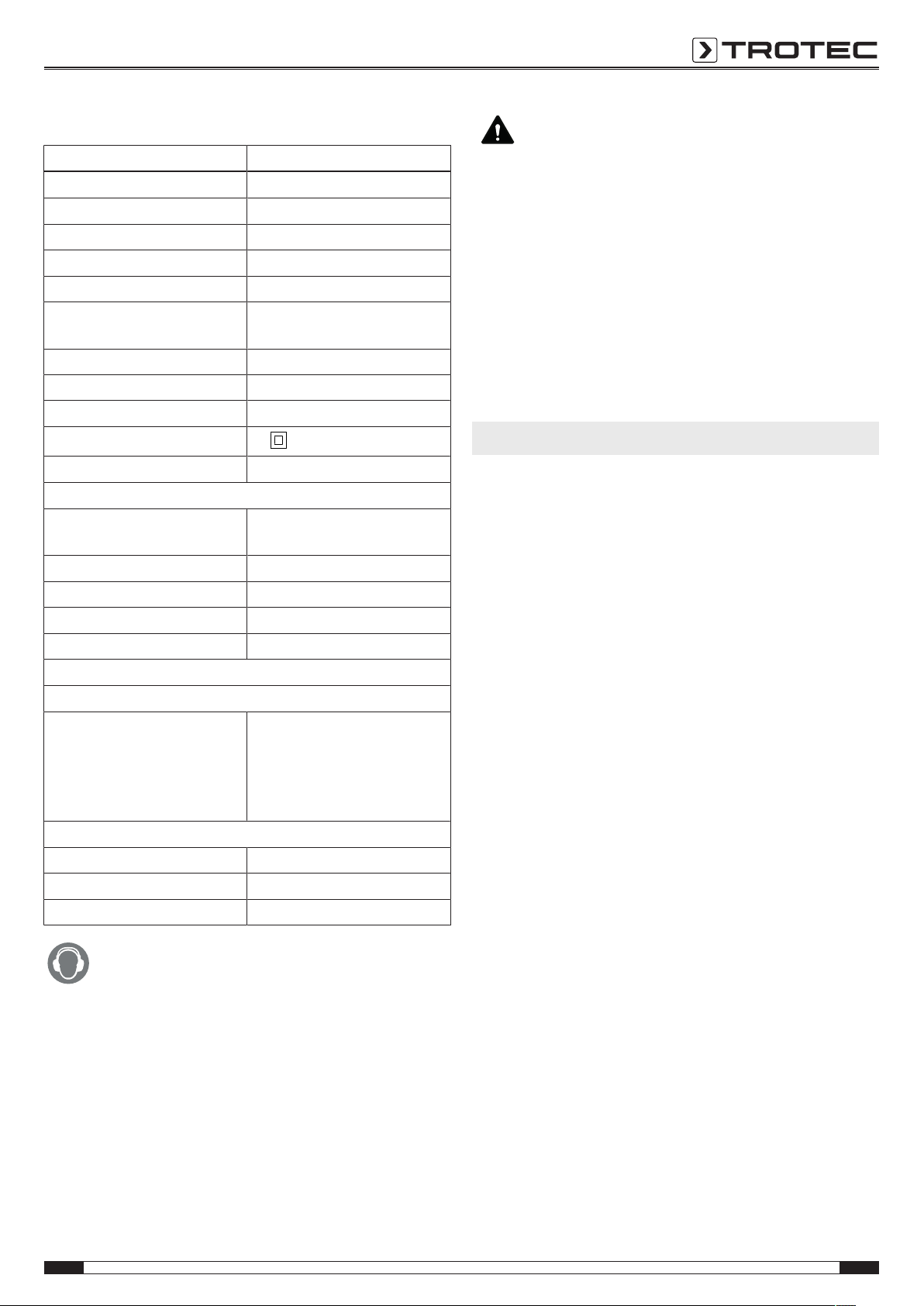
Scope of delivery
• 1x Device PCSS 10-1200
• 1 x Carbide saw blade 24 teeth (for wood and plastic)
• 1 x Rip fence
• 1 x Adapter for dust extraction
• 1 x SW6 Allen wrench
• 1x Replacement blade wrench
• 1x Manual
EN 8
Operating manual – portable circular saw PCSS 10-1200
Technical data
Parameter Value
Model PCSS 10-1200
Mains connection 230 V AC / 50 Hz
Power input 1.2 kW
Idle speed 5,000rpm
Max. saw blade diameter 160mm
Cutting depth max. 55 mm at 0°
max. 38 mm at 45°
Cutting angle 0° to 45°
Base plate dimensions 120x 260mm
Cable length 2 m
Protection class II / (double insulation)
Weight 3.34 kg
Saw blades (included in the scope of delivery)
Carbide saw blade for wood
and plastic
24 teeth
Max. rotational speed 7,000 rpm
Bore diameter 20 mm
Blade thickness 1.5 mm
Teeth thickness 2.8 mm
Vibration information according to EN60745
Total vibration emission value (for sawing wood):
Vibration emission value main
handle ah
Vibration emission value front
handle ah
Uncertainty K
2.436 m/s²
2.434 m/s²
1.5 m/s²
Sound values according to EN60745
Sound pressure level LpA 93.8 dB(A)
Sound power LWA 104.8 dB(A)
Uncertainty K 3 dB
Wear hearing protection.
Excessive noise can lead to hearing loss.
Information on noise and vibration:
• The specified total vibration and noise emission values
were measured by means of a standardized test procedure
and can be consulted for the comparison of one power tool
with another.
• The specified total vibration and noise emission values
can also be used for preliminary load assessment.
Caution
Vibration emissions can cause a health hazard if the
device is used for an extended period of time or if it is
not properly handled and maintained.
• The actual vibration and noise emission may differ from
the stated values during operation of the power tool. This
depends on how the power tool is used and especially on
the type of workpiece being processed. Try to keep the
vibration load to a minimum. Exemplary measures for
reducing the vibration load include wearing gloves during
operation of the tool and the limitation of working hours.
All parts of an operating cycle must be considered for this
(e.g. times at which the power tool is switched off and
times when it is switched on but runs without load).
Transport and storage
Notice
If you store or transport the device improperly, the
device may be damaged.
Note the information regarding transport and storage of
the device.
Transport
Before transporting the device, observe the following:
• Switch off the device.
• Hold onto the mains plug while pulling the power cable out
of the mains socket.
• Allow the device to cool down.
Storage
Before storing the device, observe the following:
• Switch off the device.
• Hold onto the mains plug while pulling the power cable out
of the mains socket.
• Allow the device to cool down.
• Clean the device as described in the Maintenance chapter.
When the device is not being used, observe the following
storage conditions:
• dry and protected from frost and heat
• ambient temperature below 40 °C
• protected from dust and direct sunlight
9 EN
Operating manual – portable circular saw PCSS 10-1200
Start-up
Unpacking the device
• Take the device and the accessories out of the packaging.
Warning of electrical voltage
Electric shock from insufficient insulation.
Check the device for damages and proper functioning
before each use.
If you notice damages, no longer use the device.
Do not use the device when the device or your hands
are damp or wet!
• Check the contents for completeness and look for
damages.
Warning
Risk of suffocation!
Do not leave the packaging lying around. Children may
use it as a dangerous toy.
• Dispose of the packaging material according to the
national regulations.
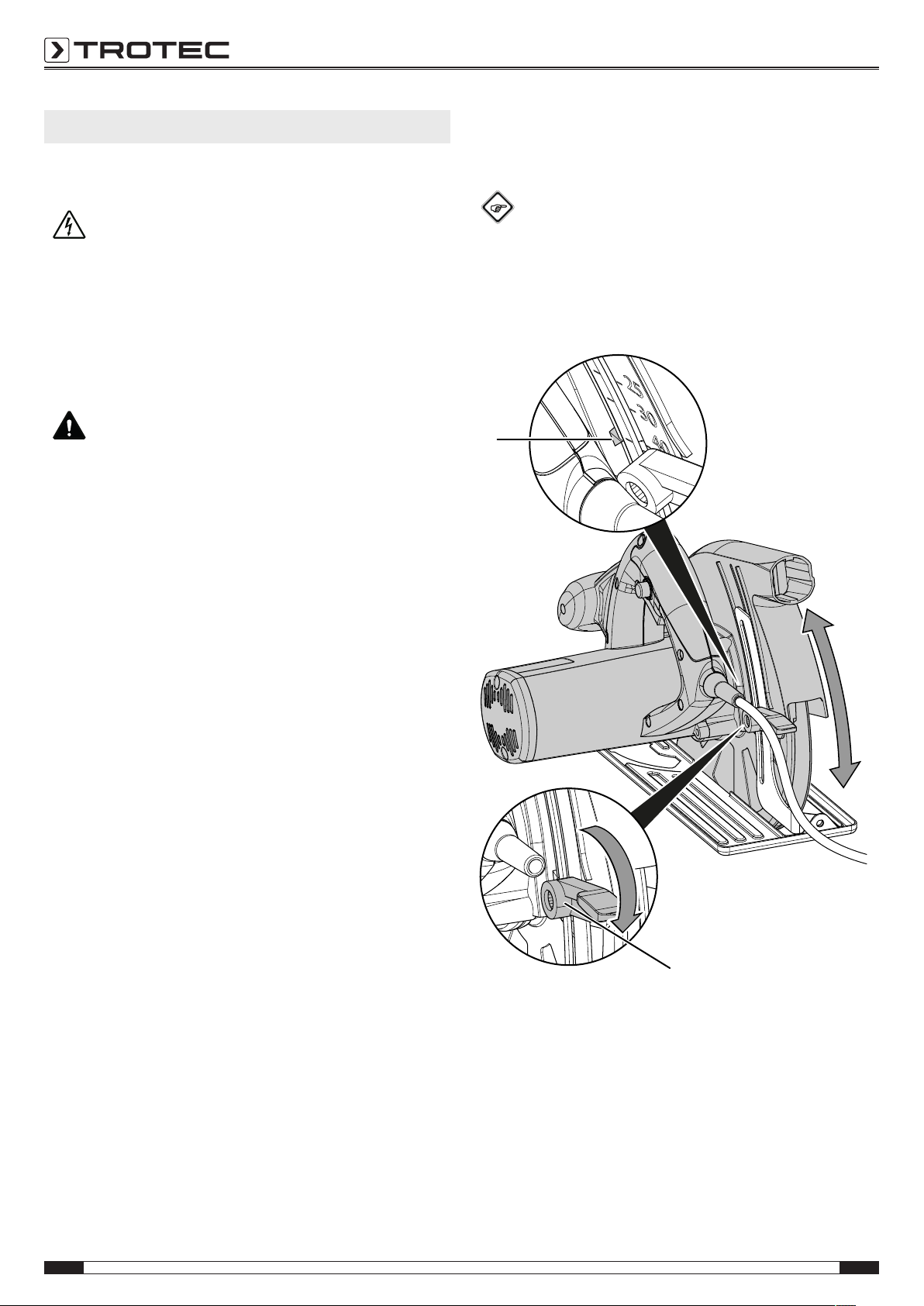
Adjusting the cutting depth
In the 0° position, the cutting depth can be set in the range from
0mm to 55mm.
Info
The cutting depth should exceed the material thickness
by approx.3mm so that a little less than the total tooth
height is visible below the workpiece.
1. Release the locking lever(9).
2. Set the desired cutting depth on the cutting depth
scale(22).
22
9
3. Lock the locking lever(9) again.
Table des matières
Autres manuels Trotec Scie


