Total Phase Level Shifter Manuel utilisateur

Level Shifter Board
Features
• Level shifting of I C, SPI, and MDIO signals from 1.2 V to 3.3 V
• I C speeds of up to 800 kHz
• SPI and MDIO speeds of up to 20 MHz
• Powering downstream devices
• Multiple voltage options
Summary
The Level Shifter Board expands the utility of all of Total Phases I C,
SPI, and MDIO products by allowing developers to communicate,
analyze, and power downstream devices of lower logic levels.
Supported products:
Level Shifter Board
User Manual v1.01
March 13, 2017
2
2
2
(注1)
(注意)
AardvarkをLevelShifterBoardのAdapter/Analyzerコネクタに接続して使用する場合、
Aardvarkがハングアップしてソフトの再起動やUSBの着脱が頻繁に必要になることがあります。
これは、Aarvarkの改造で発生しないようにすることができます。弊社にご相談ください。
LevelShifterBoardのTARGETLEDは、単にTarget側(Level変換後)の回路へ電源が来ているか
どうかだけを示しています。ロットにも依存しますが点灯時の明るさの違いは無視してください。
(注1)LevelShifterBoardのTARGET電源出力を外部で利用する場合の注意点。
1.2Vか1.5Vの設定では、電源ON(5V入力)の瞬間、出力電圧が1.8V程度になることが
あります。それが問題になる場合は、弊社に改造等をご相談ください。

1 Overview
The Level Shifter Board provides embedded systems engineers with an easy and cost-
effective method for interfacing Total Phase's products with lower logic level devices. The
Level Shifter Board is capable of down-shifting to all standard logic levels from 1.2 V to
3.3 V. Engineers can also choose to power downstream devices.
Figure 1 : Schematic of the Flash Socket Board
1.1 Features
• Level shifting for I C, SPI, MDIO, and GPIO signals.
• On-board regulator to specify and power downstream devices to 1.2 V, 1.5 V,
1.8 V, 2.5 V, 3.0 V, and 3.3 V.
1.2 What's Included
The Level Shifter Board comes complete with:
• (1) Level Shifter Board
• (1) 6.0-inch 10-pin ribbon cable
Level Shifter Board User Manual v1.01
2
2

• (1) 1.5-inch 10-pin ribbon cable
• (3) jumpers for configuration
Level Shifter Board User Manual v1.01
3

2 Hardware Specification
2.1 Power Consumption
The power consumption of the Level Shifter Board depends on its configuration. The
board will draw approximately 6 mA from the Adapter/Analyzer side when configured to
power the target device, and approximately 4 mA when the target is supplying its own
power.
The current draw of the Level Shifter Board on the Target side is only applicable when
the target device is supplying power to the board. This current draw will be approximately
1 mA.
2.2 Speed
The Level Shifter Board is rated for I C communication at up to 800 kHz.
Maximum SPI and MDIO signaling rates are highly dependent on the specific
configuration of the level shifting board and the timing specification of the target device.
The Level Shifter Board has been tested to operate at up to 18 MHz when shifting to
1.2 V, and up to 20 MHz when shifting to 3.3 V. When operating at higher speeds,
shorter cables are recommended to help maintain signal integrity.
Please note that individual results will vary.
2.3 I C Pull-up Resistors
The Adapter/Analyzer side will always require pull-up resistors for I C communication.
This is easily accomplished by using the built-in pull-up resistors of either an Aardvark I
C/SPI Host Adapter or Beagle I C/SPI/MDIO Protocol Analyzer. Additionally, any I C line
that is being used as a digital input line (GPIO) to the Adapter/Analyzer side, must also
include a pull-up on the adapter side.
It is recommended that pull-up resistors are always used on the Target side I C lines.
Users may find that they can still communicate properly without these pull-ups; however,
Level Shifter Board User Manual v1.01
2
2
2
2
2 2
2
4

it is recommended that pull-ups to the target's logic high still be used to ensure that the
signal reaches its correct level.
2.4 Leakage Voltage
The Level Shifter Board is known to leak approximately 0.2 V to the Target side, even
when configured to not supply power to the target. This is a very weak leakage which is
only capable of sourcing approximately 20 µA of current.
2.5 Board Dimensions
The dimensions of Level Shifter Board are in inches. The mounting holes are 0.187
inches diameter. The figure (Figure 2 ) shows the relevant measurements.
Figure 2 : Dimensioned Level Shifter Drawing
Level Shifter Board User Manual v1.01
5
注2製造ロットによっては、Figure2の横方向サイズが1.27mm長くなっています。
これは穴中心から側面への長さが0.15インチ(3.81mm)ではなく、0.2インチ(5.08㎜)
に左右のどちらかが長くなっていることによります。この場合横方向の全体長さが
3インチ(76.2mm)ではなく3.05インチ(77.47mm)になります。ご了承ください。
この伸びた部分は電気回路には影響しません。
注2
注2

3 Connectors
3.1 ADAPTER and ANALYZER
There are two boxed connectors on the right side (Adapter/Analyzer side) of the Level
Shifter Board (Figure 3 ) which are used to connect the board to an Aardvark I C/SPI
Host Adapter, Cheetah SPI Host Adapter, and/or Beagle I C/SPI/MDIO Protocol
Analyzer. These two connectors are cross-connected, so it does not matter which one is
used. In most cases, you will only want to connect a single adapter at a time to the Level
Shifter Board.
Figure 3 : Two boxed connectors for connecting an adapter
and/or analyzer to the Level Shifter Board.
The second connector may be used to connect a second host adapter. Examples of
these situations are: in order to have more slaves, or to create a multi-master situation.
Alternatively, the second connector can be used to connect a protocol analyzer. For
example, an Aardvark adapter or a Cheetah adapter can be connected to the board
through the ADAPTER connector to program a low-voltage memory chip. At the same
time, a Beagle I C/SPI/MDIO Protocol Analyzer can be attached to the ANALYZER
connector to monitor the bus while the chip is being programmed to ensure that the data
on the bus is correct.
The pinout of the two connectors is described in Figure 4.
Level Shifter Board User Manual v1.01
2
2
2
6

Figure 4 : The pinout for the two boxed connectors on the
Adapter/Analyzer side of the Level Shifter Board.
3.2 TARGET1 and TARGET2
There are two boxed connectors on the left side (Target side) of the Level Shifter Board
(Figure 5 ) which are used to connect the target bus to the level shifter. The signal lines
on these connectors are operating at the voltage levels specified by the user. This level
can either be specified on the board through the use of the jumper connectors, or can be
determined by the downstream system. These two connectors are cross-connected, so it
does not matter which one is used.
Level Shifter Board User Manual v1.01
7

Figure 5 : Two boxed connectors for connecting the Level
Shifter Board to one or more target buses.
These two boxed connectors have an almost identical pinout to the ADAPTER and
ANALYZER connector. The only difference is that the 5.0 V pins will have the target's
voltage level instead.
The pinout of the two connectors is described in Figure 6.
Figure 6 : The pinout for the two boxed connectors on the
Target side of the Level Shifter Board.
3.3 EXT 3.3V and EXT TGT
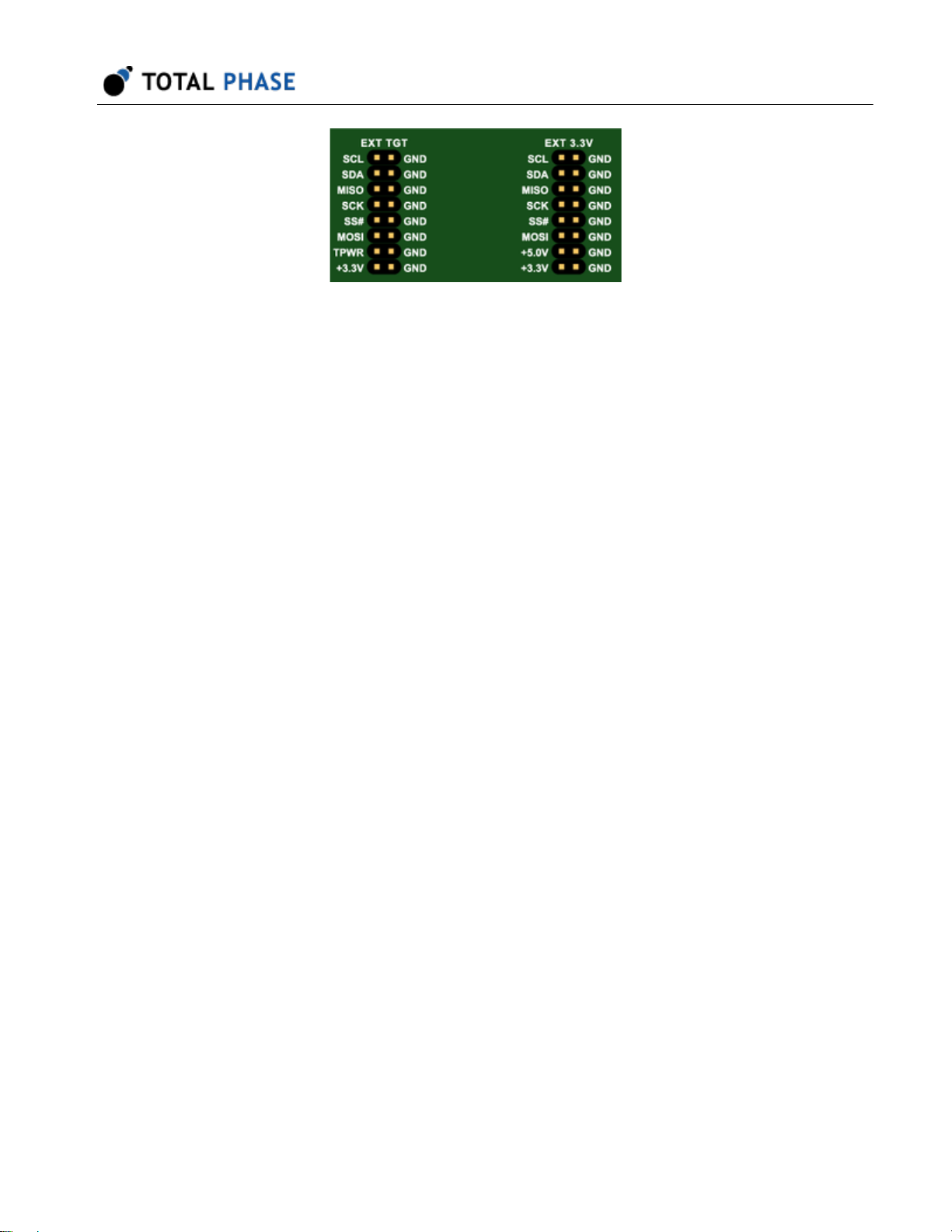
All the bus and power signals on the board are also available through two 16-pin
headers on the board (Figure 7}. The EXT 3.3 V connector provides the bus signals at
the standard signaling levels employed by Total Phases I C, SPI, and MDIO products.
The EXT TGT connector provides the bus and power signals of the downstream device
and will be at the voltage level defined by the user. All connections are labeled for the
user's convenience.
Level Shifter Board User Manual v1.01
2
8

Figure 7 : The External Connectors provide the developer
with a quick and easy way to interface or monitor any or all
of the Level Shifter Board signals on either the Adapter/
Analyzer side or the target side.
3.4 Powering the Level Shifter Board
In order to function properly, both sides of the board must be powered. The Adapter/
Analyzer side (the high voltage side) must be powered with 5 V. This can easily be
accomplished by using the target power feature of Total Phases I C, SPI, or MDIO
products when it is connected to the Adapter/Analyzer side of the board. Target power
can be enabled via the Rosetta Language Bindings, the Flash Center software, the
Aardvark Control Center Software, the Beagle Data Center software, or the Cheetah GUI
Software.
When powered-on, the board's green POWER LED will be lit.
The Target side (the low voltage side) can optionally be powered by the power already
supplied to the Level Shifter Boardor by the target device. If powering the Target side by
the target device, simply connect the device's power to the TPWR pin on the EXT TGT or
either one of the TARGET boxed connectors (Figure 8 ).
Level Shifter Board User Manual v1.01
2
9

Figure 8 : When powering the Target side of the Level
Shifter Board, power needs to be supplied to one of these
Target power pins.
If powering the Target side by the power already supplied on the board, then a jumper
must be placed to enable this feature (Figure 9 ). Refer to Section 4 for more details.
Figure 9 : When supplying power from the Level Shifter
Board to the target, a jumper needs to be place on TPWR.
When the Target side is properly powered, the board's amber TARGET LED will be lit.
Level Shifter Board User Manual v1.01
10
Table des matières
Autres manuels Total Phase Équipement de test
Manuels Équipement de test populaires d'autres marques

SMART
SMART KANAAD SBT XTREME 3G Series Manuel utilisateur

Agilent Technologies
Agilent Technologies BERT Serial Manuel utilisateur

Agilent Technologies
Agilent Technologies N3280A Manuel utilisateur

Vernier
Vernier Go Direct Voltage Manuel utilisateur

Lifeloc
Lifeloc R.A.D.A.R. Manuel utilisateur

Fluke
Fluke T5-600 Instructions d'utilisation et d'installation