Thermotech Solar Heating System
6
Installation instructions Solar collector package DB-0
123
GENERAL INSTRUCTIONS
e assembly system DB-0 for solar collector FP202 is
only intended for tile roofs. Only prescribed materials
may be used during installation.
Before installation is begun, knowledge of local ordinan-
ces must be obtained to prevent unforeseen complications
from arising.
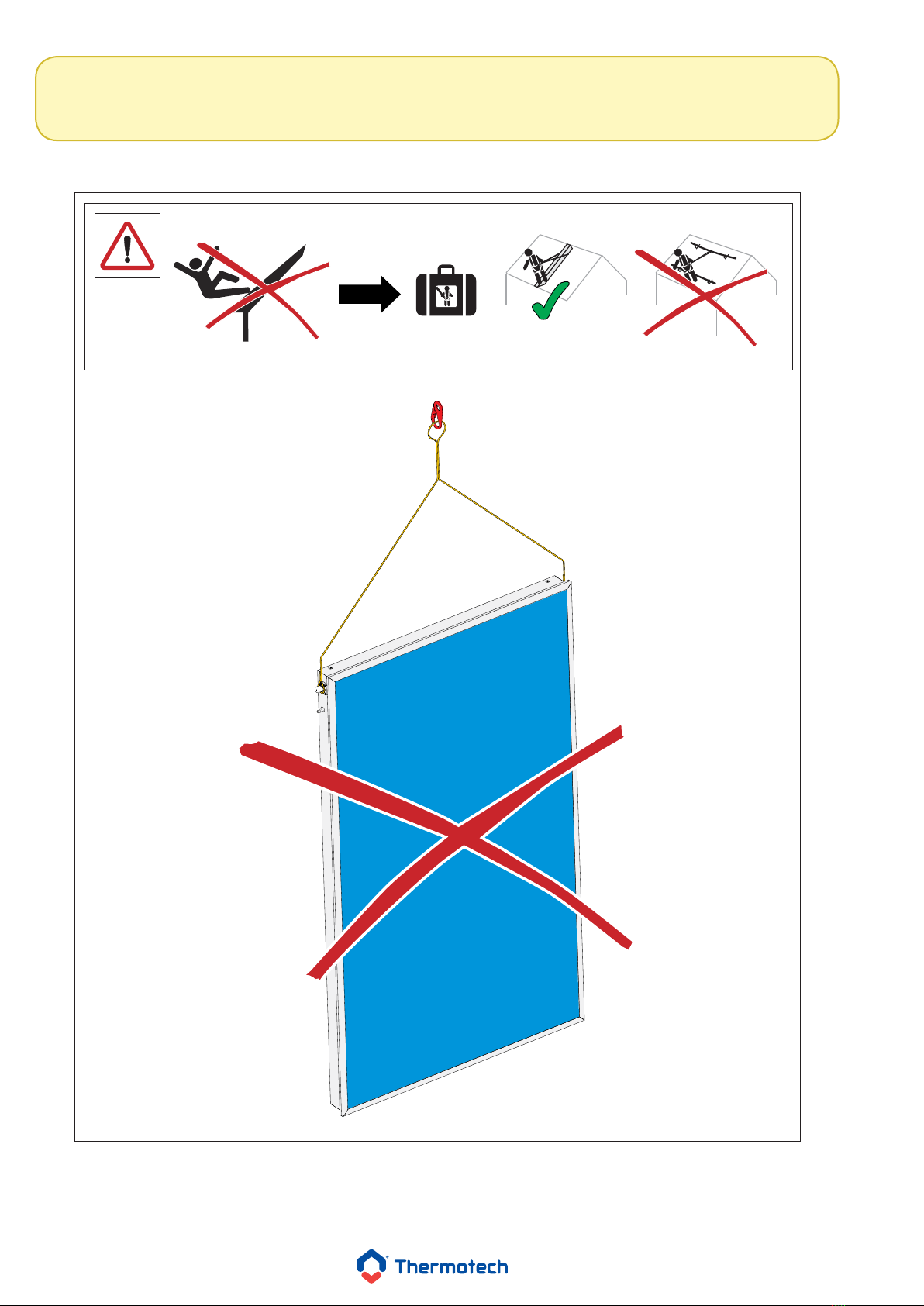
When the solar collector is to be carried by hand, straps
should be used to prevent damage to the panel. Do not
carry the panel by its connections. Avoid impact with the
solar collector, especially to the glass, rear and connec-
tions.
ROOF LOADS
e solar collectors may only be installed on roofs and
other construction elements that can withstand the static
pressure that occurs. In certain cases it can be necessary
to contact a consultant or other tradesman to determine
if the construction is suitable for installation of solar col-
lectors.
Special consideration must be taken to the quality of the
bearing wooden joists that constitute attachment points
for the solar collectors.
e customer's inspection of the entire solar collector
installation according to DIN 1055, sections 4 and 5 (as
well as the applicable local and regional ordinances) is
especially important in areas with substantial amounts of
snow or high winds (1 m3of loose snow weighs about 60
kg and 1 m3of wet snow weighs about 200 kg).
Maximum snow and wind loads may not be exceeded.
As a rule, rows of solar collectors must be installed so that
no accumulations of snow can reach the solar collectors.
is is accomplished using snow guards or other type of
protection. e distance to the roof edge must be at least
1 meter.
NB: Installation of the solar collectors requires alteration
to the existing roof. It may be that additional covering
materials are required, such as tile, bre board or other
type of covering to prevent leakage due to wind and snow
loads. is especially applies to roofs with little pitch.
LIGHTNING PROTECTION
When installing on the roof of an existing building, the
solar collectors should be connected to the lightning pro-
tection system if one exists. If the installation concerns
new construction, a risk assessment must be conducted
for the building to determine whether or not a lightning
protection system should be installed.
CONNECTIONS
Connect the solar collectors to one another using the
clamping ring connectors. If exible lines will not be used
when running the tubing, special consideration must be
taken to linear expansion to protect the lines. is can be
achieved with for example, expansion bends or exible
tubing in the system.
Larger solar collector systems must have expansion bends
or exible tubing between the solar collectors. When the
clamping ring connectors are secured, a holding-up tool
must always be used in the form of a spanner or pipe
tongs so as to prevent damage to the panel's connections.
PITCH
Solar collectors must be installed at an angle of 15–
75°, facing to the south as much possible, to achieve good
results. e solar collector's connections and ventilation
channels must be protected against both the entry of
water as well as dirt and dust.