
The Greenwich Masters CELESTIAL Manuel utilisateur

CELESTIAL WATCH
INSTRUCTION MANUAL


Contents
1. Specifications ..................................................................................3
2. Celestial Watch ................................................................................4
3. Constellation Display of Entire Sky at 50°(or 35°) North Latitude...5
4. Features ...........................................................................................6
5. Setting the Time and Constellation Dial ........................................8
6. Times for Sunrise and Sunset ......................................................10
7. Concerning Constellation Dial Display .........................................11
8. Abbreviations of Constellations and their full spellings ................12
9. Nebulae and Star Clusters on the Constellation dial.......................16
10. Diagram of the Constellation Dial ...............................................18
11. Precautionary Items and Usage Limitations ................................20
12. Warranty and Service ...................................................................29

3.
1. Specifications
1. Calibre No: 4P92
2. Frequency of crystal oscillator: 32.768 Hz (Hz: frequency per second).
3. Accuracy: Within +/- 20 seconds per month
(when worn at normal temperature +5°C - + 35°C)
4. Operating temperature range: -10°C - +60°C
5. Additional Functions:
• Constellation display functions
(period of constellation dial rotation: approx 23 hours 56 minutes and 4 seconds)
• Planisphere dial function
• Displaying of solar position
• Displaying of altitude and azimuth
• Displaying of local sidereal time
• Twilight identification function
• Displaying of pole star angle
6. Battery: Silver oxide battery 1 pce. 280-39(SR626SW)
7. Battery life: Approximately 3 years (after installing a new battery).
Specifications are subject to change without notice.

2. Celestial Watch
The Celestial Watch is a precisely designed analog quartz watch that
displays not only the current time but also the correct positions of the
constellations as they move across the sky. The Celestial Watch shows
azimuth (bearing) and altitude (angular position above the horizon) of the
major fixed stars, nebulae, galaxies and star clusters, displays local sidereal
(star) time, stellar spectral type. The Celestial Watch also has features that
provide such convenient information as the position of the sun, the time of
sunrise and sunset, and thus the hours of darkness when astronomical
observations may be made.
4.

3. Constellation Display of Entire Sky at 50°or 35°North
Because distortion is minimal in the northern hemisphere, approximately
98.5% of the celestial sphere visible at 50°or 35°north latitude is displayed.
(The range shown on the constellation dials from -40°to +90°
declination).
The design varies from one model to another.
5.
Right ascension scale
Date scale
Zenith
Horizon
Ecliptic Celestial equator
-18 altitude (twilight zone)
Constellation dial setting
Meridian
Crown
Normal position
Time setting
Direction for turning
constellation dial

4. Features
The Constellation display includes the positions of 1056 fixed stars with a
brightness of the 4.8th magnitude or brighter, 169 major nebulae,galaxies
and star clusters, constellation boundaries and the ecliptic and the celestial
equator based on their positions for the year 2000.0. (Maximum magnitude
values are indicated for variable stars. Fixed stars are represented by a four
colour spectrum at 0.1 magnitude intervals).
The constellation dial not only automatically displays the present positions
of constellations but can also be used as a planisphere dial in which the
constellations dial is independently rotated.
The solar position display shows the position of the sun along the ecliptic
(the sun’s apparent path on the celestial sphere during the year) on the 1st,
11th and 21st of each month (for 12 noon universal time over the mean
year). Times for sunrise and sunset as well as the number of daylight hours
are determined by looking on the horizon line on the transparent dial.
The altazimuth display lets you determine the altitude and azimuth of the
sun as well as the major fixed stars, nebulae, galaxies and star clusters on
the celestial sphere. (The equidistant almucanter lines at intervals of 15°on
the transparent dial are corrected for atmospheric aberration.
6.

4. Features continued...
The local sidereal time display lets you easily determine the location of the
constellations. (Local sidereal time can be read off the right ascension
graduation on the constellation dial opposite the correct date on the date
scale).
The twilight indicator lets you identify the hours of increasing darkness,
especially convenient for astronomical observations. (Astronomical
twilight line: use the -18°altitude on the transparent dial to determine the
beginning and ending times for the hours of astronomical twilight).
The pole star hour angle display lets you align an astronomical telescope to
the polar axis. (Right ascension values for the pole star between the years
2000.0 - 2050.0 are marked on the constellation dial for every ten years).
Hour angle is the angle measured counterclockwise from the meridian on
the transparent dial to the point marking the value for the right ascension
the present pole star.
The celestial sphere at the centre of the rotating constellation dial is not
displayed owing to the attachment of the watch hands.
7.

5. Setting the Time and Constellation Dial
Setting the time
1) When the second hand indicates 0 seconds, pull the crown out to the
second position.
2) Turn the crown and set the hour and minute hands to the correct time.
Move the minute hand 4 to 5 minutes ahead of the correct position and then
return it to the correct position.
3) Properly push the crown into its normal position in accordance with a
standard time signal or the like.
Setting the constellation dial
1) First it is necessary to find the correct sidereal time for the local standard
meridian or the universal time meridian.
2) Check the time difference in sidereal time between observation point
longitude and the standard meridian for the sidereal time source. Local
sidereal time depends on longitude, and is advanced four minutes per degree
eastward.
3) Pull the crown out to the first position.
4) Calculate the time obtained by adding the present sidereal time (displayed
on the 24 hour time scale) to the sum of the difference between local sidereal
time and present time. Find the value corresponding to this time on the right
ascension scale, and align it with the date scale turning the constellation
dial clockwise. 8.
5. Setting the Time and Constellation Dial continued...
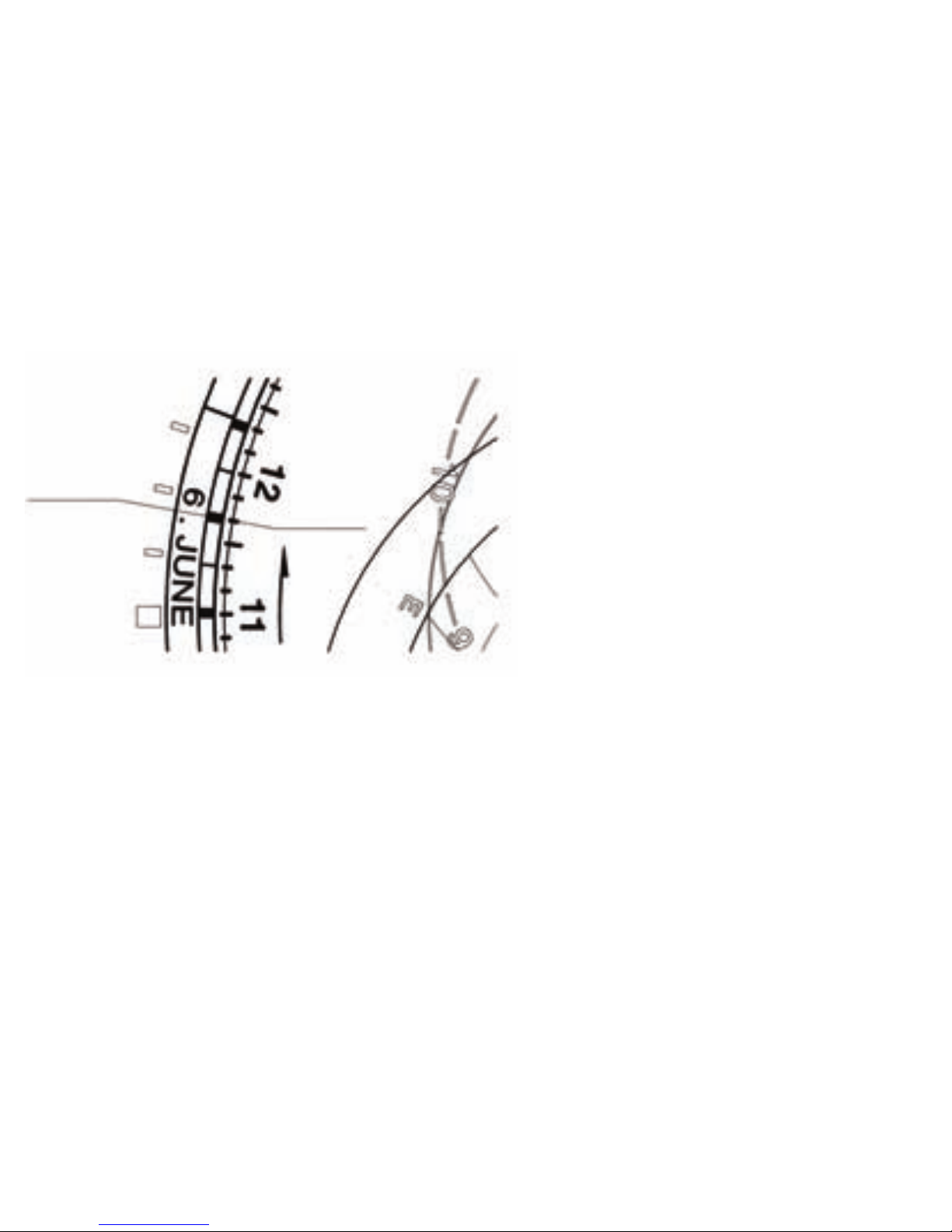
Example: To align the
constellation dial for 12.00 June
11 at a position 5°west of the
standard time longitude, turn the
constellation dial clockwise until
the point on the dials right
ascension scale opposite 11.40 is
in line with the point on the date
scale corresponding to June 11.
7) Push the crown into its normal position.
Increments on the date scale are calibrated for 12 noon Universal Time
(21h Japanese Standard Time) over the mean year. Wide lines of the date
scale are indicated for the 1st. 11th and 21st of each month. Narrow lines
of the date scale are indicated for the 6th, 16th and 26th of each month.
9.
June 11
11.40
Table des matières
Autres manuels The Greenwich Masters Montre


