
Studio Technologies Dante 5330 Manuel utilisateur

Copyright © 2018 by Studio Technologies, Inc., all rights reserved
www.studio-tech.com
50602-0718, Issue 1
User Guide
Issue 1, July 2018
This User Guide is applicable for serial numbers
M5330-02001 and later with application firmware 1.0 and later
and Dante firmware 4.2.0 (UltimoX4 4.1.2.1)
Also applicable for serial numbers
M5330-00151 to 02000 with application firmware 1.0 and later
and Dante firmware 2.5.0 (Ultimo 4.0.9.1)
Model 5330 Flex-Use
Dante® Audio Interface

This page intentionally left blank.

Model 5330 User Guide Issue 1, July 2018
Studio Technologies, Inc. Page 3
Table of Contents
Revision History ................................................................... 4
Introduction ........................................................................... 5
Installation ............................................................................ 9
Configuration ........................................................................ 12
Operation .............................................................................. 13
Technical Notes .................................................................... 18
Specifications ....................................................................... 22

Issue 1, July 2018 Model 5330 User Guide
Page 4 Studio Technologies, Inc.
Revision History
Issue 1, July 2018:
1. Initial release.

Model 5330 User Guide Issue 1, July 2018
Studio Technologies, Inc. Page 5
Introduction
The Model 5330 Flex-Use Dante Audio Inter-
face provides a simple yet high-performance
means of interfacing analog signals with
applications that utilize Dante® audio-over-
Ethernet media networking technology. Four
line-level analog sources can be connected
to the unit and then, after conversion to digi-
tal, output by way of four output (transmitter)
channels associated with the Dante inter-
face. Four signals that arrive by way of Dante
can be converted to analog and then output
as balanced line-level signals. A monitor sec-
tion allows the input and output signals to be
selectively observed using meters, a head-
phone output, and a line-level output.
The Model 5330 is a fully professional prod-
uct that offers the audio quality, features,
and reliability required by 24-hour commer-
cial applications. Four inputs, two on the
front panel and two on the back, allow simple
interfacing with a variety of unbalanced
and balanced line-level analog sources. The
2-channel (stereo) input on the front panel
is optimized for use with portable electronics
that provide “–10” unbalanced audio sources.
Using a rotary control, users can adjust the
sensitivity of the input circuitry to match the
level of the source. Two additional inputs are
provided on the back panel and meet the
requirements of professional audio equip-
ment. They are differential (balanced) with
a nominal level of +4 dBu and plenty of
signal-handling “headroom.” The four input
signals are converted to 24-bit digital audio
and then transported out of the unit via the
Dante interface.
Four digital audio channels enter the Model
5330 via its Dante interface. These general-
purpose audio channels are then converted
from the digital domain to the analog do-
main. Four 3-pin male XLR connectors,
located on the unit’s back panel, provide
balanced +4 dBu-nominal line-level analog
outputs. An auxiliary output, also located
on the back panel, provides a fifth “profes-
sional-quality” output. Pushbutton switches,
located on the front panel, allow the user
to select the source for the auxiliary output
from among the four Dante input (receiver)
channels.
The monitor section allows the user to
select any audio input or output signal
for visual and aural observation. Two
8-segment LEDs meters, calibrated in
dBFS, allow precise monitoring of signal
levels as they exist in the digital domain.
A 2-channel (stereo) headphone output
allows connection of headphones or ear
Figure 2. Model 5330 back view
Figure 1. Model 5330 front view

Issue 1, July 2018 Model 5330 User Guide
Page 6 Studio Technologies, Inc.
buds that use either 3.5 mm or ¼-inch jacks.
A separate line-level analog monitor output
allows connection to inputs on amplified
speakers or power amplifiers. Two rotary
controls allow individual adjustment of the
headphone and monitor outputs.
An Ethernet connection is all that’s required
to make the Model 5330 part of a sophisti-
cated networked audio system. Dante
audio-over-Ethernet has found wide
acceptance as an audio “backbone” due
to its ease of use, interoperability, excellent
audio quality, and wide adoption by a large
number of equipment manufacturers.
The Model 5330 can serve as an “edge”
device for a Dante network implementation,
providing high-performance input, output,
and monitor resources for various applica-
tions. The unit is an excellent general-pur-
pose “tool” to help expand Dante capabilities
for facilities and applications that were ini-
tially implemented to support signals in the
analog domain.
The Model 5330 is “universal” mains pow-
ered, requiring 100 to 240 volts, 50/60 Hz
for operation. Standard connectors are
used for interfacing with the audio input and
output channels, Ethernet interface, and AC
mains input. The unit’s enclosure mounts in
one space (1U) of a standard 19-inch rack
enclosure and weighs less than four pounds
(2 Kg).
Dante Audio-over-Ethernet
Digital audio data associated with the Model
5330 is interfaced with a local area network
(LAN) using Dante audio-over-Ethernet
media networking technology. The unit is
compatible with the Dante Domain Manag-
er™ (DDM) software application. For serial
numbers 02001 and later, the unit is also
compliant with AES67 digital audio signals.
A major benefit of using Dante is its abil-
ity to use any standard Ethernet network
implementation, including cabling and
switches, to directly transport professional
audio signals. The Model 5330 supports
digital audio signals with sample rates of
44.1 and 48 kHz and a bit depth of up to
24. These sample rates were selected for
optimal support of broadcast, production,
industrial, commercial, and consumer ap-
plications. Status LEDs provide a real-time
indication of LAN and Dante performance.
The signals associated with the Model
5330’s four analog input channels are
converted to digital and then routed to
transmitter (output) channels on the unit’s
Dante interface. Four Dante transmit-
ter (output) channels from an associated
Dante-enabled device can be assigned to
the Model 5330’s input (receiver) chan-
nels using the Dante Controller application.
These input signals are converted into ana-
log and then sent to the output circuitry.
Applications
The Model 5330 is a general-purpose
analog input, analog output and monitor-
ing device intended for use in a variety of
audio and audio-with-picture applications
where Dante technology is utilized. It’s
applicable anywhere that line-level analog
inputs and outputs need to be converted to
and from Dante while audio quality is main-
tained. The term “Flex-Use” comes from
the flexibility that the unit’s range of simple
but carefully-implemented resources can
provide. It’s suitable for demanding on-air
broadcast and live-event applications that
require both excellent audio performance
and reliable operation. It can also be a per-
fect complement for academic, industrial,
or corporate audio-visual facilities where a

Model 5330 User Guide Issue 1, July 2018
Studio Technologies, Inc. Page 7
variety of analog input and output devices
must be supported.
The rack-mounted unit is appropriate for
installation in fixed locations, serving the
needs of systems associated with stadium,
worship, education, commercial, and gov-
ernment facilities. Its lightweight enclosure
also makes it suitable for mobile and field
uses. The Model 5330 features an opti-
mized set of controls and indicators that
makes it simple and intuitive to use. With
the unit’s metering and monitoring re-
sources it’s easy for users to obtain optimal
performance. And by providing standard
connectors for all inputs and outputs, along
with universal AC mains powering, installa-
tion and setup can be completed in only a
short period of time.
Four Analog Inputs
The Model 5330’s four inputs allow connec-
tion to a range of unbalanced and balanced
analog audio sources. Inputs 1 and 2 have
a nominal level of –10 dBu and are intend-
ed for use with unbalanced sources associ-
ated with personal electronic devices such
as phones, tablet and notebook computers.
For easy access a 3.5 mm 3-conductor
(stereo) jack is provided on the front panel.
A rotary level control, located adjacent to
the input jack, allows adjustment of the
input sensitivity to match a wide range of
audio sources. This allows the audio quality
to easily be optimized. Inputs 3 and 4 are
electronically balanced with a nominal level
of +4 dBu. They use two 3-pin female XLR
connectors which are located on the unit’s
back panel. They are intended for connec-
tion to professional audio sources such as
audio consoles, wireless microphone re-
ceivers, and video playback equipment.
The four inputs are capacitor-coupled and
ESD (static) protected to provide reliable
operation in a variety of demanding appli-
cations. Extensive filtering minimizes the
chance that radio frequency (RF) energy
will cause interference. Low-noise, low-
distortion, and wide dynamic-range circuitry
ensures that audio quality is preserved. Four
bi-color signal present/peak LEDs provide a
simple means of observing input activity. The
analog input audio is routed to high-perfor-
mance analog-to-digital conversion (ADC)
integrated circuits that support sampling
rates of 44.1 and 48 kHz with a bit depth of
up to 24. The audio signals, now in the digital
domain, are connected to the Dante interface
where the data is packetized and prepared
for transport over Ethernet. The Dante Con-
troller software application will typically be
used to assign the Model 5330’s four output
(transmitter) channels to inputs (receiver)
channels on designated Dante equipment.
Five Analog Outputs
The Model 5330 provides five analog line-
level outputs, four main and one auxiliary.
The unit’s four Dante input (receiver) chan-
nels serve as the audio sources for the five
outputs. The Dante Controller software ap-
plication can be used to route (subscribe)
Dante sources (transmitters) to the Model
5330’s four Dante inputs (receivers). The
unit’s four Dante input (receiver) channels
are “mapped” one-to-one with the four main
output channels. Four bi-color LEDs provide
a signal present/peak indication of level of
the four Dante input (receiver) channels.
The audio source for the auxiliary output is
selected by the user from among the four
Dante input (receiver) channels. Two push-
button switches and four LEDs, located
on the front panel, allow for simple source
selection.

Issue 1, July 2018 Model 5330 User Guide
Page 8 Studio Technologies, Inc.
The Model 5330’s five outputs have a nomi-
nal signal level of +4 dBu and a maximum
output level of +24 dBu. The outputs are
electronically balanced, capacitor-coupled,
and ESD (static) protected. They are com-
patible with virtually all balanced and un-
balanced loads with an impedance of 2 k
ohms or greater. High-quality components,
including the important digital-to-analog
converter (DAC) integrated circuits, are
used to provide low-distortion, low-noise,
and sonically-excellent performance.
Robust circuitry provides protection from
damage should a moderate DC voltage be
accidentally connected, something espe-
cially useful in applications where powered
party-line (PL) or talent-cueing (IFB) circuits
may be present.
Monitoring
A flexible yet easy-to-use monitor sec-
tion offers the ability to listen to and visu-
ally observe the level of the four input and
four output audio signals. Two pushbutton
switches allow a user to select which au-
dio source or sources are to be monitored
over headphones and/or loudspeakers. A
configuration choice allows monitoring of
either a single audio channel or a pair of
audio channels. This mode choice can be
valuable when monitoring monaural (single-
channel) and stereo (dual-channel) signals.
Two 8-segment LED meters display the
level of the source or sources that are se-
lected for monitoring. The meters are cali-
brated in dBFS, directly reflecting the digital
signal levels of the Dante output (transmit-
ter) and input (receiver) channels.
A 2-channel (stereo) headphone output
allows support for stereo headphone or
ear buds. For convenience both 3.5 mm
and ¼-inch 3-conductor (stereo) phone
jacks are provided. In addition, a separate
2-channel (stereo) monitor output allows
interfacing with inputs on amplified loud-
speakers or a power amplifier associated
with monitor loudspeakers. Two rotary
controls allow the levels of the headphone
and monitor outputs to be independently
adjusted.
Simple Installation
The Model 5330 is housed in a lightweight
aluminum enclosure and mounts in one
space (1U) of a standard 19-inch rack
enclosure. The unit uses standard connec-
tors to allow fast and convenient intercon-
nections. This includes 3-conductor male
and female XLR connectors, 3.5 mm and
¼-inch jacks, and an IEC C14 receptacle
for mains power. The unit connects to
a local area network (LAN) using a stan-
dard RJ45 receptacle and supports
100 Mb/s twisted-pair Ethernet. Four
LEDs on the back panel display the status
of the Ethernet connection and Dante in-
terface. The Model 5330 requires 100-240
volts, 50/60 Hz mains power for operation.
Future Capabilities and
Firmware Updating
The Model 5330 was designed so that
its performance and capabilities can be
enhanced in the future. A USB receptacle,
accessible on the unit’s back panel, al-
lows the application firmware (embedded
software) to be updated using a USB flash
drive. To implement its Dante interface
the Model 5330 uses one of Audinate’s
4-in/4-out Ultimo™ integrated circuit. The
firmware in this integrated circuit can be
updated via the unit’s Ethernet connection,
helping to ensure that its Dante capabilities
remain up to date.
Model 5330 User Guide Issue 1, July 2018
Studio Technologies, Inc. Page 9
Installation
In this section the Model 5330 will be in-
stalled and signals interconnected. The
one-rack-space (1U) unit will be mounted in
an equipment rack. On the back panel ana-
log audio input and output connections will
be made using 3-pin male and female XLR
connectors. An Ethernet data connection will
be made using a standard RJ45 patch cable.
Also on the back panel, AC mains power will
be connected by means of a detachable cord
set that is compatible with the unit’s 3-pin
IEC 320 C14 inlet connector. On the front
panel a 3-conductor (stereo) 3.5 mm jack
allows access to audio inputs 1 and 2. Also
on the front panel are 3-conductor 3.5 mm
and ¼-inch jacks that provide access to the
2-channel (stereo) headphone output.
System Components
The shipping carton contains a Model 5330
Flex-Use Dante Audio Interface, a copy of
the user guide, and an AC mains cord suit-
able for use in North America and Japan.
When installation will take place in a different
geographic location your dealer or distributor
should provide a suitable AC mains cord.
Locating the Unit
Providing convenient access to the front-
panel controls and connectors is the pri-
mary focus when selecting a Model 5330
mounting location. It’s expected that users
will need to frequently access the unit so
selecting a convenient location will greatly
aid the operating experience. The selected
mounting location must be within the 100-
meter (325-foot) twisted pair Ethernet cable
limitation. But that can be overcome by using
a fiber-optic interconnection between the
Model 5330-related Ethernet switch and the
other Ethernet switches in the related local-
area-network (LAN). Access to a source of
AC mains power is also required. But that
isn’t expected to be a problem as it is typi-
cally available as part of a rack enclosure’s
resources.
Mounting
Once a mounting location has been selected
installation can begin. The Model 5330 re-
quires one space (1.75 vertical inches or 1U)
in a standard 19-inch (48.3 cm) equipment
rack. Secure the unit into the equipment rack
using four mounting screws, two per side.
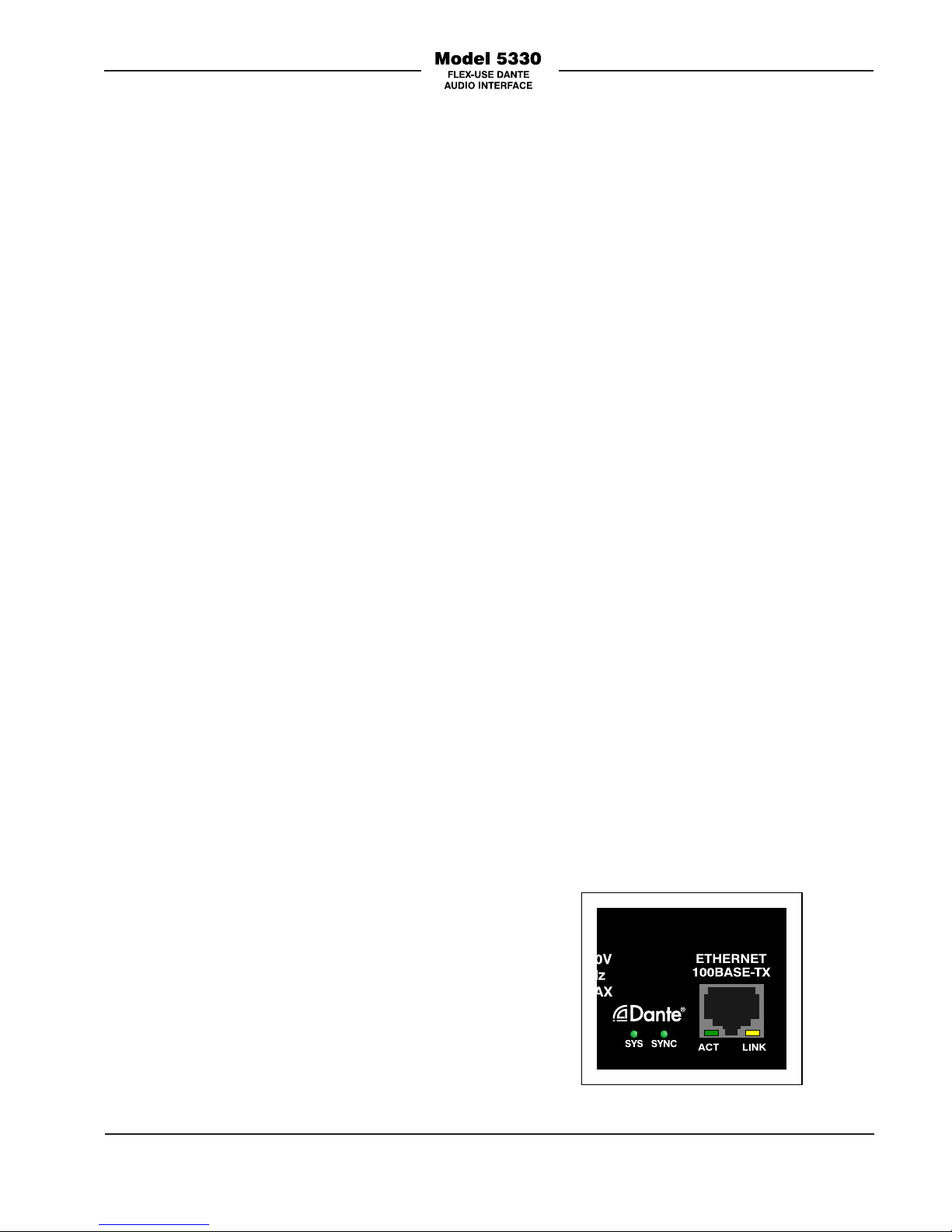
Ethernet Connection
An Ethernet connection that supports
100BASE-TX (100 Mb/s over twisted-pair) is
required for the Model 5330’s Dante audio-
over-Ethernet connectivity. A 10BASE-T
connection is not sufficient for Model 5330
operation. A 1000BASE-T (“GigE”) connec-
tion is not supported unless it can automati-
cally “fall back” to 100BASE-TX operation.
The 100BASE-TX Ethernet connection is
made by way of an RJ45 receptacle that is
located on the Model 5330’s back panel.
This allows connection by way of a standard
Ethernet twisted-pair cable and associated
RJ45 plug. The Model 5330’s Ethernet inter-
face supports auto MDI/MDI-X, eliminating
the need to use a crossover or “reversing”
cable.
Figure 3. Ethernet connection (back panel)

Issue 1, July 2018 Model 5330 User Guide
Page 10 Studio Technologies, Inc.
Analog Inputs
The Model 5330 provides four inputs that
are intended for connection to line-level
analog audio signal sources. Inputs 1 and
2 are accessible on the front panel and are
intended for connection to a 3-conductor
3.5 mm plug that is associated with an
unbalanced 2-channel (stereo) source.
Inputs 3 and 4 utilize 3-pin female XLR
connectors that are located on the back
panel.
Inputs 1 and 2
On the front panel one 3-conductor
(stereo) 3.5 mm jack provides access to
inputs 1 and 2. These inputs are analog,
unbalanced, and have a nominal level of
–10 dBu. They are primarily intended for
interconnection with a stereo audio signal
provided by a personal audio device. A
3-conductor audio patch cord with a 3.5 mm
plug on its end will typically be used to mate
with the Model 5330’s jack. It’s expected that
in many applications the connection made
to the front-panel inputs will be temporary,
varying “day-to-day” as applications change.
As such, although acceptable, permanent
wiring to the 3.5 mm jack associated with
inputs 1 and 2 is not expected to be made.
Inputs 3 and 4
Inputs 3 and 4 are located on the back
panel and utilize two 3-pin female XLR con-
nectors. They are electronically-balanced
(differential), capacitor-coupled, and have
a nominal level of +4 dBu. Prepare 3-pin
male XLR mating connectors such that
pin 2 carries signal high (+), pin 3 carries
signal low (–), and pin 1 is common/shield.
Unbalanced sources can also be success-
fully interfaced with these inputs. With an
unbalanced source begin by connecting
signal high (+) to pin 2 and signal low/shield
(–) to both pins 1 and 3. If this provides a
“clean” signal interconnection then all is
well. However, if this results in hum or noise
on the associated line input, try connecting
signal high (+) to pin 2 and signal low/shield
(–) only to pin 3; leave pin 1 unconnected
(“floating”).
Figure 4. Inputs 1 and 2 (front panel)
Figure 5. Inputs 3 and 4 (back panel)
Analog Outputs
The Model 5330 provides seven analog,
electronically-balanced line-level outputs.
They all utilize 3-pin male XLR connectors
which are located on the unit’s back panel.
The seven outputs consist of main outputs
1-4, the auxiliary output, and monitor out-
puts 1 and 2.
Table des matières
Autres manuels Studio Technologies Accessoires


