SpectraBand
The A20-Nexus Go incorporates SpectraBand, a technology that enables the A20-Nexus Go to tune over a super wide range of
169-1525 MHz. Tuning within this range varies by country.
For instance:
In the USA, the available frequency ranges are:
●The VHF band (169-216 MHz)
●The entire UHF TV band (470-608 MHz)
●The 600 MHz guard band (614-616 MHz)
●The 600 MHz duplex gap (653-663 MHz)
●The 900 MHz ISM band (902-928MHz)
●The 950 MHz STL band (941.5-960 MHz)
●The 1.5 GHz AFTRCC band (1435-1525 MHz), with an appropriate license.
In the UK, the available frequency ranges are:
●The VHF band (173-210 MHz)
●The core UK UHF TV band (470-702 MHz)
●The 800 MHz duplex gap (823-832 MHz)
●The 800 MHz guard band (863-865 MHz)
●The DME bands (961-1015 MHz, 1045-1075 MHz, 1105-1154 MHz), with an appropriate license
●The IMT band (1518-1525 MHz)
Please see https://www.sounddevices.com/available-frequencies/ for further detailed information on which frequency ranges are
available for each country.
Tuning Bands
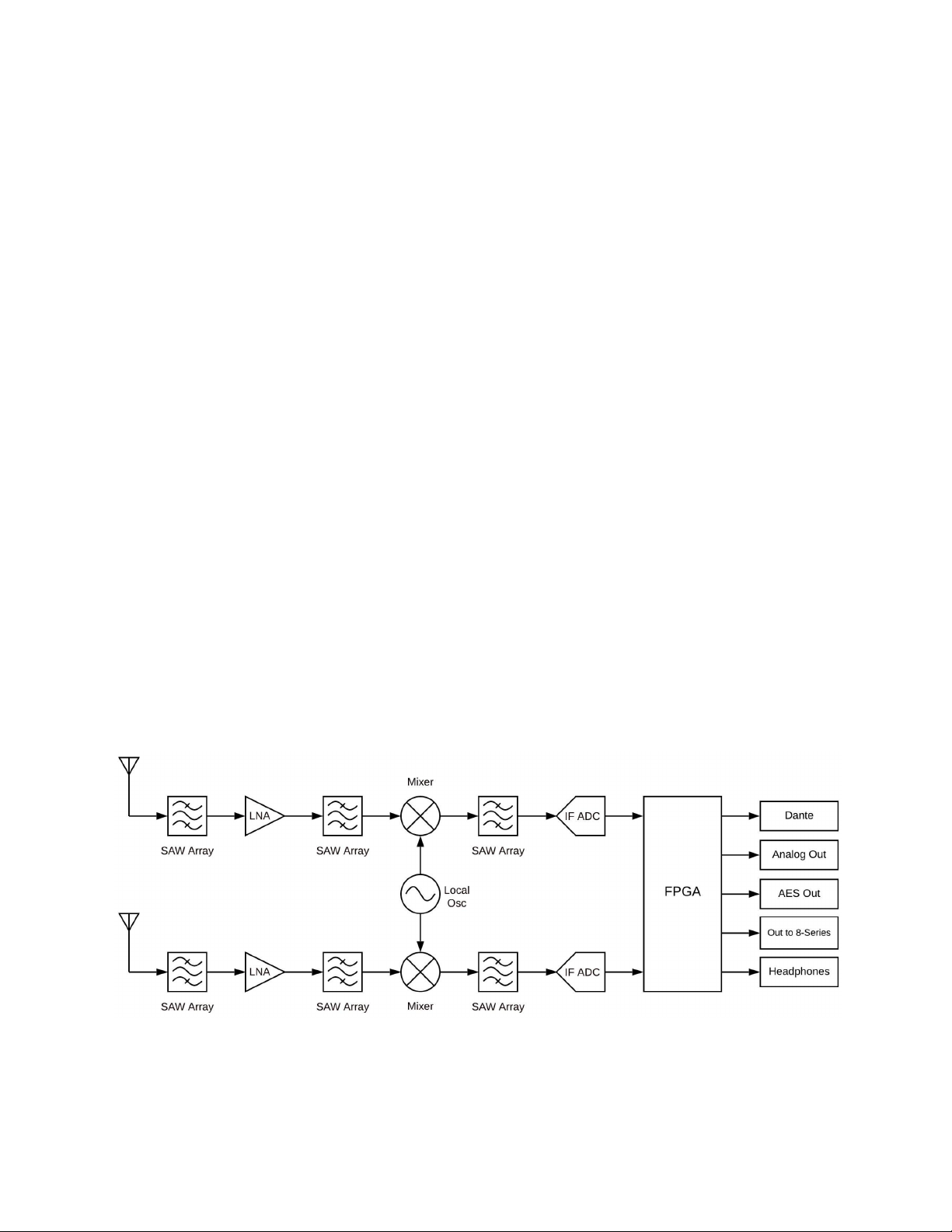
SpectraBand’s 169-1525 MHz range is divided into multiple, tightly-filtered tuning bands. The sharp attenuation at either end of a
tuning band’s range significantly reduces out-of-band interference resulting in excellent range performance.
Digital Wireless Modulation
Long Range and Standard Modulation
The A20 wireless products offer two proprietary digital modulation schemes that provide unbeatable range, unrivaled audio quality,
and very low latency. Long Range or Standard modulation can be selected on a per-receiver-channel basis. Long Range modulation
has better sensitivity which results in better range. The modulation setting must match among the A20 transmitters, A10-TX
transmitter and the A20-Nexus Go in order for the transmitted signal to be received and decoded.
Intermodulation Immunity
Because the A20 and A10 digital RF transmission is inherently resistant to intermodulation, multiple A10 and A20 Digital Wireless
systems can be used simultaneously on nearby adjacent frequencies without significant worry of intermodulation interference.
Systems can be used together when separated by at least 400 kHz. When operating in the 902-928 MHz Band, it is recommended
to separate channel frequencies by at least 1 MHz.
NexLink Wireless Transmitter Control
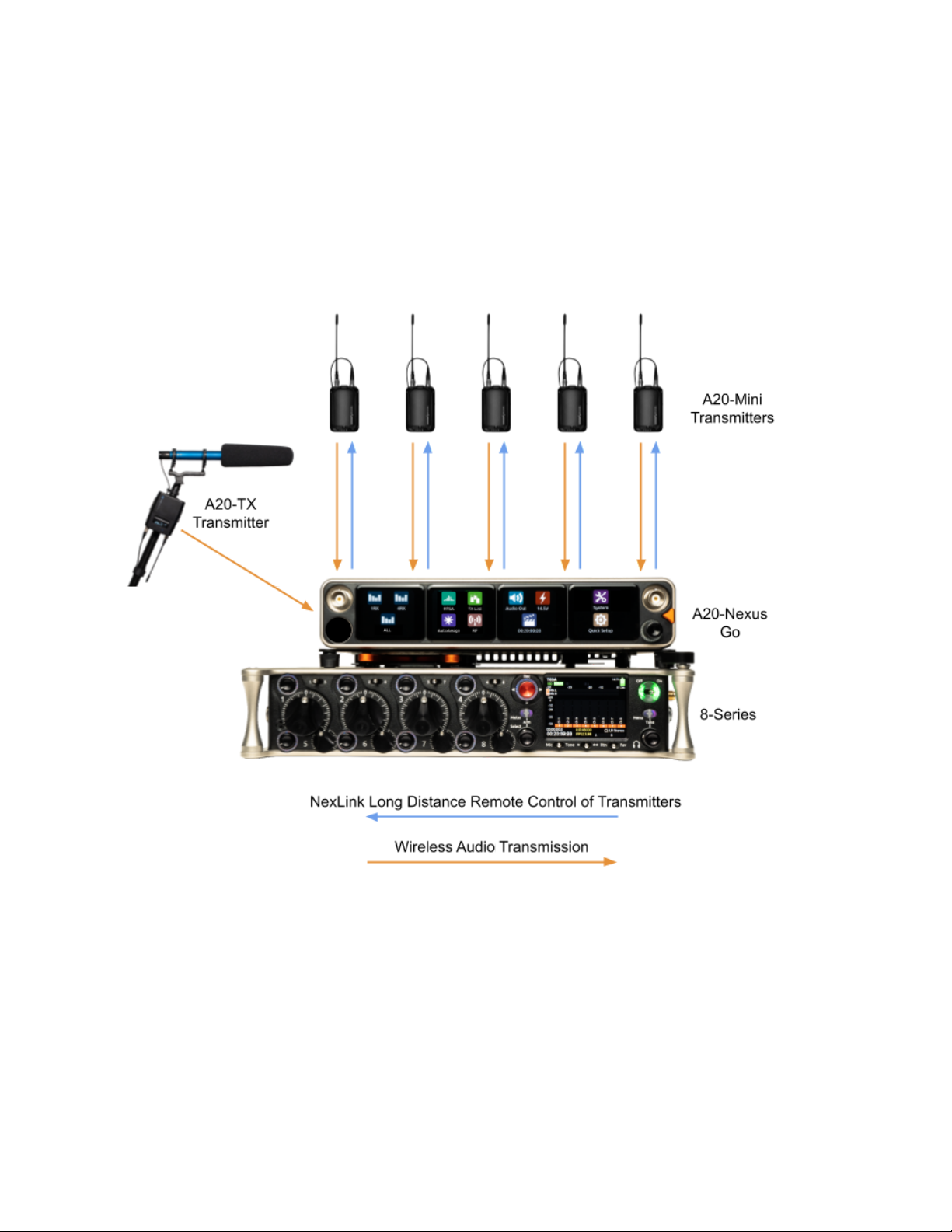
NexLink is a proprietary 2.4 GHz bidirectional wireless data link technology that allows multiple A20 transmitters to be controlled,
monitored, and timecode synced from an A20-Nexus Go over long distances. NexLink is designed to offer robust and reliable control
over distances far exceeding that of the wireless audio transmission, even in the presence of Wi-Fi and Bluetooth interference. An
A20-Nexus Go can pair with up to 64 NexLinked transmitters.
GainForward
The A20-Nexus Go supports the A20 transmitter’s GainForward feature. GainForward eliminates the need to adjust microphone
preamplifier gain at the wireless transmitter. Audio levels from the transmitter are controlled either directly from the 8-Series (or any
other mixer) trim controls, or from the A20-Nexus Go receiver screen. If the talent speaks too softly or emotes too loudly after being