SOILMOISTURE EQUIPMENT CORP.
P.O. Box 30025, Santa Barbara, CA 93105 U.S.A.
Telephone 805-964-3525 - Fax No. 805-683-2189
www.soilmoisture.com - sales@soilmoisture.com
SOILMOISTURE
55
THEORY OF OPERATION
The Model 2900F Soilmoisture Probe is a tensiometer-type instrument that reads soil
suction directly. The “soil suction” reading is a direct measure of the availability of
moisture for plant growth, and the standard unit of measurement is the “bar”. The bar*
is a unit of pressure in the metric system and is used to dene positive pressure (above
atmospheric pressure), or negative pressure or vacuum (below atmospheric pressure).
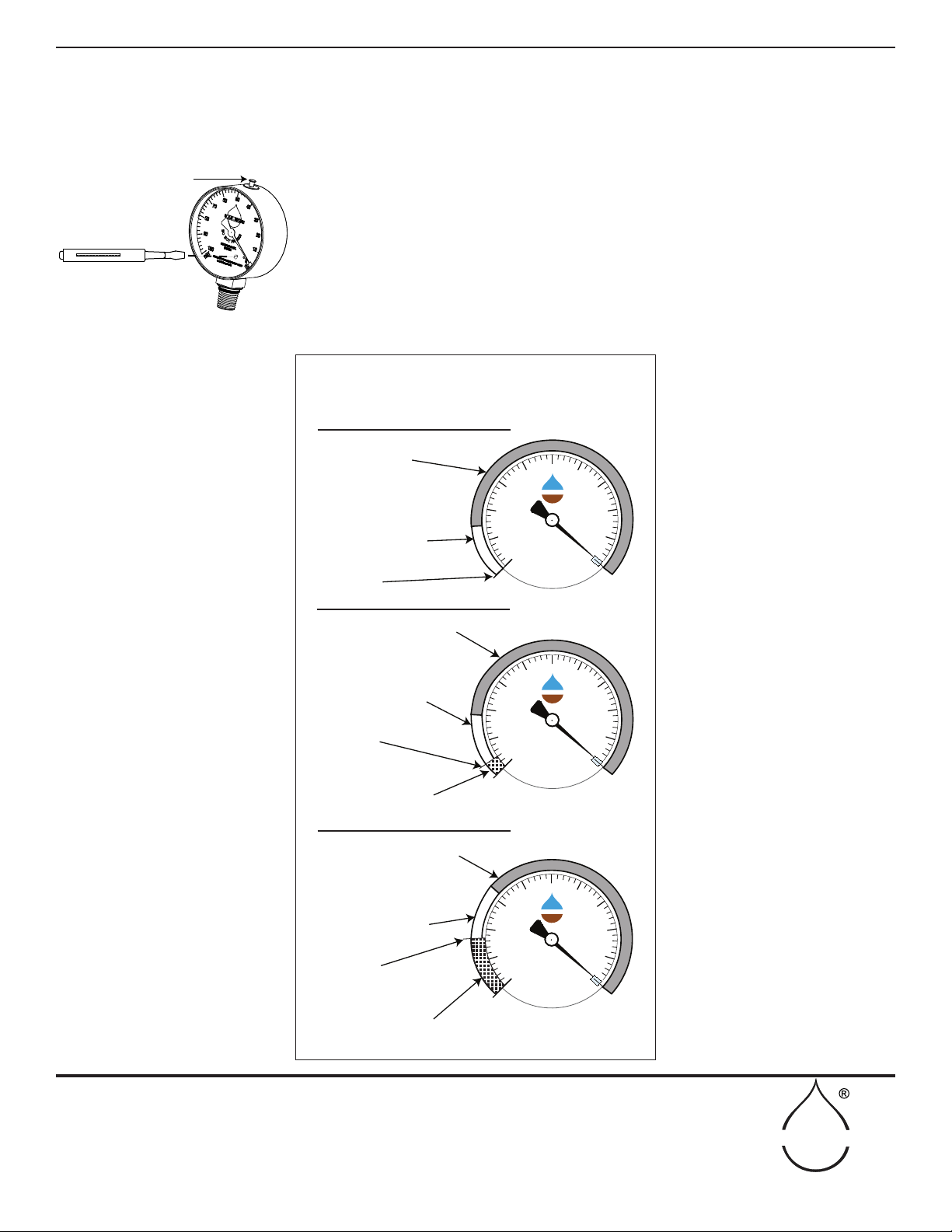
The gauge on the Probe is calibrated in hundredths of a bar (or centibars) of vacuum,
and is graduated from zero to 100.
In scientic work, it is becoming customary to express pressures and vacuums in a
unit of measure called a “Pascal”, and a “Kilopascal” which is 1000 times as large as
a Pascal. A “centibar”, as used above, is exactly equal to a Kilopascal. Therefore, the
dial gauge on the Probe also reads in Kilopascals and is graduated from zero to 100
Kilopascals (KPa).
Soil suction is actually created by the attraction that each soil particle has for the water
in the soil. Because of this attraction, water forms a lm around each particle of soil
and collects in the capillary spaces between the soil particles. As the soil becomes
drier, these lms become thinner and the attraction or soil suction increases. The plant
root has to over-come this soil suction, or attraction force, in order to withdraw mois-
ture from the soil. The measurement of soil suction then gives a direct indication of the
amount of work the plant root must do to get water from the soil. The only moisture
measuring instruments that accurately measure soil suction are those using the ten-
siometer principle. These instruments read centibars of soil suction directly without
calibration for soil type, salinity, or temperature.
When the Probe is inserted into the cored hole, there are various effects associated with
the movement of the porous ceramic sensing tip through the soil. The soil surrounding
the tip is slightly compacted and the wiping action of the porous ceramic through the
soil causes small thermal effects. It takes a few moments for these disturbances to dis-
perse, and this is the reason that it is not desirable to move the Null Knob for the rst
minute after insertion of the Probe.
In order to obtain a soil suction reading, it is necessary for a small amount of water
to transfer between the sensing tip of the Probe and the soil. When the Null Knob is
turned clockwise, water is forced out of the Probe sensing tip and into the surrounding
soil. When the Null Knob is turned counterclockwise, a vacuum is created within the
Probe, which causes moisture to move from the soil through the ceramic sensing tip
and into the Probe. In order to obtain an accurate reading within the minimum amount
of time, one must be careful not to disturb the moisture conditions surrounding the
Sensing Tip.
IMPORTANT NOTE: When examining the Probe, DO NOT leave the porous
ceramic sensing tip exposed to the air for prolonged periods.
When the Probe is removed from the Carrying Case and the Sensing Tip is not kept
moist, evaporation of moisture from the Tip will pull the dial gauge up to a very high
centibar reading. Under these conditions, air can diffuse through the water in the pores
of the Sensing Tip and enter the Probe, which can result in a decrease in sensitivity and
require a relling cycle.
REQUIREMENTS PRIOR TO USE