5. TESTING
-Warning!! Testing must be carried out by qualified
personnel only. Take all necessary safety precautions.
-Warning: the hoist must be tested before use.
Before testing the hoist make sure that it has been correctly
installed.
1) Lower the unloaded rope to the lower loading position by pres-
sing the down button, and check that at the end of its travel three
turns of rope remain on the drum.
2)No-load test. Apply a small load (20 kg) and check that the
machine works correctly by running a complete up/down cycle.
Test the up, down and emergency stop buttons and check that
the up limit switch and the electric motor brake work correctly and
that the cable winds correctly onto the drum.
3)Load test. Load the hoist with the maximum allowable load.
Run a complete up/down cycle to test the stability of the supports
and the motor brake.
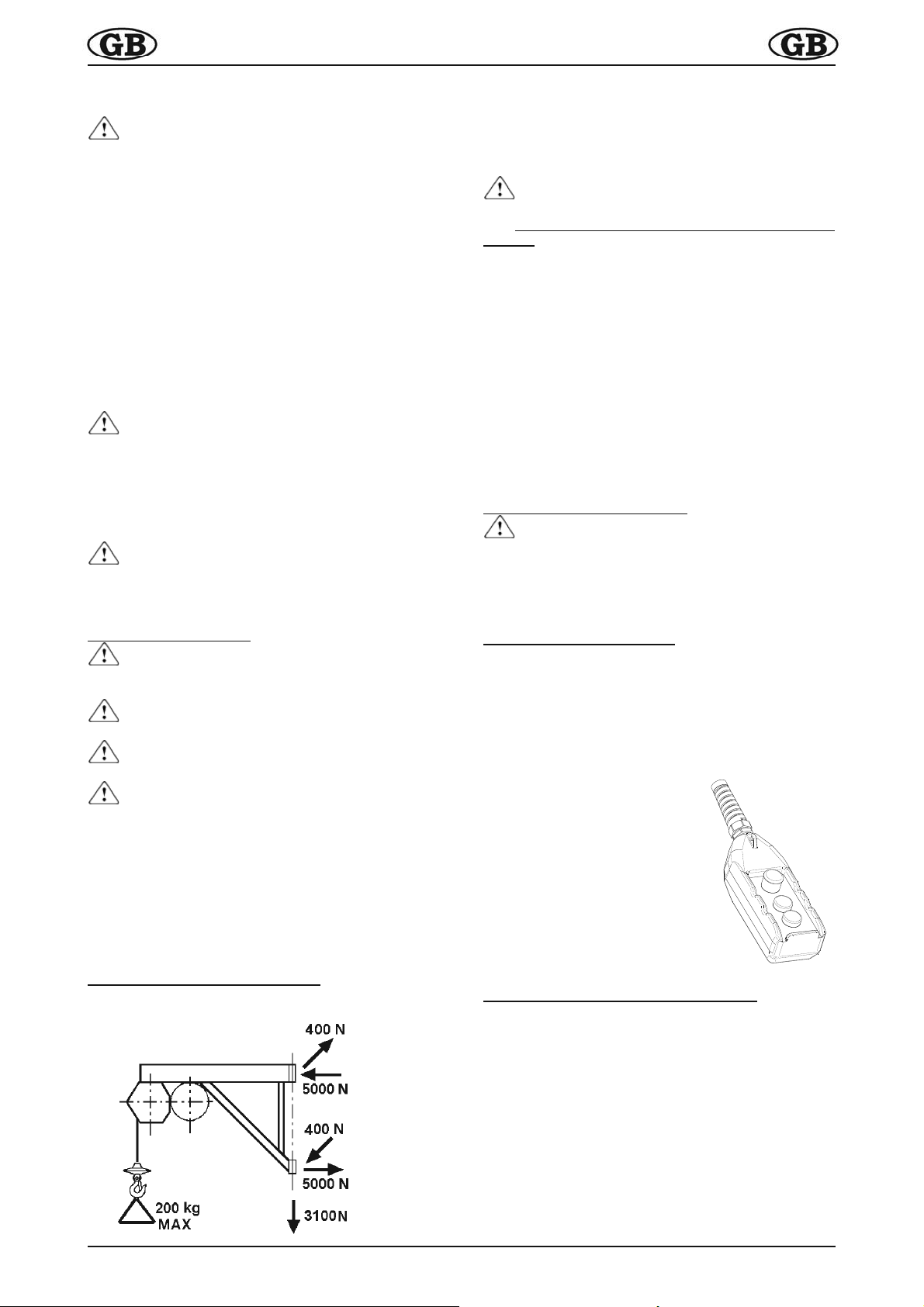
After the test, check the support structure for failure and slippage
and recheck the horizontal alignment of the drum (using a level
as shown in Þg. 1).
4) The hoist is Þtted with a safety device which stops travel at the
fully raised position (9).
It is however good practice to stop the hoist before the safety
device activates by releasing the UP button.
When the rope is completely unwound, the operator standing near
the machine must check that the rope does not wind in the wrong
direction onto the drum.
When testing is completed, Þll in the test report with the date,
installation check and signature (Table 2) along with any other
comments.
-The test procedure described above, complete with
no-load (2) and load (3) tests, must be performed every time
the machine is installed.
6. SAFETY WARNINGS AND OPERATING PRECAUTIONS
-
1) Never lift loads exceeding the capacity of the elevator.
-
2) Never allow persons to remain below suspended
loads.
-
3) Never try to lift loads anchored to the ground (e.g.
embedded posts, plinths, etch.).
-
4) Ensure that the load is securely connected to the
elevator hook and also close the safety catch (ref.6 fig. 4.1).
-
5) If the load requires accessories to be attached to be
hooked up, these must be certified and approved (harnesses,
ropes, slings, etc.). The weight of these accessories must be
subtracted from the maximum capacity.
-
6) Ensure that no part of the load protrudes during the
lifting phases.
-
7) Before releasing the load, ensure that it is in a stable
position.
-
8) A suspended load must never be detached to cause
sudden release or by cutting the slings, causing a backlash
movement of the entire structure.
-
9) Never move hands or parts of the body near the drum
during operation, as this constitutes a risk of entrapment in
the ropes unwinding, with the risk of serious accidents.
-
10) Never move hands or parts of the body near the
counterweight during the ascent phase, as this constitutes a
risk of crushing on contact with the limit switch lever.
-
11) Avoid use in adverse weather conditions (wind or
storms) as the load is not guided. Maximum wind speed must
not exceed 12.5 m/s.
-
12) The control position and lighting conditions must
ensure perfect visibility of the load throughout travel.
-
13) Ensure that all guards and safety devices are fitted.
-
14) During use, check that the rope unwinds correctly,
turn on turn, without slackening or twisting, which can cause
damage to the rope. If this occurs, unwind the rope and rewind
correctly keeping the rope tensioned at all times.
-
15) Ensure that the travel and work area is free of ob-
stacles throughout the height and take necessary precautions
to prevent persons from leaning out of intermediate floors.
-
16) Delimit the lower load area to prevent persons from
being present during lifting.
-
17) Keep children at a safe distance from the elevator.
-
18) When the elevator is not in use, do not allow unau-
thorised personnel access or operation.
-
19) Use of the elevator for oblique tractions is strictly
prohibited (over 5° with respect to vertical angle).
-
20) Never rotate the elevator on the pins by pulling the
pendant control; it must always be rotated manually from
the frame.
-
21) Do not leave a suspended load unattended. Raise
or lower it and unload it.
-
22) During lifting or lowering, never allow the load to
turn as this may cause the rope to break.
-
23) Before leaving the elevator unattended, remove the
load, wind the rope completely onto the drum, and detach the
power plug from the mains.
-
24) When a load is to be raised or lowered, this must
be done in such a way as to minimise dangerous sideways
and vertical movements.
-
25) Protect the winch against the rain.
When operation is resumed after an extended period of disuse
(e.g. overnight) the entire machine must be tested under no-load
conditions before starting (as described in section 5, point 2).
7. CHECKS AND MAINTENANCE
-
Warning! All maintenance work must be carried out
with the machine switched off, unloaded and disconnected
from the mains.
-Repairs must be made by qualiÞed personnel or by the IMER
technical service.
-Use only IMER original spares.
-
Check the motor brake every 6-7 days.
-
Make sure that the notices and inscriptions on the
machine remain legible.
-
Keep the machine clean of dirt.
-
Check operation of the UP limit switches at the start
of every work shift.
-
Check the electrical cable for accidental damage at the
start of every work shift.
7.1 WIRE ROPE
Use only new ropes, with a manufacturer's certiÞcate of conformity
attesting their satisfaction of the following speciÞcations and of
standard UNI EN 12385-4. These are minimum speciÞcations: ropes
with better speciÞcations may be used, with the exclusion of the OD,
which must always be 4 mm.
External diameter : 5 mm
Type : 133 wires anti-spin
Direction of lay : CDX
Strand dia.: 0.32 mm
Strand strength : 1960 N/mm2
Preformed: Yes
Minimum breaking strain : 16 kN
Length : 31 m
Surface treatment : galvanised and greased
The IMER reference code is given in the spare parts table.
7.1.1 ROPE REPLACEMENT
This operation must be carried out by an authorised IMER
International service centre.
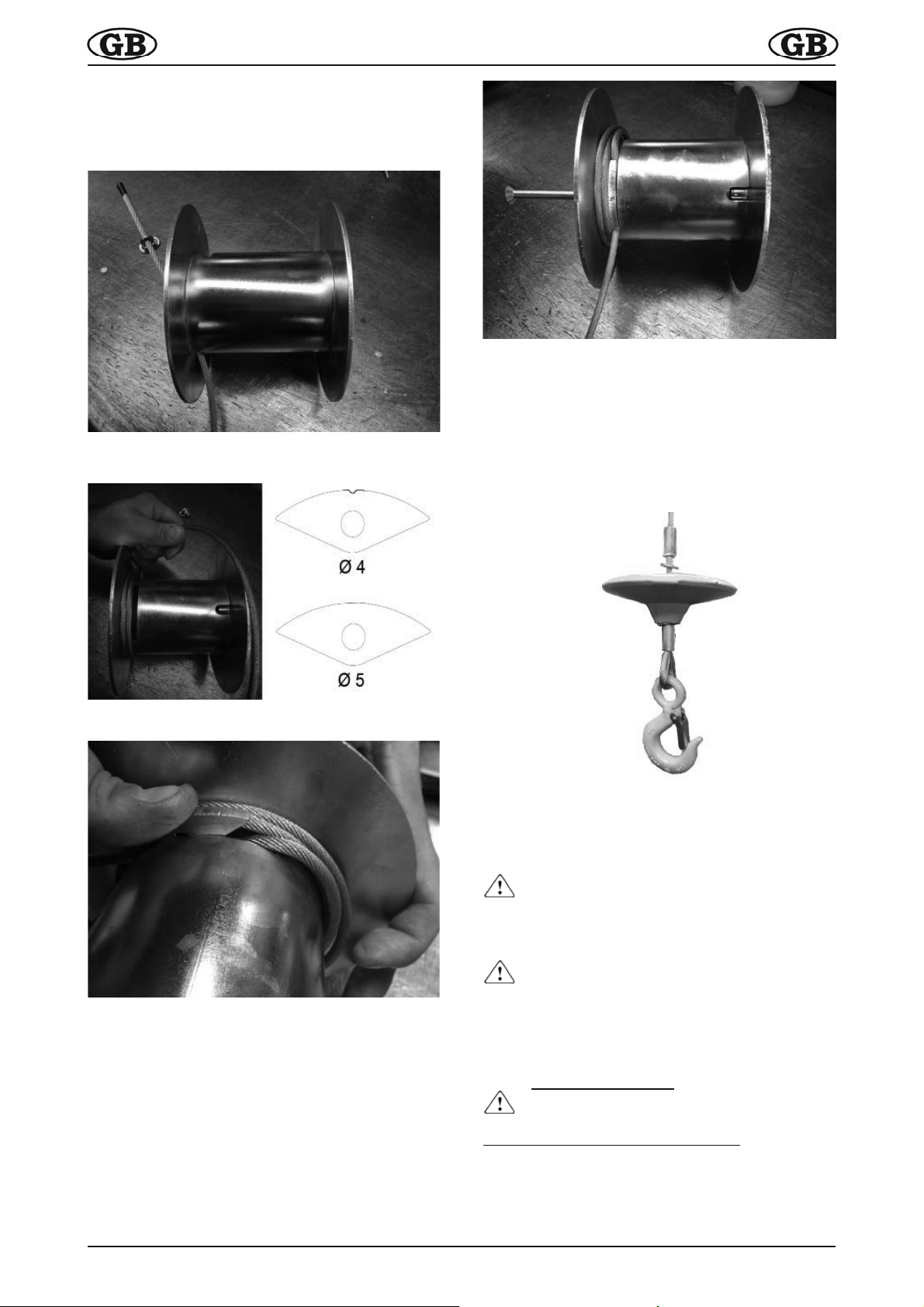
Remove the hook (ref. 2, Þg. 1) and withdraw the cable weight.
The drum is equipped with a device to ensure that two turns
of rope remain fully wound on; when a new rope is Þtted, this
condition must be maintained.