The
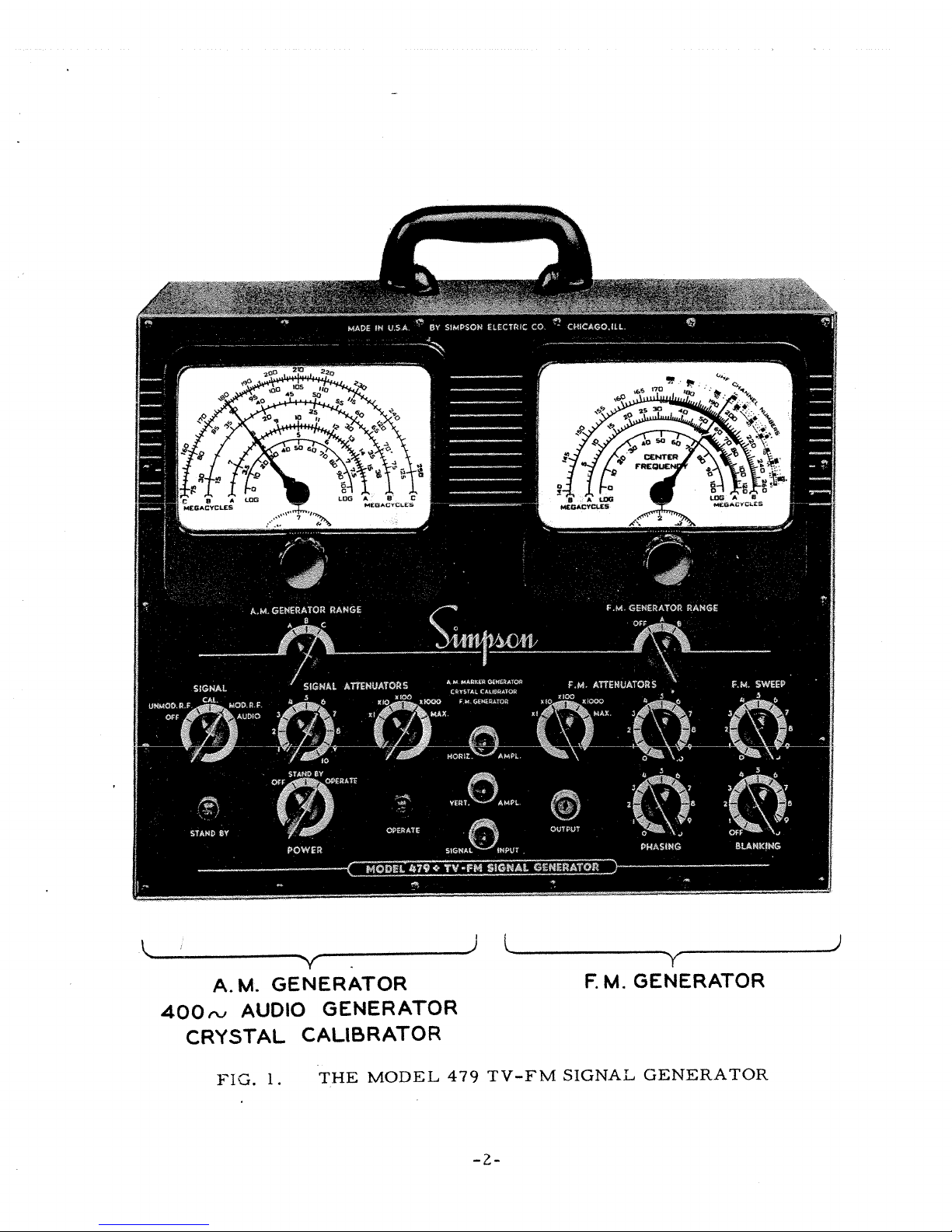
POWER
switch
lower
enter
controls
the
power
input
to
both
sections
of
the
Model
479.
When
the
switch
is
in
the
OFF
position
the
entire
instrument
is
turned
off.
In
the
STAND
BY
position,
all
the
tube
filaments
are
turned
on
but
no
plate
voltage
is
applied.
In the
OPERATE
position,
plate
voltage
is
applied.
The
green
light
is
on
for
both
STAND
BY
and
OPERATE
positions
of
the
switch,
and
the
red
light
is
on
for
the
OPERATE
position
only.
In the
center
of
the
Model
479
there
are
three
jacks
which
are
labelled,
from
top
to
bottom,
HORIZ.
AMPL.,
VERT.
AMPL.,
and
SIGNAL
INPUT.
A
cable
from
the
HORIZ.
AMPL.
jack
should
be
connected
to
the
horizontal
input
terminal
with
the
red
insulated
clip
and
ground
with
the
black
insulated
clip
of
the
oscilloscope
used
in
con
junction
with
the
Model
479.
Set
the
function
switch
of
the
oscilloscope
to
utilize this
signal
for
the
horizontal
sweep.
The
switch
position
will
usually
be
named
"horizontal
amplifier
or
"horizontal
input"
on
the
oscilloscope.
This connection
is
important
be
cause
it
offers
the
operator
his
most
convenient
source
of
60
cycle
sine
wave
sweep
voltage
which
may
be
phase
adjusted
relative
to
the
f-rn
sweep
voltage
with
the
PHASING
control
on
the
Model
479.
There
is
more
information
on
this in
the
discussion
of
the
PHASING
control.
A
cable
from
the
VERT.
AMPL.
is
used
to
connect
the
source
of
the
response
pattern
to
the
vertical
input
terminal
with
the
red
insulated
clip
and
ground
with
the
black
insulated
clip
of
the
oscilloscope.
A
cable
from
the
SIGNAL
INPUT
jack
is
used
to
connect
the
signal
output
of
the
amplifier
under
test
back
into
the
Model
479.
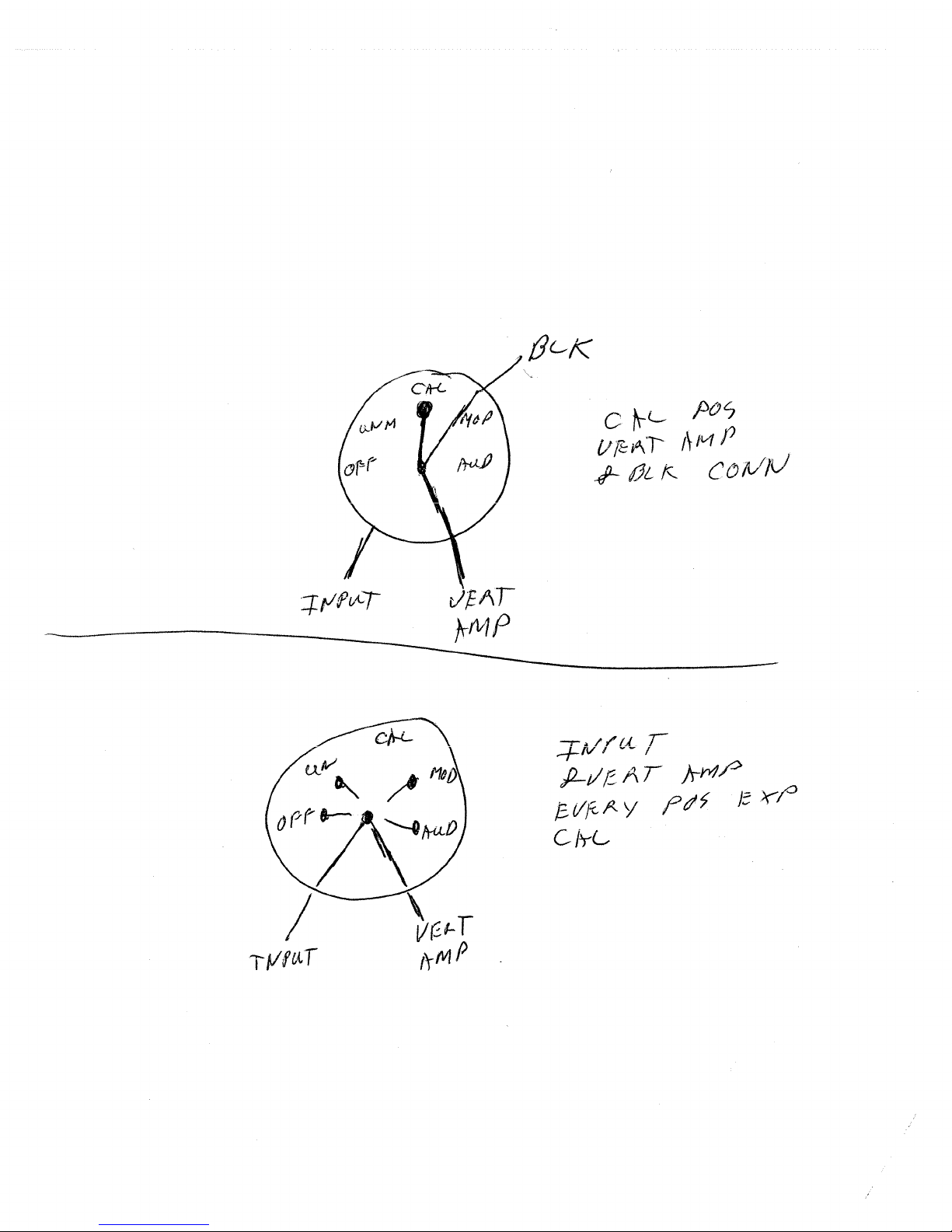
This
signal
will
be
fed
through
the
SIGNAL
switchto
the
VERT.AMPL.
jack
when
the
switch
is
in
the
OFF,
UNMOD.
R.F.,
MOD.
R.F., or
AUDIO
position.
The
right
hand
section
of
the
Model
479
contains
a
frequency
modulated
signal
gen-
erator,a
140
rnc.fixedfrequencyoscillator,a
mixer,
and
phasing
and
blanking
circuits.
The
output
of
the
f-rn
signal
generator
is
connected
through
an
attenuator
to
the
OUTPUT
jack.
The
OUTPUT
jack
serves
both
the
a-mandthe
f-rn
signal
generators
so
that
only
one
connection
need
be
made
to
the
input
of
the
receiver.
The
F.M.
GENERATOR
RANGE
switch
below
the
center
of
the
dial
has
three
posi
tions.
In
the
OFF
position,
the
f-rn
generator
section
of
the
Model
479
is
inoperative.
In
the
A
position,
both
the
140
mc.
fixed
frequency
oscillator
and
the
tunable
f-rn
oscil
lator
are
operating;
one
output
frequency
from
the
mixer
is
the
difference
between
these
two
frequencies.
The
fundamental
range
of
the
beat
frequencies
is.2
to
120
mc. The
locations
for
RF
signals
for
television
channels
2
through
6
are
marked
in
areas
be
low
the
corresponding
frequencies.
In
the
B
position, the
switch
turns
off
the
140
mc.
fixed
frequency
oscillator,
and
the
output
from
the
variable
frequency
oscillator
is
available
at
the
output.
The
fundamental
range
of
the
B
band
is
140
to
260
mc, The
locations
for
RF
signals
for
channels
7
through
13,
which
use
fundamentals
of
the
B
band, are
marked
in
areas
below
the
corresponding
frequencies.
The
locations
of
B
band
frequencies
which
will
have
harmonics
required
for
RF
signals
for
channels
14
through
83
are
marked
ingroups
above
theB
band.
Channels
14
through
21
use
second
.jiarmonics,22
through65use
third
harmonics,
and66
through83
use
fourth
harmonics.
The
tuning
knob
in
the
dial
serves
to
select
any frequency
within
the
range
indicated
on
the
arcs
of
the
CENTER
FREQUENCY
dial.
The
F.
M.
ATTENUATORS
are two
controls
which
act
as
coarse
and
fine
adjust
ment.
A
5-position
switch
provides
coarse
control
on
attenuation
and
a
continuously
variable
potentiometer
provides
the
fine
control.
The
F.M.
SWEEP
control
regulates
the
amount
of
frequency
variation
due
to
modulation.
The
center
frequency
of
the
fundamental
can
be
swept
through
a
band
width
of
zero
to
15
megacycles.
Harmonics
can
be
swept
through
multiples
of
this
band
width,
corresponding
to
the
harmonic
order.
The
rate
at
which
center
frequen
cies
are
swept
through
any
selected
range
and back
is
the
modulation
frequency
of
60
cycles.