SIG PLB 291K Mode d'emploi

Page1
PLB 291 ROCKDRILL
SERVICE INSTRUCTIONS AND SPARE PARTS LIST
MODELS:
SIG.au PLB 291 DI

Page2
PLB 291 ROCKDRILL
Contents
PAGE
Safety Precautions 3
Technical Data, ratings 4
Operation 5
•Control elements
•Compressed air & flushing water
•Lubrication
•Drill Rods
Disassembling –Reassembling the Hammer 8
Parts & Maintenance Data 9
•Handle
•Backhead
•Control Lever
•Distribution system
•Piston
•Cylinder washer bush
•Rotating mechanism
•Chuck insert
Spare Parts List: SIG.au PLB-291DI 18
Exploded Drawing: SIG.au PLB-291DI 20

Page3
PLB 291 ROCKDRILL
SAFETY PRECAUTIONS
•During Operation of the drill, safety shoes, safety glasses, ear protection and safety helmet are to be
worn,
•Exposure to excessive noise can lead to hearing deficiency. APPROPRIATE ear protection must always
be worn.
•Distraction increases danger of accident.
•Only on actual operation of drill should the operating handle be touched.
•When working with the drill, sure and firm footing is necessary.
•The drill should not be brought near to the face.
•Never place the drill on your foot.
•Never point the drill at co-workers or yourself.
•The drill should never be put into operation if it is lying on the ground or if it is not held securely in
working position.
•Compressed air is dangerous! Never point a connected compressed air hose at co-workers or yourself.
Avoid the habit of blowing your clothes free of dust with compressed air.
•Be sure that all hose connections are tight and sealed. A loose hose not only causes loss of air; danger
exists that it comes completely off the drill, whips around injuring the operators and others in the
area. Secure hoses with safety cables or ropes to prevent danger of injury in case a hose gets broken.
•Never disconnect a pressurized air hose: First shut off air from the compressor and bleed the drill.
•The drill should only be operated with a specially suitable inserted drill rod. Operate with sufficient
pressure, avoid recoils. When the machine is under pressure, oilers may not be filled up and tools may
not be exchanged.
•The drill should always be held with both hands during operation.
•The operator must have a firm footing. If possible the operator’s feet should be so placed out of the
falling range of the drill, but without the danger of losing balance. In the case of breakage of drill rod,
there is danger of sudden falling of drill with protruding and broken drill rod part.
•Never operate drill astride, I.E., with one leg over the handle. In the case of breakage of the inserted
drill rod, serious injuries can result.
•Ensure that no cables, pipes and the like are in area of drill operation (electric, gas, water, telephone).
•In the event of drill contacting unknown objects during operation, switch off drill immediately.
Identification of object should be carried out by careful uncovering with shovel, not with the drill.
•In case a cleaning solvent is used for cleaning drill parts, make sure that this meets the current safety
and health regulations and that it is used in a well-ventilated area.
The safety precautions listed in the manual are intended to alert operator and helpers to the possible
physical dangers inherent in the various stages of operating and/or maintaining equipment of this kind. All
personnel involved in operating and/or maintaining this equipment must read and thoroughly understand
the operating instructions before attempting to operate, or perform maintenance on the drill machine. Non-
authorised, or untrained personnel must not under any circumstances attempt to operate or maintain the
machine.

Page4
PLB 291 ROCKDRILL
TECHNICAL DATA/RATINGS
Carefully memorize this tool’s operation and maintenance instructions.
PLB-29DI
PLB-29K
DIMENSIONS
Weight
30Kg
30Kg
Length
690mm
690mm
Piston diam.
90mm
90mm
Piston stroke
65mm
65mm
DRIVE
Impact rate
2700BPM
2700BPM
Optimal air pressure
5-6Bar
5-6Bar
Air Consumption
5.3m3/min at 6Bar
5.3m3/min at 6Bar
FLUSHING WATER
Water pressure: Always at least 0.5 bar LESS than actual air pressure
Water flow: 9 Litres/min with 2.4 long drill rod
Characteristics
Rotation: Left (Counter clockwise)
Exhaust Silencer: Integrated into hammer housing
Tool Insert: 22 x 108mm (7/8’’ x 4 1/4’’)
25 x 108mm (1’’ x 4 ¼’’ ) – alternative
Hoses
Air Hose: 25mm (1’’)
Water Hose: 13mm (1/2’’)

Page5
PLB 291 ROCKDRILL
OPERATION
1. Control Elements
A. Turning Handle for leg extension (SIG.au PLB-29K only)
B. Push button for leg retraction (SIG.au PLB-29K only)
C. Air pressure is shut off
D. Water flushing is ON
Reduced air pressure is ON (spot drilling)
E. Full air pressure is ON
F. Blow out of drill hole is ON
2. Compressed air and flushing water
Compressed air is to be CLEAN and DRY
Inner DIAMETER OF AIR HOSES to be 25mm or 1’’
Air hoses are to be BLOWN OUT BEFORE CONNECTION to the drill hammer
Inner DIAMETER OF WATER HOSES to be 13mm or ½’’
Water hoses are to be FLUSHED OUT BEFORE CONNECTION to the drill
Water pressure ALWAYS TO BE AT LEAST 0.5 Bar LESS than air pressure
SIG.au PLB 291K
SIG.au PLB 291DI

Page6
PLB 291 ROCKDRILL
3. Lubrication
When drilling, ALWAYS have the automatic oil feeder PLO 20 or a POB 15 fitted to the air
pressure line. (The closer the device is to the hammer, the safer it works).
Make Sure that oil shows up at the drill rod shank. The bit flange must be damp with oil. The
needed output may be regulated with the adjusting screw at the oil feeder.
ATTENTION: The oil feeder PLO 20 cuts off the air pressure when its reservoir runs out of
oil and/or when the air duct between oil feeder and hammer breaks.
The following oils for drill hammers are recommended:
AMBIENT TEMPERATURES
BRAND
TYPE
UNDER 100C
100C –350C
ABOVE 350C
TEXACO
RDL
32
100
SHELL
TORCULA
32
100
150
MOBIL
ALMO
525
527
529
4. Drill Rods
Rods
Shank ends are to be in good order, clean and
not worn or damaged. Percussion faces are to be
flat and perpendicular to the rod axis.
The flushing duct should not be clogged.
Bits
The correct section is to be ground (No cross cones!)
The flushing duct is not to be clogged.
For further details, please refer to the manufacturer’s instructions
Grinding –CAUTION!
If the cutting edge is ground
to a sharp corner like that on
the right, it may end up like the
broken edge on the left.
(See drawing to right)
The profile of the cutting head
should be wider than the mounting
steel to drill a hole with clearance.
(See drawing to right)

Page7
PLB 291 ROCKDRILL
Maintenance
The drill hammer is to be disassembled and cleaned periodically. At this opportunity the
particular wear parts are to be checked accordingly to chapter ‘Components and Servicing
Data’.
Dirt Restrictor
When replacing the dirt restrictor
Part 60, care should be taken to
insert it with Part 61 as shown.
All foreign matter must be removed
from the small holes and finally
blown out with compressed air.

Page8
PLB 291 ROCKDRILL
Disassembling the hammer
Screw off nuts, Part 13 with wrench B.
Push out frame bolts, Part 10.
So far, disassembly should be good enough for current servicing.
For directions concerning further disassembly, please refer to
‘Components and Servicing Data’.
Cleaning the parts
Carefully wash all parts with kerosene. Blow off residuals with compressed air and, with a
clean cloth, wipe the parts dry. After cleaning, coat all the parts with resin-free and acid-free
grease.
EXCEPTION: Do not grease but oil the valve plate, Part 74, the valve chest,
Part 72, and valve guide, Part 75.
Reassembling the Hammer
Replace all worn O-Rings as necessary,
Including control assemblies,
If found to be excessively leaking.
Reassemble the rock drill in accordance
With the exploded view. Make sure that the
distribution system, Parts 71, 72, 74, 75 & 76
are pressed vertically into the housing, Part 80.
Take care that the lubrication channel holes
In the cylinder washer, Part 84, and the
Housing, Part 80, line up.
Caution:
The frame-bolt nuts, Part 10,
Are to be screwed down alternatively
And in an uniform manner.
In the SIG.au PLB-29K and SIG.au PLB-291K
models, care is to be taken so not to jam
the valve piston, Part 128 inside the handle.

Page9
PLB 291 ROCKDRILL
Parts and Maintenance data
1. Handle (SIG.au PLB-29K and SIG.au PLB –291K models only)
Disassembly
Disassembly the left shaft bolt, Part 10.
Remove the head screw, Part 121.
Withdraw the left lever, Part 123.
Remove the supporting ring, Part 124.
Pull off the twist grip, Part 125, and check the
KSD –sealing rings, Part 126, and O-Rings, Part 127.
Assembly Instructions for KSD-rings
•Assembly tool, “spread bush”, is a self-made item, preferably made of nylon, delrin ore the
like.
•Twist grip 126 may be used as a calibrating tool.
•Lubricate KSD-rings with molycote, position O-ring once after the other in grooves via taper
guide.
•Add KSD-rings one after the other with aid of spread bush (handle gently)
•To recalibrate KSD-rings, use twist grip 125 in proper manner as shown.
Reassembly in reversed sequence:
Coat the KSD-rings 6 with MOLYCOTE
CAUTION: When mounting the twist grip 125 take care that the cylindric pin fits into the counter sunk
groove (b).

Page10
PLB 291 ROCKDRILL
Valve piston –inside handle (Model SIG.au PLB-29K and SIG.au PLB-291K only)
The valve piston, Part 130, may jam because of dirt or incorrect tightening of the side rod,
Part 10. Check it for easy movement.
To remove dirt that is causing jamming unscrew nut, Part 130, and remove the valve pin.
Clean and lubricate with a light, non-reinous oil before assembly. Tighten side rods, Part 10,
evenly to avoid binding.
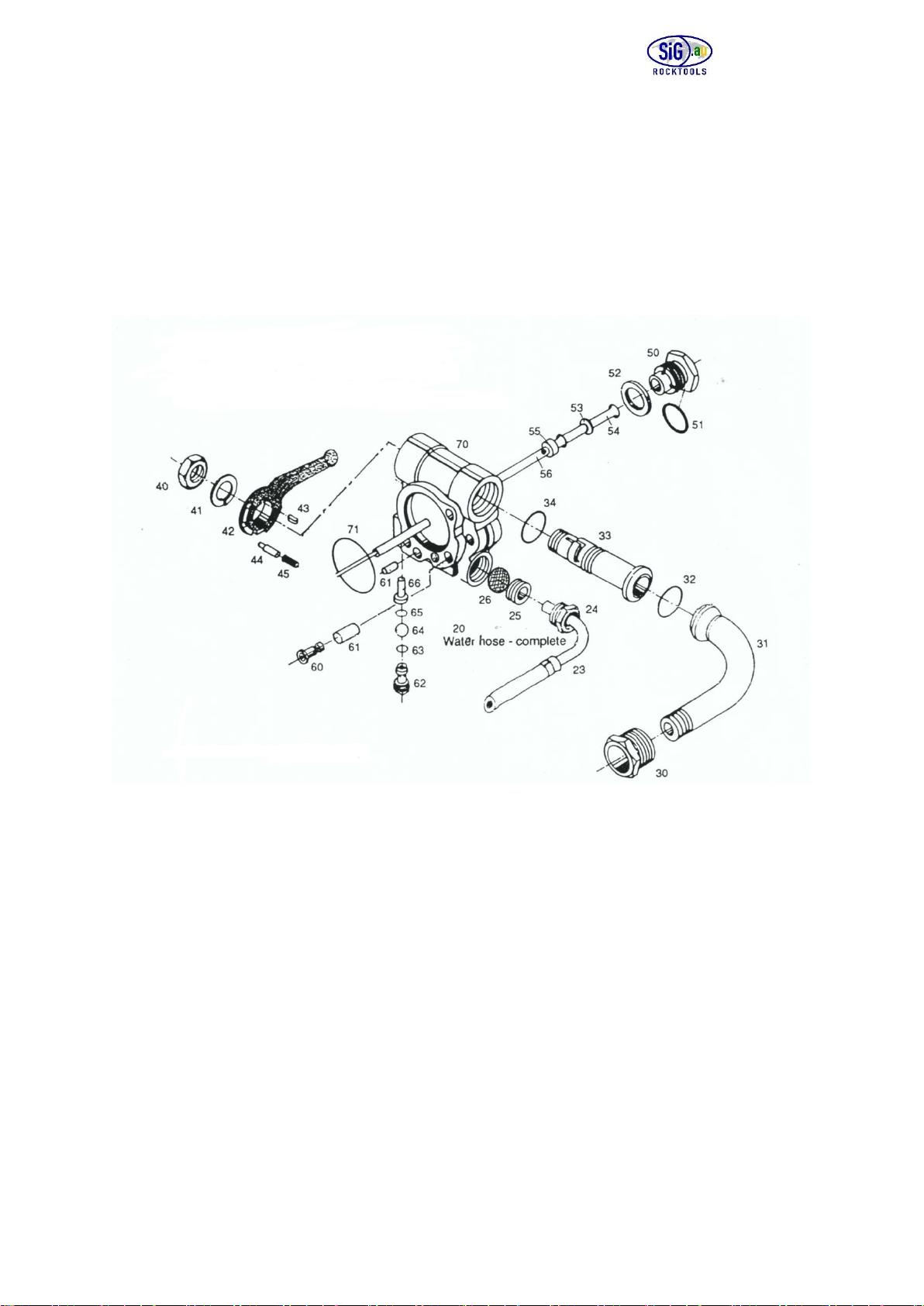
2. Back Head (Handle Part)
The rubber seals must be in order to avoid water penetration inside the hammer. Defective
seals must be replaced by new ones, Parts 53 and 55.
Disassembly
Turn operating lever to position F and then pull off operating lever, Part 42, from valve, Part
33.
Eject throttle valve, Part 33, on air connection side.
If water emerges at the operating lever, Part 42, then O-ring 65 on valve pin, Part 66, must be
replaced.
Ce manuel convient aux modèles suivants
3
Table des matières
Autres manuels SIG Outils