
Sicce CO2 Life Manuel utilisateur


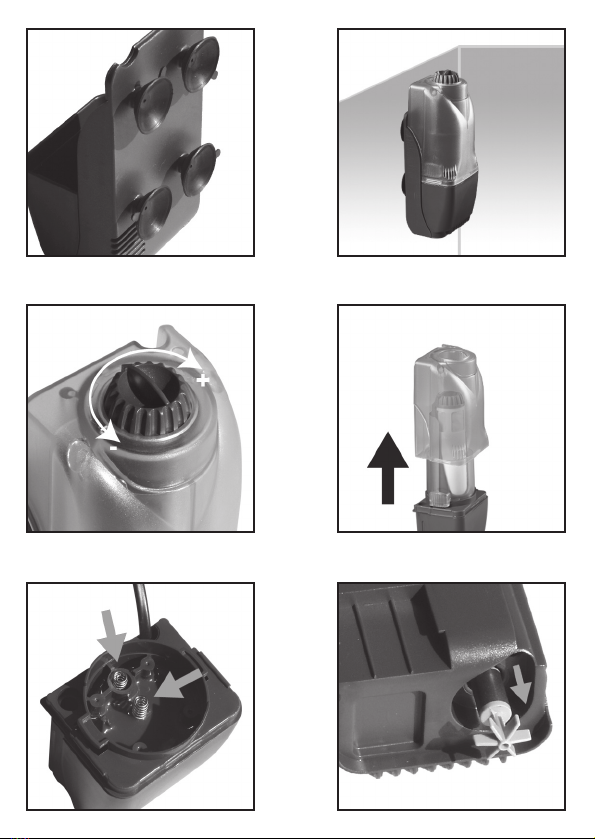
Fig. 2
Fig. 4
Fig. 6
Fig. 3
Fig. 5
Fig. 7
IMPORTANT SAFETY INSTRUCTIONS
WARNING - To guard against injury, basic safety precautions should be observed, inclu-
ding the following.
READ AND FOLLOW
ALL SAFETY INSTRUCTIONS
WARNING: To avoid possible electric shock, special care should be taken since water
is employed in the use of aquarium equipment. For each of the following situations, do not
attempt repairs by yourself. Return the appliance to an authorized service facility for service
or discard the appliance.
1) Do not operate any appliance if it has a damaged cord or plug, or if it doesn’t work pro-
perly or has been dropped or damaged in any manner.
2) To avoid the possibility of the appliance plug or receptacle getting wet, position aquarium
stand and tank or the fountain to one side of a wall-mounted receptacle to prevent water
from dripping onto the receptacle or plug.
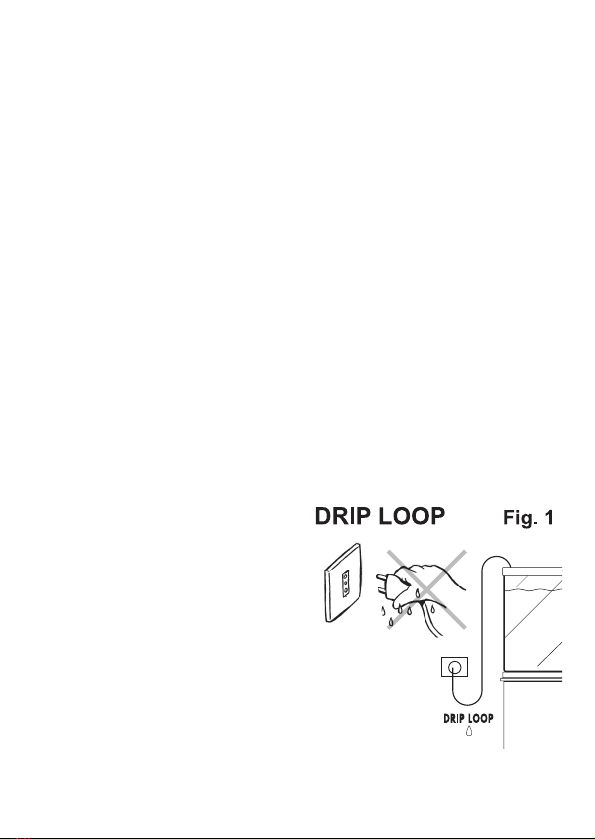
A “drip-loop” (g. 1) should be arranged by the user for each cord connecting an aquarium
appliance to a receptacle. The “drip-loop” is the part of the cord below the level of the recep-
tacle or the connector if an extension cord is
used, which prevents water travelling along the
cord and coming in contact with the receptacle.
If the plug or socket does get wet, DON’T un-
plug the cord. Disconnect the fuse or circuit
breaker that supplies power to appliance. Then
unplug and examine for presence of water in
the receptacle.
3) Close supervision is necessary when any
appliance is used by near children.
4) To avoid injury, do not contact moving parts
or hot parts such as heaters, reectors, lamp
bulbs and similar.
5) Always unplug an appliance from an outlet when not in use, before putting on or taking

off parts and before cleaning. Never yank cord to pull plug from outlet. Grasp the plug and
pull to disconnect.
6) Do not use an appliance for other than intended use. The use of attachments, not re-
commended or sold by the manufacturer of the appliance, may cause an unsafe condition.
7) Do not install or store the appliances where it will be exposed to the weather or to
temperatures below freezing.
8) Make sure an appliance mounted on a tank is securely installed before operating it.
9) Read and observe all the important notices of the appliance.
10) If an extension cord is necessary, a cord with a proper rating should be used. A cord
rated for less amperes or watts than the appliance rating may overheat. Care should be
taken to arrange the cord so that it will not be tripped over or pulled.
11) This appliance has a polarized plug (one blade is wider than other). As a safety fea-
ture, this plug will t in a polarized outlet only one way. If the plug does not t fully in the
outlet, reverse the plug. If it still does not t, contact a qualied electrician. Never use with
an extension cord unless plug can be fully inserted. Do no attempt to defeat this safety
feature.
SAVE THESE INSTRUCTIONS
CONSIGNES DE SÉCURITÉ
IMPORTANTES
MISE EN GARDE : An de se protéger contre les blessures, des mesures de sécurité
de base doivent être observées, y compris les suivantes.
LIRE ET OBSERVER TOUTES
LES CONSIGNES DE SÉCURITÉ
DANGER - Pour éviter tout choc électrique, une grande prudence est de rigueur. Dans
chacune des situations suivantes, ne pas essayer de réparer l’appareil soi-même; l’ex-
pédier au fabricant pour réparation ou le jeter.
1) Ne pas faire fonctionner un appareil défectueux, dont le cordon électrique ou la che sont
endommagés, ou qui a été échappé ou abîmé d’une façon quelconque.
2) An d’éviter que l’appareil ou la prise de courant soient mouillés, installer le support pour
aquarium et le bac à côté d’une prise de courant pour empêcher l’eau de dégoutter sur
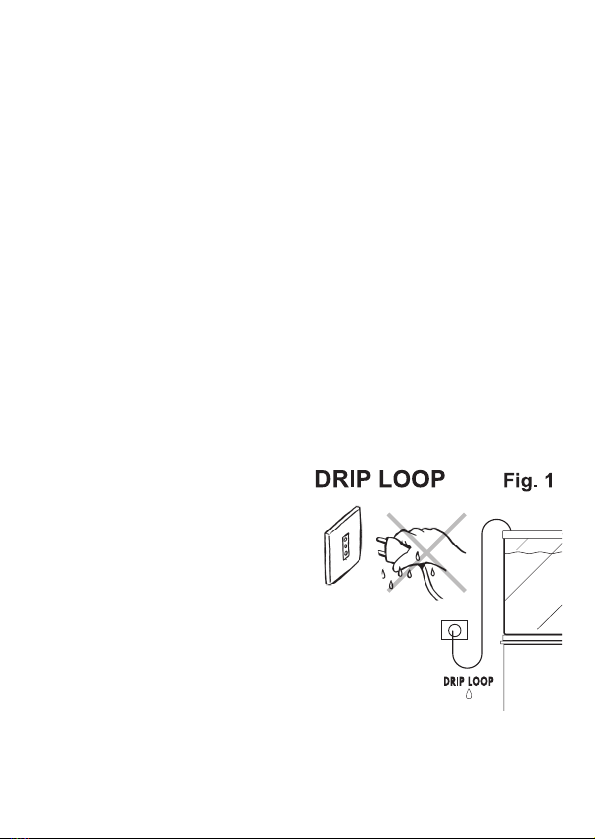
la prise. L’utilisateur devrait faire une boucle d’égouttement (voir illustration 1) pour cha-
que cordon électrique branché d’un aquarium
à une prise de courant. Une boucle d’égoutte-
ment est la partie du cordon se trouvant sous
la prise de courant ou le raccord si une rallonge
électrique est utilisée, an d’empêcher l’eau de
circuler le long du cordon électrique et d’être
en contact avec la prise de courant. Si la che
ou la prise de courant sont mouillées, NE PAS
débrancher le cordon électrique. Débrancher
d’abord le fusible ou disjoncteur qui fournit
l’électricité à l’appareil et débrancher ensuite
l’appareil en vériant qu’il n’y a pas d’eau dans
la prise.
3) Il est essentiel de surveiller étroitement les enfants utilisant cet appareil ou se trouvant
à proximité.
4) Pour éviter les accidents, ne pas toucher aux pièces mobiles ou chaudes comme les

chauffe-eau, réecteurs, ampoules, etc.
5) Toujours débrancher l’appareil quand il n’est pas utilisé, quand des pièces sont enlevées
ou remplacées et avant l’entretien. Ne jamais tirer sur le l pour débrancher l’appareil;
prendre la che et débrancher l’appareil.
6) Ne pas utiliser un appareil pour un emploi autre que celui pour lequel il a été fabriqué.
Les pièces non vendues ou non recommandées par le fabricant pourraient compromettre
la sécurité de l’appareil.
7) Ne pas exposer cet appareil aux intempéries ou à une température en dessous de 0 ºC.
8) Vous assurer qu’un appareil monté sur un aquarium est bien installé avant de le faire
fonctionner.
9) Lire et observer tous les avis importants sur l’appareil.
10) Si une rallonge électrique est nécessaire, vous assurer qu’elle est d’un calibre adéquat.
Un cordon électrique de calibre inférieur ou de moins d’ampères ou de watts que l’appareil
peut surchauffer. Le cordon doit être placé de façon à éviter que quelqu’un trébuche ou le tire.
11) Cet appareil possède une che polarisée (une lame est plus large que les autres). Par
mesure de sécurité, cette che s’insère dans une prise polarisée que dans un sens. Si la
iche n’entre pas complètement dans la prise, inverser la che. Si elle ne rentre toujours pas,
contactez un électricien qualié. Ne jamais utiliser une rallonge si la che peut être insérée
complètement. Ne pas essayer de contourner ce dispositif de sécurité.
CONSERVER CES INSTRUCTIONS

EN
WHY IS CO2 NECESSARY?
Through the natural photosynthesis process, plants convert carbon dioxide, dis-
solved in water, into vital force and oxygen, indispensible for the good health of
our aquarium’s sh and plants. In environments with low levels of CO2, plant growth is blocked
and excess nutrients aren’t eliminated, causing algae to ourish.
HOW MUCH CO2 IS NECESSARY?
Water’s chemical values are of fundamental importance for the life of your sh: understanding
these links helps the aquarist avoid disease or other inconveniences in the aquarium, increasing
sense of responsibility towards the developing biotope.
CO2 is closely linked to pH and to kH which is water hardness or the concentration of minerals
in water.
There are two quick methods to measure CO2 concentration:
• BASIC: use of a common CO2 tester, hanged inside the tank (This is not a very precise meas-
urement and is usually used for a quick indiction)
• AVANCED: measurement of pH and kH (using special testers, sold separately), intersection
of results following the zone of optimal values, found in TABLE 1. Take into consideration the
animal and or plant species present in the aquarium to determine the tank requirements. Re-
quirements for specic species can be found from reputable sources in books or referenced
documents online.
GENERAL SAFETY INSTRUCTIONS
CO2 Life is designed conforming to International and National safety laws.
• ATTENTION: unplug all electric devices immersed in water before starting maintenance opera-
tions and putting hands in water. If plug or cable are wet, turn off the general power switch before
unplugging the device.
• Check that the voltage and frequency written on the label with technical data corresponds to
your electrical network.
• Before plugging in the device, make sure it is completely undamaged, paying particular atten-
tion to the cable and plug.
• The cable cannot be substituted or repaired, in case of damage, replace the whole product.
• The pump must be turned on only when completely immersed in water: warranty is no longer
valid for any damage occurred when operating out of water.
• This product was developed to be used immersed in water with temperature up to 35°C;
• Do not use in salt water;
• Do not use in aquariums devoid of plants: in absence of plants CO2 is DETRIMENTAL to
animals;
• We advise AGAINST using CO2 Life in water with electrical conductivity superior to 600 µS/
cm2;
• We DO NOT recommend using CO2 Life without a ltering system, otherwise excess carbon
particles could deposit on the bottom of the tank and on plant leaves.
• This product is designed exclusively for aquariums and for internal use. Any other application
could ruin its parts, nullifying warranty.
• In order to guarantee safety, the use of this unit is not appropriate for children or disabled peo-
ple, unless supervised by someone responsible of their welfare.
• To avoid dripping on plug or power socket, make the wire form a curve under the socket (Fig
1 - DRIP LOOP);
• Do not use extension cords for the cable, if necessary, ask a professional installer to make the
connection, so to be sure that the extension cord is equivalent to the pump’s cable.

•Power must be supplied by a differential protection device (RCD), with rated residual current
beneath 30mA.
INSTALLATION AND USE
ATTENTION: disconnect all electric appliances before putting hands in water. Before plugging
the device in, make sure it is damage free in all of its parts, especially the cable and plug. Take
the product out of the box and undo the cable.
1) Insert suction cups in their seats and rotate until certain they are properly xed (g. 2).
2) Clean the glass and place the pump vertically, with knob facing upwards (g. 3), applying pres-
sure so suction cups adhere. Make sure the pump is completely immersed in water.
ATTENTION: to avoid vibration and resonances, DO NOT position the remaining sides of the
device to the bottom or sides of the tank.
3) Turn the knob, placed on top of the unit, clockwise to increase CO2 emission, counter clock-
wise to decrease it (g. 4)
4) Plug the product to the power socket.
IMPORTANT: ADVISE FOR USE
• Emitting Co2 in water will cause an unavoidable decrease of the pH: it is advisable to monitor
this value constantly.
• During rst use, the carbon cartridge is very sensative. Set it on the MINIMUM setting for at
least 24 hours, then measure CO2 concentration (see previous paragraph). If necessary, go up
a notch (not more!) every 24 hours, until optimal levels are reached and maintained.
• During electrolysis, the output, from the frontal grills, of CO2 mixed with water is invisible. The
speed of the emission depends on the hardness and conductivity of water. CO2 should not
be confused with bubbles of hydrogen (produced by electrolysis) that go towards the surface.
Although the output of CO2 invisible to the human eye, this is the correct operation of the unit!
IMPORTANT: remember that the abrupt interaction with the chemistry of water is a mistake that
would compromise the delicate balance of the aquarium’s environment.
• It’s possible to deactivate the pump during the night (when the absence of light hampers pho-
tosynthesis), by simply connecting it to a timer (no need of complicated solenoids). Test to make
sure the Ph level doesn’t increase inappropriately : if this happens, the pump MUST keep work-
ing.
• The cartridge’s life can vary notably, depending on water hardness: a high concentration of
minerals (“hard” water) helps conduciveness (measured in Micro-Siemens cm2 µS/cm2), con-
suming carbon more quickly
• It’s advisable to partially change water every month (20-25% of the tank’s volume), using re-
verse osmosis or demineralised water, in order to keep the hardness of water stable;
• It is necessary to clean deposits from the tank’s lamps or light shields regularly and to substitute
them once a year: low quality/ intensity light does not permit a correct photosynthesis in plants.
• Excessive movement on the water surface reduces CO2 molecules.
MAINTENANCE
ATTENTION: disconnect all electrical appliances from power supply before putting hands in
water.
1) Grasp the pump body and take it out of support (that remains attached to the glass); do not
tug on cable to do this operation
2) Remove the transparent mixing cover, lifting it from pump body (g: 5)
3) Remove the cartridge’s regulator and pre-lter;

4) Rinse motor body under running water, without taking cartridge off, using, if needed, a soft
toothbrush to remove deposits
5) Check the carbon cartridge’s state:
a - If it’s not completely worn out, remove calcareous crusts present on the steel foil and
proceed directly to comma 6;
IMPORTANT: even if done every time you maintain the aquarium, this operation DOES
NOT hamper the product’s performance!
b - If cartridge is worn out, to replace, unscrew it anticlockwise and take it out. Before insert-
ing the new cartridge (performing the operation backwards), make sure that its seat, where
the springs are (g. 6), is perfectly dry and that the steel foil faces behind;
6) Take rotor out of the base (g. 7) and immerse it a mixture of water and vinegar or lemon juice.
After about an hour, rinse it well under running water and remove deposits with the help of a soft
toothbrush. In case calcareous deposits do not come off and if the rotor (impeller) is excessively
worn (this often causes noise during pump operation), substitute it with the indicated spare part.
7) Clean the shaft (DO NOT ATTEMPT TO TAKE IT OUT) xed inside the rotor chamber, using
a Q-tip drenched in a mixture of water and vinegar or lemon juice.
8) Extract the sponge on the back of the product and rinse it well under running water
9) Reassemble all the parts performing this sequence backwards, paying attention that the
closed part of the regulator faces behind, otherwise you cannot close the transparent mixer’s
cover.
INSTRUCTIONS FOR THE CORRECT DISCHARGE OF THE PRODUCT ACCORDING TO EU
DIRECTIVE 2002/96/EC
When used or broken, the product does not have to be discharged with the other waste. It can be
delivered to the specic electric waste collection centres or to dealers who give this service. Dis-
charge separately an electric tool avoid negative consequences for the environment and for the
Health and allows to regenerate the materials so to have a great saving of energy and resources.
WARRANTY
This product, except the rotor and the carbon cartridge, is guaranteed against defects of materi-
als and workmanship for a period of 2 years from the date of purchase. The warranty certicate
must be lled in by the dealer and must accompany the pump if it is returned for reparation,
along with the cash register receipt or similar document. The warranty covers the replacement
of the defective parts. In case of improper use, tampering or negligence by the buyer or user,
the guarantee is void and expires immediately. This appliance has no user serviceable part. The
guarantee is also void in absence of the cash register receipt or similar document. The expenses
for shipping the pump to and from the factory, or the repair station, have to be paid by the buyer.
Table des matières
Langues :
Autres manuels Sicce Aquarium


Manuels Aquarium populaires d'autres marques


JBL
JBL PRO SILENT S-100 Manuel utilisateur

Amtra
Amtra VEGA Manuel utilisateur

JBL
JBL CRISTALPROFI i60 greenline Manuel utilisateur

Aquatlantis
Aquatlantis Tecatlantis EASY LED UNIVERSAL 2.0 Manuel utilisateur

Innovative Marine
Innovative Marine MightyJet 8500 Mini Mode d'emploi

SuperFish
SuperFish Planty 25 Guide d'installation

Royal Exclusiv
Royal Exclusiv Bubble King DeLuxe 300 Manuel utilisateur

Sera
Sera Marin Precision Biotop LED Cube 130 Manuel utilisateur

Commodity Axis
Commodity Axis ViaAqua Titanium Heater Manuel utilisateur

Sander
Sander Ozonizer P 2000 Manuel utilisateur

Hagen
Hagen HALF MOON Manuel utilisateur
CPR
CPR CS150 Manuel utilisateur