c) The products can only be operated in ordinary industrial atmosphere. The manufacturer
must be contacted if the atmosphere contains aggressive components. In case of adverse
ambient conditions, the sensors need to be protected accordingly.
d) Usage of the devices is only permissible when they are fully mounted and connected in an
intact condition. Damages would enable a zone entrainment which must therefore be
considered by the operator. Usage of devices with damaged casing is not permitted.
e) The defined permissible ambient conditions must be met, the products must be protected
from adverse ambient conditions.
f) Thermal radiation of other components and products must be considered.
g) The air flow sensors must be protected from impermissible inflow of liquids and/or
pollution.
h) Tight or stuck parts, e. g. due to frost or corrosion, cannot be loosened with force if
exposed to an explosive atmosphere. Icing must therefore be avoided.
i) The air flow sensors can only be exposed to minor vibrations, see IEC 34-14.
j) To ensure the dissipation of electrostatic charges, national regulations must be considered.
k) Especially capacities that build up in an isolated manner must be avoided.
l) The flow sensor housing should be connected to the potential equalization
electrostatically, a threshold value of 1MΩis permissible.
m) Only Zener-barriers and switching amplifiers with Ex-area approved output circuits can be
used. In Europe the use within zone 1 requires an EC type examination for the relevant
equipment, issued by a for explosion protection appointed authority.
n) The power P0 of all supply units combined must be lower or equal to the power Pi of the
air flow sensors.
o) The supply voltage of the supply units must be lower or equal to the voltage Ui of the air
flow sensors.
p) The current Io of all supply units combined must be lower or equal to the current Ii of the
air flow sensors.
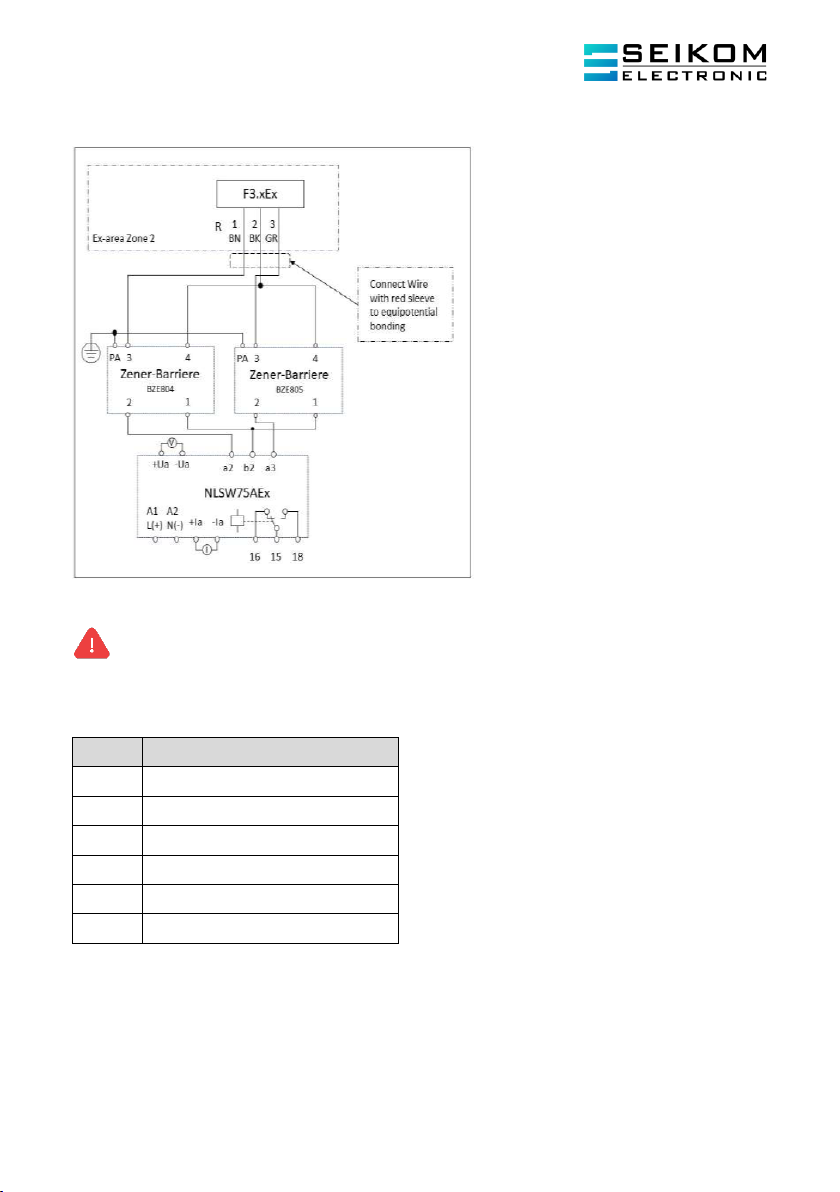
q) For the installation of an intrinsically safe electrical circuit, a block diagram (system
description) is necessary, which must be provided by the builder or operator.
r) If a Zener-barrier is used, a potential equalisation between the grounding connection and
the flow sensor casing alongside the intrinsically safe electrical circuit must be ensured.
s) The certificates including the therein defined special conditions must be considered.
t) Tight or stuck parts, e. g. due to frost or corrosion, cannot be loosened with force if
exposed to an explosive atmosphere.
u) The flow sensors cannot be used in facilities with cathodic corrosion protection. Although
special precautions might enable the use of the flow sensors in this special case, the
manufacturer must be contacted in any scenario. Parasitic currents cannot be discharged
via the construction.
v) Within the area exposed to an explosion hazard the installation must comply with local
regulations.
The following conditions must be met:
a) Installation and maintenance may only be executed in atmospheres without any explosion
hazard and in compliance with the applicable national regulations depending on the
location of operation.
b) Additional precautions must be made if hydrogen sulphide, ethylene oxide or carbon
monoxide may be or are present. These substances require only very low energy to ignite.
c) In case these substances and a substance of explosion group IIC and a presumably
explosive atmosphere are present only non-arcing tools can be used!